DD
MM
YYYY

PAGES

DD
MM
YYYY

spot_img

PAGES

Home Blog Page 7066

Netflix Acquires Lionheart, kickstarts a New Era for Nollywood

0

A new era begins: Netflix acquires its first worldwide rights of a Nigerian movie. Lionheart staring the best in the world of comedy, acting and [you add more) Nkem Owoh and the Nigerian acting goddess Genevieve Nnaji has been taken over by Netflix. Lionheart will premiere in Toronto International Film Festival (TIFF). This is how to build a nation – you predict its outcome by inventing the future you expect.  When Living in Bondage made it into our TVs many years ago, no one would have predicted that Nollywood would be this promising. We can do same in other sectors. With more money, I would expect improving higher quality from Nollywood.

Netflix has bought worldwide rights to Genevieve Nnaji’s comedy “Lionheart” on the eve of its world premiere at the Toronto International Film Festival.

Netflix announced the deal Friday. The film will premiere at TIFF on Saturday. “Lionheart” marks the first Netflix original film from Nigeria.

Nnaji stars with Nkem Owoh, Pete Edochie, and Onyeka Onwenu. The story follows a daughter who’s forced to work with her feckless uncle in order to save her father’s ailing bus company. Nnaji plays Adaeze, a level-headed executive in her father’s bus company, Lionheart Transport. When her father (played by Edochie) falls ill, both she and her rival (Kalu Egbui Ikeagwu) are passed over in favor of the uncle, played by Owoh.

Complications arise when they discover that the family business is in dire financial straits — leading to absurd results as they try to save the company. The film also touches on everyday sexism that saturates the workplace, as well as the delicate balance between honoring one’s family while finding the courage to strike out on one’s own.

Nnaji also wrote the script with Chinny Onwugbenu, Ishaya Bako, Emil Garuba, and C.J. Obasi. “Lionheart” is produced by T.E.N. — The Entertainment Network. MPM Premium handled the sale.
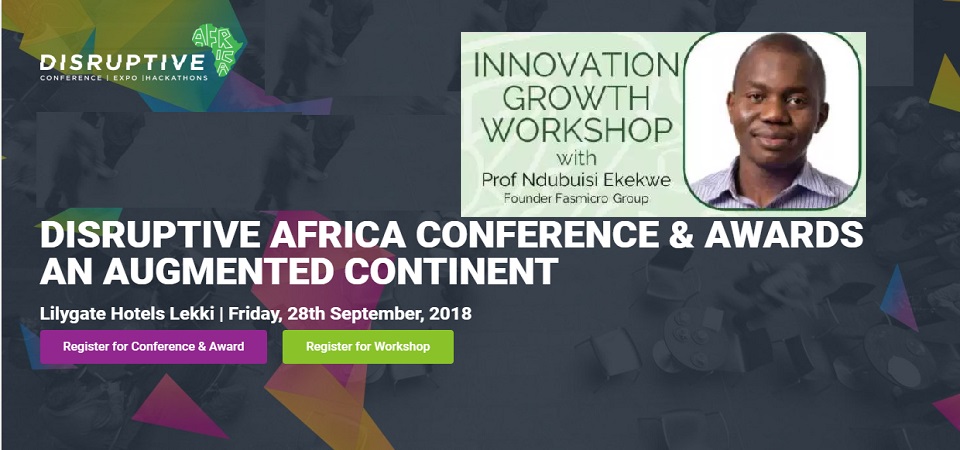

Use This Discount Code and Register for my Disruptive Africa’s Innovation Workshop

0

On September 28, 2018, I will run a workshop during Disruptive Africa. I will also deliver a presentation during the Conference and play a role in the Award Night. To connect, meet me and participate in these events, you would need to register. https://disruptiveafricaexpo.com/product/innovation-growth-workshop/

This is a mass-version of my popular Innovation for Growth Workshop. It has been designed to provide a way to support those who cannot afford to hire my Practice single-handedly.

David Alozie and his team run every aspect of this event. My role is to bring my team to lead the workshop. It was his idea to provide this level of support to the community. And it makes me feel better that we can help.

He has been making progress and today he is offering further discount to anyone that registers in coming days. Visit Disruptive Africa and use this code “Followers” to get more discount as you register.

We are not being paid for this: it is a way to support the community. In short, I am personally subsidizing for students who register. Yet, Disruptive Africa has to cover its bills. So, it cannot be free. Hope you would be interested.

The Burning of $37 million by Burberry

0

In a farming conference last year, one researcher made a strong case: the world’s food problem is not necessarily lack of food production but the economics of food. He went on to explain how some extremely rich countries throw away food into oceans just to ensure prices do not fall below some levels.

There is a policy element to it: if you do not buy-out excess capacity and waste them, you may be forced to pay farmers compensations if they sell below “certain” prices due to overcapacity. Yes, it is far cheaper to spend say $200 million to buy the food and waste them to keep price within threshold instead of spending $1 billion on compensations. Devilishly, that becomes a policy which must be pursued in a world where many are dying of starvation.

Source: BBC

So, when I read that Burberry, the fashionista brand, wasted unsold clothes, perfumes, etc worth $37 million by burning them, I went speechless. Check, the CEO of that company is preaching the sermon of business: we do well to society through our products and services. Apparently, burning excess capacity instead of donating them will not be service since it would possibly “dilute the brand”.

The fashion brand Burberry is to stop burning its unsold goods, following an environmentalist backlash to the news that it destroyed unsold clothes, accessories and perfume to the tune of $37 million last year (Fortune Newsletter)

British luxury goods maker Burberry has announced that it will stop the practice of burning unsold goods, with immediate effect. The fashion label also said it would stop using real fur in its products, and would phase out existing fur items. In July, an earnings report revealed that Burberry destroyed unsold clothes, accessories and perfume worth £28.6m in 2017 to protect its brand.(BBC)

Central Bank of Nigeria Debits Stanbic IBTC Bank $5.2M for Helping MTN on Repatriation

0

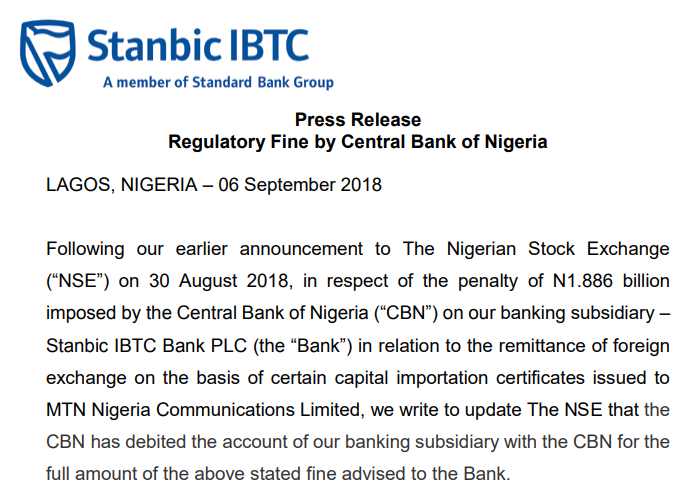
The Central Bank of Nigeria has debited Stanbic IBTC for allegedly helping MTN in illegally repatriating money. The bank informed the Nigerian Stock Exchange that CBN debited it N1.9bn ($5.2m) from its account.

Following our earlier announcement to The Nigerian Stock Exchange (“NSE”) on 30 August 2018, in respect of the penalty of N1.886 billion imposed by the Central Bank of Nigeria (“CBN”) on our banking subsidiary – Stanbic IBTC Bank PLC (the “Bank”) in relation to the remittance of foreign exchange on the basis of certain capital importation certificates issued to MTN Nigeria Communications Limited, we write to update The NSE that the CBN has debited the account of our banking subsidiary with the CBN for the full amount of the above stated fine advised to the Bank.

Stanbic IBTC Holdings PLC as well as our banking subsidiary maintain our position on this matter, which is the fact that the Bank has done nothing illegal and accordingly the Bank will continue to provide CBN with documents and details in support of our contention that our actions in relation to these transactions were not illegal.

No matter how you see it, the MTN $8.1 billion refund is now real. CBN would be callous to have gone ahead and debited Stanbic IBTC if it was not obviously confident of its investigation. In other words, MTN has $8.1 billion to worry about as a real action has been taken by the government.

Yes, MTN Nigeria has another issue: now, it is coming from the Central Bank of Nigeria. The bank asked it yesterday to refund $8.13B (with B) which the apex bank said the mobile giant (allegedly) illegally repatriated. This is the CBN Letter to MTN (MTN-Letter-of-outcome-of-investigation)

But note one thing: the MTN Nigeria IPO is about dead for 2018. The next chapter of MTN Nigeria will be determined in coming weeks. If the market has become toxic, do not rule out the unthinkable: MTN may consider! Yes, sins are not forgiven easily in Nigeria. The good news is that there are still courts but with the debit on Stanbic IBTC account, I am not sure those banks that recently pumped N200 billion into MTN Nigeria would be laughing anymore. MTN Nigeria is on paralysis at this moment of its history when you consider the extra $2 billion on unpaid taxes and fees coming from the Attorney General office.

Zinox Bought Konga for less than $32.4 million, Naspers Documents Show

0
Konga sale

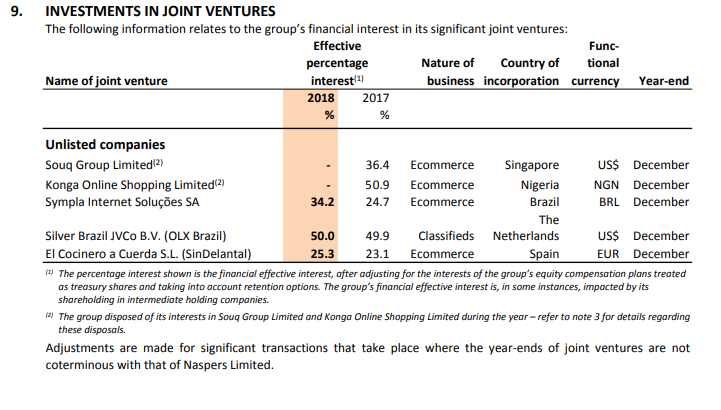
No one knows how much Zinox Group bought Konga for sure. But from the latest Naspers’ financial statement, there is clarity on that. Naspers made two investments in Konga: $41 million and $13.5 million totaling $54.5 million. In the financial statement, the company noted the following “…disposed of its investment in its joint venture Konga Online Shopping Limited. A loss on disposal of US$38m,…”

During February 2018 the group disposed of its investment in its joint venture Konga Online Shopping Limited. A loss on disposal of US$38m, representing the reclassification of the group’s foreign currency translation reserve from other comprehensive income to the income statement, has been recognised in “(Losses)/gains on acquisitions and disposals”.

Without adjusting for currency fluctuation since Naspers reported its numbers in U.S. dollars, we can say the company received $16.5 million on pure cash basis: $54.5 million – $38 million. From the financial statement, Naspers held about 50.9% of Konga before the disposal. From that, we can calculate how much Konga was sold, and that number is $32.4 million [$16.5M*100/50.9]. So, the maximum possible amount Konga was sold was $32.4 million based on pure cash play from Naspers’ documents.

Source: Naspers

Meanwhile, I do believe that the new Konga is brilliant. It is building a business that would deal with the marginal cost issue. With that it will find success as the integration of atoms and bytes will remain the cornerstone of many entities in Nigeria for years to come.


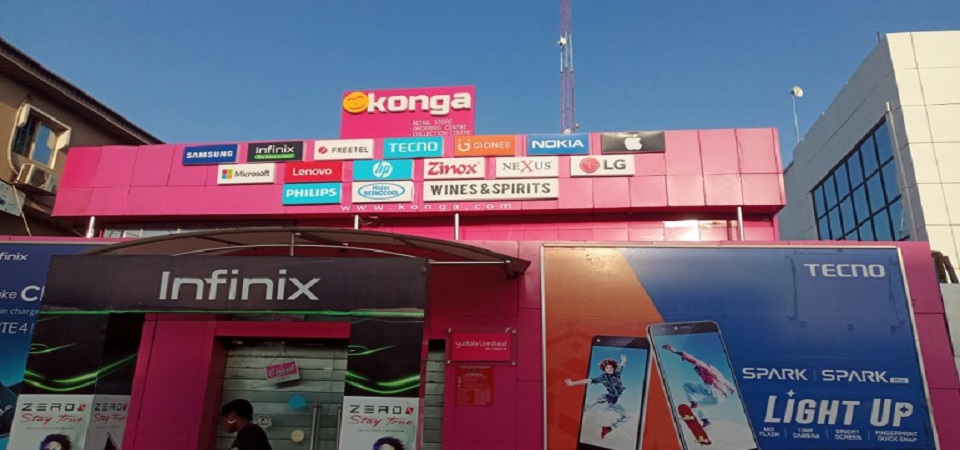
The key sentence is thus: “Our mid-term goal would see to the establishment of more stores across Nigeria”. Yes, the new Konga would be opening physical stores across Nigeria. Certainly, that is a great winning business model. Besides the money being in the physical space, having stores will reduce the marginal cost challenges associated with pure play ecommerce. The piece quoted me as it argued the brilliance of pursuing this hybrid commerce for Konga.


The number was possibly less than $32.4 million as Naspers could have received preferential and preferred stock as it invested late as a majority investor. I wrote this after reading this which postulated that Konga was sold for $230 million. That is certainly not possible: Zinox would not do such a deal and Konga could not been sold that much.

The old Konga raised about $108 million but struggled with the typical long gestation period of turning profits in ecommerce operations. The core investors gave up!

Imagine if this money had been used to build physical stores in major ten Nigerian cities [Shoprite style], Konga might be a unicorn now. Digital is the future, but we need to thrive today also. And as we move to the web, everyone needs to know that Nigeria has no modern supermarket chain (excluding Shoprite). That may be the opportunity now before the fancy of ecommerce.