DD
MM
YYYY

PAGES

DD
MM
YYYY

spot_img

PAGES

Home Blog Page 7072

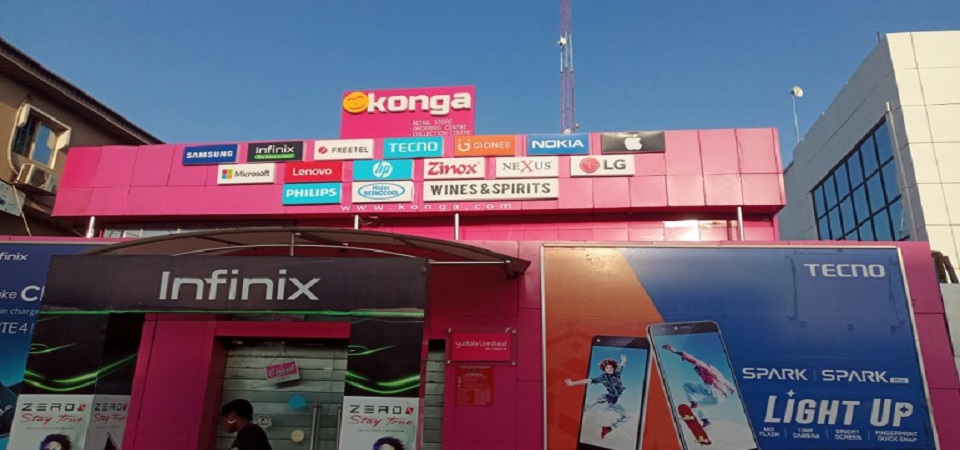
Zinox Bought Konga for less than $32.4 million, Naspers Documents Show

0
Konga sale

No one knows how much Zinox Group bought Konga for sure. But from the latest Naspers’ financial statement, there is clarity on that. Naspers made two investments in Konga: $41 million and $13.5 million totaling $54.5 million. In the financial statement, the company noted the following “…disposed of its investment in its joint venture Konga Online Shopping Limited. A loss on disposal of US$38m,…”

During February 2018 the group disposed of its investment in its joint venture Konga Online Shopping Limited. A loss on disposal of US$38m, representing the reclassification of the group’s foreign currency translation reserve from other comprehensive income to the income statement, has been recognised in “(Losses)/gains on acquisitions and disposals”.

Without adjusting for currency fluctuation since Naspers reported its numbers in U.S. dollars, we can say the company received $16.5 million on pure cash basis: $54.5 million – $38 million. From the financial statement, Naspers held about 50.9% of Konga before the disposal. From that, we can calculate how much Konga was sold, and that number is $32.4 million [$16.5M*100/50.9]. So, the maximum possible amount Konga was sold was $32.4 million based on pure cash play from Naspers’ documents.
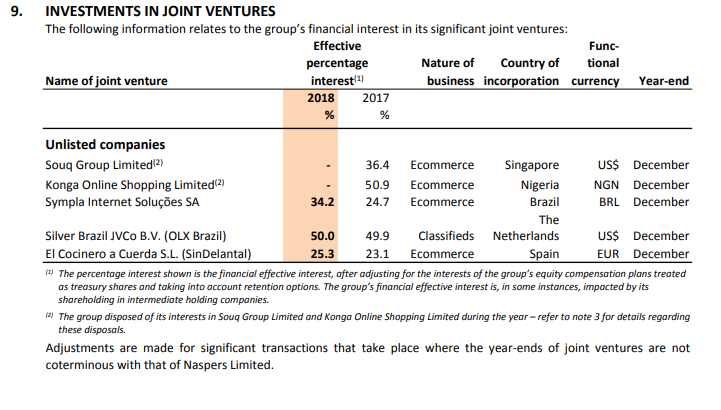
Source: Naspers

Meanwhile, I do believe that the new Konga is brilliant. It is building a business that would deal with the marginal cost issue. With that it will find success as the integration of atoms and bytes will remain the cornerstone of many entities in Nigeria for years to come.


The key sentence is thus: “Our mid-term goal would see to the establishment of more stores across Nigeria”. Yes, the new Konga would be opening physical stores across Nigeria. Certainly, that is a great winning business model. Besides the money being in the physical space, having stores will reduce the marginal cost challenges associated with pure play ecommerce. The piece quoted me as it argued the brilliance of pursuing this hybrid commerce for Konga.


The number was possibly less than $32.4 million as Naspers could have received preferential and preferred stock as it invested late as a majority investor. I wrote this after reading this which postulated that Konga was sold for $230 million. That is certainly not possible: Zinox would not do such a deal and Konga could not been sold that much.

The old Konga raised about $108 million but struggled with the typical long gestation period of turning profits in ecommerce operations. The core investors gave up!

Imagine if this money had been used to build physical stores in major ten Nigerian cities [Shoprite style], Konga might be a unicorn now. Digital is the future, but we need to thrive today also. And as we move to the web, everyone needs to know that Nigeria has no modern supermarket chain (excluding Shoprite). That may be the opportunity now before the fancy of ecommerce.

When Being A Visionary Founder Is Not Enough

0
Visionary Founder

One of the hardest realizations for any founder is coming to conclusion that he has to make way if he wants to save his company. But making way does not mean leaving the company, but rather understanding that the sector has moved into a new era where competitive advantage has moved from just being a visionary, into having the capacity to execute, and run a business at scale.

Yes, you can be a visionary founder but that does not mean that you can be execution-oriented to compete when some of the elemental components that made you a star have diminished in your sector. As competition heats and sectors mature, gross margins drop. Most times, competitive advantage moves to having steely-hardened execution-oriented brilliant professional managers over fast-breaking visionary founders.

New research from a team of professors at the business schools of Duke, Vanderbilt, and Harvard universities finds that founder-run companies to be less productive and more poorly managed than those whose chief executives didn’t start the firm.

The researchers looked through data collected by the World Management Survey, a detailed review of more than 13,000 mid-to large-sized companies in 32 countries. Firms led by the people who founded them were 9.4% less productive, on average, and on average had consistently lower management scores—which typically rose once the founder-CEO was replaced.

“Founder CEOs were by far the worst type of CEO,” said Victor Bennett, an assistant professor of strategy at Duke’s Fuqua School of Business and a co-author of the paper

The founder of Uber was a visionary founder but he was not a steely-hardened execution-oriented manager to manage a business in a maturing sector like e-hailing transportation. So, for Uber to thrive, where just breaking things fast was not the main advantage anymore, someone has to take over. We can say the same in Zenefits – a benefit management startup which grew under its founder until it hit a hard rock on growth execution.

When the visionary loses its scent, the founder should move to Executive Chairman position and hire a CEO with execution-oriented capabilities. Many founders do this when they realize that they perform better in the big picture phase over the daily rituals of running a business as a CEO. Jack Ma as Executive Chairman is shaping Alibaba Group even though he has handed over the operational keys to a CEO. In the last few years when Larry Ellison moved to the Chairman position, Oracle has transformed into a stronger innovating company, moving into cloud and blockchain at a faster pace.

In the next 5 years, the Nigerian fintech will enter that phase where just being a visionary founder may not help a startup. Yes, the competitiveness will come from having execution-oriented managers to steer the ship. Of course nothing stops one from being a visionary founder and a stellar manager at the same time: examples abound in the lives of Richard Branson (Virgin Atlantic), Aliko Dangote (Dangote Group) and Jeff Bezos (Amazon).

Medcera’s Ndubuisi Ekekwe Speaking in UNILAG, UNIABUJA & UATH – Date and Time

0

Hello,

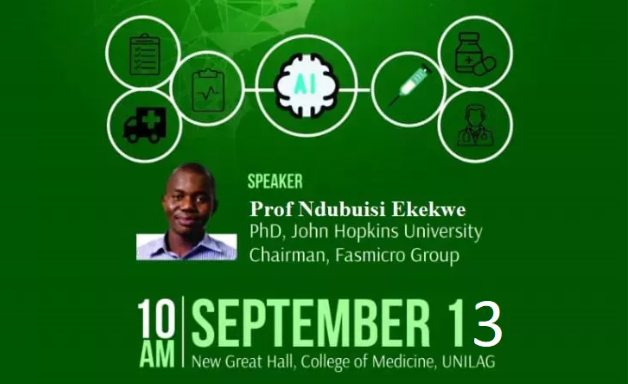
Prof Ndubuisi Ekekwe will deliver major speeches in University of Lagos College of Medicine, University of Abuja College of Health Sciences and University of Abuja Teaching Hospital on artificial intelligence and integrated electronic healthcare record systems for improving the healthcare  sector in Nigeria. All the speeches are open events and everyone is invited.

  • UNILAG event

Date: Sept 13, 2018
Time: 10am
Venue: New Great Hall, College of Medicine, UNILAG, Inside LUTH, Idi-Araba, Surulere, Lagos

  • College of Health Sciences, UNIABUJA – Sept 19th
  • University of Abuja Teaching Hospital  – Sept  20th

The venues and times for the Abuja talks will be shared here once the university and hospital make them available.

Please read this Harvard Business Review  article which Prof Ekekwe wrote few weeks ago for a good idea of the thesis of the talks. He has been working with the European Commission on how AI and robots can work to improve healthcare delivery. Prof Ekekwe invented and patented a microprocessor which powers dexterous medical robots while a PhD student in the Johns Hopkins University, USA.

Few weeks ago, we launched Medcera -an integrated EHR which brings patients, doctors, labs, imaging, insurance, pharmacy etc together with AI component which supports enhanced patient outcomes.

If you have any question, please get in touch with me.

Regards,

Nky Udo
Medcera Community Manager
support@medcera.com

The New York Supply Chain Meetup (#TNYSCM)

0

Who can establish a Lagos branch of The New York Supply Chain Meetup? If interested and have the capabilities, email my community manager or connect directly with the Co-Founder. The world of commerce is nothing but supply chain. Lagos is a world’s premier Center of Excellence; we need to fix our supply chain. The TNYSCM is working in many global cities to make that happen.

The New York Supply Chain Meetup (#TNYSCM) is a recently formed community whose mission is to nurture and grow the world’s foremost open, global, and multidisciplinary community of people devoted to building the supply chain networks of the future – starting in NYC. Since it was founded on August 23, 2017, #TNYSCM has grown organically to include more than 1,000 members. This makes it the largest supply chain meetup in the United States, by a substantial margin. It’s growth has been driven largely by the enthusiasm its members have for topics related to supply chain, innovation, and technology. You can join the community by visiting its meetup page. There’s also a snippet, and a story in FreightWaves, about the group’s gathering in January 2018. This #TNYSCM Overview Presentation will give you a sense of the kind of community we are trying to create. #TNYSCM is the originating chapter of The Worldwide Supply Chain Federation – with sister chapters in the process of being established in Singapore and Vancouver, and with more to follow in Europe and Australia

Ndubuisi Ekekwe to Keynote Convergence 2018 at National Stadium, Surulere Lagos

0
Convergence 2018

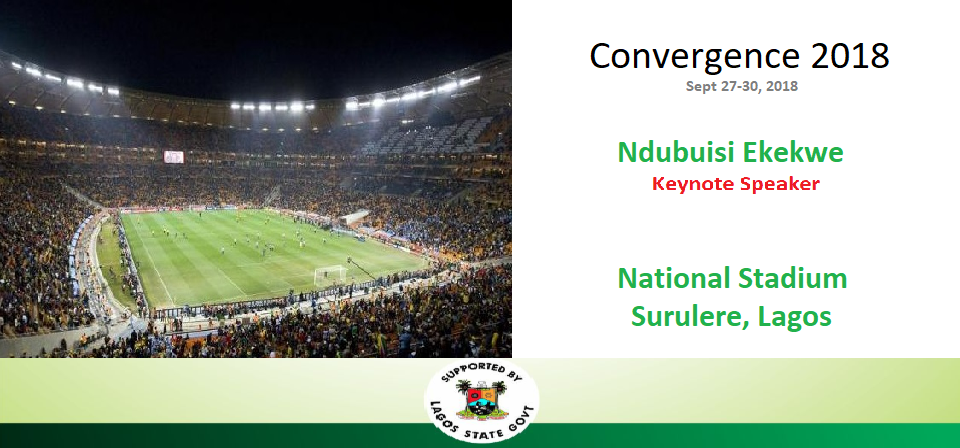
Join me as I keynote the largest gathering of African farmers, food and beverage industry players during Convergence 2018 in National Stadium, Surulere, Lagos.  The conference is a four-day event, Sept 27-30 2018. I will speak on Sept 27 at 10 am. The theme of the conference is “Driving Food Security Through Technology”, an area I am playing a major role in the continent through Zenvus.

LIFBEF AFRICA is the largest food and beverage focused convergence. A trade fair, A festival, and conference. A trade show that focuses on the whole food and beverage value chain. Agriculture Biotech, food technology, food machinery, Agric technology, and Processing. from start to finish.

The event, offers a platform for stakeholders in the F&B industry, to converge and showcase product and services at an international level. Stakeholders will be offered a highly focused event which caters to their needs and opens them to the world. It an avenue to explore possible options, innovations, best practice in the food industry, also bring them the best ROI.

There will be a Conference, and master classes. Over 200 exhibitors from 10 countries will be hosted, and more than 20,000 trade visitors are expected to visit LIFBEFAFRICA 2018. If you are looking to introduce, exchange and learn about the latest innovation and technologies from around the world and feel the Nigerian Market, LIFBEFAFRICA is the place to be.

Photo from previous event

Over the years, I have been working with farmers, helping them to improve yield. In this talk, I will not be talking of scalable advantage, one oasis strategy, accumulation of capabilities, etc. Rather, I will simply speak how our food and beverage industry value chain players can sustain the mission: cure extreme poverty through massive scaling of agricultural productivity, and put quality meals on different tables across Africa. I will explain why a shift at scale is critical because when technology comes into a sector, productivity improves. It is time for massive adoption of modern technology in African agriculture.

Supported by Lagos State Government

Our generation must cure extreme poverty and every child born in Africa deserves a balanced nutrition. If we double farm yield in five years, we will reduce extreme poverty by half because more than 65% of working Africans are employed in agriculture. Yes, agriculture remains the fastest and easiest means to liberate people from the pangs of poverty.

On Sept 27, 2018, I hope to meet you in the National Stadium. I am coming with two Zenvus sensors: make it and see the beauty of AI working in African agriculture. I am a farmer; they know me and I hope to meet people we have been helping to advance the mission.

Photo from previous event