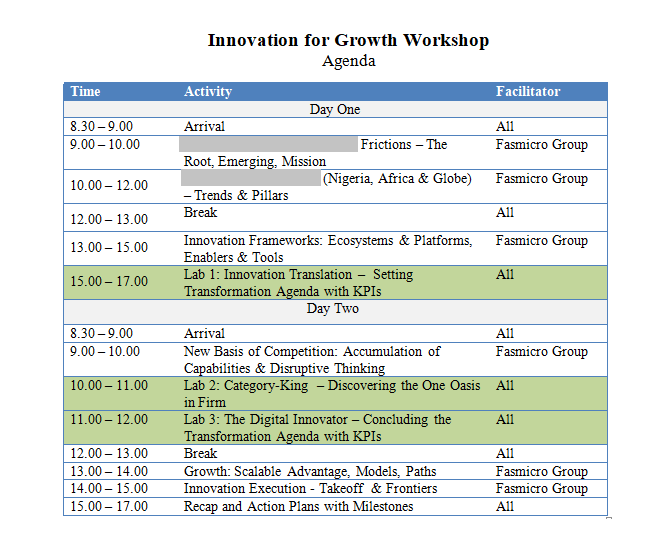
A workshop agenda for a workshop we will run this next week in Lagos
We just finished a program agenda for an Innovation Workshop which we would run in Lagos in a client’s office. This workshop is relatively expensive for startups unless you have received good funding; it is designed for growing companies. I still have some available slots remaining for late September and early October.
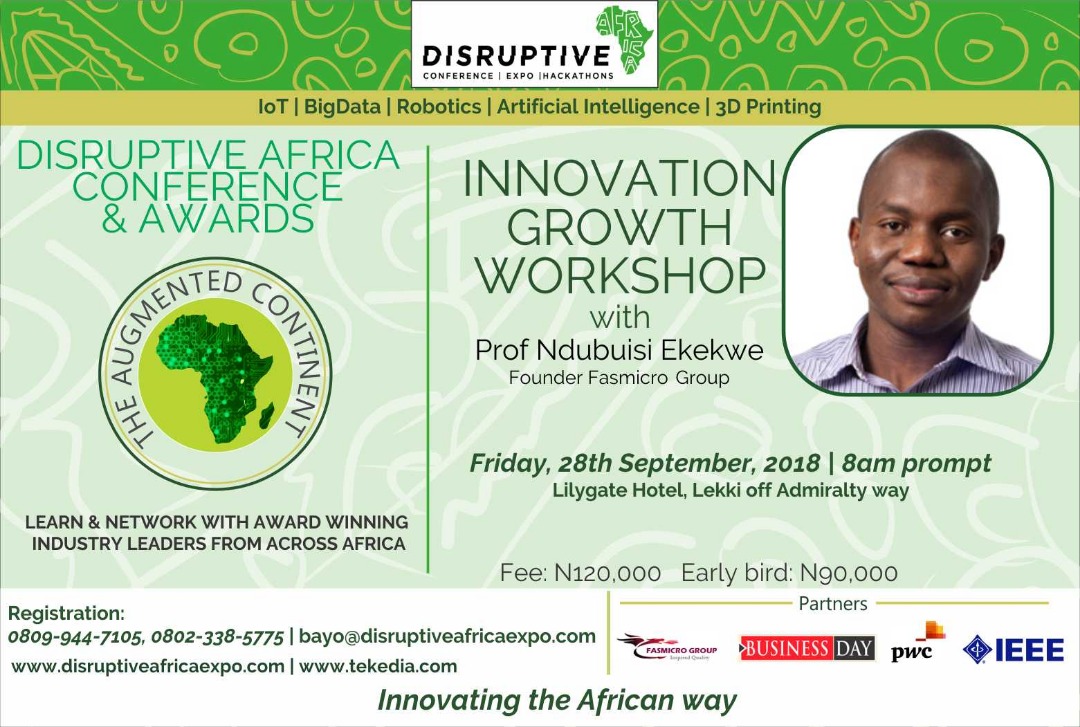
Note: With Disruptive Africa, we have created an affordable version which you can register here. That offers a workshop, conference and award ceremony in one day. I will drive the workshop, speak in the conference and attend the award ceremony. If you can, make it on Sept 28th in Lagos.
(I blocked some contents to protect client privacy, etc).
Discovery Innovation Workshop: To innovate is to set a new basis of competition in an economy, business sector or market. Typically, it results to disruption. This workshop will focus on innovation and growth because growth is the reward of innovation. Otherwise, that innovation is actually an invention. I will be the lead instructor with my supporting crew. We can adapt this workshop to two days.
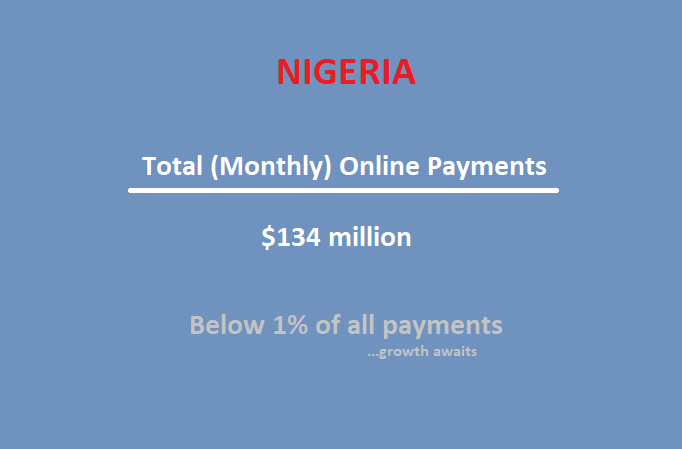
My Lord, what are you doing? Payment. Payment. Payment. Yes, I have mashed the words of Lord Polonius and Hamlet in Shakespeare’s Hamlet for the state of payment startup in Africa. Today, it is Lagos-based Paystack which added $8 million, bringing its total to $10 million. Visa, Stripe (hello, future acquisition) and Tencent are some of the backers. Paystack processes about $20 million transactions monthly, keeping 1.5% as fees. Simply, to become great it needs scale and this money will help.
Paystack, a Stripe-like startup out of Lagos that provides online payment facilities to merchants and others by way of an API and a few lines of code, is announcing that it has raised $8 million in a Series A round of funding. The company is active today in Nigeria, where its payment API integrates with tens of thousands of businesses, and in two years it has grown to process 15 percent of all online payments; and the plan is to both continue to growing in its home country, as well as expand to more, starting with Ghana.
But do not worry – Paystack founders know where they are doing: the $301 billion.
According to research done by The Fletcher School and Mastercard, of the $301 billion of funds flow from consumers to businesses in Nigeria, 98 percent is still based on cash.
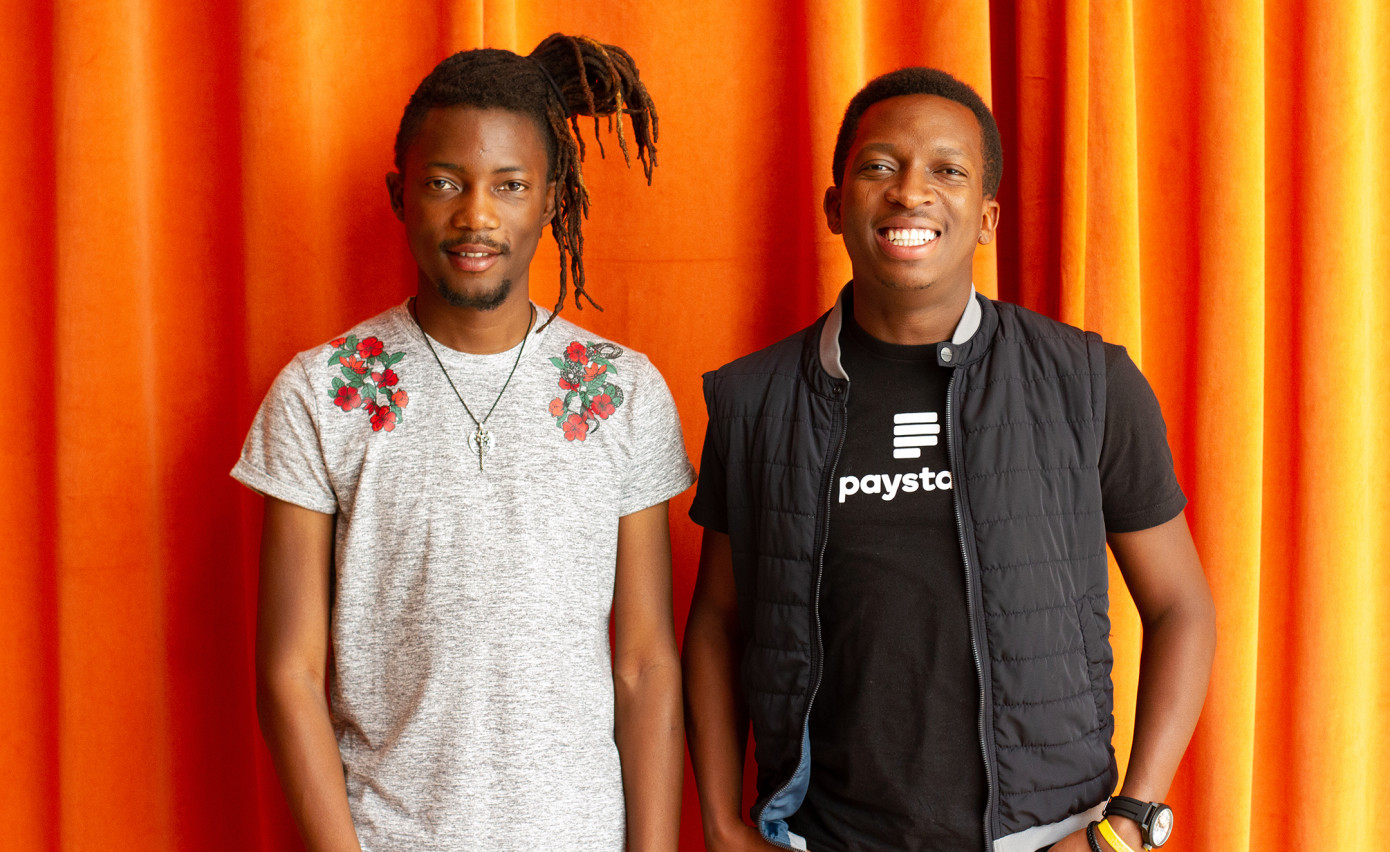
Yes, there is a huge pile of opportunities which must be digitized. If you get just 10% of that market, you have a business. Congratulations to Shola and Ezra: they now process 15% of all online payments in Nigeria.
The company is active today in Nigeria, where its payment API integrates with tens of thousands of businesses, and in two years it has grown to process 15 percent of all online payments; and the plan is to both continue to grow in its home market, as well as expand to more countries, starting with Ghana.
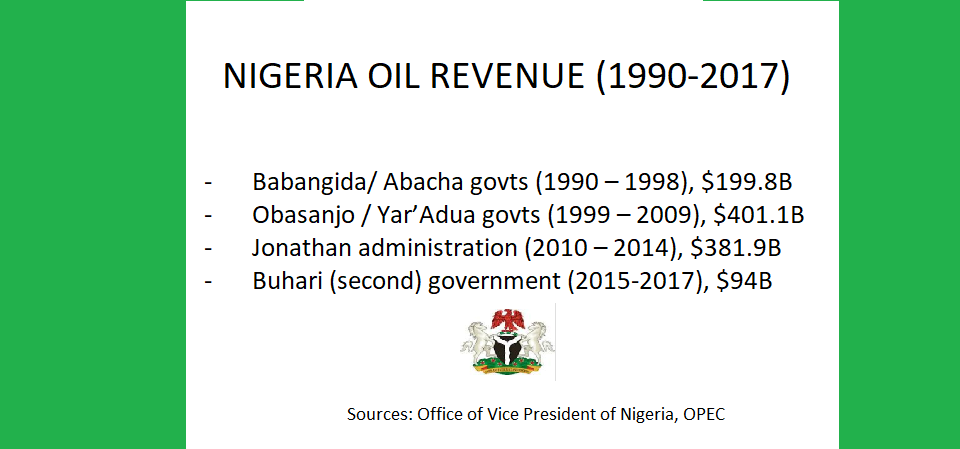
This is from the Vice President of Nigeria, Prof Yemi Osinbajo, breaking down how much money Nigeria has made over the years from oil. He relied on OPEC data. Looking at the numbers, Nigeria does not look like a poor country but a country that is poor on efficient management of resources.
Under the Obasanjo / Yar’Adua governments (1999 – 2009), $401.1 billion
Jonathan administration (2010 – 2014), Nigeria got $381.9 billion dollars
Buhari (second) government (2015-2017), 94 billion dollars
To give you a good comparison: the total value of the Nigerian Stock Exchange today is not up to $40 billion. But that is the exchange that powers our private sector. Technically, all our companies (the key ones are publicly traded) have not created enough value for what we make from oil in some good years.
Now, I understand better: If oil gives you $76 billion per year (using 2010-2014 numbers) and all the public companies (Nigeria Stock Exchange) are worth $40 billion, no one needs a seer to understand why successive governments have not bothered on how to deepen the competitiveness of the Nigerian private sector through provision of amenities like electricity, good roads, etc. That is unfortunate: this oil could be a curse indeed!
Good people, Nigeria is NOT a poor country; we are just poor in the right things.
The National Broadcasting Commission (NBC) plans to shut down many radio and television stations due to non-payment of licensing fees. Cumulatively, they owe NBC N4.3 billion (about $12.3 million). If you look carefully, Nigerians do not pay a lot of attention to many of those radio and TV stations except to watch religious programs.
The National Broadcasting Commission (NBC) on Monday said it would shut down radio and television stations owing the commission licensing fees.
The Director General, Is’haq Modibbo-Kawu, said that any broadcasting station that failed to come up with a payment plan before September 15 would be shut down.
Mr Modibbo-Kawu said this at a news briefing in Lagos after a meeting with the stakeholders in the broadcasting industry.
He said that the broadcasting stations are owing the commission N4.3 billion.
Yet, in the same country, a cable TV which people have to pay is increasing prices. Analyzing all, it comes down to value. When free products like our traditional radio and TV stations cannot make enough money to pay their annual licensing fees, and entities like DStv are doing just fine to increase prices, you will get the picture.
A Nigerian Court has stopped DStv from increasing its prices in the nation. In July, MultiChoice, the owner of DStv, announced new monthly subscription rates, jacking up the Premium package by 7.5%; the new rates took effect from August 1.
Our per capita income may be low but Nigerians will spend when they want to spend. The numbers from MallforAfrica always thrill me. It tells me that there are people who shop on Macy’s, Target, and other top American stores and get them shipped to Lagos and Abuja. Paypal has a special feature to make that possible as Nigeria, before the recession, became one of the highest spenders on Paypal mobile.
PayPal has ranked Nigeria as the 3rd highest mobile shopper worldwide. We indeed are masters in spending! The online payment giant is the most popular medium among Nigerian cross-border shoppers, and estimated 55 percent of all oversea online purchases in the past 12 months were done via PayPal
People write about the benefits of “lowest price” but I am not an apostle of that in Nigeria. In my workshops and writing, I avoid the trap that strong competitive advantage in Nigeria will come from mere pricing (where that product is not designed for the bottom of the pyramid). I focus on value which of course includes pricing!
Yes, you can make it free and no one will care. But if you deliver value and price fairly, they will come. But the key is providing value. That is the message. We all get frustrated when customers do not patronize local brands. We accuse the customers that they like foreign things which are typically more expensive. Focusing on that misses the whole point: they want predictable value even when it costs them more. That explains why free radio and TV stations are going bankrupt and pay TVs which are increasing prices are winning more hearts.
Check that product and service: the problem may not necessarily be price. You have not offered any clear value to Nigerian users. You must fix the value paralysis to make progress. Offering great value is the path to winning Nigerian customers.
Bayer Foundations has nominated Zenvus, my agtech business, for Aspirin Award – an award honoring companies which are “innovating to solve humanity’s grand challenges in health and nutrition”. The foundation wrote us last week. We are very thankful for the honor of being considered in this award from the makers of Aspirin. A powerful statement that brings humility: “We want to honor the most powerful social changemakers in the world – people with new answers for the challenges of society in areas connected to health and nutrition.”
I am so excited to hear about a farmer in Zamfara state who after receiving his Zenvus Boundary report made a special safe to preserve the document. Of course, we are not government but he was simply happy to have a piece of document recording his farmland. As we expand our agent network, using young people to map farmlands, we believe the formalization of informal assets will take hold step by step.
We want to honor the most powerful social changemakers in the world – people with new answers for the challenges of society in areas connected to health and nutrition.
Therefore, we organize the award in strategic partnership with non-profit organizations and leading entrepreneurship networks.
Carefully selected nominations will come from these networks. Self-nominations with the Bayer Foundations are not possible.