DD
MM
YYYY

PAGES

DD
MM
YYYY

spot_img

PAGES

Home Blog Page 7100

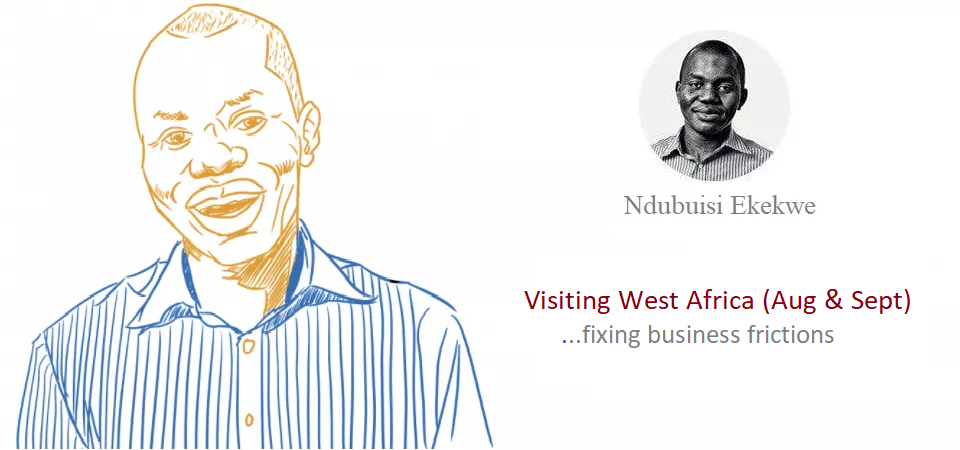
Let’s Visit Your Business in August & Sept in West Africa

0

In coming days, I will be on my way to West Africa. We will be spending 6 weeks starting from the Centre of Excellence (Lagos). We will launch a new business and also use that time to meet current and new clients on our advisory services. We remain the largest embedded electronics company in Africa – the larger of only two Intel FPGA partners. We also help startups, banks, insurers, etc deepen their capabilities through seminars and presentations.  From agtech to health-tech, electronics to advisory, we have a mini-diversified digital conglomerate. Email me or team (below) and let us schedule time. Let us work together to fix that market friction.
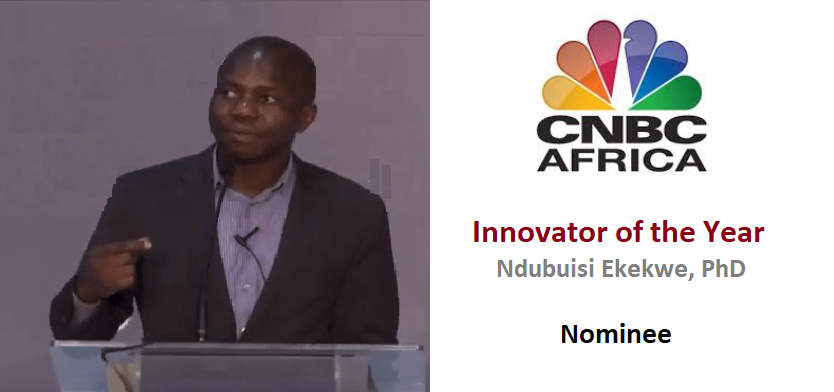
Ndubuisi Ekekwe Innovator of the Year CNBC


At Fasmicro Group, we do not recite numbers and tell you what you already know: we deliver unparalleled insights through uncommon perspectives shaped by our experiences as entrepreneurs and advisors in the markets. Our moments are unique because things we share with clients are shaped by our direct exposures to the markets. Fasmicro Advisory Services solutions are structured as follows:

  • Development of Business Roadmap & Strategy: A business plan is not enough to anchor business execution. A Roadmap Document is required especially in a sector which is in a state of flux [changing market, changing model, startup, competition, regulation, etc]. To avoid pursuing many windy paths or dead ends, a roadmap helps to encapsulate a profitable path to the vision with pillars and enablers necessary for success. Read more here.
    • We will conduct a review of the Firm’s current strategy, and identify the current gaps considering the business needs and market best practices and make recommendations to implement the strategic gaps with fit for purpose solutions in line with global best practices and local realities.
  • Discovery Innovation Workshop: To innovate is to set a new basis of competition in an economy, business sector or market. Typically, it results to disruption. This workshop will focus on innovation and growth because growth is the reward of innovation. Otherwise, that innovation is actually an invention. I will be the lead instructor with my supporting crew. The table below provides the workshop structure. We can adapt this workshop to two days.
Day 1 – Innovation Discovery Day 2- Innovation Exploration Day 3- Innovation Design and Applications
The State of Nigerian markets State of the Tech Nation address Becoming a Digital Innovator
Mapping internal & external trends Innovation Translation Filtering & modelling [Business & Functional Vision]
Digital Innovation frameworks Emerging Technologies Labs with Innovation Roadmap Brief
Business Challenges Teamwork / Disruptive thinking Takeoff Vision & Frontiers
Enablers and Creativity tools The Category-Kings Benchmarking [Local  & International] Innovation Execution
  • Discovery Innovation Presentation:This is a two-hour seminar where we will present what is happening in your market, customized for your company, and then offer insights on how you can plot your strategies to win. This goes beyond industry statistics and typical SWOT analysis. We work to help clients see their markets in new ways, providing roadmaps on how they can unlock opportunities. It is an intense talk, combining technology, finance, political economy and strategy. As technology redesigns markets, I break the implications in short, medium and long-terms.
    • Case: How can a (mall) real estate developer understand that ecommerce is a tangential threat since malls can be disrupted by digital commerce in future? My client now considers triple-play designs where malls can be converted into offices or homes, in case the moment comes.

Our services cover all industries, and we operate at the highest ethical level. .

If interested, email tekedia@fasmicro.com. Our cost is industry-competitive.

 

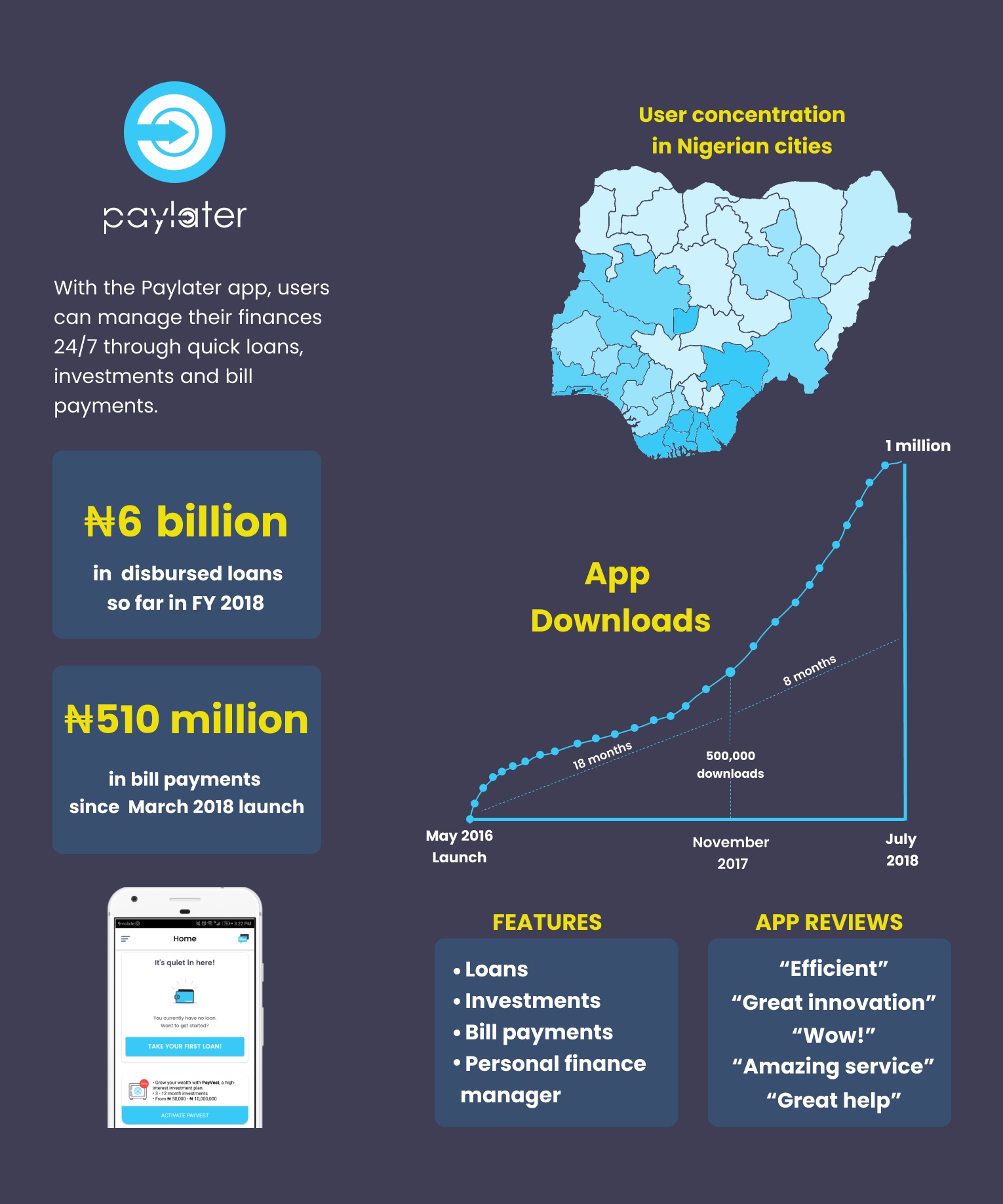
Paylater Hits One Million Downloads; Disbursed N6 Billion So Far in 2018

0

Paylater, the fintech company which pioneered micro-lending in Nigeria, at scale, has hit one million app downloads. I wrote about this company and called it a brilliant business. With this growth rate, Paylater could be the largest “Nigerian bank” with no bank license by 2025. It will eclipse three banks in customer base possibly by the end of 2019.

That is why Paylater is exciting. Owned by One Finance & Investments Ltd,Paylater is going after that market where the highest pain points are found in the Nigerian banking sector. We can surely live without shopping through the modern digital payments. But we know that it is challenging when there is an urgent need for funds and no friend or family can help. That is what happens across Nigerian families today. Challenges go beyond how to move money fast across digital channels. Simply, we want credits. Paylater focuses on short-term loans, mainly for emergencies.

The mobile app provides Nigerian consumers with access to credit. And it does its entire works completely digitally, without seeing or speaking to customers. Call it AI or analytics, it is a leap ahead.

From an email sent to Tekedia, the company has disbursed N6 billion in 2018 alone.

In Nigeria, a country of nearly 200 million people, 61% of the adult population is un- or underbanked. Fintech companies like Paylater represent a tremendous opportunity to get formal banking services in the hands of Nigerian consumers to provide much needed liquidity for entrepreneurial investment, personal development, or unexpected expenses.

Consumer credit is nearly non-existent in Nigeria. But, Paylater is issuing loans to Nigerians completely digitally, without seeing or speaking to customers. Customers can receive funds in their account in as little as 5 minutes, with no need for paperwork, collateral or guarantors. Digital financial services platforms have been well received by consumers and it appears that fintech platforms like Paylater are here to stay.

The evidence is in the numbers. With over 800,000 registered users, across every Nigerian state, Paylater has loaned over $17M USD to Nigerian consumers in 2018 so far. The technology platform has supplemented that loan growth with very strong early adoption of its bill payments  and investments features as well.

“We are very excited by the market adoption of Paylater and we believe there is still a significant growth opportunity ahead for digital financial services” – Co-founder and CEO Chijioke Dozie

Before Paylater, only commercial banks?—?with physical branches nationwide and extremely large capital bases?—?had the reach, stability and customer trust to offer financial services to a variety of people. Unfortunately, these same institutions turned record profits by taking deposits from average consumers, and reserving actual ‘banking’ services like loans and investments for large corporate entities and high-net worth individuals.

Access to credit is a fundamental human need and the foundation on which most modern economies are built. Pioneers like Paylater have embraced the difficult task of unlocking the power of financial access for the underserved, and so far, it looks like they are winning.

[Apply] African Master’s in Machine Intelligence with Google and Facebook

0
AIMS

The African Institute for Mathematical Sciences (AIMS) has announced the launch of a one-year intensive African Master’s in Machine Intelligence (AMMI) in partnership with Facebook and Google. The master’s will begin this September at the AIMS-Rwanda campus in Kigali.

“Machine Intelligence (MI) is revolutionizing critical aspects of our lives. It enhances medical diagnosis, improves industrial processes and enables scientific discoveries. Over the past decade, thanks to large public and private investments, MI has progressed rapidly in both basic research and the development of a vast array of applications. However, the talent pool currently advancing MI is modest and unrepresentative of the diversity of our world, leaving us less capable of facing global challenges. The challenges we choose to work on are strongly influenced by our backgrounds and our environment. Our goal with AMMI is to train a generation of young scientists who will bring a fresh perspective to machine intelligence research and contribute to advancing its development across Africa, for the benefit of its society” said Dr. Mouhamadou Moustapha Cissé, Founder and Director of the AMMI program and Professor of Machine Learning at AIMS.

AIMS, together with its partners, believes creating an effective, globally connected community of Machine Intelligence practitioners in Africa will reduce the technology gap, strengthen Africa’s economies and enable better governance.

Commenting on the partnership, Jerome Pesenti, VP of Artificial Intelligence said: “We’re proud to be partnering with AIMS and Google to launch the African Master’s in Machine Intelligence programme. At Facebook our goal is to drive positive social and economic impact across Africa, and this partnership is another step-in driving innovation by supporting the continent’s already exciting tech ecosystem and talent pool. We’re excited to see how students will utilise advanced technologies to solve problems and build solutions for the future of Africa and the rest of the world. We look forward to seeing them contribute to the growing ecosystem of African machine intelligence scientists and bring a fresh perspective on the challenges tackled by the scientific community.”

Jeff Dean, Lead of AI at Google said “The field of machine intelligence is advancing rapidly, and it’s imperative that industry leaders including Google and Facebook, continue to partner with academic institutions like AIMS to develop the next generation of students who will build MI that benefits everyone. We look forward to working with AIMS to drive this effort through the AMMI program. Along with our recent announcement of a Google AI center, scheduled to open later this year in Ghana, this partnership with AIMS is another example of our long term investment and commitment to Africa.”

The AMMI program will provide brilliant young Africans with state-of-the-art training in machine learning and its applications. Every course on AMMI will be lectured by leading experts from prestigious African and international institutions, providing the AMMI students the best possible foundation.

Links to apply here

DISCOs’ Threats To Exit Nigeria’s Energy Distribution Sector

0
privatize power Nigeria
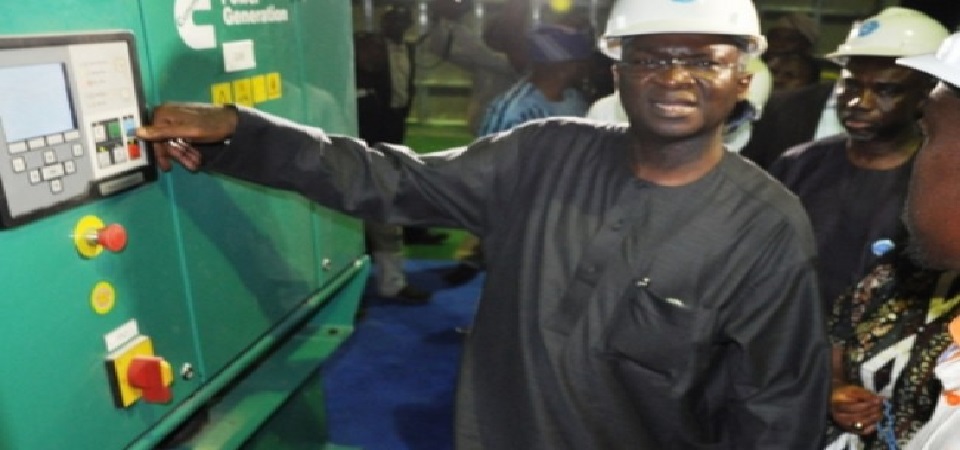
Mr. B. Fashola, Nigeria's minister supervising electricity sector

It is a season of decamping and reconnecting: it is all politics. Yes, it is possible right now that Nigeria is on auto-pilot at state and federal levels as politicians work days and nights to retain their jobs. Unfortunately, numbers cannot like: this is how we are growing, using GDP growth figures.

2010: 11.3%

2011: 4.9%

2012: 4.3%

2013: 5.4%

2014: 6.3%

2015: 2.7%

2016: -1.6%

2017: 0.8%

And if you consider that our power sector is moving into a terrible territory, you would be concerned. Things have gotten so bad that DISCOs are ready to exit the energy distribution sector.

The disagreement between the Federal Government and power distribution companies continued on Tuesday, with the Discos threatening to quit the sector and expressed willingness to resell the power assets at discounted rates.

[…]

Speaking at a press conference in Abuja on Tuesday, the investor in Jos Electricity Distribution Company Plc, Tukur Modibbo, stated that the power firms were doing their best but were willing to resell the companies at discounts to whosoever was interested in them.

He said, “You asked me whether we are willing to quit the business. Now, please listen to me and put it down clearly that we bought our distribution company cash down for $82m in 2013; we are willing to take $72m in 24 hours and leave.

“If you have $72m or Fashola can give us $72m, we are giving him $10m discount; if we get that sum, in 24 hours we are out of this business. Please, is there anybody with $72m here? If there is none, please advertise it for me because I’ve given you the price.”

Modibbo advised the minister to call for a meeting of stakeholders in order to avoid a further deterioration of the sector.

This threat from the DISCOs goes back to my old statement: the problem is the government, past and current. Yes, there is something fundamentally wrong that no one wants to do business in Nigeria’s electricity sector despite the obvious latent opportunities. If the opportunities are there, and people are not jumping to make money tapping them, then you have a policy problem. It is irrelevant if you are shouting for investors to come. Great policies are visible because everyone wants to jump in and make money. But making that money comes with fixing market frictions. In our electricity sector, people are not interested to invest because they see no path to profitability. It is a paralysis that government must fix.

Unfortunately, the problem with Nigeria’s electricity is the government. There is no sector in Nigeria where everyone knows that money can be made than in the electricity sector. Yet, it is also the one where people are not investing. The implication is that we have a misalignment between market needs and investment risks. Everyone understands the real need in the market for electricity. Yet, few are running to invest. No matter how you see it, the problem is not with the investors. The problem is with the government because the right policy is not available to stimulate the animal spirit of capitalism.

This is certainly broken; the distribution companies are doing far better compared with the transmission companies. At the moment, despite the fact that generating companies can expand capacity up to 24,000 MW, a limitation is imposed on the transmission system at about 7,000 MW.  For the DISCOs, they are not close to distributing that capacity and they have no clear incentive to expand because doing so is simply losing money. It is in Nigeria where DISCOs will reject power because selling will be making losses. When you look at it, you will agree with them: they are demanding for reflective tariff, and if we expect them to remain in business, the nation has to carefully examine their points.

Finally, DISCOs have to also ensure they have done their parts. The nation is overdue for smart metering, estimated billing must be discontinued immediately.

NIS – We Want To Partner

2
NIS

Dear Sir,

I am writing from Zenvus. We appreciate all the comments about Zenvus Boundary technology. We want to explore if you can help us reach out to NIS. Our proposal is to offer Zenvus Boundary as an additional digital value to the typical outputs licensed surveyors deliver to customers. We do believe that this will add value to NIS customers if you provide them a digital map besides the paper output. This digital map opens opportunities to all kinds of things.

Zenvus Boundary has a property search engine which provides a public record of any property it has ever mapped. This makes it possible that no one can clone the outputs. Each output comes with a unique code which the user can give to partners to search and verify the ownership (at least as stated on the survey). This has made it possible that financial institutions can independently validate our outputs.

If you plan to use your survey to apply for loan, government verification of property, security, etc and you need the party to check the authenticity in our records, use Zenvus Boundary public search. Use the code on your report (it begins with SB) and check it here (looks like below).

Zenvus Boundary Property Search

As we maintain, we are not a legal advisor. We are not licensed surveyors. Yet, our services offer huge value in Africa. We make integration possible at scale because our outputs are in digital forms which customers can use for different uses. If you have farm sensors to track moisture, temperature and other pertinent data, Zenvus through its digital integration makes it possible to superimpose all that data on your farmland. And we deliver all these solutions for just $20!

I am seeking an opportunity to partner with NIS and will appreciate if you can make an introduction.  We will like to speak in any conference organized by NIS or possible meet the Excos. We want to standardize what we are doing at least for farms and farmlands by working with NIS. We truly believe that this is the future of mapping. Yes, giving people besides paper surveys, digital surveys which they have control on what to do with them.

Some of our enterprise customers use Zenvus Boundary to track farmlands they have invested in Africa. Through our digital maps, the investors rely on global satellites to check how the specific farmland has changed via the vegetation. The cheap maps were produced by the farmers with our low cost solution, making this possible.

As always, we thank NIS for the services to Nigeria. We want to work with all of you to deliver digital surveys with implications for precision agriculture, farm remote monitoring, etc at scale.

Regards,

Nky Udo

Zenvus / zenvus@fasmicro.com


NIS – Nigerian Institution of Surveyors

-We welcome partnerships with similar institutions across Africa