DD
MM
YYYY

PAGES

DD
MM
YYYY

spot_img

PAGES

Home Blog Page 7100

Nigerian State Wants the “Anti-Corruption” Tool of LinkedIn Nation

0
anti-corruption tool

When I became the President of the LinkedIn Nation (lol), I presented my inaugural presentation to the nation. Some components of that speech have gotten some of the decision makers talking.  Few weeks ago, a state government wrote that it would like to have more details on the Pillar 1 – Anti-Corruption & Business Reform.

What I shared publicly (the procurement fraud) was a small component of a comprehensive national framework on how to deal with corruption in Nigeria. I am confident that making systems human-agnostic with unrivaled transparency would significantly reduce corruption. And prevention of corruption over just focusing on prosecution would be catalytic.

For this state government, in a preliminary framework, we have noted that the state must examine how it could build a state equivalent of EFCC but with focus on corruption-prevention by looking at corruption incidents and refining constantly the state processes and systems to close them in near-real-time. And interestingly, even the Government House and security votes would not be exempted.

Our laws and systems on corruption have focused too much on prosecution; we need to invest on prevention. Also, the outcomes on prosecution have not been stellar because of legal loopholes. If we deepen our efforts on prevention by researching and investing on it, we would not just improve the systems but eliminate the pains upon the citizens emanating from corruption, because we would prevent it.

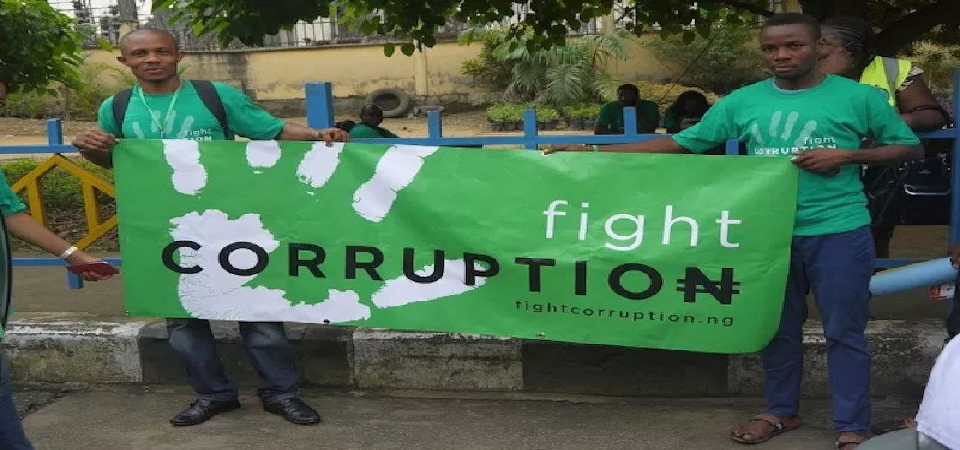
Pillar 1 – Anti-Corruption & Business Reform: We will build a corruption-free nation where it would be extremely impossible to perpetuate corruption because technology will make things obviously transparent. All government systems must be structured to be corruption-resilient so that people that want to perpetuate corruption will fail. We will publish any government expense that is more than N10 million in a web diary which all citizens will have access to. This applies to all levels in the federal government, from ministries to agencies. For national security reasons, a segment will be available to the civil society and accredited press team. Our government will improve business systems and make doing business in our nation easier.
The State of Nigeria Mobile Operators: MTN Nigeria, Airtel Nigeria, Globacom, 9mobile

0
Nigeria mobile operators

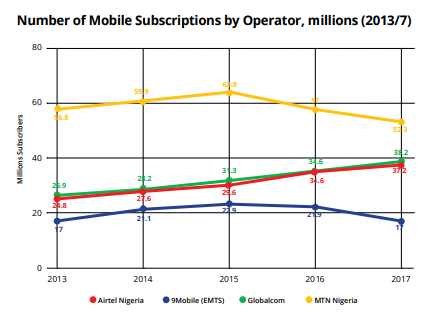
The following are the four main Nigeria mobile operators:  MTN Nigeria, Airtel Nigeria, Globacom, 9mobile. Asoko Insight, a consultancy, has studied these firms; I present a summary of the results.

Nigeria Mobile Operators

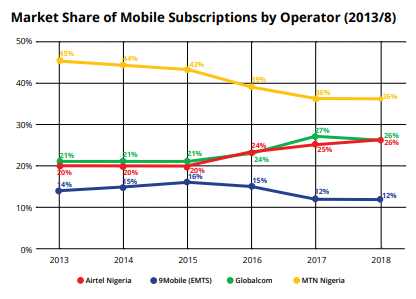
According to the Nigerian Communications Commission, the total number of mobile subscriptions stood at 237.6 million in January 2018. MTN Nigeria’s market lead has decreased in recent years; from 2013 to 2018 the company lost 6% of its subscribers. The company disconnected around 5 million subscribers in early 2016 following suspension of its services by the regulator. Meanwhile Globacom and Airtel Nigeria have seen steady gains: Globacom accounts for 38.2 million subscribers, up 47% from 2013, while Airtel Nigeria has 38.3 million subscribers, up 54% over the same period. Subscribers of 9Mobile (formerly Etisalat) declined going into 2017, on the back of the company’s debt default.

Nigeria Mobile Operators
Source: Asoko Insight

Nigerian Communications Commission data indicate that MTN Nigeria, the country’s largest telecom player, has seen a drop in market share since 2013, from 45% to 36% of total subscriptions in 2018. Smaller players have also seen shrinking subscription figures: 9Mobile (formerly Etisalat) lost 2% market across the same period. However, Globacom gained 5 percentage points during the same period, and Airtel Nigeria saw similar growth.

source: Asoko Insight


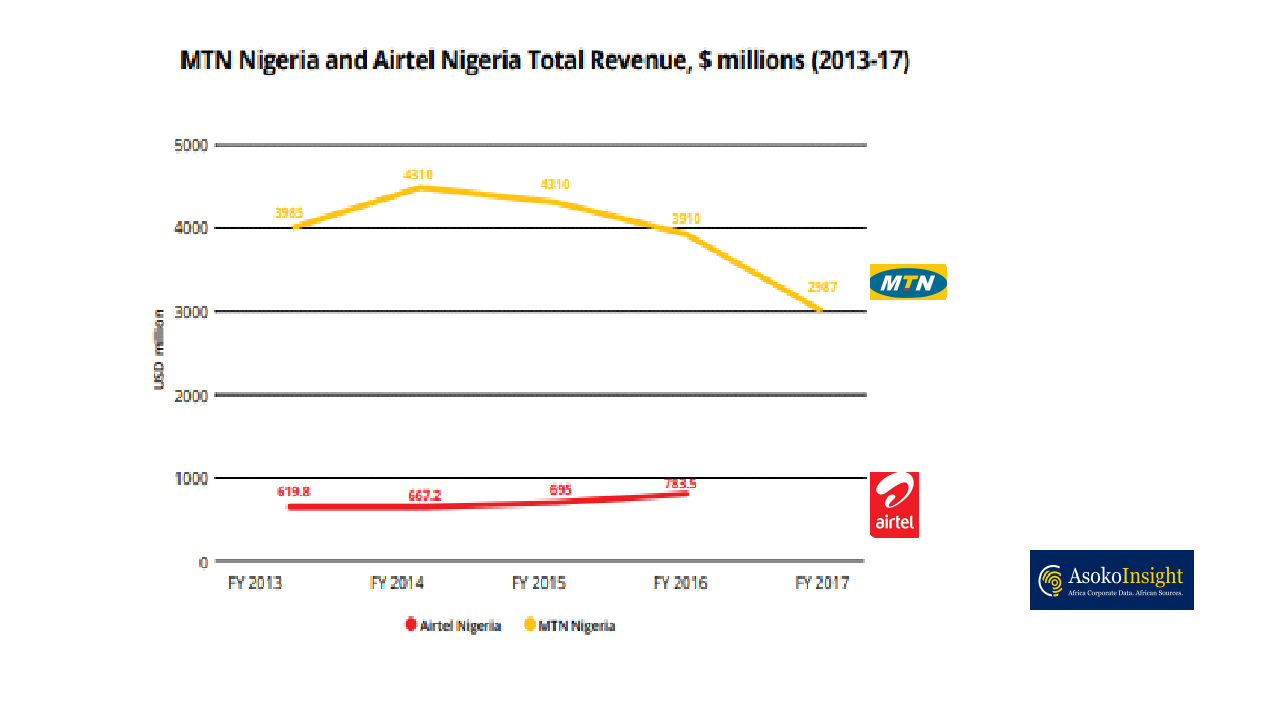
Airtel Nigeria and MTN Nigeria Revenue

Airtel Nigeria’s total revenue increased by 22% from 2012 to 2016 reaching a high of $783 million at the end of the recorded period. (Airtel Nigeria 2017 revenue is unavailable.) MTN Nigeria’s revenue has been in steady decline since 2014, having fallen by 33.3% to reach $2.99 billion at the end of the period. Company statements identify the difficult economic environment, competitive data pricing, and regulatory uncertainty as the core drivers of the decline.  Recent report suggests revenue is on the up going into 2018.

Source: Asoko Inight

Just Accepted Horasis Global Meeting Invitation, co-hosted by Portuguese Government

0
Horasis

I have just accepted an invitation to speak in the 2019 Horasis Global Meeting. The event is co-hosted by the Portuguese Government and the City of Cascais. From the invitation letter:

I take great pleasure to invite you to speak at the 2019 Horasis Global Meeting to be held in Cascais, Portugal over 6-9 April 2019. Under the theme Catalyzing the Benefits of Globalization, the Horasis community of more than 600 selected world leaders (including several heads of governments) from 70 countries will gather for an unparalleled experience devising novel ideas to sustain and nurture our development in the future.

Attending this invitation-only event are prime ministers, presidents, chairman of major global banks and CEOs of many Fortune Global companies.

The annual Horasis Global Meeting is one of the world’s foremost gatherings of business leaders who interact with key government officials and eminent thought leaders.

Horasis is an independent think tank based in Zurich, Switzerland. It holds invitation-only meetings of global business leaders. From its Wikipedia page, the think tank has been dubbed “a kind of junior league World Economic Forum for the emerging market set” by The New York Times.

It would be a fascinating moment to spend the days with these world leaders as we continue to deepen our thought-leadership in Africa and beyond.


Kenya Follows Nigeria on Electronic Tax, hits Mobile Money with 2% Transfer Tax

0
mobile money tax

There is one area I have sympathy for African telecom operations: multiple and excessive taxes and fees. Sure, I do know that customers do end up paying those fees and taxes since the operators transfer them into their pricing models. But that does not mean that it does not hurt the operators; some customers may drop the services if the fees are high which would not have arisen if the telcos did not increase prices to cover the fees and taxes.

According to ATCON, a telecom industry association in Nigeria, operators are exposed to dozens of fees and taxes. Nigeria upped the game recently with 0.005% on electronic transaction bringing everyone in the party, from fintech to banks. Around the continent, it is the same story: telecommunication sector is the default industry to fund one (small) government idea or another, via fees or taxes.  With millions of users in the networks, enact the fees, money flows in days into government purses.

The Association of Telecommunications Companies of Nigeria (ATCON) hates that because it would make your phone calls and browsing more expensive since telcos would pass the costs to you. Banks, insurers and fintechs would also help to collect the new levies since anything electronic transaction would be levied the 0.005%.

But what is happening in Kenya is taking this to the next level: 2% mobile money tax on transfers.

A proposed tax increase on mobile money transfers in Kenya is drawing protests from several services, including M-Pesa.

As part of a new tax proposal to raise government revenues, Kenya’s government is pushing to raise duties on mobile cash transfers by 2%. The government expects to net around $270 million in additional revenues and claims the extra income will fund a universal health care program to cover all households by 2022.

I hope they do not do it. If they do, some of the gains via mobile money could be gone. That is exactly what Safaricom, the owner of MPESA, noted: ‘it will “negatively impact mobile-led transfer services and payments” and reverse the gains of financial inclusion by making it more expensive to conduct business transactions and make payments using mobile money services”.

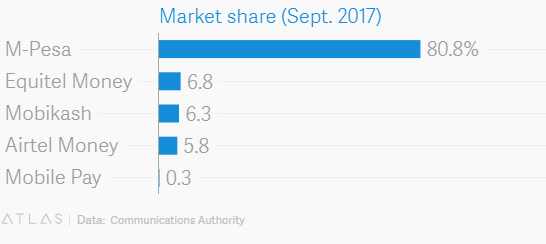
MPESA leads Kenya’s mobile money market. I do hope government understands the risks of making transfer very expensive for the citizens. Excessive mobile money tax will not help the poorer citizens; most would go unbanked!

mobile money market Kenya

Breakdown of 2018 Nigeria Budget Signed into Law by President Buhari (Charts)

0
2018 Nigeria Budget

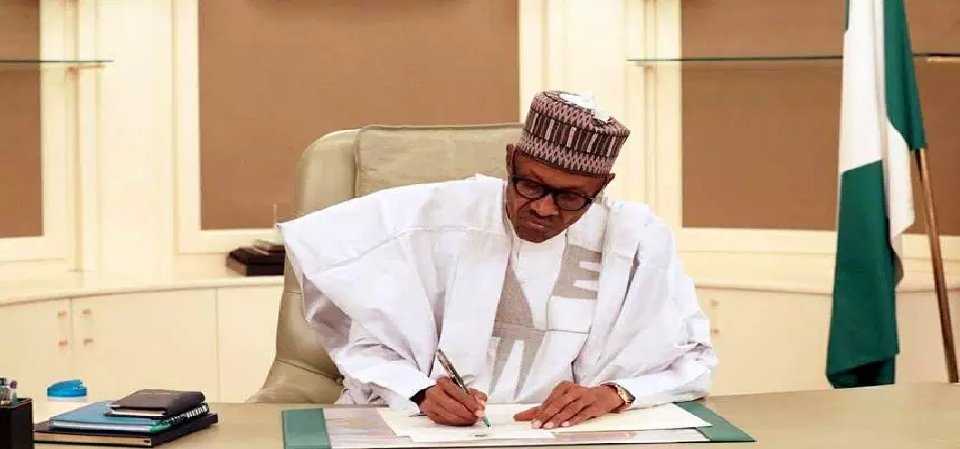
The President of Nigeria has signed the 2018 Nigeria budget. This is the breakdown of the signed budget, according to Premium Times. You can refer to the 2017 Nigeria’s federal budget here.

  • The total budget is N9.1 trillion, up from the N8.6 trillion estimates he submitted to the Assembly on November 7, 2017. The National Assembly raised the total figure by N500 billion.
  • They also increased the oil benchmark proposed by the executive from $45 to $51 per barrel.
  • The Assembly, however, retained oil production volume proposed at 2.3 million barrels per day and an exchange rate at N305 to $1.
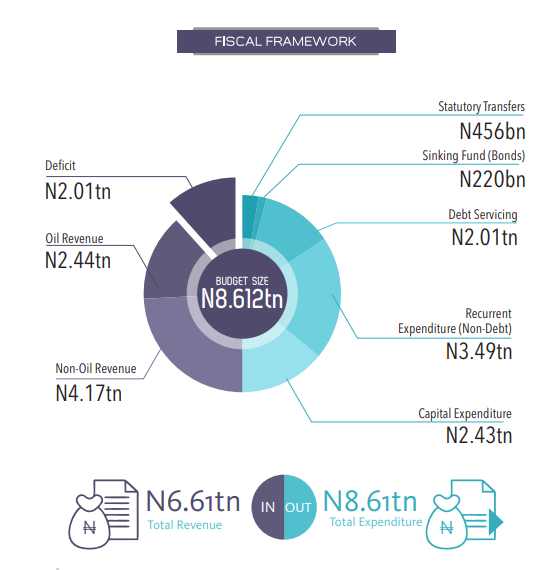
  •  The budget as passed by the two chambers also has N530.4 billion as statutory transfer; N2.2 trillion for debt service; N1,95 trillion as fiscal deficit.

Notice that the official rate of Naira to $1 is N305. The full proposed budget before the National Assembly added the N500 billion is here (pdf).

2018 Nigeria Budget

2018 Nigeria Budget (source: BudgIT). Note this plot did not capture the additional N500 billion added by the National Assembly.

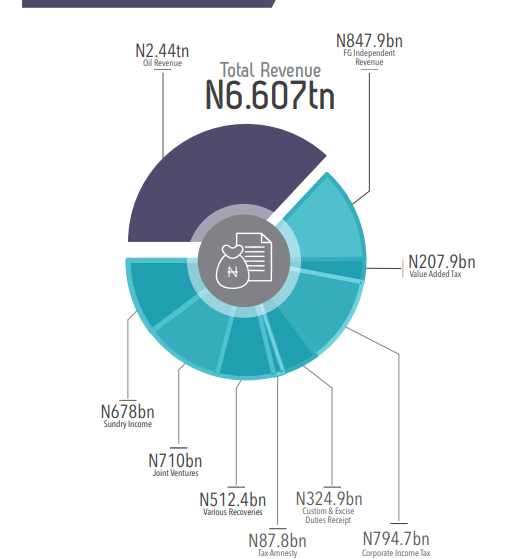
2018 Nigeria Budget Revenue estimate
2018 Nigeria Budget Revenue Sources (source: BudgIT).


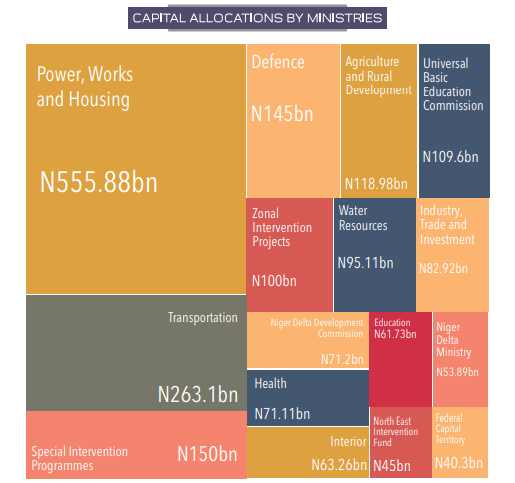
2018 Nigeria Budget
2018 Nigeria Budget – Capital allocation by ministries (source: BudgIT).


2018 Nigeria Budget - summary of funds
Summary of funds (source: Nigerian govt. Click the proposed budget PDF above)


You can read BudgIT full report here (note, this was done before the addition of the extra N500 billion by the National Assembly)