DD
MM
YYYY

PAGES

DD
MM
YYYY

spot_img

PAGES

Home Blog Page 7101

Sending & Receiving Money In Ethiopia Set To Become Easier With M-Pesa Deal

0

According to the GSMA State of the Industry on Mobile Money 2017 report, the number of central Africans transferring cash via money apps increased from 23.6 million in 2016 to 32.9 million in 2017. Therefore, the news that Safaricom plan to launch their mobile money app, M-Pesa, which has nearly 30 million subscribers in Kenya alone, in Ethiopia is a positive move. Millions have already been raised to support the development of digital payments, leading experts to predict that the launch of M-Pesa in Ethiopia will transform the way the nation handle their money for good.

The growth of Safaricom

In Kenya, M-Pesa holds 80.8% of the country’s mobile money app market share, while its closest rival, Equitel Money, holds just 6.8%. Across the country, Safaricom has become more than just a method used to transfer money from one individual to another. The telecoms operator has invested in multiple sectors including, ride-sharing apps and e-commerce. Additionally, the company has also launched its own social network which allows users to send money while talking to one another. So, it’s clear to see why they would want to branch out into other heavily populated countries, such as Ethiopia which has a population of more than 100 million.

A positive move for the country’s finances

Data released from the IMF earlier this year revealed that Ethiopia is on track to become the fastest growing economy in sub-Saharan Africa by the end of 2018. With the economy booming, now is the time for the M-Pesa app to launch to ensure that the nation takes control of its money in the most effective and convenient way possible. Ethiopians with loans and other forms of debt will benefit significantly from the M-Pesa app as it will allow them to transfer cash to those they owe at any time and give them the means to track all their payments.

The benefits of mobile money apps

One study that looked into the long-term effect of using mobile money on Kenya’s economy found that 194,000 Kenyan households were no longer in poverty as a result of mobile money. Ethiopia currently falls within the top 10 countries with the highest prevalence of poverty as 23.9 million currently live in such conditions, according to The World Poverty Clock. Therefore, with mobile money apps providing such impressive results in Kenya, families in Ethiopia could see themselves financially better off should M-Pesa become available in the country, too.

M-Pesa is a major money management app in Kenya which other African countries could benefit substantially from. Therefore, should Safaricom agree a deal with Ethiopian officials, the nation would be sure to utilize the service and all that it offers due to its financial tracking, sending and receiving abilities.

Central Bank of Nigeria (CBN) Guideline on Chinese Yuan-Naira Currency Swap – First Bank

0

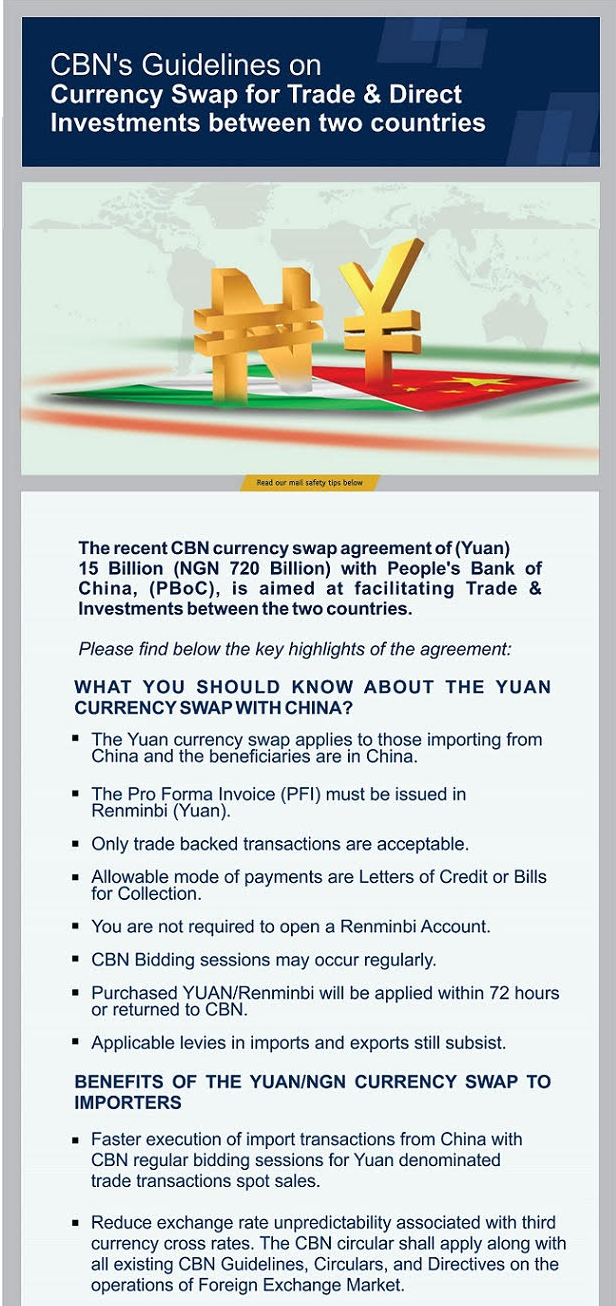
This is the Central Bank of Nigeria (CBN) guideline on the Chinese Yuan-Naira currency swap, courtesy of First Bank of Nigeria.

Disintermediation does not only apply in the technology world where producers cut-off middlemen or intermediaries to reach consumers directly. What is happening in the Chinese currency swap is the disintermediation of the U.S dollars. The $2.5 billion currency swap deal will open opportunities, hopefully, for manufacturers in Nigeria. If you want to buy something from China, you do not need to look for U.S. dollars. If you have your Naira, the government will make it possible for you to pay directly in Yuan

Naspers’ $20 Billion Revenue, $112 Million CEO Bonanza

0
Naspers

I like Naspers (parent of MultiChoice – operator of DStv and GOtv), Africa’s largest company by market capitalization, because it is an amazing institution. The more I learn about this firm, the more hopeful the promise could be about Africa. This is the same company that turned $34 million into $170 billion (with b).

So when South Africa’s Naspers invested in China-based Tencent $34 million, it was making a huge call, in 2001. Today, that $34m berth is now worth $170 billion (with b), based on Tencent’s current market capitalization. Magically, Naspers is the 65th most valuable company in the world. That berth is perhaps the greatest investment in Africa.

Naspers is a digital conglomerate and it is everywhere in the digital world. Yet, it is South African, making it clear that capital can be accumulated in any continent. In the league of some of the best investments ever, Naspers has a seat. It had a great year: $15.6 billion revenue from internet segment alone.

Naspers announced that its core headline earnings grew by 72% to R33.6bn ($2.5bn) as the company released its financial results for the year to March 31, 2018, on Friday afternoon.

Revenues, measured on an economic interest basis, increased by 38% year-on-year to R270bn ($20.1bn).

[…]

In a statement, Naspers said its revenue in the internet segment was up by 50%, compared to 51% in 2017, to R213bn ($15.9bn).

Interestingly, golden paycheck does not discriminate when there is huge value created. The CEO of Naspers, Bob van Dijk, went home with about US$112 million (R1.6bn) on wages, bonuses, vested stocks, etc during the year ended March 31, 2018. The investment in China’s Tencent, owner of WeChat, continues to make everyone a star in Naspers. Move over Wall Street, Africa has got the real king; Bob van Dijk, CEO of Naspers, is the king.

“But the quantum being paid out is obscene and probably puts Van Dyk amongst the richest 1 percent on our planet.”

[…]

The latest report does little to dispel the worry that Van Dyk and his executive colleagues are securing huge payouts because of the stellar performance of the Naspers share price, which is driven by the 31% investment in Tencent — over which Naspers executives have no influence.

Almost R1bn of the R1.6bn Van Dyk picked up during 2018 was the payout on 284,031 Naspers N shares that had been allocated to him in 2014 when he was appointed CEO.

In addition, Van Dyk cashed in R619.6m in share appreciation rights during 2018. The value of the share appreciation rights is based on an assumed value of Naspers’s e-commerce businesses, which exclude Tencent and MultiChoice. Most of the e-commerce businesses are making little or no profit.

Investors should not castigate executives of Naspers for their pay bonanzas. The executives have created value and made many of them millionaires. If more money would motivate them, so be it. Of course, the correlation between more pay and great returns has a limit before paying more becomes a waste. Yet, it is extremely important that investors see this firm as uniquely positioned to redesign many sectors in Africa, and should be allowed to invest in talent. If Naspers had been Nigeria-born, its tax alone could possibly fund the national budget, assuming it brings all the money it has made outside Africa home same time.

As Naspers shifts its massive profit home to South Africa, there is no way the South African treasury will not get at least $30 billion if you have around 20% tax rate. That is a national budget for Nigeria if this had happened in our country. We need to pay more attention to venture funding to stimulate our economy.

Think about it: if Africa could have ten of Naspers, the conversation about the continent would change. We need MVPs as I have noted before.

Market cap of Apple and Amazon

Four Pillars Enabling Future Retail To Consider In African Ecommerce

0

The new Konga is on a mission as it is working to enable the fusion of offline and online retails. The expectation is that doing so would remove more frictions in Nigeria’s retail sector. As I have noted, hybrid commerce is an opportunity as most elements of our business systems are still offline. Largely, building a business with carries a huge offline marginal cost with purely online components will not work in the contemporary business scene in Nigeria. Leading global ecommerce players like Alibaba and Amazon continue to drive the integration of the physical and digital in retail, and they are enabling new vistas in the industry.

The key sentence is thus: “Our mid-term goal would see to the establishment of more stores across Nigeria”. Yes, the new Konga would be opening physical stores across Nigeria. Certainly, that is a great winning business model. Besides the money being in the physical space, having stores will reduce the marginal cost challenges associated with pure play ecommerce. The piece quoted me as it argued the brilliance of pursuing this hybrid commerce for Konga.

[…]

Simply, if the money is in the physical space, why must we build a business that is exclusively online? Unless for pride and fancy, it makes no sense. The new Konga understands this and is working to enter the race where the opportunities abound

The Mind of Jack Ma

From the legend of Alibaba, we can see a clear picture where future retail is going. Simply, the future will have many integrations where data, logistics, etc will morph offline and online components, making it possible for customers to have seamless experience during shopping.

Alibaba Founder and Chairman Jack Ma coined the term “New Retail” in a letter to Alibaba’s shareholders in October last year. Ma said, “Pure e-commerce will be reduced to a traditional business and replaced by the concept of New Retail?the integration of online, offline, logistics and data across a single value chain.” We believe that this is very much how next-generation commerce will look globally, with large retailers and niche category specialists leveraging technology to provide an integrated service with the consumer at its core.

This approach will be anchored on four major elements – the enablers of modern digital companies:

  1. Digitalization: Digitize business processes to improve supply chain and process efficiency.
  2. Omnichannelization: Deliver omnichannel experience across platforms and ecosystems,
  3. Platformization: Unify online and offline information regarding customers, products and services through platforms.
  4. Entertainmentization: Enable experiential retail at scale.


All Together

The future of retail will run through the amalgamation of both online and offline. That means building ecommerce ecosystems without physical integration may not be enough. Companies can approach this through partnerships since it would be expensive to execute such models single-handedly. The four elements noted are going to be catalytic in the retail sector of Nigeria in coming years.

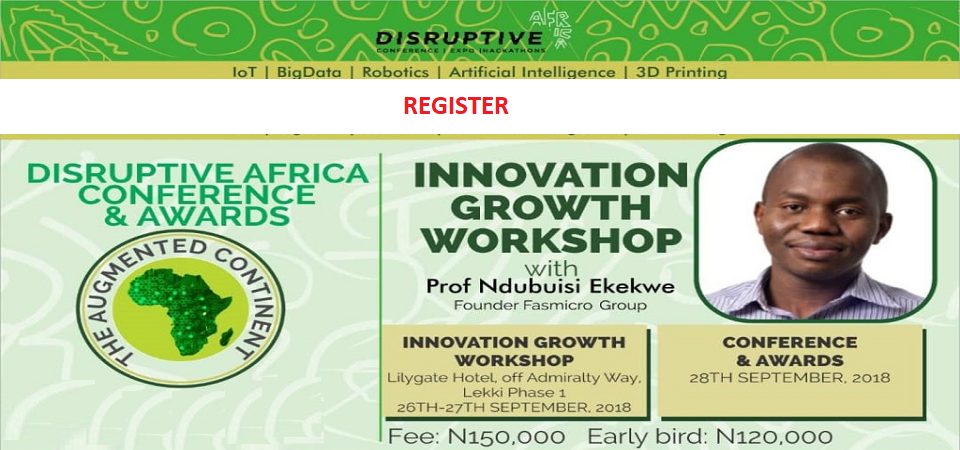
[REGISTER] Disruptive Africa’s Innovation Growth Workshop w/ Prof Ndubuisi Ekekwe, Lagos, Sept’18

0
disruptive Africa Workshop with Ndubuisi Ekekwe, Innovation Growth Workshop

On May 14, 2018, I announced that I would run a workshop in Lagos this September. The promotion and marketing of Innovation for Growth Workshop was expected to take months. Fascinatingly, the 24 seats structured for the event sold out within five days. A Lagos-based multinational bought out the seats.

According to my team, many intending participants had asked for end of May and June to register for the N800k three-day program. With the seats gone, I asked them to explore options that would possibly offer more seats. At the same time, David Alozie who runs Disruptive Africa, an immersive technology and innovation-focused event in Lagos, reached out.

I am happy to note that I will run an Innovation Growth Workshop during this year’s Disruptive Africa Conference & Awards in Lagos.  I would also speak in the conference. The early bird registration is N120,000 (covers the workshop, conference & awards pass) and it is planned for two days.

Innovation Growth Workshop under the tutelage of Prof. Ndubuisi Ekekwe (TED Fellow, World Economic Forum Young Global Leader and Harvard Business Review author), to help companies come up with Innovation roadmaps and models for their organisations. Workshop is scheduled Sept 26-27 2018. Learn more on structure, topic, and more here.

To learn more and register, visit Disruptive Africa website. If you have any question, please contact bayo@disruptiveafricaexpo.com or tekedia@fasmicro.com. I do hope to meet many of you.

Sponsorship opportunities are also available to co-sponsor the conference, awards, etc.

DAX Innovation Workshop

Disruptive Africa Expo is an initiative designed to provide interested developers, service providers and enterprises with the needed knowledge support, periodic hands-on trainings, through conferences, hackathons and other events, in order to provide a platform to support people/business in order to maximise the opportunities in disruptive technologies and thereby foster economic growth in Africa.