As Nigeria goes through a challenging season of political quagmire, I want you to remember that nations rarely kaput. Yes, Nigeria and Nigerians would always be around. And despite anything, Nigeria will remain an opportunity. I share this video about two men I study – Carlos Slim (Mexican billionaire) and Franklin Templeton (stock picker of 20th century). As Abuja demoralizes you, remember that the sun will always rise. Do not kill that idea, because Nigeria will always be.
I study two men – Franklin Templeton and Carlos Slim – for my family investment strategies. Templeton began a firm in 1947, against all odds, at the ruins of World War II. Mr Slim bought anything in his sight at one of the lowest points in Mexican history – the peso was down and markets in ruins. Templeton trusted the human race and bought “useless” stocks. Slim’s father told him that countries do not fail; they always come back. I read about these two
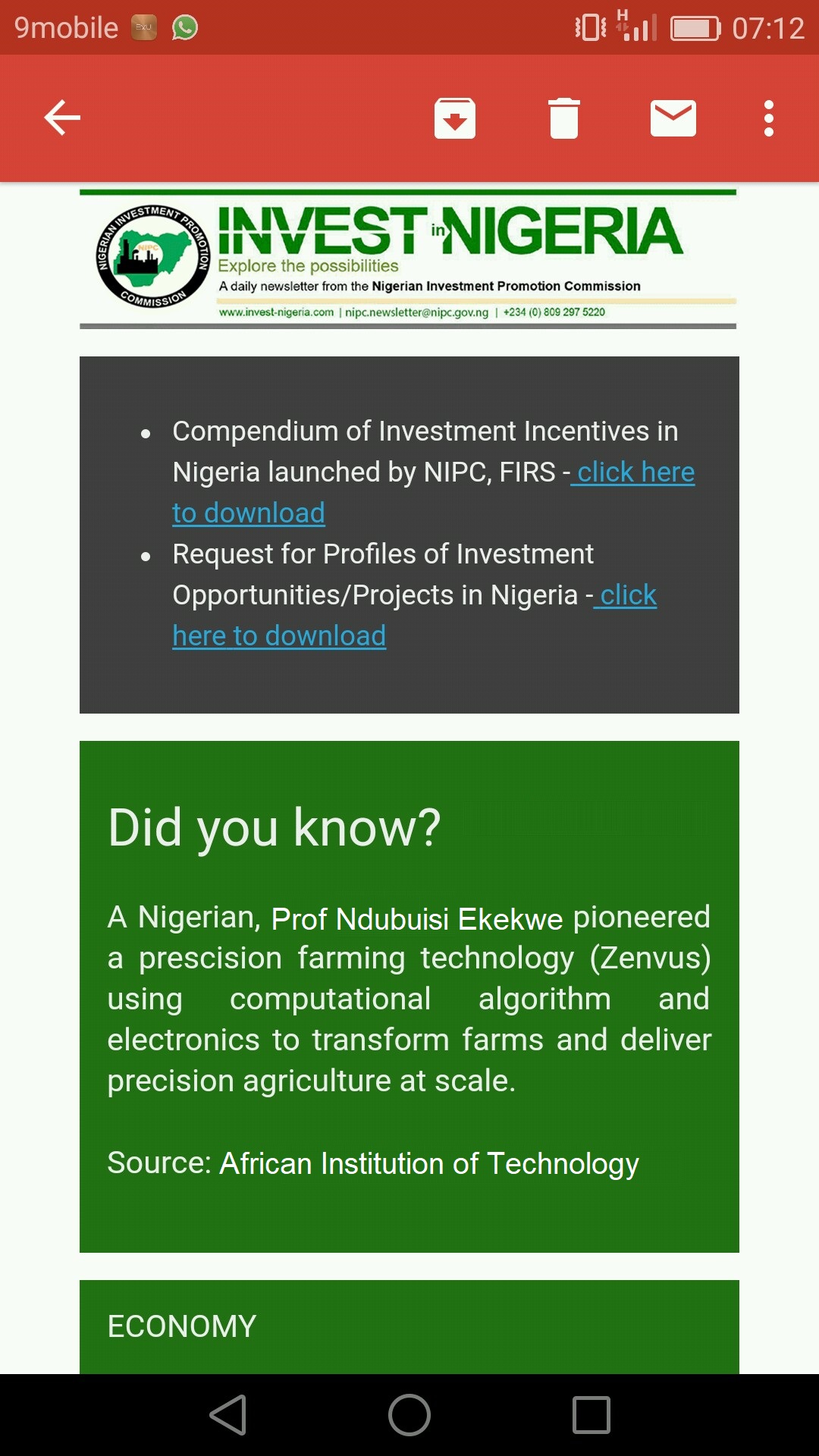
On behalf of my good colleagues in our business, we want to thank the Federal Republic of Nigeria and the Nigerian Investment Promotion Commission (NIPC), a government agency, for promoting Zenvus in its global publication. When your nation is behind you, the world will come to party with you.
Our vision remains to “cure” extreme poverty in Africa by improving farm yields via replacing guesswork in farming with data-driven agricultural systems. If more than 65% of African working population works in agriculture, doubling farm yields will reduce poverty by at least 30%. So, agriculture is the fastest way to improve the wellbeing of the citizens.
Zenvus is a pioneering precision farming technology company which uses computational algorithm and electronics to transform farms. Know When, How and What to farm.
According to the GSMA State of the Industry on Mobile Money 2017 report, the number of central Africans transferring cash via money apps increased from 23.6 million in 2016 to 32.9 million in 2017. Therefore, the news that Safaricom plan to launch their mobile money app, M-Pesa, which has nearly 30 million subscribers in Kenya alone, in Ethiopia is a positive move. Millions have already been raised to support the development of digital payments, leading experts to predict that the launch of M-Pesa in Ethiopia will transform the way the nation handle their money for good.
The growth of Safaricom
In Kenya, M-Pesa holds 80.8% of the country’s mobile money app market share, while its closest rival, Equitel Money, holds just 6.8%. Across the country, Safaricom has become more than just a method used to transfer money from one individual to another. The telecoms operator has invested in multiple sectors including, ride-sharing apps and e-commerce. Additionally, the company has also launched its own social network which allows users to send money while talking to one another. So, it’s clear to see why they would want to branch out into other heavily populated countries, such as Ethiopia which has a population of more than 100 million.
A positive move for the country’s finances
Data released from the IMF earlier this year revealed that Ethiopia is on track to become the fastest growing economy in sub-Saharan Africa by the end of 2018. With the economy booming, now is the time for the M-Pesa app to launch to ensure that the nation takes control of its money in the most effective and convenient way possible. Ethiopians with loans and other forms of debt will benefit significantly from the M-Pesa app as it will allow them to transfer cash to those they owe at any time and give them the means to track all their payments.
The benefits of mobile money apps
One study that looked into the long-term effect of using mobile money on Kenya’s economy found that 194,000 Kenyan households were no longer in poverty as a result of mobile money. Ethiopia currently falls within the top 10 countries with the highest prevalence of poverty as 23.9 million currently live in such conditions, according to The World Poverty Clock. Therefore, with mobile money apps providing such impressive results in Kenya, families in Ethiopia could see themselves financially better off should M-Pesa become available in the country, too.
M-Pesa is a major money management app in Kenya which other African countries could benefit substantially from. Therefore, should Safaricom agree a deal with Ethiopian officials, the nation would be sure to utilize the service and all that it offers due to its financial tracking, sending and receiving abilities.
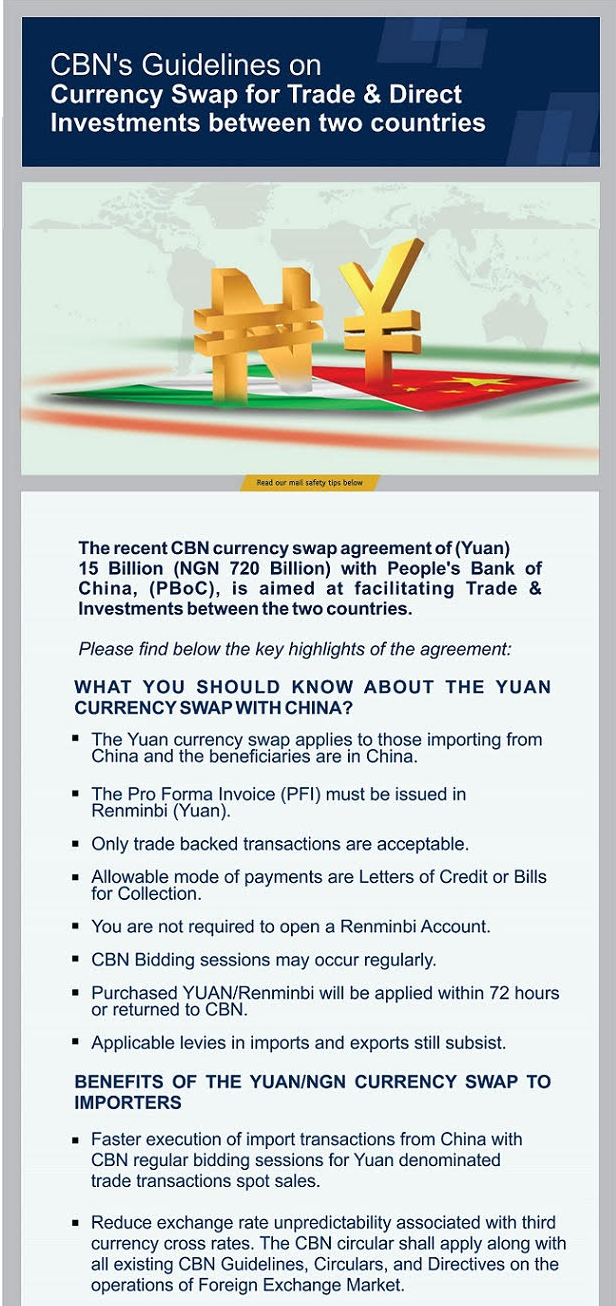
Disintermediation does not only apply in the technology world where producers cut-off middlemen or intermediaries to reach consumers directly. What is happening in the Chinese currency swap is the disintermediation of the U.S dollars. The $2.5 billion currency swap deal will open opportunities, hopefully, for manufacturers in Nigeria. If you want to buy something from China, you do not need to look for U.S. dollars. If you have your Naira, the government will make it possible for you to pay directly in Yuan
I like Naspers (parent of MultiChoice – operator of DStv and GOtv), Africa’s largest company by market capitalization, because it is an amazing institution. The more I learn about this firm, the more hopeful the promise could be about Africa. This is the same company that turned $34 million into $170 billion (with b).
So when South Africa’s Naspers invested in China-based Tencent $34 million, it was making a huge call, in 2001. Today, that $34m berth is now worth $170 billion (with b), based on Tencent’s current market capitalization. Magically, Naspers is the 65th most valuable company in the world. That berth is perhaps the greatest investment in Africa.
Naspers is a digital conglomerate and it is everywhere in the digital world. Yet, it is South African, making it clear that capital can be accumulated in any continent. In the league of some of the best investments ever, Naspers has a seat. It had a great year: $15.6 billion revenue from internet segment alone.
Naspers announced that its core headline earnings grew by 72% to R33.6bn ($2.5bn) as the company released its financial results for the year to March 31, 2018, on Friday afternoon.
Revenues, measured on an economic interest basis, increased by 38% year-on-year to R270bn ($20.1bn).
[…]
In a statement, Naspers said its revenue in the internet segment was up by 50%, compared to 51% in 2017, to R213bn ($15.9bn).
Interestingly, golden paycheck does not discriminate when there is huge value created. The CEO of Naspers, Bob van Dijk, went home with about US$112 million (R1.6bn) on wages, bonuses, vested stocks, etc during the year ended March 31, 2018. The investment in China’s Tencent, owner of WeChat, continues to make everyone a star in Naspers. Move over Wall Street, Africa has got the real king; Bob van Dijk, CEO of Naspers, is the king.
“But the quantum being paid out is obscene and probably puts Van Dyk amongst the richest 1 percent on our planet.”
[…]
The latest report does little to dispel the worry that Van Dyk and his executive colleagues are securing huge payouts because of the stellar performance of the Naspers share price, which is driven by the 31% investment in Tencent — over which Naspers executives have no influence.
Almost R1bn of the R1.6bn Van Dyk picked up during 2018 was the payout on 284,031 Naspers N shares that had been allocated to him in 2014 when he was appointed CEO.
In addition, Van Dyk cashed in R619.6m in share appreciation rights during 2018. The value of the share appreciation rights is based on an assumed value of Naspers’s e-commerce businesses, which exclude Tencent and MultiChoice. Most of the e-commerce businesses are making little or no profit.
Investors should not castigate executives of Naspers for their pay bonanzas. The executives have created value and made many of them millionaires. If more money would motivate them, so be it. Of course, the correlation between more pay and great returns has a limit before paying more becomes a waste. Yet, it is extremely important that investors see this firm as uniquely positioned to redesign many sectors in Africa, and should be allowed to invest in talent. If Naspers had been Nigeria-born, its tax alone could possibly fund the national budget, assuming it brings all the money it has made outside Africa home same time.
As Naspers shifts its massive profit home to South Africa, there is no way the South African treasury will not get at least $30 billion if you have around 20% tax rate. That is a national budget for Nigeria if this had happened in our country. We need to pay more attention to venture funding to stimulate our economy.
Think about it: if Africa could have ten of Naspers, the conversation about the continent would change. We need MVPs as I have noted before.