DD
MM
YYYY

PAGES

DD
MM
YYYY

spot_img

PAGES

Home Blog Page 7105

Different Ways to Grow Revenue in Your Business

0
Nigeria Naira US Dollar

In this table, I have summarized all the possible ways you can earn revenue in your business. Largely, if you are in business to make money, you would fall into one of these revenue models. But there is an opportunity cost involved: the path you choose could affect your success, not just in the short term, but also in the long term.

For software-enabled companies, we have this specific table.

This is Home

0
This is home

At home – the beautiful home: Nigeria.

The land where I am simply Ndubuisi, unconscious of my color.

The land where man is just man – never black or white.

The land where policemen use guns to frighten but rarely to shoot.

Yes that beautiful land where policemen go to break fights without holding guns.

It is a home, not perfect, but the liberation on Nigerian soil is matchless.

The World Economic Forum (WEF) may rank Lagos low as a livable city on culture because we have limited museums. People, in Switzerland, you need invitation to join a party. In Lagos, the taxi that drove me has a sticker: “This Car Stops in All Parties, Uninvited”.

There are things which no human can measure unless you live them. Those WEF people know nothing of Lagos because they are not of Lagos!

I can hear the sound of owambe as the African chrysanthemum withdraws, and crickets beckon with a fading energy of the rainy season which will usher the dry season. The cry of lullaby breaks through and finds itself into the thick of the beats, bringing the pitch that tomorrow holds a promise. The heavens open with gentle rain, in perfect melody for aluminum roofs, after the prayers have broken through before the face of God. Then light goes off, asking everyone to sleep for tomorrow. But I could hear deep faraway: Oshodi, Oshodi.

Nigeria – this is home.

450 million Africans Connected Online, 60% Remains Offline

0

As Internet access continues to grow in Africa, with over 450 million people now connected to the Internet, more than 60 percent of the population still remains offline. Community Networks are a key way to address this connectivity gap, says the Internet Society, a global non-profit dedicated to ensuring the open development, evolution and use of the Internet.

Community Networks are communications infrastructure built, managed and used by local communities. They provide a sustainable solution to address the connectivity gaps that exist in underserved urban, remote, and rural areas around the world. In Africa, where these gaps are more prevalent, a recent survey was able to identify 37 community networks initiatives in 12 African countries, of which 25 are considered active.

The Internet Society in partnership with the Association for Progressive Communications (APC) and Zenzeleni Networks (http://Zenzeleni.net) will hold the third Africa Community Networks Summit in the Eastern Cape, South Africa from 3-7 September, 2018.

Access to spectrum is critical for Community Networks.  Policy makers and regulators can play a key role in ensuring innovative approaches to making spectrum available by working with Community Networks.  An Internet Society report examines the various ways that Community Networks can gain access to spectrum, including the use of unlicensed spectrum, sharing licensed spectrum, and innovative licensing.

“Enabling communities to actually connect themselves is a new way of thinking,” explains Michuki Mwangi, Senior Development Manager for Africa at the Internet Society.  “Policy makers and regulators should recognize that connectivity can be instigated from a village or a town and that they can help communities to connect themselves by providing an enabling environment with innovative licensing and access to spectrum.”

The Africa Community Networks Summit will conclude with a visit to communities served by Zenzeleni Networks, South Africa’s first telecommunications organization that is owned and run by a rural cooperative.  Zenzeleni Networks installs and maintains its own telecommunications infrastructure to deliver affordable voice and data services.  All revenues stay in the community and the residents together decide what is done with the proceeds.

The cost to deploy Community Networks can be low. Often, the technology required to build and maintain the network is as simple as a (inexpensive, locally available) wireless router. The networks can range from WiFi-only to mesh networks and mobile networks that provide voice and SMS services.  While they usually serve communities under 3,000 people, some serve more than 50,000 users.

“These networks not only provide affordable access in areas where operators don’t find it commercially viable to provide similar services,  but, by being built and operated by people from within the community, they bring many other benefits to the areas where they operate.  They are key to enabling the unconnected connect themselves in Africa,” explains Carlos-Rey Moreno, Community Access Project Coordinator for APC.

Medcera – Network and Sign-Up

0
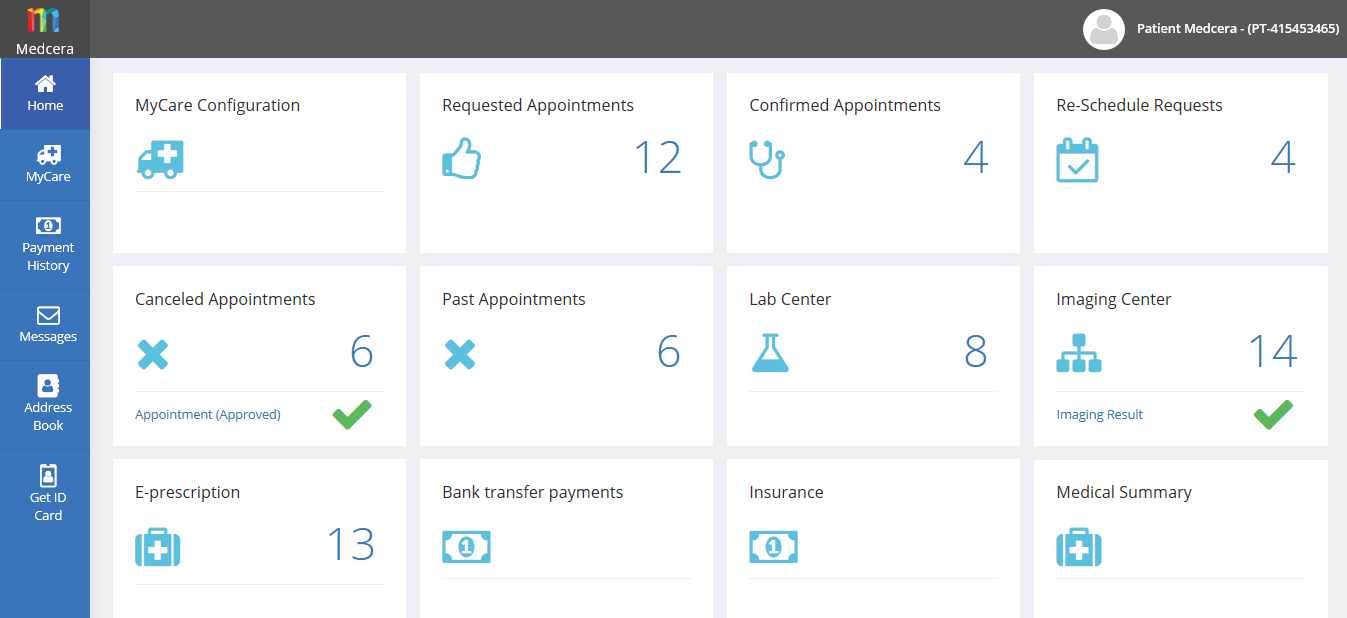
Medcera Dashboard

Dear Medcera Users,

Some users may be experiencing issues depending on where they are in Africa. We have noted that under some networks, the user experience may be degraded. Our engineers are aware and are working to handle the problem.

The problem is this: if your network is slow, and the latency falls outside our server response time, you would see error [some do experience html server error feedback]. On Monday, we will default assuming the slowest possible network to avoid the issue. I apologize for the quality issue.

We remain fanatically committed to deliver the best experience. Today, we received this from a medical doctor:

 “Whao, what a fantastic and innovative platform .I am quite greatly impressed” – Dr […]

We are seeking his permission to use his full name.

Medcera is under consideration to power a national electronic health record system. We understand the expectation and the quality level even in very poor networks. We have a 24/7 support.

If you have any issue during usage or registration or simply any concern, email support@medcera.com. My colleagues will respond.  Thank you; please sign-up at login.medcera.com

Nd

This Month in Lagos and Abuja – Innovation Workshop, Presentation & Roadmaps

0
This Month

We would be running Innovation Growth Workshops, Innovation Presentations and also helping companies on Innovation Roadmaps & Strategies this month in Lagos and Abuja. Connect our team to schedule a session.

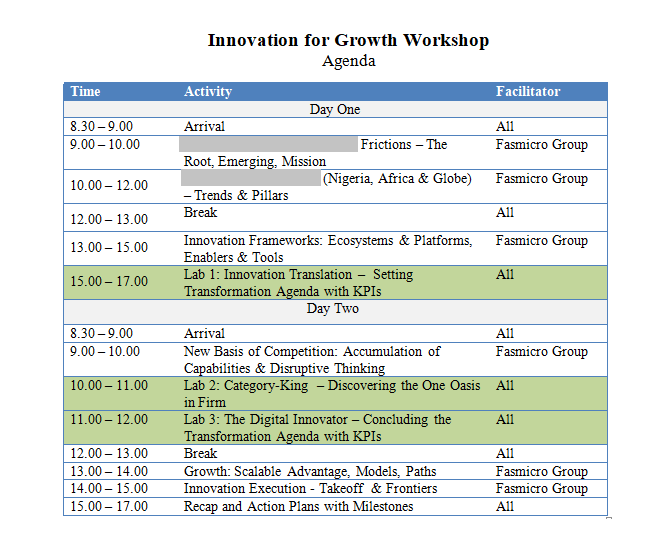
  • Discovery Innovation Workshop: To innovate is to set a new basis of competition in an economy, business sector or market. Typically, it results to disruption. This workshop will focus on innovation and growth because growth is the reward of innovation. Otherwise, that innovation is actually an invention. I will be the lead instructor with my supporting crew. The table below provides the workshop structure. We can adapt this workshop to two days.


Innovation Workshop
A workshop agenda for a workshop we will run this next week in Lagos
  • Innovation Presentation: This is a four-hour seminar where we will present what is happening in your market, customized for your company, and then offer insights on how you can plot your strategies to win. This goes beyond industry statistics and typical SWOT analysis. We work to help clients see their markets in new ways, providing roadmaps on how they can unlock opportunities. It is an intense talk, combining technology, finance, political economy and strategy. As technology redesigns markets, I break the implications in short, medium and long-terms.
  • Development of Business Roadmap & Strategy: A business plan is not enough to anchor business execution. A Roadmap Document is required especially in a sector which is in a state of flux [changing market, changing model, startup, competition, regulation, etc]. To avoid pursuing many windy paths or dead ends, a roadmap helps to encapsulate a profitable path to the vision with pillars and enablers necessary for success.
    • We will conduct a review of the Firm’s current strategy, and identify the current gaps considering the business needs and market best practices and make recommendations to implement the strategic gaps with fit for purpose solutions in line with global best practices and local realities.