DD
MM
YYYY

PAGES

DD
MM
YYYY

spot_img

PAGES

Home Blog Page 7108

Fixing Property Fraud With AI

0

To all users of Zenvus Boundary, today we added a feature which makes it possible that once a property boundary has been recorded within Zenvus Boundary ecosystem, an alert will be triggered if the same boundary is captured by another user. For instance, if you use Zenvus Boundary to map the boundary of a farm, and next week another person (not in your specific Zenvus Boundary) maps at least part of that farm, our system will detect a conflict, triggering an alert to Zenvus Boundary support. We will contact both customers to note what our system has detected.

Zenvus Boundary maps farm, land or house perimeter boundaries, calculates the areas and populates the data onto Google Earth. From Zenvus portal, the surveys can be downloaded or printed. It supports cooperatives, governments and individual farmers, enabling these entities to have survey reports at a fraction of the typical cost of surveys.

Until that is resolved, our Property Search feature will blank the names to avoid either using the property to access loans and other services. The individuals can resolve the problem via government data, oral history, etc. Zenvus Boundary neither offers legal advisory services nor government support services.

You want to be a Zenvus Boundary partner? Click here.

Zenvus Boundary Property Search


WhatsApp Payment Arrives Africa; Welcome Africa’s Single Currency

0
WhatsApp Payment

WhatsApp Payment has arrived in Africa. That has been expected since there is no clear path to monetize WhatsApp without subscription which Facebook has no interest in pursuing. Advertisement may not necessarily work for WhatsApp if Facebook hopes to keep the customers happy. So, here we go: WhatsApp payment is here in Africa.

As of Wednesday (August 1) South Africa’s Absa Group officially rolled out WhatsApp banking as part of its continuing effort to develop a digitally-led bank in Africa. Absa has signed on 10,000 customers since early July, according to Reuters.

{…}

“As technology advances and more customers become connected, bringing banking to where our customers are is important to us, especially as we continue our journey to become a digitally-led business driven by innovation,” chief executive of Absa retail and business banking Arrie Rautenbach said in a statement.

The addition of WhatsApp banking is part and parcel to a growth plan for Absa that observers have called “ambitious.” The goal — once it has completed its separation from Barclays — is to capture (and in some cases recapture) market share in South Africa and double sales across the African continent from 6 percent to 12 percent. WhatsApp allows Absa to offer banking services that are available anywhere, anytime, to customers that want to use it.

Absa’s WhatsApp service, ChatBanking, will mostly be simple banking transactions. Users will be able to check their account balances and make payments to existing beneficiaries using brief and natural sounding conversational commands.

The Massive Dislocation

This will be a huge challenge to African fintechs. Payment is going to see massive dislocation because it is always harder to pull people from the ecosystem where they are to another. In others words, why would I launch a fintech app when I can make that payment via WhatsApp which I am already using with that client?  The launch of WhatsApp payment in Africa is a big deal for the local banking and payment ecosystems.

I noted few days ago that WhatsApp’s move into payment would cause massive dislocation in African banking. In this age of chat and social media, transactions have evolved into content, commerce and financial services. To examine the impact in Africa, let us consider what these solutions have done in India where they are already or being deployed. India has about 250 million WhatsApp users, the world’s largest (China is a WeChat nation).

New payment trend in India

All Together

As I wrote few months ago in Harvard Business Review, companies like Facebook, the ICT utilities, can bulldoze themselves into new sectors. Adding payment in WhatsApp is industry-shaping. Largely, we have entered a new dawn where transactions have evolved into content, commerce and financial services – the so called social commerce which WeChat had perfected.

Going forward, I expect new basis of competition with disruptive consequences in the African payment markets. Simply, the game has changed and everyone has to evolve: WhatsApp payment is possible the single African currency; Google Tez is on the way. The good news is that African consumers will experience lesser payment frictions, and that could be a good thing across many communities.

Let’s Visit Your Business in August & Sept in West Africa

0

In coming days, I will be on my way to West Africa. We will be spending 6 weeks starting from the Centre of Excellence (Lagos). We will launch a new business and also use that time to meet current and new clients on our advisory services. We remain the largest embedded electronics company in Africa – the larger of only two Intel FPGA partners. We also help startups, banks, insurers, etc deepen their capabilities through seminars and presentations.  From agtech to health-tech, electronics to advisory, we have a mini-diversified digital conglomerate. Email me or team (below) and let us schedule time. Let us work together to fix that market friction.

Ndubuisi Ekekwe Innovator of the Year CNBC


At Fasmicro Group, we do not recite numbers and tell you what you already know: we deliver unparalleled insights through uncommon perspectives shaped by our experiences as entrepreneurs and advisors in the markets. Our moments are unique because things we share with clients are shaped by our direct exposures to the markets. Fasmicro Advisory Services solutions are structured as follows:

  • Development of Business Roadmap & Strategy: A business plan is not enough to anchor business execution. A Roadmap Document is required especially in a sector which is in a state of flux [changing market, changing model, startup, competition, regulation, etc]. To avoid pursuing many windy paths or dead ends, a roadmap helps to encapsulate a profitable path to the vision with pillars and enablers necessary for success. Read more here.
    • We will conduct a review of the Firm’s current strategy, and identify the current gaps considering the business needs and market best practices and make recommendations to implement the strategic gaps with fit for purpose solutions in line with global best practices and local realities.
  • Discovery Innovation Workshop: To innovate is to set a new basis of competition in an economy, business sector or market. Typically, it results to disruption. This workshop will focus on innovation and growth because growth is the reward of innovation. Otherwise, that innovation is actually an invention. I will be the lead instructor with my supporting crew. The table below provides the workshop structure. We can adapt this workshop to two days.
Day 1 – Innovation Discovery Day 2- Innovation Exploration Day 3- Innovation Design and Applications
The State of Nigerian markets State of the Tech Nation address Becoming a Digital Innovator
Mapping internal & external trends Innovation Translation Filtering & modelling [Business & Functional Vision]
Digital Innovation frameworks Emerging Technologies Labs with Innovation Roadmap Brief
Business Challenges Teamwork / Disruptive thinking Takeoff Vision & Frontiers
Enablers and Creativity tools The Category-Kings Benchmarking [Local  & International] Innovation Execution
  • Discovery Innovation Presentation:This is a two-hour seminar where we will present what is happening in your market, customized for your company, and then offer insights on how you can plot your strategies to win. This goes beyond industry statistics and typical SWOT analysis. We work to help clients see their markets in new ways, providing roadmaps on how they can unlock opportunities. It is an intense talk, combining technology, finance, political economy and strategy. As technology redesigns markets, I break the implications in short, medium and long-terms.
    • Case: How can a (mall) real estate developer understand that ecommerce is a tangential threat since malls can be disrupted by digital commerce in future? My client now considers triple-play designs where malls can be converted into offices or homes, in case the moment comes.

Our services cover all industries, and we operate at the highest ethical level. .

If interested, email tekedia@fasmicro.com. Our cost is industry-competitive.


Paylater Hits One Million Downloads; Disbursed N6 Billion So Far in 2018

0

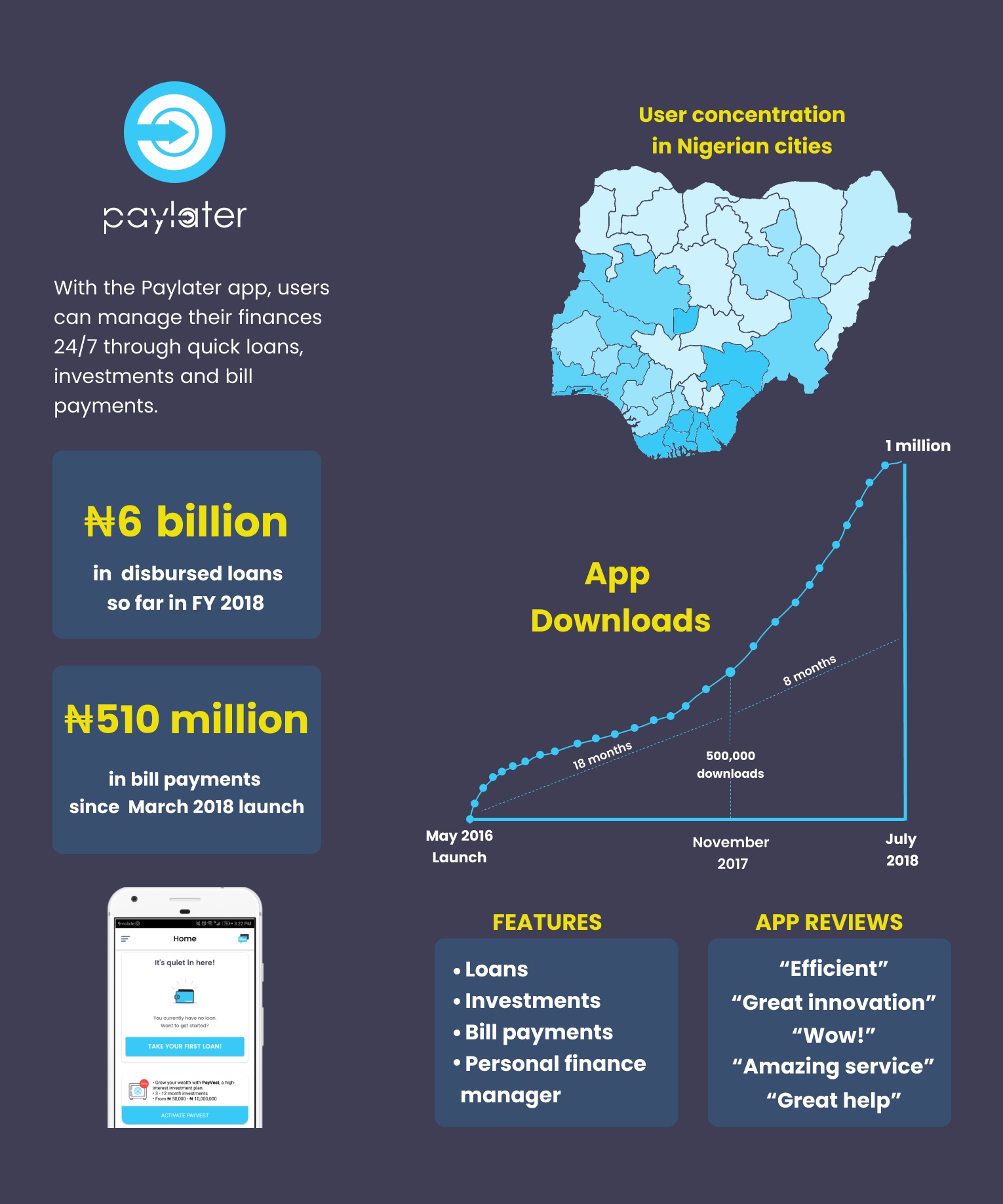
Paylater, the fintech company which pioneered micro-lending in Nigeria, at scale, has hit one million app downloads. I wrote about this company and called it a brilliant business. With this growth rate, Paylater could be the largest “Nigerian bank” with no bank license by 2025. It will eclipse three banks in customer base possibly by the end of 2019.

That is why Paylater is exciting. Owned by One Finance & Investments Ltd,Paylater is going after that market where the highest pain points are found in the Nigerian banking sector. We can surely live without shopping through the modern digital payments. But we know that it is challenging when there is an urgent need for funds and no friend or family can help. That is what happens across Nigerian families today. Challenges go beyond how to move money fast across digital channels. Simply, we want credits. Paylater focuses on short-term loans, mainly for emergencies.

The mobile app provides Nigerian consumers with access to credit. And it does its entire works completely digitally, without seeing or speaking to customers. Call it AI or analytics, it is a leap ahead.

From an email sent to Tekedia, the company has disbursed N6 billion in 2018 alone.

In Nigeria, a country of nearly 200 million people, 61% of the adult population is un- or underbanked. Fintech companies like Paylater represent a tremendous opportunity to get formal banking services in the hands of Nigerian consumers to provide much needed liquidity for entrepreneurial investment, personal development, or unexpected expenses.

Consumer credit is nearly non-existent in Nigeria. But, Paylater is issuing loans to Nigerians completely digitally, without seeing or speaking to customers. Customers can receive funds in their account in as little as 5 minutes, with no need for paperwork, collateral or guarantors. Digital financial services platforms have been well received by consumers and it appears that fintech platforms like Paylater are here to stay.

The evidence is in the numbers. With over 800,000 registered users, across every Nigerian state, Paylater has loaned over $17M USD to Nigerian consumers in 2018 so far. The technology platform has supplemented that loan growth with very strong early adoption of its bill payments  and investments features as well.

“We are very excited by the market adoption of Paylater and we believe there is still a significant growth opportunity ahead for digital financial services” – Co-founder and CEO Chijioke Dozie

Before Paylater, only commercial banks?—?with physical branches nationwide and extremely large capital bases?—?had the reach, stability and customer trust to offer financial services to a variety of people. Unfortunately, these same institutions turned record profits by taking deposits from average consumers, and reserving actual ‘banking’ services like loans and investments for large corporate entities and high-net worth individuals.

Access to credit is a fundamental human need and the foundation on which most modern economies are built. Pioneers like Paylater have embraced the difficult task of unlocking the power of financial access for the underserved, and so far, it looks like they are winning.

[Apply] African Master’s in Machine Intelligence with Google and Facebook

0
AIMS

The African Institute for Mathematical Sciences (AIMS) has announced the launch of a one-year intensive African Master’s in Machine Intelligence (AMMI) in partnership with Facebook and Google. The master’s will begin this September at the AIMS-Rwanda campus in Kigali.

“Machine Intelligence (MI) is revolutionizing critical aspects of our lives. It enhances medical diagnosis, improves industrial processes and enables scientific discoveries. Over the past decade, thanks to large public and private investments, MI has progressed rapidly in both basic research and the development of a vast array of applications. However, the talent pool currently advancing MI is modest and unrepresentative of the diversity of our world, leaving us less capable of facing global challenges. The challenges we choose to work on are strongly influenced by our backgrounds and our environment. Our goal with AMMI is to train a generation of young scientists who will bring a fresh perspective to machine intelligence research and contribute to advancing its development across Africa, for the benefit of its society” said Dr. Mouhamadou Moustapha Cissé, Founder and Director of the AMMI program and Professor of Machine Learning at AIMS.

AIMS, together with its partners, believes creating an effective, globally connected community of Machine Intelligence practitioners in Africa will reduce the technology gap, strengthen Africa’s economies and enable better governance.

Commenting on the partnership, Jerome Pesenti, VP of Artificial Intelligence said: “We’re proud to be partnering with AIMS and Google to launch the African Master’s in Machine Intelligence programme. At Facebook our goal is to drive positive social and economic impact across Africa, and this partnership is another step-in driving innovation by supporting the continent’s already exciting tech ecosystem and talent pool. We’re excited to see how students will utilise advanced technologies to solve problems and build solutions for the future of Africa and the rest of the world. We look forward to seeing them contribute to the growing ecosystem of African machine intelligence scientists and bring a fresh perspective on the challenges tackled by the scientific community.”

Jeff Dean, Lead of AI at Google said “The field of machine intelligence is advancing rapidly, and it’s imperative that industry leaders including Google and Facebook, continue to partner with academic institutions like AIMS to develop the next generation of students who will build MI that benefits everyone. We look forward to working with AIMS to drive this effort through the AMMI program. Along with our recent announcement of a Google AI center, scheduled to open later this year in Ghana, this partnership with AIMS is another example of our long term investment and commitment to Africa.”

The AMMI program will provide brilliant young Africans with state-of-the-art training in machine learning and its applications. Every course on AMMI will be lectured by leading experts from prestigious African and international institutions, providing the AMMI students the best possible foundation.

Links to apply here