DD
MM
YYYY

PAGES

DD
MM
YYYY

spot_img

PAGES

Home Blog Page 7108

Will a Vehicle Provide a Boost to Your Business?

0
Boost to Your Business

As of 2017, an estimated 81.5% of workers in Nigeria were categorised as being self-employed. One survey revealed that even among the middle class, “38% are entrepreneurs.” From business, to farming, to eCommerce, running a business in Nigeria takes dedication, time, and plenty of effort. Because so much is at stake when an individual is self-employed, it is crucial to be wise with every dollar that is spent. With the cost of an average vehicle set at approximately N10,500,000, and an average monthly salary at N82,045.45, it isn’t often that business owners rush out to buy a vehicle.

However, despite the obvious expense, the purchase of a vehicle could turn out to be an investment in your long-term success. Explore some of the top ways a vehicle could boost your business.

Are you missing opportunities?

Whether you work online or in person, having a vehicle for your business can open new opportunities. What kinds of opportunities? First, almost any kind of vehicle affords the chance to deliver goods to customers without the use of shipping services. If you find yourself spending a significant amount of money on local shipping costs, a vehicle could eliminate the hassle and reduce costs over several years. Second, if you do not currently offer delivery services, could your business benefit from doing so? If you have services or products that lend themselves to a delivery service, you have an opportunity to increase your earnings. For those who work in highly competitive fields, you can differentiate yourself by offering personalized service to your customers.

Will the cost of the vehicle benefit profits in the long-run?

As stated earlier, even a standard car is not inexpensive (at about N10,500,000). Although there is an initial upfront cost to owning a vehicle, as well as ongoing maintenance costs, the purchase could serve as a long-term investment. How can you determine if this is the case for your business? Compare the potential profits gained by the use of a vehicle in your business with the actual vehicle cost. If you find that your profits would ultimately pay for the vehicle in a short amount of time, this is a business purchase that is definitely worth exploring.

What kind of vehicle would enhance your business?

There isn’t one vehicle that fits all business needs. If you’ve decided that the purchase of a vehicle could be advantageous for your company, assess which sizes and styles would work best. Is a used truck appropriate? Or do you need a brand new car? Whatever the right answer is, be sure that you seek out the best possible deal among multiple sellers.

Buying a vehicle isn’t the right choice for every business owner. However, for those that can benefit from this purchase, enhanced profits, improved customer relationships, and easier day-to-day operations await.
MallforAfrica Takes Africa To The World

0
MallForAfrica

MallforAfrica is re-engineering the path of African shopping which has largely originated from America (and Europe) to Africa with a reverse path which begins from Africa into American and European homes. Yes, MallForAfrica is working with DHL to make it easier for artisans and makers within Africa to sell things to the world. They have created a web portal, MarketplaceAfrica.com, and introduced Africa Made Product Standards (AMPS). This partnership will cover fashion, body care, handbags, jewelry and home décor and the platform “will provide craftspeople and customers order verification, fast delivery, and shipment labeling and packaging services. Suitable delivery costs also keep products affordable”.

DHL, the world’s leading international express services provider, today announced its partnership with e-commerce giant, MallforAfrica’s new platform, Marketplace Africa, to help online retailers bring African-made products to the US and global market. The site offers items from the continent’s most talented designers and artisans from a variety of categories including fashion, body care, handbags, jewelry and home décor.

By providing this portal, MallforAfrica will fix one major friction which exists in African ecommerce: trust.  Trust has been the major reason why African makers are isolated from the world.  With this partnership, it would be easier for global buyers to shop from African makers and the items delivered to them by DHL. The system creates a kind of intermediation enabling the two elements (maker and buyer) to do business.

Until today, African craftspeople have been isolated from global customers due to distance, fear of not receiving overseas payments, and complex shipping requirements.  Customers who wished to purchase products directly from African artisans faced obstacles regarding accessibility of items, authenticity and validation of the product, uncertainty of delivery, high delivery costs, and payment security.

The introduction of AMPS is a welcome development. I have noted the need of that in a piece on Aba leather industry. According to the press release, the AMPS will be used “to ensure that the highest quality products are being sold on the Marketplace Africa platform. It provides consumers with the assurance that products meet an international standard in quality. All products are crafted with the utmost care by an African artisan”. When product quality comes into the game, the most talented makers will reach more global markets. If AMPS advances, it would be all positive for artisans and markets across Africa.

A key element of the new system will be quality. The makers have to produce quality shoes and bags. delivering consistent quality which can be sold internationally. The brand owner will give them the specifications and then offer training to assist them do the job right. This will include better materials, use of Computer Aided Designs (CADs) and general automation to improve quality. Quality, defined by the brand owner, becomes the identify of that brand.

All Together

When they originally announced this partnership, I commended the vision. Africa needs a mechanism to ship items to U.S. and other global markets where some of our items are actually sought after. But our logistical challenges and payment infrastructures have hindered making such possible. This new platform is certainly a step in the right direction.

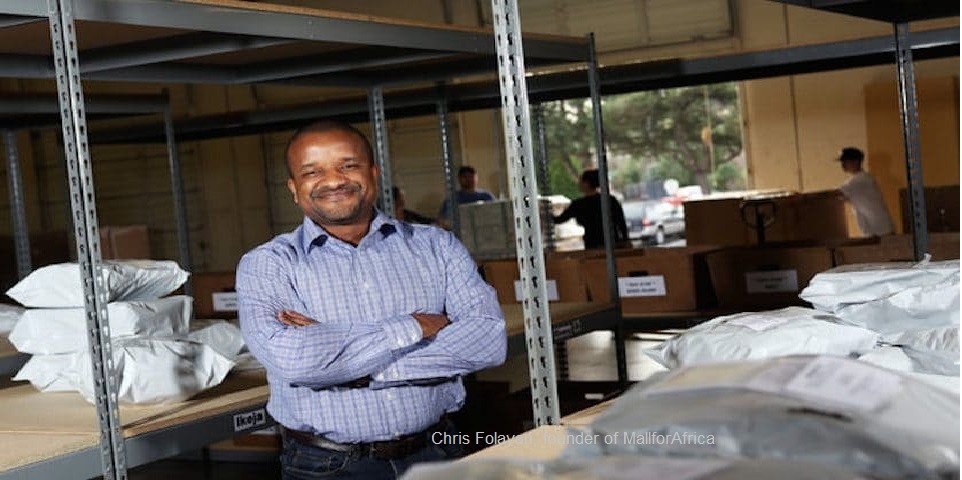
Of course, the complexity of the business has increased since it will start sourcing for opportunities in Africa with our infrastructure challenges. But this firm has developed and accumulated capabilities over the years. I do think it will manage the challenges of shipping from Africa to U.S. despite our logistical issues as it in-bounds items to DHL offices. Do not be surprised that they can appoint local firms to aggregate the sub-local supplies across cities. And just like that, MallforAfrica CEO Chris Folayan will focus on processing the invoices, counting the profits, with his usual smiles. People, treasure brilliance: this one is from home.

MallforAfrica will test its aggregation construct model at a deeper level with the aggregation of goods from within Africa to the world. It would not be that easy because of the lack of homogeneity in the African markets. Solutions have to be tailored for each community and scaling will struggle. Everything depends on unit economics and logistics: if the cost is manageable, the Americans, Europeans and the world would absorb all. The key element to look at is the marginal cost (which affects scalable advantage) of bringing these items at collation centers where DHL will pick before they would be shipped to the world. It is a big challenge, and if the team gets it right, they would lift the living standards of many families across African communities.


Five Ways To Raise Capital [Video]

0
Five ways to raise capital

In this video, I present five key ways you can raise capital as an entrepreneur. I have biased all for African entrepreneurs. They are as follows:

  1. Crowdfunding
  2. Angels, families & friends
  3. Venture Funding
  4. ICOs
  5. Vision Fund/SWF


Medcera Partners: Business Development Pipelines [Video]

0

This is mainly to organizations & people who have connected with Medcera, an integrated electronic medical record system, as partners. Here, I present ideas on business development pipelines as they work to help Medcera advance African healthcare sector. We are still accepting partners; connect with our team as noted here.

We are looking for partners across Africa and some Nigerian states who can work with us in their countries or states to deploy Medcera at scale. Partners must have deep business development networks and contacts in the healthcare sector and with operational structures in their domains

There are many sectors which offer bulk integration/business development opportunities for Medcera partners. Here are some:

  • Government (local, state, federal)
  • Military, police, law enforcement
  • Schools (primary to university)
  • Companies
  • Cooperatives/associations
  • ETC ETC

We want you to succeed because that is how we would thrive.

The Ecommerce Bank of Africa

0
Ecommerce Bank

Ecommerce is hard especially in Africa where marginal cost challenges make it an offline business. Yes, if the cost of logistics still dominates the transaction/distribution cost, making the operations bounded by geography, it is nothing truly online. As I noted years ago in the Harvard Business Review, we have a long way to go before we can fix most of the frictions in the sector. My summary is that ecommerce is a wasteful venture at this time in Africa unless you have free money to be throwing at it before things improve. And do not call it an online business because there is nothing in it that is truly online: serving an extra customer does not end with a click. It costs real money to reach that person in an area with no postal services.

The biggest challenge in ecommerce is the marginal cost paralysis. And unfortunately, no ecommerce company can fix it since none can price without consideration of losing buyers to supermarkets and open markets.  So, any ecommerce operator that wants to keep its products low must discount it and that means absorbing the marginal cost. That is what they do. And they keep doing so until they run out of more money.

As I explained in the HBR, buyers have options, from local open markets to hustlers on traffic lights. Any ecommerce must beat the alternative ecosystems on price to win new customers and keep present ones. To do that, they would need volume, only possible with a nationwide or regional operation. But without logistics like postal systems, that will not happen

Tomorrow’s Ecommerce Operator

If you want to become a tomorrow’s ecommerce operator in Africa, you have to do many things right. As Facebook, Instagram and WhatsApp morph into platforms of trade, a clear separation would be extremely critical. The following are needed:

  • Connect merchants to sell more and increase their numbers
  • Get buyers to buy more and boost their numbers
  • Eliminate any element of friction which exists between buyer/seller

To be successful, you need to become an ecommerce banking institution with dedicated focus to serve your merchants and customers and nothing more. And you need to also become an efficient logistics operator. You would need a lot of money to do these things in Africa. Be warned: Africa’s largest company by market cap, Naspers, has been opening and closing ecommerce entities, in Africa, for years. None has worked out, from Kalahari to OLX Nigeria. If this firm cannot get this right, you need to examine your game plan very well.

Addressing these issues will require inventing new models: the new Konga is pursuing the integration of physical stores and digital ecosystem. It would cost money because the perceived asset-light advantage typical in online business would be gone. Building and running stores on generators in Nigeria is not easy. But that is what may be needed to unlock the inherent opportunities in the sector.

Ecommerce Bank Component

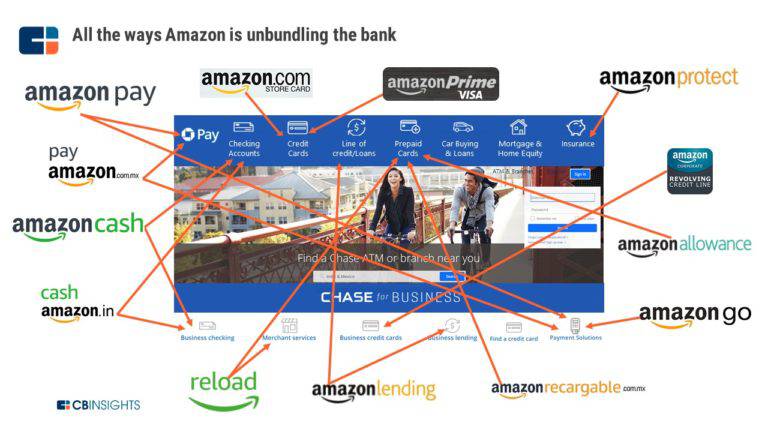
Take a look at what Amazon is doing where everything is done to improve the core ecommerce operations using the one oasis strategy. Amazon has built a formidable banking institution without a bank license: call it the Bank of Amazon. It covers any financial service solution you can imagine to help improve merchants and customers experiences in its portal.

Different financial products by Amazon (Source: CBInsights)

You would need to have such capabilities to reduce different levels of frictions if you want to thrive at scale. The merchants have to sell more. And the customers have to spend more. Doing that would involve improving the capacities to reduce frictions between them. Payments have to be frictionless and cost-efficient as well.

All Together

Any African ecommerce operator who has not understood that Amazon has succeeded by building one of the most feared financial service technology tools is not paying attention. By reducing cost for merchants and improving payment options for customers, the company continues to grow. Any company that plans to become a strong ecommerce company in Africa must also become a strong bank without a bank license, delivering services on merchant lending, payments and more.

There needs to be a way to incentivize merchants to come while luring customers to open their wallets, physical and digital. Interestingly, one key parameter that enables that to happen is promising and delivering value: making money and saving money. If ecommerce is about advancing commerce by reducing friction between buyers and sellers, fixing payments and logistics are the functional pillars in Africa. Anyone that can deliver this will need to become an ecommerce bank without a bank license.