DD
MM
YYYY

PAGES

DD
MM
YYYY

spot_img

PAGES

Home Blog Page 7124

Improve Your Sales Game, Become a Better Entrepreneur

0

They do not talk about it alot in technology hubs and accelerators. They like the coding, hacking and high-fives. But interestingly, one of the most important things that would make you a successful entrepreneur in Nigeria is SALES. For you to get Nigerians to spend their monies on your product, you need a strong game plan. Most times, the problem is not the product or the service – the challenge is getting people to switch. Yes, buy.

It is possible that a man can sign a three year office lease and after three years, he has not made a single sale for a business. As MAN noted, about 79% of Nigerian companies go under within three years. Most of those firms have great products and services. But the leaders have not developed a solid sales strategy.

People, it is not easy. If you do not have the skill to articulate clearly a compelling value proposition through great understanding of a product, and then communicating that in a very fashionable way, you would be out of luck. You do not need Harvard MBA but you need to be extremely ready.

Have you ever made a presentation to a bank committee? Before you are some of the elite professionals in the country. There is nothing you are selling before them someone had not presented within the last two months. They can get anything they want because they have the brand – they can call any company and everyone would like to work with them because they have the money!

Connecting into the heart of that manager to switch means you need to come with authenticity and passion packaged with value-everywhere. Deciphering the right message for the same product based on the specific friction of the client is critical. Yes, the message should be client-dependent even though you are saying the same thing. By that I mean, the case studies. To the insurer, use insurance case studies. To the banker, use banking case studies, and so on for other industries.

Your success will not just come with more coding and launch. You need to sell things as I noted here in the Harvard Business Review.

In the tech startup world, technology is important for success, but it does not disproportionately determine winners and losers. Two companies can invent similar technologies; one will win and the other will lose. Focusing on technology supremacy alone is a model for failure. Over the years, I have consistently seen what I call “latent factors” — business features that are generally outside the scope of the core tech team — to be real factors in a company’s success.

For entrepreneurs in developing nations where experienced institutional investors are scarce and starting companies is very challenging, the impact of these latent forces becomes hugely vital. Though we enjoy writing about dropout tech legends, most times their success is catalyzed by others — they came up with the ideas and the investors provided the leadership and the non-tech factors (such as pricing models, branding, and promotions, among others) that propelled them to stardom. The incubation system, the ecosystem and the environment are important, but sometimes, it can be a very simple “latent factor” ingenuity that redesigns not just a company, but an entire industry.

So, besides the .php and Python books, it may make sense to pick a book on sales. Do not neglect those “other elements”. If not, you could be roaming around Lagos for months with no single revenue. I like my sales innovation in Nigeria. Over the years, we have worked on it and perfected the process. I will be sharing experiences in my workshop this September, in Lagos, on how to win including in the public sector.

My goal is that after this workshop, you would have a clear roadmap to execute innovation at a company-wide or functional level. My workshops are intense, practical and interactive with local cases flavored with international examples, making sure you are global-aware even as you plot a gloCal strategy (see my Harvard piece on this]. I will focus on the growth of your business (or your functional role), and I expect you to return to work with clarity on how to make innovation happen at scale.

Comment from LinkedIn Feed

Dealmaking remains the highest paying job, that’s where sales belong.

I will go as far as stating that sales is one of the main reasons why one person shouldn’t own or run a company, especially entities with scalable capabilities. You cannot successfully be the outfield player and a goalkeeper at the same time; it’s a recipe for failure.

But a distinction of competence is key here: those who are very much steeped in coding and technical stuff should not bother to become great salespeople, they rarely inspire confidence in that regard.

Sales requires creative thinking, eloquence, great communication skills, attention to details; all laced with GRACE, with some sort of swag to drive everything home. The revenues don’t come from the labs, they come from the sales division, and the finest minds in both emotional and social intelligences are stationed there!

Nice insights, September loading..
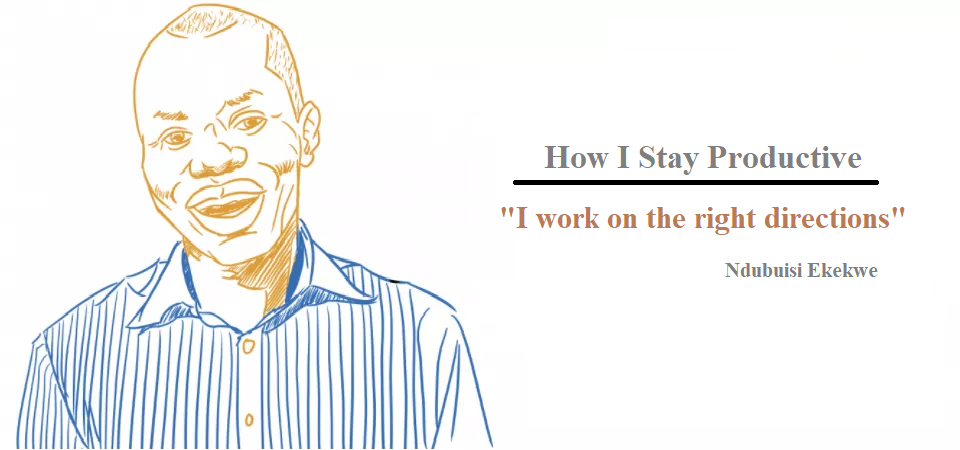
How I Stay Productive – Ndubuisi Ekekwe

7

How do you become more productive at work, home or school? I do get questions with people asking me how I juggle many things at the same time. I always respond PROCESS.

In secondary school, I took 15 subjects when WAEC typically allowed 9 maximum. In my first term in SS1, I realized that I had so much free time after the 9 subjects. To keep myself busy and challenged, I added an extra 6 subjects which those on the science path would not have been allowed to take. While in the bank, I was employed full time and still ran two master’s degree programs at the same time plus a correspondence doctoral program [my job reviews were Excellent].

The Process saw me through; I continue to refine it. Besides working fast, I do one thing daily – I put 20 minutes to plan the next day. If I improve and optimize my productivity by say 3% daily, I could possibly achieve more within a year [they compound over time]. Productivity for me is not doing many things – I select just what I want to focus on because the impacts would be great.

I have a TODO text file with contents divided into two sections: Key and Possible. The Key items are things which must be done that day; the Possible are bonus if I can get to them. Then, I have a LongTD [Long TODO] text file which has weekly, monthly and yearly things to be done; I review this LongTD daily and see which activities can be moved to TODO. I try to free my brain by not packing things which can be written down.

As I plan, I do not focus first on speed – I focus on the direction of my efforts. The activities must be impactful and catalytic to what I want to accomplish. Within the 20 minutes, I design what is important because working on things that matter is the best way to be productive. I give thoughts to anything I do, and nothing comes by chance.

Now, to make sure I execute on my plans – daily, weekly, monthly and yearly – I make sure I connect with people who can help me. I spend good time building networks of people with capabilities in many areas I may need help with.

So, to be productive and get things done, you must know the most important things you have to work on a specific day or time frame. And then do all to get them done. Also, I make free space to learn. For example, I have a block of time for LinkedIn which is now a Lab for me.

For things that do not add value, they are cut-out. And if I have to do them, I try to use the fastest [least resistance] path to get them done. Generally, I do not like any ecosystem where I experience bad moods. I treasure energy and certainly want to experience optimism. So, I avoid activities or events that can kill my energy.

Productivity does not mean being busy and just working all the time. Reading a book, learning something new, sleeping well and spending time with family are elements that make getting things done optimally. I do not measure mine by mere time. I focus on the trajectory of important things I am getting done. Those things could be in business and family.

Take an example: I spent about 5 years on Facebook. I measured it and found no professional value. The family value was also not good [Facebook would tell people I read their messages, making them know I did even though I have not made time to respond to them. To the person, it was disrespectful that I did not respond. But I knew I did not have the time to work on that response. With that tension, Facebook was not helpful]. I simply deactivated my account. The same happened with Twitter: it was making me develop a writing style I did not like [making statements without analytical rigor]; I closed the account.

Productivity is working on things that matter and you have to define those things. Spending time daily to think through things you want to accomplish would help your productivity journey.  

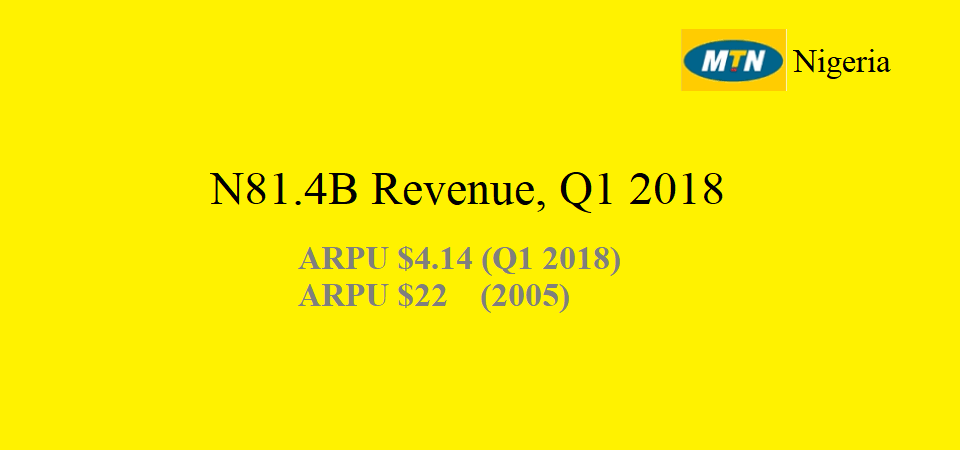
MTN Nigeria Made N81.4B Revenue in Q1 2018; ARPU Dropped from $22 (2005) to $4 (2018)

0

Here, relying on the Q1 2018 MTN Group financial reports, I present the extracted numbers for MTN Nigeria. MTN Nigeria made N81.4 billion (about $225.7 million using reported exchange rate) in the first quarter of 2018 on its 54.5 million subscribers.

(You are reading this post as I am doing my research to decide if MTN Nigeria is a good deal when it begins to trade on the Nigerian Stock Exchange. I will not make that call public here as it would be irresponsible.)

MTN NIGERIA – SUMMARY (From the Report)

MTN Nigeria continued with the positive momentum of 2017, increasing service revenue by 14,4% YoY, led by a 73,2% increase in data revenue and 15,2% growth in voice revenue. While the increase in voice revenue was encouraging, it was supported by the lower customer spend on VAS. As growth in our digital services is expected to resume in the latter part of the year, this may impact growth rates in voice revenue.

MTN Nigeria reported net additions in the quarter of 2,3 million following on from the 2,0 million adds in 4Q17 as the business benefited from the increase in our SIM registration footprint.

ARPU

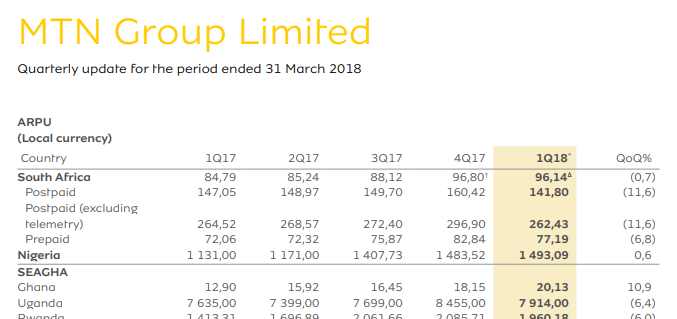
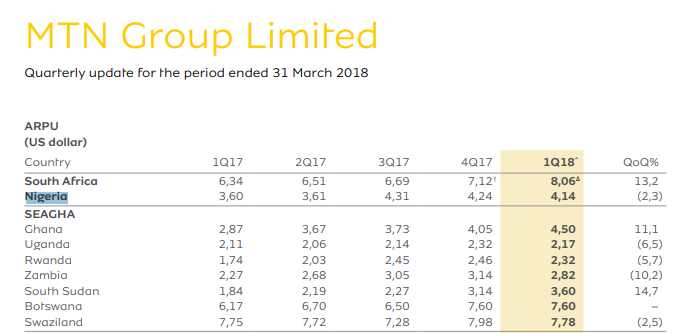
MTN Nigeria has ARPU (average revenue per user) of N1500 – about $4.14 – in Q1 2018 [see the second table below, MTN used the black market rate which makes sense as it would have had to buy dollars from the black market to ship any money from Nigeria to South Africa]. Currency fluctuation is a big issue when you look at the USD table where even though MTN Nigeria had better ARPU in Q1 2018, in Naira, the amount in USD was lower than the one recorded for Q4 2017 ($4.14 vs. $4.24)


Total Revenue for Q1 2018

If MTN had ARPU (see above) of $4.14 for the 54,528,527 subscribers it recorded for Q1 2018, the implication is that MTN Nigeria made a revenue of $225,748,101.78 for the quarter. In Nigeria, using the reported ARPU in Naira, the revenue was N81,411,090,811 (simply N81.4 billion) for the quarter. (For comparison sake, GTBank made N44.7 billion on profit before tax [note PBT] in the same quarter, implying that GTBank made more than half of MTN Nigeria’s revenue as PROFIT.)

The WhatsApp and OTT Problem

To help me understand the impact of WhatsApp and other OTT solutions, I pulled MTN Group financial report in 2006. In 2005 (yes 2005), MTN Nigeria was recording ARPU of $22. Today, it is $4.14. Sure, competition has a huge role there but I do think the OTT services are largely to be blamed. When the ARPU dropped to $18 in 2006, we already had Glo and Airtel (you take the name, Econet, Zain, Celtel etc). So, the reduction of ARPU is not just on direct industry competition, the OTT is having a real effect.

Nigeria In an exceptional performance, MTN Nigeria increased its subscriber base by 47% over the prior reported period, recording some 3,9 million net connections for the year with more than 12,3 million subscribers at year-end. In addition, MTN Nigeria recorded market share of 46% and reduced churn levels from 35% to 30%. This performance was largely due to the successful introduction of a segmented value proposition and distributor campaigns. ARPU declined by 18% from US$22 in the prior year to US$18, consistent with increased penetration and reflecting the continued acquisition of subscribers at the lower end of the market.

All Together

The MTN Nigeria numbers are not necessarily great. As they share more financial information for the expected listing on the Nigerian Stock Exchange, we would understand this business better. Honestly, I had expected MTN Nigeria to be closing at least N100 billion per quarter on revenue. This WhatsApp thing is indeed real, I must note. Generating N81.4 billion from 54.5 million subscribers every quarter is not that stellar after all the campaigns, bonuses, promotions, etc. There is something fundamentally missing in the purchasing power in Nigeria. That people spend mere N500 on phone and data services per month (for the total of N1500 quarterly), on average, on MTN ecosystems, means the real talking should focus on economic empowerment. Who knows what is happening in Glo, Airtel and 9Mobile if MTN Nigeria looks this way?

You can download the MTN quarterly result here.

UPDATE

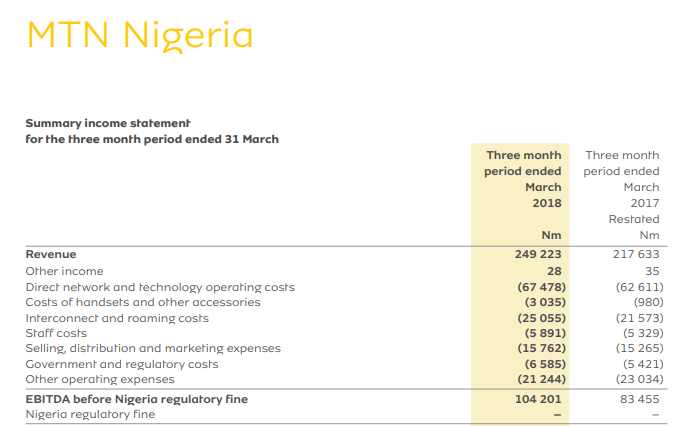
MTN Nigeria responded informing me of this link. In that link,  the company made a service revenue of N248.3 billion for Q1 2018. I have asked them to correct what was published in the Johannesburg Stock Exchange financial report as both do not align.

  • MTN Nigeria reported strong subscriber net additions of 2,3 million
  • Active Mobile Money customers increased to 2,0 million
  • Naira service revenue increased by 14,5% to N248,3bn
  • Data revenue increased by 73,2% year-on-year
  • EBITDA margin increased by 332bp to 41,8%
  • MTN Nigeria invested N17,9bn in capex in the period

COMMENTS FROM LINKEDIN FEED.

These are some comments from LinkedIn feed of this piece.

  1. While I enjoyed reading the dimension you took to explain the financial report, I will add to your piece with my understanding of the issues in relation to the multi dimensional factors. There are many factors that have lead to the decline in ARPU. As at 2005, the competition wasn’t stiff, some of the call rates were over priced, exchange rate of $1/N133.5 and today it’s $1/N375, the subscriber base was actually less, we didn’t have the so powerful smartphones that gave the platform for alternative way of communicating, data subscription wasn’t as high as 2018 and finally the mobile operators network wasn’t even robust enough to support large consumption of data. e.t.c Using one of the indices(exchange rate) you will realize that ARPU should be about $12, and with increase in subscriber base it should be higher, but a downward review in call rates to about less 40/50% has a major role to play. A shift in strategy is required just like declaring a state of emergency. If MTN has about 50m subscriber base(Mobile) what percentage of homes are they connecting or are connected? In relation to the Nigerian population and also the data being published by NCC, you would realize that we have over 120million subscriber base. Page 1
  2. Too many things to deduce from the piece, but I will keep it simple:Nigeria and Nigerians’ money (or wealth) appears to be imaginary all the time, the ecommerce operators aren’t seeing the numbers, the telcos aren’t seeing them. Bank’s numbers are highly deceptive, because it’s possible that less than 10% of its customers are generating more than half of the revenues and subsequent profits.There is dearth of knowledge and awareness in the land, many people keep thinking that MTN and others are raking in huge (or even YUGE) profits, while forgetting the business environment, security, cost of doing business, and the disproportionate purchasing parity between the rich and the poor here.Huge population figures are only useful when the majority of the citizens are empowered, with decent standard of living and disposable incomes. The illusory belief that our numbers are huge potentials must cease, the country is simply nowhere in terms of productivity and purchasing power. The few wealthy people aren’t enough to compensate for the millions of poor people in the land.This is a country with annual budget of less than $30 billion, and we keep hearing that we are very rich. Simply, Nigeria is way below expectations!

This Stolen Bag Will Not Come Down Despite All Efforts [Hello Isaac Newton]

0

This is hilarious – a stolen bag would not come down from a man’s head. That is Isaac Newton’s work error code. Yes, gravity ceased and the man needs the old woman he had stolen his bag to help. He went to Police; Police could not help. Someone says the technology needs to be patented by Tanzania before NASA knows about it! Watching the video, you would pity the guy: the bags cannot fall down.

A man from Tanzania was compelled to report himself to the nearest police station after a bag he had stolen from an old woman refused to come down from his head.

It is not clear under what circumstances Frank Buhet stole the bag and what it contained.

The man reportedly told police that he made every effort within his powers to get the load off his head, including lying on the ground, but to no avail.


Looking for Promotion Partners for “Innovation for Growth” Workshop

0

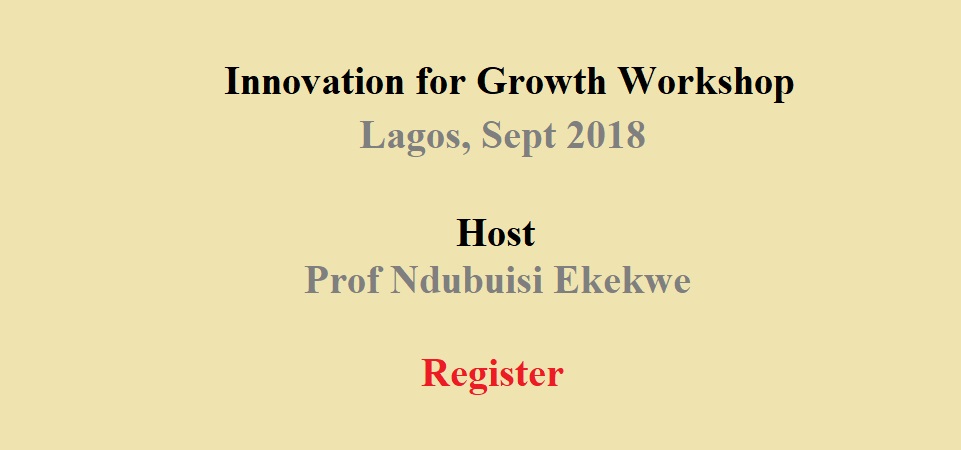
I am Nky Udo. I am the community coordinator in all Fasmicro Group ecosystems, handling digital support on Facyber, Zenvus, AA, Fashostit Web Hosting, Tekedia, etc. For our workshop – Innovation for Growth Workshop– which is scheduled in Sept 2018, I want to engage partners. Simply, we have a generous commission for agents or partners who can bring participants. For example, today, we closed a deal for an Abuja-based hub to send participants. If interested to work with me on promoting this workshop [you get commission], please email tekedia@fasmicro.com.

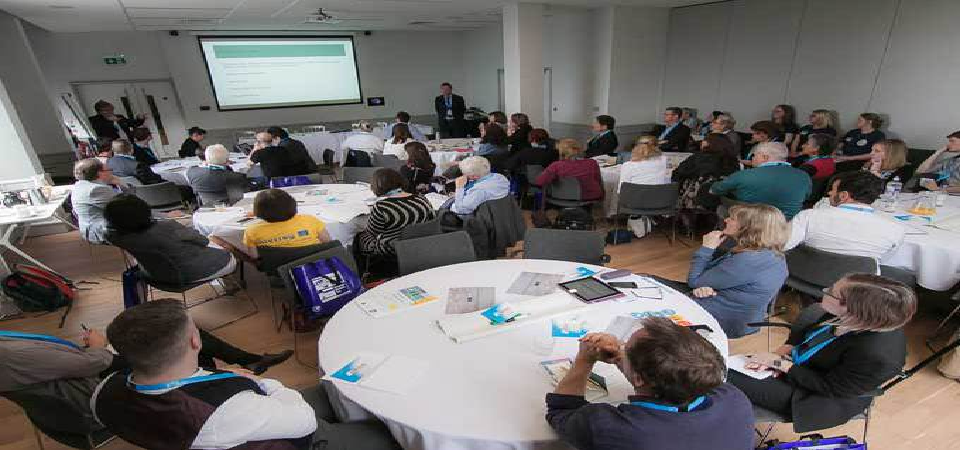
This September, I will bring an innovation workshop to Nigeria. I always come to Nigeria to lead programs for banks, insurers, technology companies, governments and more.

[…]

The workshop is designed for mid and senior leadership teams. These include CEOs, VPs, directors, technology, sales, marketing, strategy and finance leads in all business sectors. The workshop is aimed at:

  • Companies looking for new growth areas and products
  • Companies with potential, ambition and capacity for high growth
  • New company owners, founders and entreprenuers who want to build robust businesses.
  • Existing companies who want to engineer innovation within existing enterprises
  • Startups and their leaders who need directions on roadmaps and strategies
  • Governments and policy makers working to stimulate innovations

Meanwhile, to those that want to register, click here or email me at tekedia@fasmicro.com

Photo credit: European Commission (EC)