DD
MM
YYYY

PAGES

DD
MM
YYYY

spot_img

PAGES

Home Blog Page 7204

Open Innovation Event

0

In our Advisory Services, we offer four services. One is called the Open Innovation Event. Others are Discovery Innovation Presentation, Discovery Innovation Workshop, and Advisory Services.

Open Innovation Event: In this engagement, we would run a mini-pitch competition within your firm as part of a process to mine ideas from your team. We understand that some of your staff members have great ideas. We would work with you to get them to share them. We will handle all aspects of the process – structuring the survey, analyzing the data, coordinating with representatives and deciding on the finalists. In a recent client engagement, 45 staff members of the client (out of 420 that submitted ideas) pitched ideas to judges (from IT, Strategy and Executive Management office). At the end, 5 of those ideas became products.

Contact: tekedia@fasmicro.com

The Most Important Gene in Great Digital Startups

0

Between building for platforms and not just products is also making things for users and not just buyers. Great digital companies turn customers into fans: they design and create products for users and not just buyers. Making things for buyers is an industrial age business model – they buy and they are gone. Today, products must have full-cycle value where the users are engaged at both pre- and post-purchases. Indeed, you are selling living experiences and not just things. Yes, you want the products to be part of the lifestyles of the users for you to have success. WeChat is a good example: it is both a platform and a full-cycle product with users who depend on it to run their lives.

Any digital product that does not have the duality element will struggle especially in consumer market: you need the product and the platform as one to make progress these days. You need to build platforms because they have the elasticity to evolve with your business logic. Products are static and fade quickly as markets change. Platforms can grow without bounds, anchoring new opportunities on top. The business logic of integration, process and decision making are best handled on platforms over products in the internet space. With platforms, you have CUSTOMERS; products deliver consumers.

Largely, the shift to platform-full-cycle product is anchored on network effect – the positive continuum which is based on the construct that the more users you have in an ecosystem, the better is the value to everyone.  Digital companies like Facebook begin without thinking of sales. They simply focus on delivering the best possible experiences to customers. The goal is to help to reduce the frictions in the lives of customers. They spend money for years, earning no revenue, as they work hard to ensure users like and use their products.

You can associate the funding mechanism from venture capitalists as part of the catalyst for this.  Non-digital firms typically begin lives looking for how to immediately get users to buy and spend money. The reason is that they have no platform to nurture. So, the only thing they gain is the sale that happens. The experience is immaterial: it is buy that drives the strategy.

As you build your business, hiring marketing, advertising and all the elements required to run firms, you must architect a roadmap on how that product must be structured for users and not buyers.

Four Themes for Digital-First Retail Banking in Africa

0

McKinsey identifies four themes for digital-first retail banking in Africa. They are:

  • End-to-end digital transformations (e.g. Equity Bank);
  • Partnering with telco companies (e.g. CBA in Kenya or Diamond Bank in Nigeria);
  • Building a digital bank (e.g. ALAT in Nigeria); 
  • Building an ecosystem (e.g. Alipay in China).

Notice that no African bank has a banking digital ecosystem. Alipay remains a great benchmark globally. Read the press release below.


The McKinsey Global Banking practice has published a new report on African Retail Banking – Roaring to life: Growth and innovation in African retail banking (https://goo.gl/grn5ju).

The report finds that Africa’s banking markets are among the most exciting in the world. The continent’s overall banking market is the second-fastest-growing and second most profitable of any global region, and a hotbed of innovation. Nearly 300 million Africans are banked today, a number that could rise to 450 million in 5 years. The report illustrates four segments of African markets – from the advanced markets like South Africa and Egypt, to fast-growing transition markets such as Kenya, Ghana and Cote D’Ivoire, to sleeping giants like Algeria, Nigeria and Angola, to nascent banking markets like DRC and Ethiopia.

The report finds that Africa’s top quintile banks – the so-called “winners” – are simultaneously 4 times more profitable and over 2 times faster growing than bottom quintile banks. The report’s key findings are that these “winners” are defined by employing one or more of five winning practices:

  • Draw the right map. In Africa, geography matters. About 65 percent of African banks’ profitability (measured by RoE) and 94 percent of their revenue growth are attributable to their geographic footprint. Importantly, the report highlights a shift in exchange-rate adjusted revenue pools North Africa, East Africa and West Africa, and away from South Africa.
  • Right segments, compelling offers. We find that 70 percent of revenue pool growth will occur in the middle segments, defined as earning between US$ 6,000 and US$ 36,000 in annual income. The mass market – individuals earning less than US$6,000 per annum – accounts for 13 percent of the growth, but is the fastest growing segment. Whichever segment banks choose, having the right proposition is key. Our survey of 2,500 banking customers in 6 African countries finds that 25 percent of customers choose price as the most important factors in choosing banks. Equally important is convenience, also cited by 25 percent of customers. Service is the third most important factor, selected by 12 percent of customers. We also find huge cross-sell opportunities – while 95% of Africans have transaction products, fewer than 20 percent have lending, insurance, investment or deposit products.
  • Leaner, simpler banking. While African banks’ cost: income has been falling, we find that this is due to rising margins for banks, and their cost-to-assets ratio has actually been worsening. At 3.6 percent, Africa has the 2nd highest cost-to-assets ratio in the world. However, rapid efficiency gains are possible, and we spotlight eight African banks that have made strides in efficiency in the last five years, through a combination of three levers – end-to-end digitisation; sales productivity improvements fuelled by advanced analytics; back- and middle-office optimisation.
  • Digital first. 40% of Africans prefer to use digital channels for transactions. In four major African countries – South Africa, Nigeria, Kenya, Angola – a higher proportion of Africans prefer the digital channel for transactions to the branch channel. Given low branch density in Africa, banks need to employ a digital first approach. The report hones in on four themes of innovation emerging in Africa on digital – end-to-end digital transformations (e.g. Equity Bank); partnering with telco companies (e.g. CBA in Kenya or Diamond Bank in Nigeria); building a digital bank (e.g. ALAT in Nigeria); and building an ecosystem (e.g. Alipay in China).
  • Innovate on risk. African banking still has the second highest cost of risk in the world. Poor data availability is part of the problem: 11 percent of Africans are on credit bureaus, compared to in excess of 90 percent in advanced markets. However, we are seeing innovations such as banks partnering with data and analytics fintechs like Jumo to improve credit underwriting; banks partnering with telcos to leverage telco data to issue small-ticket loans on mobile; and players employing payroll lending across countries.

This new report draws on the experience of McKinsey’s partners and colleagues serving banks across Africa; McKinsey’s Global Banking Pools research; a proprietary database of the financial performance of 35 of Africa’s leading banks; a survey of executives from 20 banks and financial institutions across Africa; and a broad-based survey of 2,500 banking customers from 6 African countries – South Africa, Egypt, Nigeria, Morocco, Angola and Kenya.

Apple’s China Compliance Gives Hope on Niger Delta

0

Privacy seems to be an illusion on the web. China makes its lack of privacy projection very obvious while U.S. may not be so obvious. Without Edward Snowden, we might not have known the state of privacy violations in U.S. Yet, we do not need to freak out: if governments need these violations to provide security, I would not care that much. I just hope this excessive privacy intrusion stops for security. If Apple allows China to have access to iCloud accounts of China-based users, it means China has won big on policing its citizens.

Apple is moving iCloud accounts registered in mainland China to state-run Chinese servers, along with the digital keys needed to unlock them. This has human rights groups and privacy advocates worried because Chinese authorities now have all the tools they need to access users’ data. Apple made the move to comply with China’s regulations on cloud services, and it highlights the trade-offs global companies make to do business in China. (CNN Newsletter)

Yes, the talks of corporate values are moving targets. If a government runs the servers which private companies rent to support their customers, you may think that companies that support such have no core values. For them, it is all profit. Yet, when you look at this critically, you would agree that Apple has no choice: how can a global phone company leave the largest smartphone market in the world? Not possible. So Apple has to do what it has to do irrespective of what privacy crusaders are writing.

That takes me to oil companies that pollute Niger Delta in Nigeria, and do what they cannot do in their lands. We can blame those companies but what is happening in China tells me that firms are just looking for alpha and most would do anything to maximize same. Where you have laws, even draconian, they would bend provided they would make money. But where you have none, they would maximize the worst of the unregulated space.

Nigeria should blame itself for the mess in Niger Delta. These foreign empires actually comply with local regulations if you are serious to push them to do just that. Yes, Apple is hosting user accounts in government’s servers and has handed over users’ “passwords and usernames” to governments. If that is possible, Nigeria can shape its environmental policy and every company would comply.

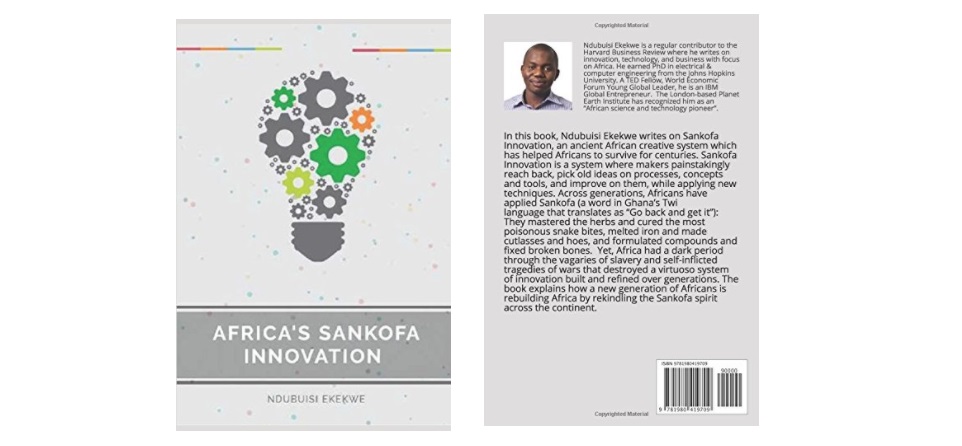
Amazon Kindle and Paperback Links to buy book “Africa’s Sankofa Innovation”

0

Here are the links to buy my book “Africa’s Sankofa Innovation” on Amazon

For Kindle:  Buy here.

For paperback: Buy here.

Book Description

In this book, Ndubuisi Ekekwe, a regular Harvard Business Review contributor, writes on Sankofa Innovation, an ancient African creative system which has helped Africans to survive for centuries. Sankofa Innovation is a system where makers painstakingly reach back, pick old ideas on processes, concepts and tools, and improve on them, while applying new techniques. Across generations, Africans have applied Sankofa (a word in Ghana’s Twi language that translates as “Go back and get it”): They mastered the herbs and cured the most poisonous snake bites, melted iron and made cutlasses and hoes, and formulated compounds and fixed broken bones. The Egyptians pioneered the field of geometry, out of the need to re-partition plots of land near River Nile, whenever it overflowed its banks. The Ethiopians invented an indigenous way of writing, and documented some of the earliest components of African history. The ancient trade routes from Accra through Kano to Khartoum were anchored on the ingenuity of Africans who dyed clothes, transformed hides into leather, and improved agricultural yields through self-taught farming mechanisms like fallow and erosion control. Yet, Africa had a dark period through the vagaries of slavery and self-inflicted tragedies of wars that destroyed a virtuoso system of innovation built and refined over generations. In this book, Ndubuisi explains how a new generation of Africans is rebuilding Africa by rekindling the Sankofa spirit across the continent.