DD
MM
YYYY

PAGES

DD
MM
YYYY

spot_img

PAGES

Home Blog Page 7209

The Hottest Funding Sector Right Now In Nigeria

0

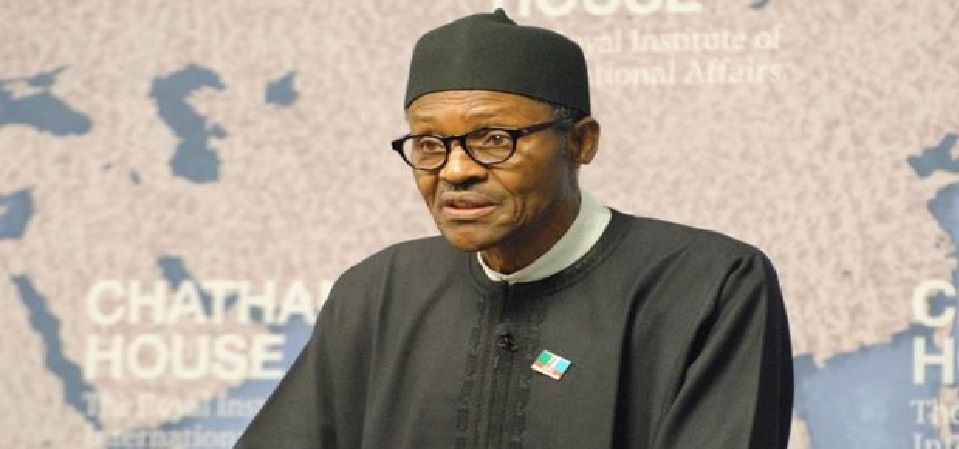
President Buhari did a good job this week, getting the Council of State to move funding for agriculture from $200 million to $1 billion. Sure, that is not really big, but it is a step in the right direction.

After a six-hour deliberation on the prevailing insecurity in the country, the economy and electoral matters, the Council of State meeting, presided over by President Muhammadu Buhari, yesterday reviewed the funding of agriculture from $200 million to $1 billion to cater for livestock and farmers.

The funds, according to council, would be disbursed through the Anchor Borrower and Commercial Agricultural Crédit Scheme (CACS) to boost the diversification agenda of the current administration and food security, among others.

Now that he has the funding, he needs to develop a better strategy to make sure the real farmers get this money. The National Identification Number (NIN) and Bank Verification Number (BVN) must be incorporated in any strategy the government adopts as it makes the funds available.

This Buhari’s call is coming when the President of the African Development Bank is also pushing for more funding in African agriculture. I do believe that the decade of 2020s would be one where Africa would have the turning point. Yes, we would have the capacity to feed more of our citizens.

According to Adesina, “For too long, Agriculture has been associated with what I call the three Ps – pain, penury, and poverty. The fact though is that agriculture is a huge wealth-creating sector that is primed to unleash new economic opportunities that will lift hundreds of millions of people out of poverty.”

[…]

The African Development Bank is also pioneering the establishment of Staple Crop Processing Zones(https://goo.gl/P8FvaY) in 10 African countries, that are expected to transform rural economies into zones of economic prosperity and save African economies billions of dollars in much needed foreign reserves.

“We must now turn the rural areas from zones of economic misery to zones of economic prosperity. This requires a total transformation of the agriculture sector. At the core of this must be rapid agricultural industrialization. We must not just focus on primary production but on the development of agricultural value chains,” Adesina added. “That way, Africa will turn from being at the bottom to the top of global value chains.” (AfDB newsletter)

Essentially, if Nigeria could double farm yield, we would reduce poverty by at least 30% since more than 65% of our working people are in agriculture. There is no other sector that holds the future of Nigeria than agriculture. I am very happy that President Buhari tabled that before the Council of State this week. You rarely discuss agriculture in Council of State. He made it happen, and they gave the blessing. Now, he needs to go and execute.

While we are talking of technology funding, the government has made a call that it has $1 billion to invest to seed farmers. It does not have to be in tech to be called capital. Nigeria has capital right now. If you want to farm, join cooperatives to access this funding which typically goes through Bank of Agriculture and cooperatives. Every LGA through the state State Ministry of Agriculture has a cooperative. You must join to tap into the funding.

University of Ibadan’s MSC Forum Discusses The One Oasis Strategy

0

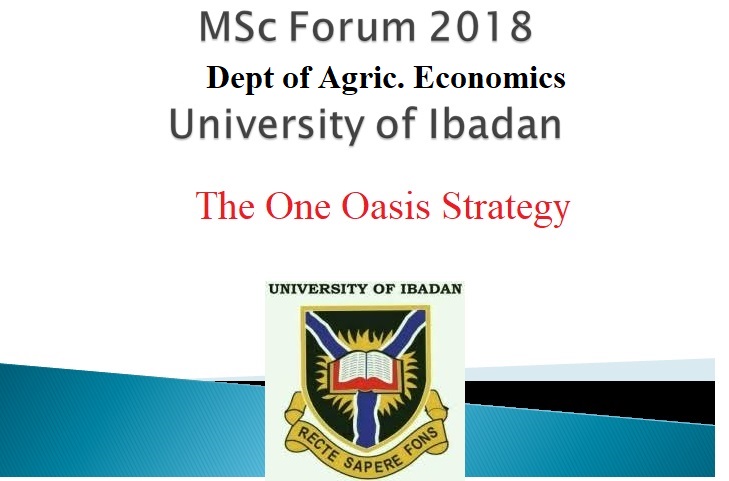
Today, I received feedback that MSC (Agricultural Economics) students of the University of Ibadan are using the One Oasis Strategy to design new models for agricultural development. Yusuf sent me a solid presentation on how they have analysed the strategy and then integrated it into some core pillars in their MSC Forum programs.

A company’s position in the largely imperfect market is determined by its products which help to remove market frictions. The best product in a firm anchors its survival, just as oasis does in a desert. And every business must discover its oasis, if it hopes to thrive. Discovering the oasis is very important because it would help the company to pursue optimal allocation of the factors of production.

For competitiveness, there is a way a company can allocate the factors of production to make sure it supports the best product (the oasis which anchors the firm). If that is done, effectively, that best product will blossom, and other products in the business will also do well, as they will feed from the best product.

Simply, if you build your investment around that main product, you will find success, because those investments will have a clear internal “customer”, and that reduces market risks. In other words, if your new business investments are geared to support the best product, and the best product is doing well, it implies the risks on the new investments will be easily managed. Provided the best product continues to do well, demand on the new investment is assured (i.e. the customer exists, irrespective of the external market). That is the One Oasis Strategy.

The students extrapolated the work into competitive advantages of firms. The slide notes in parts “Although Prof Ndubuisi Ekekwe did not mention this, I suppose that the supporting node must be a strategic resource to prevent the drying up of the oasis (competitive edge)”. They went ahead to make new cases, focusing on agricultural chain. It is a very impressive work.

Sure, I cannot post the slides since this is possibly going to be part of postgraduate theses.

Meanwhile, I would be publishing the One Oasis Strategy Toolkit and also a Harvard Business Review piece is coming with research works we have done in three Nigerian companies on this.


My Alma Mater Honors Me, Renames an Inter-House after Me

0

My secondary school alma mater, Secondary Technical School Ovim (Abia State), today informed me that it would like to rename one of the Inter-Houses to my name. It has five Houses – Red, Green, White, Yellow and Blue. Essentially, during the annual Inter-House Sports competitions, one of the Houses would be Ndubuisi Ekekwe House. Unlike the chieftaincy title, I accepted this one. The letter was written by the school principal on behalf of the staff, students and the PTA.

Secondary Technical School Ovim is a community school. It was established by Ovim Community as one of the foremost technical secondary schools in eastern Nigeria. The Motor Vehicle Lab, Wood Work Lab and other labs remain some of the best in the state. In short, the new computer lab is used by Abia State University for lab works.

This is not anyhow school – community sons like Rear Admiral Ndubuisi Kanu (rtd) [former governor of Lagos State], Major General Ike Nwachukwu (rtd) [former governor of Imo State], Lt General Ihejirika Azuibuike (rtd) [ former Chief of Army Staff] are some of the icons that invest efforts to make sure our school remains strong.

The school is largely managed by Ovim Community League – a community development entity. We are recording high double-digit percentage on transition from secondary to university education. They have accomplished impressive number on primary education to secondary education. Largely, any child in my village is guaranteed of secondary education.

I attended this school. I became a local legend, breaking and holding all-time WAEC academic result in the school history. I also became a teacher while a student teaching Maths, Physics and Further Maths. I won laurels for my school in competitions across the nation. After my WAEC, my principal and vice principal received State Awards.

The last time I visited home, primary school kids were brought by their parents for me to help them with algebra, numbers, etc. And the bigger boys and girls in secondary school came with Geography map reading, Calculus and Physics.

It makes you humble that you are inspiring young people. I would likely attend the next Inter-House Sports Competition, not to cheer those competing from Ndubuisi Ekekwe House but all kids in our school. Ovim is a very small community (about 10,000 people) but we are enviable in our quest to build a society for all. I benefited from the efforts of those ahead of me – they brought the best teachers in Nigeria to teach me. We would keep that tradition going. I am indeed honored.

Zenvus Progresses on Katerva Award

0

Our AgTech pioneer, Zenvus, moves to the next phase of the Katerva Award which was referred by Reuters as “the Nobel Prize for Sustainability”.

Zenvus is a pioneering precision farming technology company that uses computational algorithm and electronics to transform farms. Zenvus collects soil fertility data and crop vegetative health data, concatenating them with AI to deliver precision agriculture at scale. It then uses the aggregated and anonymized data to deliver financial services to farmers. Zenvus can support any size of farms, from small to the largest farms.

The Katerva Award is the pinnacle of global sustainability recognition. Through them, the best ideas on the planet are identified, refined and accelerated toward impact at a global level.

Katerva isn’t looking for ideas that will improve the world in small increments. We are looking for game-changers and industry breakers; ideas that leap efficiency, lifestyle, consumption and action a generation ahead of current thinking. Single-digit percent change isn’t enough. We’re looking for triple-digit and beyond. We’re looking for what are truly the most promising and impactful ideas!

Katerva Award is managed by Thomson Reuters Foundation and Indiana University.

Blockchain Explained for Executives and Non-Techies [PDF]

0

A lot of people think blockchain technology and cryptocurrency are one in the same, but that isn’t true. Cryptocurrencies are in the headlines, but the transformative power of the underlying blockchain technology is the pot of gold at the end of the rainbow.

One simple analogy is that the blockchain is to money as the internet is to information. It removes the friction and costs of access to the masses. But don’t confuse blockchain technology with the bitcoin-ethereum-blockchain crytocurrency. It is quite easy to be distracted by the media onslaught of coverage around virtual currencies, and more recently, Initial Coin Offerings (ICO), however, this is mostly smoke and mirrors when compared to the potential held within blockchain itself. Token technology may anchor the next web revolution, spawning crowdfunding behemoths that expedite the value delivery path to their users while cutting out the advertisers and fee-based middlemen.

The current thought model posits the question, “What can’t be tokenized?” Future research notes will explore and detail the many use cases of blockchain and how they are being put to the test with early adopters in this bleeding edge space. Big banks are embarking on programs to provide syndicated loans and the grocery supply chain has signed up with IBM to launch a blockchain-based solution to track food shipments and monitor food safety.

It all sounds mysterious, intriguing and, to be frank, easy to dismiss as so few of us really understand what blockchain technology really is and how it works. Let’s take the first steps towards closing this knowledge gap.

There are five foundational principles that underlie blockchain technologies:

  • Distributed Database: All access all the time! Everyone partaking in the database can see everything in the database. This architecture provides true decentralization where there is no single point of control or failure. This transparency allows independent verification of transactions to occur without a middleman verification step.
  •  Peer-to-Peer Transaction: Blockchain takes the idea of “serverless computing” to a whole new level as there is no central hub for processing transaction data. All transactions are processed and stored in the nodes plugged into the network and those nodes share that data with all of the other nodes.
  • Transparency with Pseudonymity: Blockchain users have the choice to remain anonymous or share their identities. However, the record itself is present and visible to all. Transactions are encrypted and assigned a unique address as the means of identification.
  • Irreversibility of Records: Once a record has been transacted in the distributed ledger, it cannot be modified due to the linkage between all records (blocks) that comprise the blockchain. These records are encrypted, ordered chronologically, and visible to all.
  •  Computational Logic: Due to the programmatic nature of the blockchain, logic and algorithms can be applied to automate transactions between nodes upon pre-defined conditions

For the rest of the piece, download the Basics_of_Blockchain (PDF).

Note: This is used with permission from Info-Tech Research Group .