DD
MM
YYYY

PAGES

DD
MM
YYYY

spot_img

PAGES

Home Blog Page 7229

The Problem with Apple Siri’s Accented Language

0

I have written extensively that the strategy which Apple pursues through differentiated hardware and exclusive software would not work in any other market but smartphone. As I wrote in the Harvard Business Review, iPhone was a perception product which exceeded not just the needs and expectations of the customers, but met them at the level of perception. Replicating the business model of iPhone is any other product would be extremely challenging.

It is really important that the focus moves from the excitement on the technology to the value created in markets. We have to work on building products that bring perception demand. But just having the products is not enough. We need to find ways to also stimulate demand for them. By moving into perception demand, you have changed the basis of competition, a new curve, and if you do not clearly communicate, you could be alone. I never see Apple as a technically great company (yes, those fashion patents!). It does not need to be to have success. The company is peerless in innovation from the lens of customers and that is what matters.

Yes, that you got users at perception demand, for smart iPhone, does not mean that you will get them in smart speakers. So, that Apple exclusivity business model would become a limitation over time especially in these products where the more the users, the better. And that is what usually happens in platforms: you want to deepen your inversibility construct by making the user experience better. And that capability provides a positive continuum which works like this: a great product would attract more users, and the more the users, the better would be the product. It is about data which when it is used to improve the product further, makes it better.

Expect the same struggle as Apple moves into automobile infotainment. I am not really sure if many car companies would adopt the iOS platform (over the open Android) with its closed ecosystem of take whatever you are given, and nothing more. Car makers would like to have the capacity to improve and customize the operating system. Apple does not make that a possibility. That would hurt Apple. Contrast that with Android which you can largely do whatever you want.

Apple is losing in the voice assistant business. It does not have a radically great disruptive product which can technically change the basis of competition. Unlike iPhone, it is one of the players, and not ahead by any measure. So, the exclusive business model depresses its ability to attract more users in the ecosystems. Why work with exclusive Apple when Google and Amazon are open ecosystems. Android is a product that you can use to build a phone business; Apple’s iOS is exclusive to Apple.

Among Apple Siri, Amazon Alexa, Cortana (Microsoft) and Google Assistant, Siri is not the category-king even though it was among the pioneer. At the moment, Apple is yet to build a smart speaker business. It started the voice AI with Siri but it has massively lagged Amazon’s Alexa because even the people using Siri are the richer people who can afford Apple’s largely more expensive products. So, technically, Siri may not excellently understand poor people’s voices because not many of them are using it. That is a limitation to scale.

As Google and Amazon expand the nexus of their voice AI products, they would reach more users. The smart speaker business would give them more opportunities to add more voices and insights over Siri.

Who is winning the market for smart speakers with digital assistants? It’s not Apple yet, obviously. Amazon Alexa has a 69% share with an estimated 31 million units sold, trailed by Google Home with a 31% and 14 million units sold, according to surveys by Consumer Intelligence Research Partners.

We would be waiting for what changes when Apple launches a smart speaker to see if that would improve Siri’s numbers. I do not think so because Apple is sticking with its pricey exclusive strategy: “Apple’s smart speaker HomePod is scheduled for release on February 9. It will have an uphill climb given its higher price ($349) and late entry.”

Apple Siri has an accent problem: it can only understand rich people because it was born for the rich who have been communicating with it. In a world of economic diversity, Siri would be a minority. The other friends, Alexa and Assistant, born into human economic diversity, would have better careers in volumes and growths.

Massive Deal Opportunity Just Opened Up in the Nigerian Insurance Sector

0

There is a huge deal in town right now. Yes, something big is brooding. The Nigerian insurance sector has once-in-a-generation opportunity. Simply, when the Nigerian Stock Exchange introduced yesterday a new pricing system by amending the Pricing Methodology Rule, most traded insurance companies saw their stocks drop below 50 kobo. Hitherto, the minimum floor for listed NSE firms was 50 kobo. Under this new Par Value and Share Price Methodology, the number is now 1 kobo.

Since that yesterday, the market forces have started working, and stocks of many listed insurance firms have dropped below 50 kobo. They had been on 50 kobo for years as the old rule made it impossible to drop further. Now, that is gone, and these firms could lose further value. It is very unfortunate of course – nothing to celebrate here. Yet, it is also a problem to be fixed.

Nigerian stock market had a very good year in 2017 but that was driven mainly by category A and B equities; the Category C had marginal impact.

In coming months, I expect most of these insurance firms to move hands. Otherwise, they would be delisted. In short, expect strategic trading at high levels. And if the bulls move, outright acquisitions would happen.

Now, how do you fix these companies when you buy them? It is not going to be easy. But that would not stop me from presenting a roadmap. I would be sharing some components in the subscriber area.

How a Lagos Software Company Is Growing

0

I made public the One Oasis Strategy last year. It has become a key element when I analyse firms and how they could approach market entries. The One Oasis Strategy is about finding how to create solutions which can find their first customers within the business. Amazon Cloud has the ecommerce operation as its first customer thereby removing any market demand risk. Samsung Semiconductors has the Samsung mobile devices business as the first customer. With those assured internal customers, these firms deploy resources, irrespective of the market dynamics, because they have found the first customers already, in-house. But over time, the products are now made available to the general public.

Indeed, oasis is very critical and every company has oasis. Your best product is the oasis in your business. Every other product feeds on that best product. If you build your investment around that main product, you will find success, because those investments will have a clear “customer”, and that reduces market risks. In other words, if your new business investments are geared to support the best product, and the best product is doing well, it means the risks on the new investments will be easily managed. Provided the best product continues to do well, demand on the new investment is assured. That is the One Oasis Strategy.

Every product is like the animal that returns to the oasis for water. Every product is like the humans that depend on the oasis for habitat. Provided that the oasis is there, and doing well, their survivals are guaranteed. Yet, as those new products do well, they could find new customers, beyond the first customer (that best product). That means, you can introduce them to the markets for other customers to buy, even when they are supporting the best product, which is the most important reason the original investments were made.

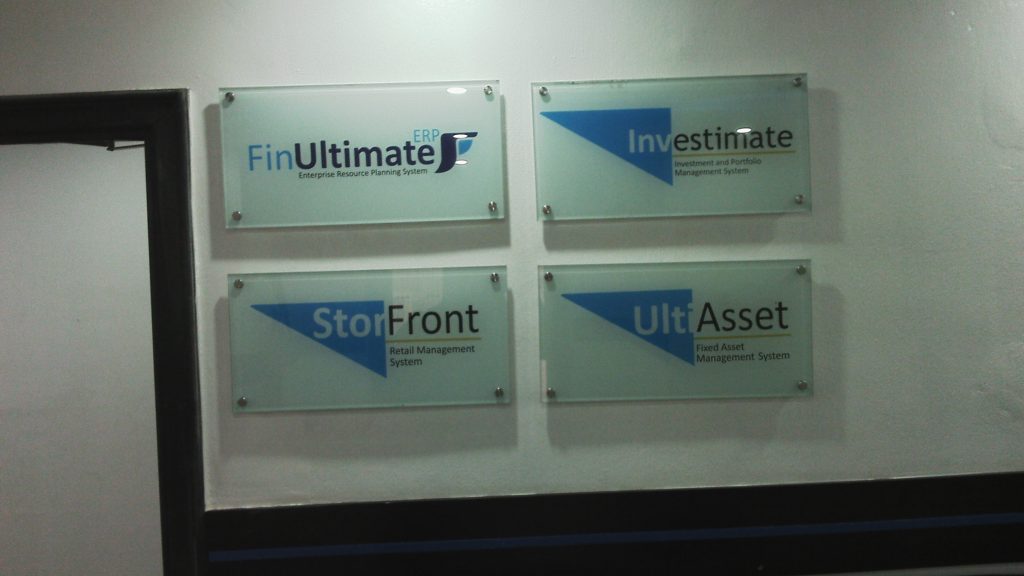
In business, you need to identify your best product (the oasis) and get other products to build habitations around it.  I’d spent time in a very fascinating software powerhouse in Lagos: ATB Techsoft Solutions. ATB Techsoft is one of the largest emerging software companies in Nigeria today with excess of 20 great products with applications across industrial sectors.  I would be sharing more on this company in coming days. But in a conversation, I asked the MD of the company to find an oasis within his firm. He came back after one week with an answer: its oasis is FinUltimate.

Finultimate offers the most comprehensive portfolio of applications software designed to help financial services companies improve operational effectiveness, profitability, product innovation, distribution / delivery channel growth, customer relationships and enterprise information management.

Now, with FinUltimate, it can deepen other products into the market. What he did is what I expect every entrepreneur to do. Now, from more than 20 products, the company is positioning all as one, even when having the capacities to deliver better results to customers in sectors like education, banking, logistics, education, insurance and more. Yes, for ATB Techsoft, the world now is FinUltimate, and it can take up your software business needs. FinUltimate is homegrown, with elasticity to capture any specific customer needs because it was created in Magodo Lagos in a rapidly expanding business.

ATB Techsoft brands

The Entrepreneur’s Awareness

0

Two cases:

  1. While speaking at the World Economic Forum …, Maersk’s chairman Jim Hagermann Snabe revealed the extent of a recent cyberattack’s damage to the shipping giant’s IT systems. The NotPetya ransomware worm forced the company’s tech team to reinstall “a complete infrastructure” over 10 days, he said. The crew set up “4,000 new servers, 45,000 new PCs, and 2,500 applications” to the tune of $250 to $300 million.
  2. Leaders of Egypt, Ethiopia, and Sudan convened in Addis Ababa to break a diplomatic deadlock over Ethiopia’s plans to build a hydroelectric dam on the river. Egypt fears the dam could lessen the amount of water it gets from the Ethiopian highlands. (Fortune newsletter)

In these unrelated cases, we can see one thing: connectivity. In the case of Maersk, the firm had networks of connected computing systems which were compromised by a ransomware. Typically, for most ransomware, the only solution is to rebuild a system infrastructure, from scratch, where you decide not to pay the hackers. Too bad for Maersk, it is possible a cloud-based infrastructure could have prevented the level of mayhem it experienced.

For Egypt and Ethiopia, this simply explains the interconnected nature of our world. Most times, we do not appreciate all these elements. Templeton Investments has this popular advertisement where it explains that markets are connected; that one event in one country could impact what happens in another. It used an example on how an agriculture policy in one nation could affect the seafood sector in another. Yes, a dam project in Ethiopia could cause severe dislocation in Egypt’s economy in years.

The Mind of an Entrepreneur

Winning markets comes through awareness. The brilliance of Aliko Dangote happens because of his high level of awareness to link market frictions and opportunities. The same goes for Jim Ovim, Tony Elumelu and others. For these men and others, they do not need to have (directly) experienced something to know the impact of that thing. Yes, Dangote might not have gone grocery shopping in years, but he has awareness of the range of food prices. He may not be directly connected to the operational elements within a sector, yet, he has awareness of what is happening there. Without awareness, any entrepreneur would struggle. Connecting the dots is what makes it possible to understand how markets are moving and what the emerging opportunities are. You must invest to have the capacity to connect pieces of (unrelated) events and things, in order to stay ahead of competitions as markets shift.

How Buhari Can Create 1.5 Million Immediate Jobs And Boost Growth

0

As I travel around the country, there is one thing that seems purely universal in Nigeria: massive unemployment. Unemployment has reached the level where government must declare a state of emergency to fix it. I mean, it is very alarming that extremely brilliant young people in Nigeria cannot find jobs.

In my typical way, I would offer a suggestion to the government.  Here is a summary of a strategy I do think could boost economic growth and get people back to work.

Forget Free Market; Stimulate the Economy with State Guarantees

My suggestion to the President is to listen less to people that tell him that free market would drive all vibrancy in our economic system. The private sector is working but we are not growing enough companies due to funding paucity in Nigeria.  The implication is that most firms are not following their growth trajectories. Without those trajectories, the firms cannot hire for expansion. So, we are on paralysis because many companies which are entering their 10-15th birthdays are trapped within a banking system that does not have much assets to offer loans. You should not fault the banks; they have capital adequacy ratios to meet in an economy which is just coming out of recession.

To fix the growth stasis, the government should use state guarantees to unlock $10 billion in loans to at least 50,000 companies in Nigeria at average business loan of $200,000. Under this scheme, government would guarantee 25% of all business loans made by commercial banks. In other words, government would cover any loss by up to 25%. With this, banks would drop their tight credit criteria and allow some companies which might not have qualified for loans to qualify. This is basically playing at the borderline of creditworthiness with the guarantees flipping it for businesses.

Under this scheme, I expect loan growth to hit at least 30% within a quarter. That would put many companies on the path to move to the next level of their business lifecycles. As they grow, I expect them to hire. That would help in fixing the massive unemployment in the land.

Scene from a job fair in Nigeria (source: Cable)


Historically, government had focused on funding new companies. While that has merit, the reality is that new companies take time before they can add workers. The strategy now would be to stimulate already operating businesses which need capital to grow. Here are some elemental components of this plan:

  • BVN is a must: All the businesses that need loans must have BVNs to ensure the identities of the promoters are documented.
  • Digital Payment: Government would push as much as possible to get many of the companies to collect payment digitally (not just online). The goal is to have real insights on cashflow, and how the firms are doing. Also, digital receipts would make it possible to collect the right tax from them.
  • Existing companies: Focus on existing companies and help them expand, over funding startups. Companies must be at least 3 years old to qualify.
  • Banks decisions: The banks would have 100% control on the credit decision and administration. Only the banks would determine the companies they would lend to; after all they are going to lose 75% of the money if things go bad. But with the 25% of potential loss covered, they would be encouraged to reduce their criteria. Government would bound the maximum amount which can be loaned to a single firm or promoters under the scheme.
  • Software automation: The whole process of this scheme must be wholly transparent to the business community, banking sector and the government. I recommend creating a software system to make that happen.

Projected Impacts

I project the following as impacts:  Each of the 50,000 benefiting companies would add 10 employees within a year for a total capacity of 500,000 (direct) new jobs. The boom in the economy as result of this expansion (the new workers would spend money, the banks would expand, the firms doing business with these 50,000 companies would expand, etc) would result to additional 1 million jobs.

So, within a year of the initiative, government would have created very good 1.5 million jobs. And it can do this without losing a dime if the loans perform well.