DD
MM
YYYY

PAGES

DD
MM
YYYY

spot_img

PAGES

Home Blog Page 7255

My Reason for Liking Wema Bank’s ALAT Strategy

0

I have gotten this question many times on why I think ALAT from Wema Bank is different from other bank apps or digital products.

Great initiative. Great strategy. But I am yet to see how any digital offering yet in Nigeria is helping businesses increase their own revenue.  Digital has mostly helped to make spending or payments  easier but none is expanding access to markets or investments.

This is my response:

ALAT is not necessarily a bank product because the creators took the bank out of it. That means it is a startup which is not designed to make money immediately for the bank. Just like startups can operate for years at losses provided they are adding customers, ALAT wants to do just that. So, because it was not structured to bring immediate revenue, it is not relevant looking for one. What you look for is the capacity to bring new customers to the bank: 90% of its users are new to the bank. That is significant.

These numbers are significant because the implication is that ALAT is driving growth in Wema Bank. Wema Bank has about 1.5 million customers and hopes to push the number to 3 million through ALAT by 2020. Within 8 months, they have 200,000 on-boarded. My focus is not really the 200,000 customers in ALAT but the fact that Wema is attracting new people into Wema: “with just 10% of our users being existing @wemabank customers”. This is significant for the relatively small bank. Getting 90% of new customers through ALAT is very great. It would have been bad if it was only moving current customers to ALAT. So, ALAT offers growth to the bank

So, there is no issue of helping Wema Bank improve revenue immediately. They did not call it Wema Bank App; they called it ALAT. That strategy is very significant: they want to create a new business possibly from the bank which can appeal to the youth. And they are succeeding: they moved from 16th position to 7th in youth attractiveness within a year.

The 2016 Ciuci Consulting Annual Banking Report- What Nigerian Retail Customers Want shows a significant climb for Wema Bank in the perception ranking of the 18 to 24 age group, where they moved from 16th place in 2015 to 7th place. Wema Bank is succeeding in capturing the hearts of the youth as the report shows a strong attraction by this age group as their ranking with them is much higher than the bank’s overall perception ranking of 14th.

With a near-zero marginal cost, this can scale and over time most young people will forget it is coming from a bank.  All the bank needs to do is to put resources and grow it just like other fintechs that keep growing even when losing money.  My understanding looking at the strategy is that Wema Bank is building a NEW business within Wema Bank. That business is ALAT.

But where you make your app as an extension of your bank, the hangover will happen as there are things you cannot easily do because you are running a bank app. ALAT does not have to worry about that because it is a digital native. The implication is that it will not bring any great revenue but it can grow the bank. Wema Bank needs that growth because it has not done well in adding users for 72 years.

See the numbers: Wema Bank was established in 1945. It has about 1.5 million customers in Nigeria. ALAT was established in 2017 and has brought NEW 180k customers to the bank, about 12% of the total bank customer base. Wema Bank is a relative small bank but if ALAT can add 180k NEW customers within 8 months it is a home run. For 72 years, the bank got 1.5 million customers; about 21k per year on average. If it can get something that gives it 180k in 8 months, it can party. So if you are looking for revenue, you may not be looking at it from the right angle: this bank wants to grow and ALAT is the path to it.

And finally, ALAT is not just a product, it is also a platform. And that is good. Because it is not built to be an extension of a bank, it has the capabilities to transmute. It will be the oasis in a one oasis strategy.


Restructuring and Harmonization: PDP’s Atikulate Abubakar in 2019

0

President Buhari in his New Year address to Nigerians made it known that restructuring nation is not a major priority.

“In respect of political developments, I have kept a close watch on the on-going debate about “Restructuring”. No human law or edifice is perfect. Whatever structure we develop must periodically be perfected according to changing circumstances and the country’s socio-economic developments. We Nigerians can be very impatient and want to improve our conditions faster than may be possible considering our resources and capabilities. When all the aggregates of nationwide opinions are considered, my firm view is that our problems are more to do with process than structure” 

Honestly, Mr. President has a point there. I have noted that while we did better in terms of infrastructural development in early 1960s when the nation was divided into regional governments with control at regional levels, the situation today is different. The time of Awolowo, Okpara and others, we had decent leaders who actually utilized the immense resources they controlled to develop the regions they managed.

Today, if you take a hard effort, more than 50% of former Nigerian governors since 1999 have a court case related to corruption. And these are from the pool we are going to hire for the new restructured governments.  My suspicion is that the problem we have in Abuja will move to state capitals and they would be very far away from ICPC and EFCC to deal with them [I know some will prefer that model provided the stealing is happening in their state capitals; very unfortunate indeed]. Governors are like lords and no one can police them in the states, so allowing them full control would be a big mistake unless we can set condition precedents.

Yes, restructuring while leaving 36 states will not change anything. I want Nigeria to revert back to regional government via six super-sized states where the six geopolitical zones we have today are converted into states. That will save us more than 80% we spend in the national assembly and state capitals maintaining politicians. With that we can invest more in the real country. If we can have that condition precedent, then restructuring makes sense.

Otherwise, I agree with Mr. President, the problem is not structure but process, and if you do not deal with the processes, you just push the issues to the state capitals as the same actors in Abuja will be running the states. So before restructuring, get the National Assembly to collapse the 36 states into six states. Lol. When that is done, we can begin the talk of restructuring. With six states, governors will have resources to invest. Today, the fragmentation is mind-blowing that some states cannot afford to build anything. We need them to come together to have scale to finance major projects. That was how Nigeria developed in the past. Harmonization of states will do that and not restructuring.

A Nice comment on LinkedIn feed on this

Within the Nigerian context, restructuring (fiscal federalism) will usher in the following benefits:

  • Result in a lose of ultimate significance of the presidency. It will put an end to the perpetual scramble for the presidency thereby reducing the do or die tension about what geopolitical region will produce the next president.
  • It will deescalate or totally eliminate the quest for secession as the people can now hold their state or regional governments accountable for their development or the lack thereof.
  • It will result in state or regional governments leveraging on their competitive advantages for overall economic viability instead of waiting cap in hand for manna from Abuja. State governments will become more enterprising because suddenly the buck stops there. No more excuses – all the current secession energy will be redirected against any non-performing state government.

I, however, agree with you, a successful restructuring requires a successful harmonisation. Some states are simply not up to scratch as far as viability goes.

Wema Bank’s ALAT sends Alerts to Nigerian Banks on New Year

2

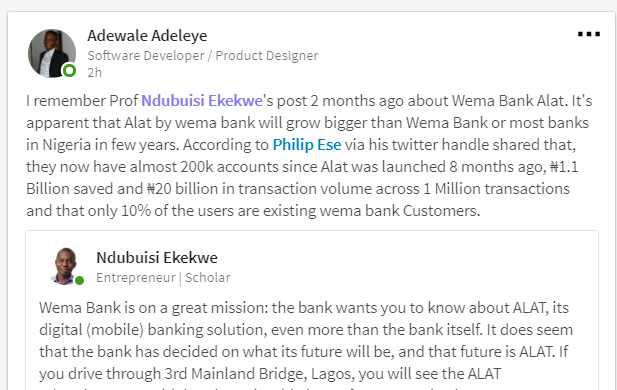
Wema Bank is having a great New Year. A LinkedIn user shared some nice stats which the bank posted on Twitter.

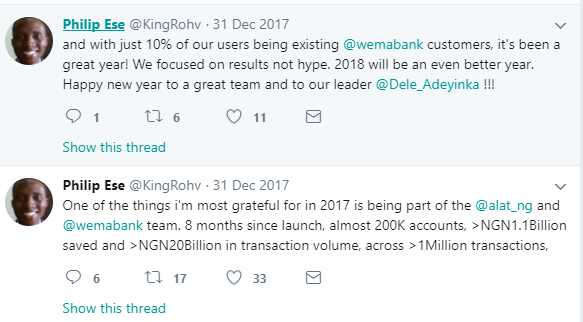
I remember Prof Ndubuisi Ekekwe‘s post 2 months ago about Wema Bank Alat. It’s apparent that Alat by wema bank will grow bigger than Wema Bank or most banks in Nigeria in few years. According to Philip Ese via his twitter handle shared that, they now have almost 200k accounts since Alat was launched 8 months ago, ?1.1 Billion saved and ?20 billion in transaction volume across 1 Million transactions and that only 10% of the users are existing wema bank Customers. 

In that post, the user linked to my piece on Wema Bank’s ALAT where I made bold predictions that in future, Wema Bank could either be folded into ALAT or ALAT be divested as a separate entity.

ALAT is the first step for Wema Bank. In the next few years, depending on its progress, ALAT can be divested from Wema Bank, to allow it to compete more aggressively in the African market without being tethered to a bank and the associated regulation. The regulation is important and there is nothing wrong with that: banks like Wema Bank take customer deposits, unlike most fintechs, and should be regulated. So, ALAT can become an operational arm of Wema Bank while the bank remains a dumb pipeline, typical of most traditional banks today (i.e. not much intelligence due to lack of deep insights), to support what that modern banking named ALAT does. Perhaps in 10 years, Wema Bank may even simply change its name to ALAT if this new modern banking solution evolves into its future.

Wema Bank’s ALAT numbers


The original tweets are reproduced below

The twitter update from the bank

The Implications

These numbers are significant because the implication is that ALAT is driving growth in Wema Bank. Wema Bank has about 1.5 million customers and hopes to push the number to 3 million through ALAT by 2020. Within 8 months, they have 200,000 on-boarded. My focus is not really the 200,000 customers in ALAT but the fact that Wema is attracting new people into Wema: “with just 10% of our users being existing @wemabank customers”. This is significant for the relatively small bank. Getting 90% of new customers through ALAT is very great. It would have been bad if it was only moving current customers to ALAT. So, ALAT offers growth to the bank.

ALAT is a bank, and it can become a truly African banking institution, if it pursues new opportunities in Africa, with growth typical in most highly scalable businesses. I am expecting the management to make ALAT a pan-African “bank”, and use it to redesign the banking experience for young people which it continues to pursue. Wema Bank is working. It is on ALAT now and that is a good thing.

There are many strategic things which the bank can do to scale ALAT across the ECOWAS region. The product has demonstrated that it can offer value to non-Wema customers since 90% of users are new to the bank. This is a fintech within a bank and the bank must take it and run with it. The bank needs to drive it with the fierce urgency typical in a high growth scalable business with a low marginal cost and a high scalable advantage. There is nothing that can stop this product from scaling when you look at the product design.

ALAT is digital which means that its marginal cost of adding a new user is close to zero, and with that capability it is not bounded by geography within Nigeria where the bank has license to operate. I expect ALAT 2.0 to anchor a redesign in Wema Bank where most of its branches would be closed even while making it easier for customers to do business. That will improve its cost-to-income ratio even when growing its customer base. Most Nigerian banks saw their digital products as extensions of their traditional products; Wema Bank’s ALAT was the only one that built something sequestered from the current for an opportunity into the future. From the naming and marketing, they diminished the bank to allow ALAT to glow. In other words, ALAT does not need Wema Bank and that removed any potential innovation hangover in the product design.

ALAT has sent an alert to the Nigerian banks. Wema Bank needs to sustain this product because it is one of the finest fintech products in the nation. It needs to use this product to drive its agency banking by linking it to voice banking. Also, that location-agnostic intra-African remittance should not be far away. ALAT is sending alerts and that is a good thing.


Here, I explain my reason for liking the ALAT Strategy

The American Terminator Paralysis

8

A man opened his door in Kansas, USA and was shot by police. There had been a swatting call which triggered military-kind response to the private home.  Unfortunately, video game players instead of killing virtual avatars played a heinous game that took a man’s physical life. Our prayers go to the families of the victim.

A feud between two Call of Duty players led to the death of a 28-year-old Kansas man, who was shot and killed by police after a fraudulent 911 call sent a SWAT team to the man’s private home.

[…]

In this case, Wichita local Andrew Finch, whose family members say did not play video games and was a father of two young boys, answered his door only to face down a SWAT team-level response. Allegedly, one officer immediately fired upon Finch, who later died at a hospital. It’s unclear why Finch, who is said not to have had a weapon on him, was fired upon. The Wichita Eagle reports that the police department is investigating the issue, which occurred late Thursday night.

In this piece, I am focusing on the trigger-happy American police force which is trained to KILL as they always shoot to the head or heart. In Nigeria, the police force is largely trained to shoot at the legs (unless there is an active criminal battle) with the main motive being to maim or stop motion. Yet, in the U.S, the problem is not with the men and women serving their counties and cities as police officers; the issue has to do with the laws, constitution and the environments the police officers operate.

In Nigeria, the police assume that the subject is not armed most of the time. In short, policemen go to arrest people in their homes (for domestic issues) unarmed. The power is in the uniform as they arrest people to settle disputes with neighbors. But in U.S., the policeman assumes the citizen to be 100% armed, always. The implication is that the policeman is coming with the assumption that he can be attacked or killed. And that is why bad things happen: a man calls the police, sees the police outside his house, comes out to meet the police, and ends up dead. Everyone is at risk: the caller, the suspect and the police.

Few weeks ago, a woman called the police in U.S. informing the force that she could not recognize people in her neighborhood. The police responded. The woman then walked to meet the police and the police shot her dead. Reason? The police did not see her hands as she was coming!

The Power of Policy

What is happening in U.S is largely driven by the U.S. Constitution and all the subsequent amendments which empower ordinary citizens to own and carry ammunition. The implication is that anyone of legal age with clean criminal record could acquire a gun. So, people can pack guns as though they are packing biscuits (cookies) and candies (sweets). And with that, the police assumes that every home is armed thereby going with all precaution biased to the safety of police officers. With that, any tolerance of error is practically eliminated because thinking too much could be tragic to the officers.

While it is easy to criticize cops for being too quick to reach for the gun—and more often than not, in the case of police brutality, it is correct to do so—we must understand that policemen, being humans, experience fear as well. There is sufficient evidence that explains why police officers fear for their lives when going out on patrol in bad neighborhoods. Keep in mind that officers are three times more likely to be murdered in high gun ownership states. It is therefore far more understandable and, more importantly, acceptable, for a police officer to draw his weapon in America than it is in any other country.

Contrast that with Nigeria where ordinary citizens are outlawed to own and carry guns. And because many people do not own guns, the police officers work on the assumption that they can go and arrest those two men that fought and broke glasses in the bar, last night, in their different houses, with no fear of being shot.

All Together

The deaths from police mistakes are unfortunate. But they will not stop in America because the root cause is not within the power of the police to fix. Since the American Congress cannot do anything about gun control under a Republican Congress and Presidency, we would continue to see the police training to follow the unique pattern of shooting as a core element of defense.

An ordinary Kansas citizen, Andrew Finch, is dead because of the fake police calls. But it is fair to extrapolate that in some places the police would have held fire despite the information they were fed. At least, someone could have waited to see him draw a gun before firing. But that was not the police training. Mr. Finch is dead. And you wonder how opening a family door, unarmed, could result to a loss of life.

America needs to fix its trigger-happy policing. But that will not happen because it is the tenet of the American constitution that is driving how the police force is trained, and subsequently act in the field. The point I am drawing here is that policies have impacts, and most times unless you can piece them together well, you run the risk of stimulating regrettable consequences. The gun rights in America could be the reason why the police force is always shooting even when police in other nations could have held fire.


Update: added a quote which I have in the comment section in the piece.

Duality Element: Move from Making Products to Platforms

3
Duality Element

Construction workers build platforms. Those platforms can serve bricklayers, carpenters, painters and anyone working in the project. In internet business,  great companies engineer products with duality: products which are also platforms. Facebook is a product and also a platform. The most valued top 10 tech companies in the world have products with platform duality.

In this piece, I explain why you must make 2018 a year to create platforms and not products. Just like construction platforms, platforms enable you to rewire your business logic with ease. Products are hard-wired and fixed. Platforms create digital customers while products make consumers; customers are better.


Two definitions:

“A product is anything that can be offered to a market that might satisfy a want or need. In retailing, products are called merchandise. In manufacturing, products are bought as raw materials and sold as finished goods. A service is another common product type” Wikipedia


“Platforms are structures that allow multiple products to be built within the same technical framework. Companies invest in platforms in the hope that future products can be developed faster and cheaper, than if they built them stand-alone. Today it is much more important to think of a platform as a business framework. By this I mean a framework that allows multiple business models to be built and supported. For instance, Amazon is an online retail framework. Amazon started by selling books. Over time they have expanded to selling all sorts of other things. Apple iTunes started by selling tracks and now uses the same framework to sell videos.” J. Clarks

The best modern technology businesses are platform-anchored, not product-driven. Facebook is a platform. Apple has a platform. Google runs as a platform. These are among the most valuable companies on earth. As marginal cost goes lower in the internet age, platforms will rise because of the positive continuum of network effects. From aggregation construct to one oasis strategy, businesses with consumer focused frameworks are wired to succeed if they are platform-oriented.

Because of this inherent platform-element, these great companies have duality in their natures: they are both products and platforms at the same time. Facebook has an app (web and mobile) which is a product. That app is also a platform which enables other applications (including 3rd party apps like WordPress plugin) to be built upon. The transition of Facebook app from a mere product to a platform was the reason it won over Myspace which was a product with no platform capability. As Clarks noted above, Amazon can keep adding more to its platform because it can grow its logic, unbounded. Facebook has extended its ecosystem to do more including messaging, video chat etc from the original text feeds. From the beginning of Facebook, the founders saw a platform in the business and not just a product.

The Key Design Difference: Duality

Product applications are wired with predefined logic which means they do only what you want them to do and nothing more. Myspace built a social connection app and nothing more. But in platforms, you do not have “hard-wired” logic states making it easier to reconfigure the ecosystems for different uses. Here, Facebook engineered a platform which makes it possible that it can do whatever comes in future. Once that happens, you see amazing scalability driven by network effects: a virtuoso circle where as more people use a digital product, the product gets more data which is used to improve the customer experience, and that improved quality attracts more users.

Any digital product that does not have the duality element will struggle especially in consumer market: you need the product and the platform as one to make progress these days. You need to build platforms because they have the elasticity to evolve with your business logic. Products are static and fade quickly as markets change. Platforms can grow without bounds, anchoring new opportunities on top. The business logic of integration, process and decision making are best handled on platforms over products in the internet space. With platforms, you have CUSTOMERS; products deliver consumers.

The Facebook Platform is an umbrella term used to describe the set of services, tools, and products provided by the social networking service Facebook for third-party developers to create their own applications and services that access data in Facebook.

The current Facebook Platform was launched in .The platform offers a set of programming interfaces and tools which enable developers to integrate with the open “social graph” of personal relations and other things like songs, places, and Facebook pages. Applications on facebook.com, external websites, and devices are all allowed to access the graph. (Wikipedia)

Because of Facebook platform, we see Like buttons and Comment sections to like, share and comment using Facebook on this blog. Just like we use construction platforms when building houses, when you mount them, you never know everyone who will use them. But you know that no matter who, the platform will help in the house construction. The platform supports the bricklayers, carpenters, painters and plumbers. Simply, it makes it possible for you to build on top of one project phase to another; from bricklaying to plastering to painting. Digital platforms do similar works: you begin with texts but over time, you have messaging, video, etc as products all integrated as one.

Comment on LinkedIn

This is an excellent comment, and we think it offers additional insight to the piece.

Digital platforms, be they transaction, innovation, integrated, or investment platforms have revolutionized how contemporary products and services are built and delivered. It moved the decision-making for products and services from inside to outside, which gave birth to “inverse processes’. With platform, customers become integral part in product development cycle, rather than mere consumers of whatever the business managers deem fit for them. Amazon’s Reddit, which technically gives everyone the opportunity to become an author and possibly the bestseller, even before the book is published. This is possible, because the potential readers are the ones to do the ranking, in place of relying on the judgment of gatekeepers (editors and traditional publishers), which sometimes might not be popular. Due to Facebook’s platform nature, it’s now a multi-sided platform, comprising the users, advertisers, developers and publishers; that’s what platform brings. Every business model is capable of engineering a platform, with proper governance structure, you do not just have customers, but fans. The Internet has reduced the entire globe to a single village, platform brings that to manifestation. Nice insights.