


Bottomline: New technologies are emerging around the world. They include technologies like cloud computing, blockchain and AI (artificial intelligence). Among them, blockchain is one of the most fascinating in that it can change the basis of competition across many industrial sectors. In this section, I explain the numerous opportunities available for African entrepreneurs and startups […]
How To Win Nigeria’s Digital Banking Competition
Nigeria’s GTBank key enabler which has helped it to run efficiently delivering industry-leading 40.2% cost-to-income ratio (CIR) will anchor its scalable advantage into the digital domain. At this low CIR number, the bank is strategically positioned to lead the new ecosystem of banking: digital. Simply, when the cost of doing business is cheap, a firm enjoys huge advantage in the competition. Yet, this digital banking competition is still open.
Yes, any Nigerian bank or fintech can win the digital banking competition. The key element is managing your marginal cost to be as low cost as possible, thereby making it possible to enjoy scalable advantage. Once that is done, other benefits will fall in line. If the marginal cost does not tend to zero, the fintech or bank will struggle to enjoy a huge scalable advantage that will deliver scale within the unbounded distributed internet channels.
Internet makes it easy to have low marginal cost, a major contributor on top of the broad ICT productivity gains we already enjoy on our businesses. With the low marginal cost, digital products do better. This ability to scale massively on internet via possibly zero cost is the reason why blockchain poses a threat to the banking industry. Blockchain technology can attain that zero marginal cost thereby moving customers to blockchain-based platforms. The key competitive weapon is any technology that delivers zero or near zero marginal cost. I recommend for Nigerian banks and our fintechs to critically examine the adoption of blockchain in their business processes.
Back to GTBank, it may be having a CIR of 40.2% but blockchain can make digital banking to deliver 5%. If that happens, you have changed the basis of competition. When that happens, you are talking of disruption. Any bank or fintech that gets ahead will have an immense advantage. I expect these evolutions as Internet matures.
- Remittance: As internet matures and the core elements developed, the world will have one “currency” and the elements of remittance will not be needed. Besides, the transfer of funds, if necessary, can be done without fintech in the midst. We already have companies doing remittance for free between U.S. and Europe. In future, that will not be a service because technology will make Internet to get all nations and their currencies to converge.
- Within a decade, moving money around the world will be free. It is already done. Circle which received funding from Goldman Sachs allows Americans and Europeans to move money at zero fee across the Atlantic. And that reminds me, if you have a technical team, put efforts to see how blockchain can improve your business process and save you so much money
- Payment: In a blockchain, no one will need a bank or fintech to facilitate payment. The buyer and seller can exchange blockchain transactions to effect deals. It is going to be an advanced mPesa where buyer pays seller through the mobile number, except that mPesa is not owned by any corporate entity
- Lending: With most frictions gone, lenders will lend to borrowers and all contracts sealed in the open general ledger of blockchain. The need for fintechs and banks will be limited.
What To Do
You must find a technology strategy to have a marginal cost as close to zero for you to win. Blockchain may be that path today.
Africa’s Sankofa Innovation Book Is Helping Entrepreneurs: My Exchange With One
This is a conversation with a subscriber on my new book – Africa’s Sankofa Innovation (subscribe here). This book is helping many people to think critically on how they execute their African business strategies. This is our reader’s conclusion: “Sankofa is deep. It’s worth the charge. Thank you”
This is an exchange on LinkedIn few hours ago with one of the subscribers (I have his permission to share). I formatted it to make it readable.
Reader: Good day Sir. I am confused trying to understande what you mean, when you stated on the 12.1 of Sankofo “How to Compete Against Conglomerates to Win” That is ” Accumulation Of Capabilities ” How did Dulfil Prima Foods accumulate these capabilities.
Ndubuisi Ekekwe: Greetings. Did you watch the video? Let me know. But if you check the video, the typical things say Dangote could have done like power plants, training school, etc are things Dufil did. It took the firm many years. So with those capabilities, there are no other way Dangote for example could be more efficient than Dufil in noodle making. Watch the video and let me know if there is any further confusion. We can skype and I will explain. The deal is to operate at the upper level of the competition pyramid
Ok. Let me watch the video, would let you know if any more issues. Have finished the text. Waiting for the next. Sankofa is deep. It’s worth the charge. Thank you.
Thanks. Cheers
Have watched the video and couple of others. Wow. I have had sleepless night on how to play at the upstream, even with the mobile cinema project that we are about to launch its 1st phase, the plans and challenges has been how to contend with potential challengers, how to dominate the sector over a short period and how when we get to the top. I never knew what we have been working on is Accumulation of Capabilities. And you so made it clear. What more can I say.
Thanks Eloka. Check Chapter 12.3 also to get the frameworks as you plan a cinema business. Those frameworks will help you in managing your cost. Can I share your comment on Linkedin? This last one. I want people to see the value on how this book can help people find insights on business. Thanks
Yes. The Open Model. It’s basically Aggregation Construct. By the 1st phase is building the network effect, where we expand the user base within a short period before the cinema presence.
Yes – you are connecting the pieces together now.
No. Problem air. You can share it.
[We continued discussing the business model]
How Amazon Will Fix Aba Shoe Sector In Nigeria
I am a fan of Amazon.com because Amazon works. I see how Amazon simplifies commerce through superior distribution system and efficient pricing mechanism. Amazon makes freelancers business people and supports people to earn income for things they enjoy doing on their spare time. Writers, craft-people and indeed anyone can find an opportunity to monetize a skill via the Amazon ecosystem.
(I have chosen Amazon because so far it is the only digital company that enters an emerging nation with loads of cash. In India, it is going with $5 billion. Contrast that with others that only come with enough money for sales offices.)
But I have not even thought about this particular experience captured by a Tekedia commenter:
… Africa and Nigeria in particular needs Amazon. Its not only in connecting small businesses with buyers, the Internet space will also thrive. Think about lots of bloggers like me that are struggling. On my website, I recommend books but I can’t find a good affiliate program to sell and earn commission on those books.
There are bloggers that writes about phones, laptops, fashion, ceramics, arts, but they are not thriving because they cannot really make money from what they do.
With Amazon and it’s Affiliate Program, a lot of value will be created both for the original sellers and the people writing about them.
Yes, Amazon can unlock value in the blogging community. The Amazon we have today is the spending Amazon, we need to have the making-money Amazon where Nigerians can operate shops on Amazon and make money. I have noted many ways Amazon will support and improve the African economy if it makes here with the same bravado it unleashes in U.S.
Amazon, if it comes to Africa, will invest in logistics which small businesses can use to improve e-commerce. Amazon will become the modern postal systems in Africa. In Nigeria, where none practically exists, Amazon will build one, for itself as first customer, and then open it up to enterprises to use in order to support its business. Most of the Amazon fulfillment centers in America are used by Amazon sellers. Africa needs that.
Amazon, if its makes it into Africa, will bring efficiency in the food delivery system. It will invest in preservation and storage of food, making sure that waste is reduced. Amazon is vertically and horizontally integrated and understands the meatspace more than any of the present operating peers in Africa. It will find a way to source local food items in local farms and will touch the lives of farmers. The vision of Whole Foods will be the one for Africa.
A content creator, unlike Facebook, Google and others that aggregate and feed on others, Amazon will invest in local contents for Amazon. You will see it build up Amazon Prime Africa with local contents that will give jobs to artistes and others. Instead of asking you to do it, Amazon will do it with you, providing the money.
Amazon will massively put money in local carpenters, apparel makers, etc to make sure they can produce enough to meet the demand in its ecosystem. It will lend money as it does in U.S. to those doing well.
Above all, Amazon will make sure that Africa intra-trade works. We rarely trade among ourselves because our trade routes are still linked to the colonial masters that built them. Amazon will provide a digital trade route that will decouple us from those colonial routes and offer a true emancipation.
The question is this – who can get Amazon, an evolving important company in the 21st century with increasing deflationary power in the U.S. economy to think Africa. It is the real deal because of its mantra of big and bold vision. Amazon may even build new airports across African cities to make sure its businesses work. Sure, you may say Amazon will dominate but the good news is that with its ecosystem business, it can only succeed when the locals are succeeding. That is why it is different.
I see a future, if Amazon makes it into Africa, for Amazon Africa virtual wallet to become the single African currency, because if everyone trades on Amazon, we can simply use its wallet to settle obligations across borders. This will work because Amazon is both a meatspace and cyberspace business, unlike any other.
The Aba Shoe Industry
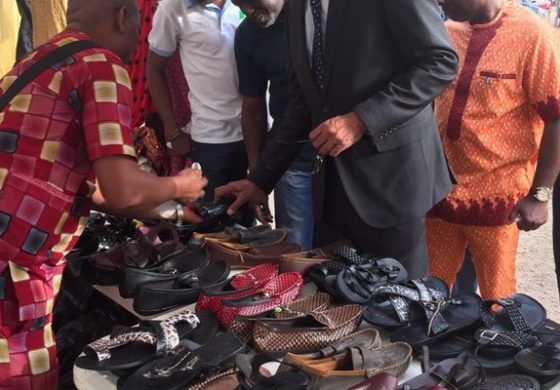
Today, I want to note that Amazon will solve the Aba Shoe sector mess. We have not been able to grow that sector for decades. Amazon could help to unlock it, by taking it global. The same can be said of the leather industry in Kano, arts in Osogho, and other crafts across the nation. Specifically, these are some things Amazon can do to fix Aba shoe industry mess:
- Support some shoe designers and get them to produce under a unique label. You can call it the Amazon NG label
- Amazon will provide a shared infrastructure at scale to make it easier for makers and designers to have access to tools and equipment they need to design and make shoes
- If Amazon NG controls some of the brand rights, it will support the shoe makers to expand capacity in production. The firm will invest to boost capacity for the designers so that they can produce more shoes and leather materials
- Amazon will help the shoe makers improve quality so that the shoes can be sold internationally
- Amazon will lead a globally structured advertising, using the Aba Innovations (Aba needs a city brand which has to be nurtured)
- Amazon is international with experience in the luxury and non-luxury leather materials. It will market the shoes globally
- Amazon will hire global anchors that can help make the message of Aba Innovations powerful around the world.
All Together
As I noted earlier this week that Amazon has a global ambition. Nigeria can be part of that global expansion plan: we have the population and we love to shop. Now is the time for the Nigerian government to send a letter of invitation to Jeff Bezos, the CEO of Amazon, and tell him that we are waiting for the firm. Jeff may consider that request and make it to Nigeria. Amazon is as important as Shell, Mobil, and GE in the future Nigerian economy, if not more catalytic. Now that we are transitioning our economy, through diversification out of minerals and hydrocarbon, to a knowledge-based one, Amazon can play a critical role through commerce.
Yes, Amazon will unlock the value in ecommerce and make multitudes of merchants in Nigeria by fixing the weakest link we have today in ecommerce: logistics. Nigeria has no strategy to fix this weak point, and without the resolution through a functioning postal service, the promise of ecommerce will not be possible. A company with capacity can support our ecommerce with capital and take our merchants global. Amazon has that pedigree.
Nigeria’s GTBank Secret Winning Formula

Bottomline: In this piece, I explain the secret winning formula of GTBank. Any bank can mimic that formula for similar results. An eminent banking institution in Nigeria, GTBank leads the industry with 40.2% cost-to-income ratio. Across many industry metrics, GTBank is leading or among the top three in the nation. But GTBank did not start […]