DD
MM
YYYY

PAGES

DD
MM
YYYY

spot_img

PAGES

Home Blog Page 7419

5G internet on its way with speed of 100mpbs in rural Africa

0

Intracom Telecom, a global telecommunication systems and solutions vendor, announced today that EOLO SpA, an Italian telecommunications operator focusing on ultra-broadband in sub-urban and rural areas, selected its WiBAS™-Connect for the implementation of an ultra-broadband wireless residential network across rural Italy. EOLO intends to complete the rollout of its new network within a period of 5 years, being the first to offer 5G speeds to homes and businesses.

Within the framework of this multimillion contract, Intracom Telecom will supply its Point–to-Multipoint (PtMP) systems to EOLO enabling the operator to deploy a wireless network to connect homes and businesses across Italy that cannot be reached by fiber and ADSL/VDSL. This first ever PtMP deployment will enable EOLO to improve its coverage (13 regions, 70 provinces) of Italy and offer internet speeds up to 100Mbps to its subscribers. The total agreed scope is for a PtMP network for several hundred thousand subscribers, consisting of base stations and CPEs operating in the 28GHz frequency band, recently awarded by the Italian government to EOLO.

The installation of WiBAS™-Connect is part of EOLO’s current extensive investment in its fast expanding network in the whole of Italy, aiming at becoming the first provider of ultra-broadband services to residential and SME subscribers in the country’s suburban and rural areas. The selection of Intracom Telecom’s Multipoint technology came following rigorous testing by EOLO experts. The WiBAS™-Connect was proven to be the optimal solution presently available in the market satisfying the long list of technical criteria.

Commenting on the project award, Mr. Luca Spada, President of the Board & CEO of EOLO, said: “As EOLO expands its coverage and introduces new value-added services for its subscribers, it was important to form a strategic partnership with a company like Intracom Telecom that can assist us achieve our goals to deliver 5G ready services in more regions in Italy, so to enrich subscriber experience.” Moreover, Mr. Spada added: “Starting from the second semester of 2017, a “5G ready” network, able to supply a real connectivity of 100Mbps in download and 50Mbps in upload, will support our country to achieve a leading position in 5G, with an important focus on those peripheral areas where fiber networks will not be deployed in the next years.

Mr. Mohamed Ahmed, President of the Board & CEO of Intracom Telecom, said: “We are delighted to partner with EOLO and support them accomplish their vision to be the first provider in Italy for Ultra-Broadband Internet connectivity to rural residential subscribers. We worked diligently with EOLO during the past years to provide our state-of-the-art technology to meet their high-end demanding requirements. We are determined to be part of their success.”

Intracom Telecom has been accumulating expertise for the past 40 years in providing innovative wireless access solutions, having successfully developed and deployed its Point-to-Multipoint systems with numerous operators in Europe, Southeast Asia and Africa, meeting the constantly growing demand for broadband access services.

Facebook Developing The Brain Operating System For Computing With Keyboardless Interface

0

During the second day of its annual F8 conference, the head of the social networking company’s mysterious hardware research division talked up the idea of letting people “type” commands or messages by using their minds. Don’t get too excited: it’s not ready to announce a product anytime soon. Meanwhile, it would love for people to try out its new 360-degree digital cameras, built for collecting video that could be used in virtual reality apps

Facebook is working to create a data input method that doesn’t rely on a keyboard, but instead allows the user to type directly from the brain, the company said at its two-day developers conference in San Jose, California.

“In a few years’ time we expect to demonstrate a real-time silent speech system capable of delivering 100 words per minute,” or about five-times faster than a person can type with a smartphone, said vice president of engineering Regina Dugan on the second day of the conference.

Ms. Dugan also heads Facebook’s hardware research unit known as Building eight, which has more than 60 scientists and engineers working on the new keyboardless typing method.

The input method could, for example, allow users to send a text message or email to a friend without taking out a smartphone to type.

Ms. Dugan also tried to calm consumers at the conference, saying the California-based social media giant isn’t interested in detecting a person’s thoughts, but only what the person intends to type.

“We’re not talking about decoding your random thoughts. That might be more than any of us care to know,” she said.

Ms. Dugan referred to research at Stanford University, which has allowed a paralysed woman to type at about eight words per minute directly from her brain.

But the current method requires invasive surgery in which an array of electrodes is implanted to receive data where the brain would normally control the person’s motor functions.

“That simply won’t scale,” Ms. Dugan said, referring the surgery process.

“So we’ll need new non-invasive sensors.”

Facebook is considering wearables such as caps that can read data through the human skull.

While the company may need years to produce a mass-scale device, any advances in the research have potential to be a huge breakthrough in human communications, Ms. Dugan said.

“Even something as simple as a yes-no brain click would fundamentally change our capability.”


Harvard Leadership Insights—Why African Entrepreneurship is Booming by Ndubuisi Ekekwe

0

Harvard Business School used this piece written by Fasmicro Group Founder for Harvard Business Review  in a recent newsletter. We want you to read again this great piece.


Across Africa, the collapse of the commodity boom has pushed countries and their citizens to invent other ways to survive. The cloud, open source software, cheap computing resources, and ideas from local technology hubs are redesigning the competitive landscape. Could a golden era of entrepreneurship anchored by local innovation be on the horizon? This Harvard Business Review article explores how some African economies are being transformed by the sheer power and optimism of their entrepreneurs. Continue read here.

Union Bank Unveils Centenary Innovation Challenge To Support Nigerian Entrepreneurs With Cash And Mentoring

0

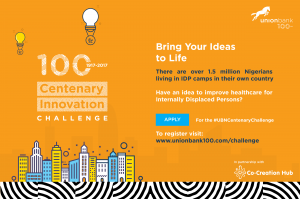
In celebration of 100 years of Union Bank, Nigeria’s simpler, smarter bank is running a Centenary Innovation Challenge to unearth and support good ideas for addressing critical social and business challenges in Nigeria in entrepreneurial ways.

The innovation challenge will engage eligible young and talented people across Nigeria to submit novel ideas to specific problem areas or thematic issues of interest to Union Bank. We will encourage applicants to propose innovative ideas that solve fundamental social and commercial challenges faced by Nigerians in a range of sectors starting in one community but potentially scalable across the nation.

Through the challenge, we hope to find hidden social innovators across the length and breadth of Nigeria, supporting them to develop their ideas and to scale leveraging digital technology and Union Bank’s reach and networks.

Individuals and partnerships (of not more than 3 persons) from university students, software developers, academics and entrepreneurs in Nigeria can participate for this program.

The competition will run in the following stages:

Call for Ideas | 12th April – 19th May, 2017

Idea Sprint Workshops | 18th April – 9th May, 2017

Pitch Preparation | 2nd June – 20th June, 2017

Pitching Session & Selection of Winners | 27th June, 2017

Incubation | 30th June – 15th December, 2017

Ideas Needed

You can submit ideas for applications, technologies, tools, services or other kinds of digital innovation. We’re particularly keen to hear great ideas for addressing the Sustainable Development Goals (SDGs) in entrepreneurial ways.

We’re particularly keen to hear ideas related but not limited to financial inclusion, agriculture and education etc. Ideas may be totally brand new or extensions of existing products and services.

We are open to all ideas as long as they are innovative, solve a clear problem and contribute to addressing the Sustainable Development Goals (SDGs).

How To Win

Winners will be contacted by email in May. Due to the volume of submissions we anticipate, only semi-finalists (top 10 ideas) will be notified once selection has taken place. The top 3 selected ideas will attract immediate cash prizes and further incubation support via the Co-Creation Hub (CcHUB) incubation services with full engagement with Union Bank.

The best ideas generated & submitted will leverage Union Bank’s expertise and the reach of its value chain to develop and scale. The top 3 ideas will receive immediate cash prizes of 2 million Naira, 1.5 million Naira and 1 million Naira respectively towards the execution of the idea. Further incubation support will be provided via the Co-Creation Hub (CcHUB) incubation services with full engagement with Union Bank.

Over the subsequent six months, the top three ideas will be supported with a range of services focused on product development, distribution and business modelling to turn their ideas into fully working products to launch in late 2017.


Amazon Unveils Lex As OEMs Tap Into Alexa, The Voice Operating System

0

Amazon released a version of its Alexa speech-recognition service to let developers enable apps for voice. The Lex service comes at a time when chip vendors, including Conexant, NXP and QuickLogic, are hopeful multiple OEMs will start shipping Alexa-like devices this year with their chips.

Amazon Lex is a service for building conversational interfaces into any application using voice and text. Amazon Lex provides the advanced deep learning functionalities of automatic speech recognition (ASR) for converting speech to text, and natural language understanding (NLU) to recognize the intent of the text, to enable you to build applications with highly engaging user experiences and lifelike conversational interactions. With Amazon Lex, the same deep learning technologies that power Amazon Alexa are now available to any developer, enabling you to quickly and easily build sophisticated, natural language, conversational bots (“chatbots”).

Speech recognition and natural language understanding are some of the most challenging problems to solve in computer science, requiring sophisticated deep learning algorithms to be trained on massive amounts of data and infrastructure. Amazon Lex democratizes these deep learning technologies by putting the power of Amazon Alexa within reach of all developers. Harnessing these technologies, Amazon Lex enables you to define entirely new categories of products made possible through conversational interfaces.

As a fully managed service, Amazon Lex scales automatically, so you don’t need to worry about managing infrastructure. With Amazon Lex, you pay only for what you use. There are no upfront commitments or minimum fees.

The news marks the latest foray in a battle of cloud computing giants using machine learning to attract users. It came the same day Facebook was encouraging developers at its annual conference to use new augmented reality capabilities powered by machine learning.

Analysts say Google has an opportunity to marry its superior search service with its Google Assistant, a voice service currently only available on its Pixel smartphones and a new model from LG. Apple is a wild card here with its Siri, an early entrant in the field.

Amazon’s Lex handles speech recognition and natural language processing as a Web service. The company announced support from a handful of early preview users including a bank, an insurance company and a non-profit.

All three of South Korea’s telecom providers already offer voice assistants similar to Alexa based on their own voice servcies and a reference design from Conexant, including KT’s GiGA Genie. “We expect to ship millions of units in Korea,” said Saleel Awsare, president of Conexant.

The company launched a reference design in December with software to link to the Alexa service. It already enables Microsoft’s Cortana on some Hewlett-Packard PCs and has had discussions with Google about its Assistant. “I believe in 2018 [voice assistants] will become the largest business for Conexant, said Awsare.

Conexant is working with a handful of OEMs for voice-enabled devices including a digital thermostat maker in Canada. Others want to add voice to set-top boxes, Wi-Fi extenders and even smart light bulbs, he said.

The company already sold nearly 500 of its voice developer kits at $299 each. It expects third-party products at or below the price of an Amazon Dot will hit the market this summer.

Amazon is believed to have sold as many as 7 million Alexa devices to date, mainly using audio chips from Texas Instruments. It claims it will enable 100 million systems for voice by 2020, largely through third-party products