DD
MM
YYYY

PAGES

DD
MM
YYYY

spot_img

PAGES

Home Blog Page 7438

What is IoT Digital Forensics?

0

Digital forensics, also known as digital forensic science, is a branch of forensic science encompassing the recovery and investigation of material found in digital devices, often in relation to computer crime.

It involves investigation of electronic devices to find data that can be used to solve a digital crime. With the proliferation of Internet of Things (IoT), a new field in digital forensics has emerged. It is called IoT Forensics.

IoT forensics is a branch of digital forensics which deals with IoT related crimes and includes investigation of the connected devices, the sensors as well as the cloud of data.

The Internet of things (IoT) is the inter-networking of physical devices, vehicles (also referred to as “connected devices” and “smart devices”), buildings, and other items—embedded with electronics, software, sensors, actuators, and network connectivity that enable these objects to collect and exchange data.

Here you are looking at your cameras, home thermostats, Alexa voices, wearable etc for signatures which can be used to solve crimes. The fact is that the ubiquitous nature of these devices present crime investigators with things they need to solve crime. It is already happening in America as reported recently where law enforcement went for these IoT systems to help investigate crime.

Inside, detectives discovered a bevy of “smart home” devices, including a Nest thermostat, a Honeywell alarm system, a wireless weather monitoring system and an Amazon Echo. Police seized the Echo and served a warrant to Amazon, noting in the affidavit there was “reason to believe that Amazon.com is in possession of records related to a homicide investigation being conducted by the Bentonville Police Department.”

Globally, there is a huge demand for ToT Digital Forensics Investigators. There is also a huge gap between demand and skilled resources available. This is an emerging field as it goes beyond just electronics to understanding AI, cloud computing and more.

Use of IoT Forensics in Crime Investigation

IoT results in interconnection of devices leading to these becoming smart. In case a crime occurs, say from a corporate set-up/organisation, investigators can easily mine data from all connected devices. This is becoming critical as data from our home sensors can be used to prosecute us, depending on the legal jurisdictions and privacy laws in that area.

Computer documents, emails, text and instant messages, transactions, images and Internet histories are examples of information that can be gathered from electronic devices and used very effectively as evidence. For example, mobile devices use online-based based backup systems, also known as the “cloud”, that provide forensic investigators with access to text messages and pictures taken from a particular phone. These systems keep an average of 1,000–1,500 or more of the last text messages sent to and received from that phone

Data, thus mined, can then be studied and analysed for user patterns and behaviour. Even minute aspects such as the data & time, location and even the IP address of an IoT connected device can be traced. This is at the device level itself, the data on cloud can also then be mined to validate data at the device level, and therefore a match can be obtained.

This will change crime and transform the world of criminal investigations. People through IoT will simply provide all the data prosecutors need to nail them in courts.

Crime Prevention with IoT

With smart sensors and IoT components, we can have a system that can respond quickly to any incident. These sensors can also immediately alert the concerned law authorities without the aid of a human to do so. In fact, this has been a trend from a long time in the western economies. This means that IoT can also do a good of good even as we surrender our privacy to it.

These tools will help identify and predict where security vulnerabilities can occur and help fix them. By picking data across different platforms including social media and news website, the tools will provide law enforcement the tools they need to efficiently and effectively deliver their services.

IoT will drive Predictive Policing where the Police may be steps ahead of bag people.

Predictive policing tries to harness the power of information, geospatial technologies and evidence-based intervention models to reduce crime and improve public safety. This two-pronged approach — applying advanced analytics to various data sets, in conjunction with intervention models — can move law enforcement from reacting to crimes into the realm of predicting what and where something is likely to happen and deploying resources accordingly.

Rounding Up

The future will be driven by data. And data will be very critical and fundamental in commerce and industry. Everything we will do will be driven by data. IoT will be the engine that will drive this collection of data. Digital forensics must evolve as IoT emerges with new promises. For the users, they have to understand that there is no promise of privacy because as more things move into platforms, law enforcement can have any data they want about you at any time.

How Palantir-built ICM, useful for mass deportations in U.S., can be used to fight Boko Haram in Nigeria

0
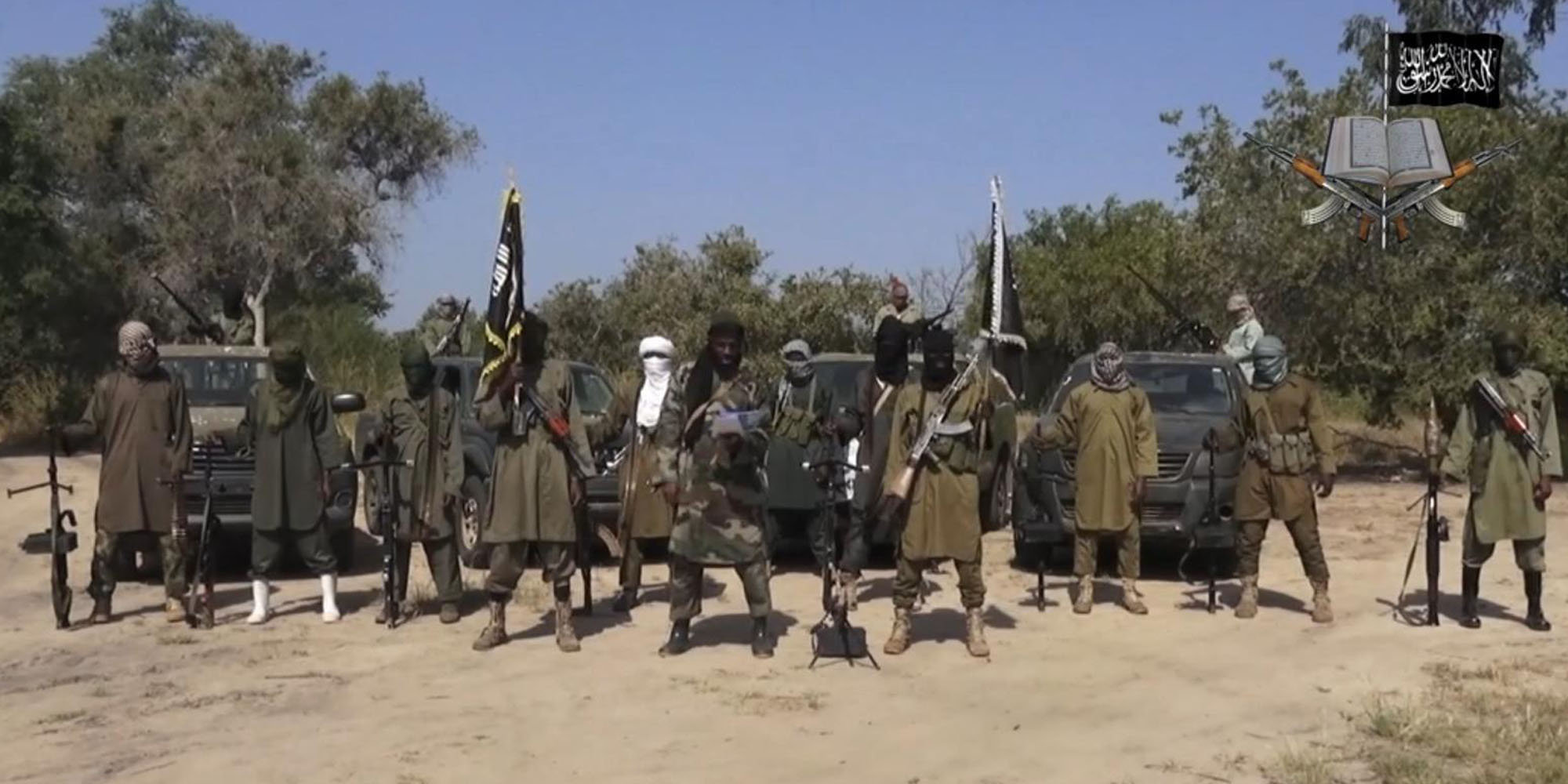
FILE - In his file image taken from video released late Friday evening, Oct. 31, 2014, by Boko Haram, Abubakar Shekau, centre, the leader of Nigeria's Islamic extremist group. Boko Haram fighters have shot or burned to death about 90 civilians and wounded 500 in ongoing fighting in a Cameroonian border town near Nigeria, officials in Cameroon said Thursday, Feb. 5, 2015. (AP Photo/Boko Haram,File)

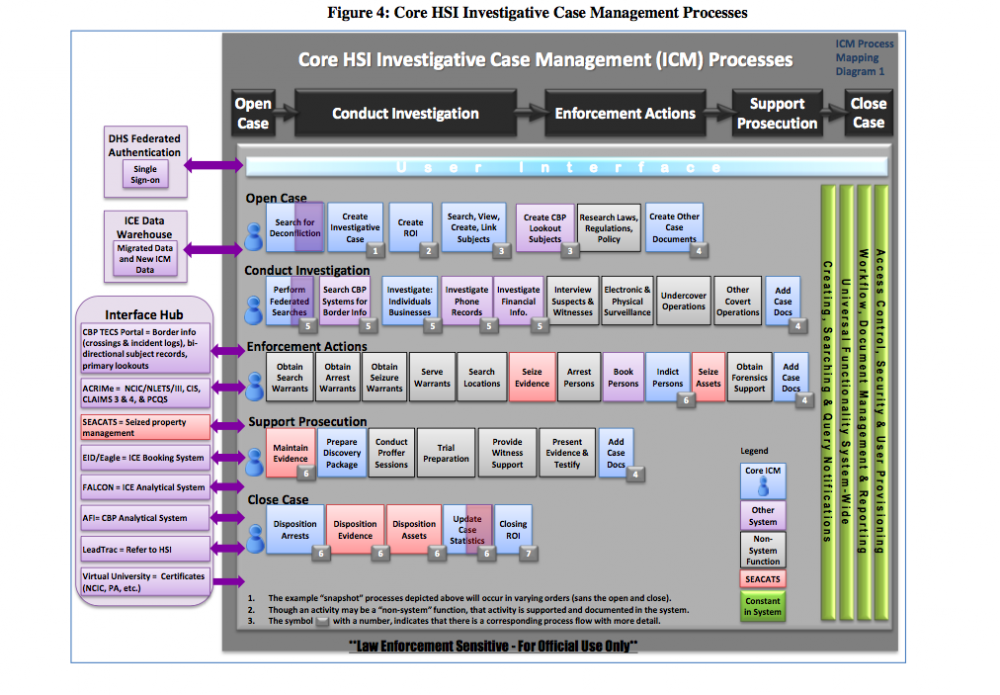
A new report from The Intercept details the new intelligence system called Investigative Case Management (ICM), built by Palantir, that is going live this fall and could assist Donald Trump’s efforts to deport millions of immigrants.  The system, developed through a $41m contract awarded in 2014, is designed to help ICE (Immigrations and Customs Enforcement) agents identify illegal immigrants by collating data from a half-dozen law enforcement databases.

By cross-referencing data from the FBI, ATF, DEA, and other entities, ICM can build a profile including a person’s job, background, schooling, relationships, address, criminal record, and other data. This can be used to drive mass deportations of illegal immigrants in U.S. President Trump has promised to do just that and one of the founders of Palantir, Peter Thiel, is a pal.

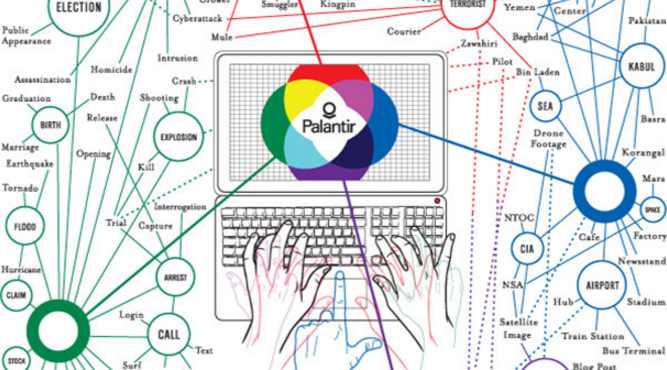
Palantir tech mesh

Why Nigeria needs better Intelligence

Nigeria is making progress on fighting Boko Haram. But it cannot afford to be like U.S. that won the war on Iraq but lost the battles with Iraqi people, making it possible for ISIS and other terror groups to blossom. Sustained intelligence is very critical:

Intelligence gathering refers to the process of collecting information relating to a particular organization or phenomenon based on a variety of information available within and outside the organization. Through intelligence gathering, a person may be able to forecast the future behavior or conduct of the organization in question as well as recommend alternative courses of actions in tackling future challenges. Governments and related security agencies such as armies or militaries and law enforcement agencies like the police usually use intelligence gathering to conduct researches on terrorist groups. Intelligence gathering entails collecting, reviewing and analyzing past and present information available about a particular organization or situation. Various techniques such as networking and mapping, imagery, observations and electronic communication can be used during intelligence gathering.

In relation to the Boko Haram group in Nigeria, the intelligence community may use intelligence gathering to collect information relating to the organizational structure, funding, operations and network or linkages of the group.

Nigeria Needs ICM Type of Solution

Palantir is a data-analytics company that does work for agencies like the NSA and the FBI. Nigeria needs an equivalent which can help the Police, SSS and other law enforcement agencies to be more effective in information gathering, analysis and application.

This solution must be innately Nigerian and cannot be an imported ICM (from Palantir) or any other foreign company. The Nigerian system will have an Analytical Framework for Intelligence engine, with capability to pull data from a host of national, state, and local law-enforcement databases to create profiles of individuals, including personal details, travel histories, and even social relationships. This can be modeled to detect patterns of behavior and stop the bad guys before they cause problems.

The National Assembly may need a new law to support building this solution in the country, if the existing law does not cover its creation.

ICE Interface

Who Can Build?

There are many startups in Nigeria that can help government build this solution. Government could use this as a vehicle to deepen the relationship between local companies and the state. A system that is organic and evolving can only be created by Nigerian companies.

The technology must be built with analytic heuristic capability to make sense of different data sets in varying formats. It needs three nexus – Fusion, Discovery and Knowledge Engine:

  • FUSION: Collates your data and transform into human understandable form
  • DISCOVERY: Searches your data to unlock patterns
  • KNOWLEDGE ENGINE: Provides insights from data

One company, Milonics Analytics, has components to make this work. There are other companies within CC Hub nexus that can step forward.

The fight against Boko Haram and terrorists can only be won with solid and refined intelligence. Nigeria needs that apparatus.

Rounding Up

Mr President is winning the physical fight against Boko Haram. The Administration needs to win the data fight. Building an ICM clone for Nigeria will be very critical in making sure the nation has the intelligence to have sustained success over terror today and in the future.

Nigerians comment on Prof CC Soludo’s “The Hard Facts To Rescue The Nigerian Economy” speech

0

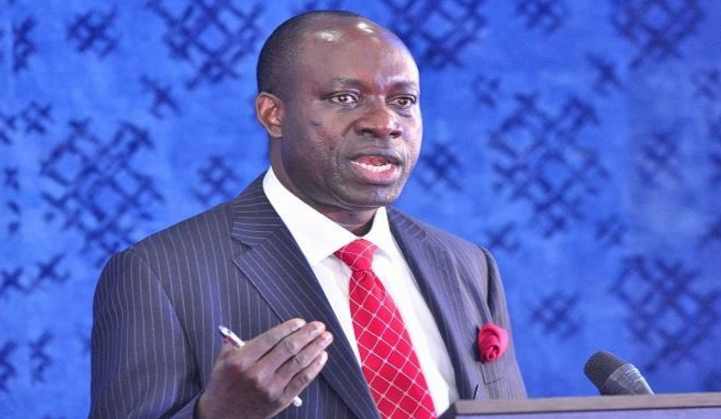
Whenever Prof CC Soludo, the former Central Bank of Nigeria governor, speaks, everyone listens. He is an eminent economist and one of the finest economic thinkers of his generation. Recently, in a program organized by the Vanguard, he brought that analytical vigor he has been known for years. Read his talk here.

Now the conversation is ON across the social media, on what he said, and meant for the recession-plagued nation – our Nigeria.

The Comments by Nigerians

We aggregate comments from Sahara Reports (here and here), Vanguard and other platforms.

  • Prof Soludo was not vocal during Jonathan Goodluck administration. Most accused him as being part of the “intellectual economy” with so many analyses and modeling but no action. Most Nigerians noted that Prof Soludo was part of the system in the past and barely built anything sustainable

This so-called “economic summit” was a sham. If you set up a Summitt and your keynote speaker is one of the perpetrators of the economic mess we find ourselves today, then the whole exercise is a fraud. Soludo should’ve been put on trial. Where did all the money go? What did you do to stop the greatest heist of a country’s wealth in human history? But, of course, Vanguard being a favorite mouthpiece for the Biafraudsters of the world, skews the reporting to fit their intentions. This was not an economic summit; it was a fraud.


The annoying thing about these so called economist and experts is that they had opportunities to move Nigeria forward but never did. They all looted and move down on leaving the economy and Nigeria worst than they met it.

  • He is speaking to power and many have branded him a Biafran.. “Any body that ever speak the truth to Buhari and his bankrupt clueless government is branded a biafran”. Yet, he has many supporters who appreciated his intellectual brilliance.

Soludo’s reasoning is higly realisitc. Arguabley most Nigerian professionals are simply a bunch of theorists. This one problem facing Nigeria. But Soludo is among the few who are very practical, able to translate theory into practice. At least many agree that when it was Soludo’s turn to serve, people saw the impact he made. No be small impact; real impact.


Soludo helped bring the economy down? Seriously? By his astute management of global economic headwinds that brought countries like USA, Uk and most of Europe to their knees between 2006 and 2008, Soludo cannot be faulted by an informed person, Nigeria was able to withstand the tsunami that pillaged most economies that period. This is notwithstanding the poor fiscal regime that prevailed that time. That we saw some measure of stability was down to his masterful application of monetary policy which is the turf of CBN. Introducing prejudice in discussing technical matters helps nobody.

  • The independence of CBN from the Presidency is a weak link and continues to affect the performance of any CBN governor in Nigeria. That will help explain the inaction and action of many governors of the bank.

The CBN was not independent of the FG for 90% of the time that Soludo was CBN governor. Soludo was heavily marked by OBJ who essentially directed and micro managed his workers. The year that the CBN under Soludo was given independence (during Yar Adua’s time) we know full well how the entire banking system nearly collapsed.

  • Nigerians want results and not analysis as many cannot understand all the analyses when nothing is working from one leader to another.

Mr Soludo, we have heard all the economic theories, Okonjo spent years saying similar craps but we are not in the lecture theatre, please suggest some practical solutions. You were the Governor of Central Bank, what did you actually do, Nigeria was not any good then

  • These past leaders have supporters and some Nigerians tend to appreciate,

Okonjo midwifed our economy into the largest in africa, GDP was growing at a rate of 3-5% year on year, FDI was increasing , Dollar was stable, and inflation was kept at a single digit.
Enter APC and clueless GMB, inflation is now 19%(its actually higher if you do the maths, it should be closer to about 50%), GDP is contracting year on year, Dollar exchnage rate has hit the roof, there are now at least 5 rates for FX in the country.

Its obvious APC and GMB have no idea of economics, but will continue to blame GEJ for the next 50 years if allowed.

Contrary to public opinion, Foreign reserves when GEJ left was higher than $25Billion, and considering that Ameachi took GEh and team to court to deplete both the foreign reserves and the ECA, that is to be expected. Especially taking into account that just before the 2015 elections, dollar was released to Fuel importers to clear a backlog of FX needed to import fuel into the country(i am sure you remember the fuel shortage then).

The problem is GMB has no economic idea, no economic policy, how will you explain a budget(2 years now infact) , where 100% of the capital expenditure was funded by loans? A budget 3 times higher than that when crude oil was at a high of $80-120, how will you explain a budget where GMB allocated 10 times what GEJ allocated to himself as feeding allowance?
Does that not reek to you of economic saboteuring?

Its not even like the budget increased to fund some heavy infratsuructure needs, we will have understood if that was the case.
But the budget increased bcos they need to fund and pay back their paymaster.
And so we r still left in a situation where our president after budgeting an hefty amount for aso rock clinic and shouting “Buy nigeria” is jetting out for any small illness.

Counter Proposal as Comments

One commenter proposed a new economic model with clear fiscal steps:

I just read this article and a number of things jumped out at me. 1. It concentrated on the state of the economy left by the PDP. It criticized the implementation of the TSA and macro economic monetary policy of the CBN (all points made by me over the years) and identified the worsening indices of the economic performance under the APC government. It also identified gaps in the recently released economic blue print of government. What it is lacking is any positive counter suggestions for the future that would aid economic regeneration. In a nutshell, it is a lot of hot air about failures of the past with no suggestion as to wise future actions.

My two cents for the government are as follows:

Fiscal steps:

1. Dispose of FG assets that require management of state run companies. It should only keep investments in those ventures that yield to it passive income without the burden of management (eg NLNG). This should reduce the govt wage bill and increase its net positive income.

2. It should change the constitution that allows states to exploit mineral resources within their states and keep 50% of the income derived therefrom. This will increase the income levels of all states and the income accruing to the FG. All states will be richer (some states will however be significantly richer than others). The Nigerian state will however by significantly richer. The solid minerals ministry cannot exploit, optimally, the resources found in 744 LGA. It lacks the manpower, resources, funding or staff to do that. The individual states will be able to do this much more efficiently.

3. The FG should significantly reduce the costs of government and if that means consolidating certain overlapping parastatals then so be it. Should there be an ICPC and EFCC?

4. Tax policies should be considered that gives tax advantages to business start-ups. That means reducing tax rates to banks, commercial landlords, etc that cater to small and start up businesses. Also give tax holidays to start – businesses in their first 5 years of operation.

5. Universities should be compelled to have courses that identify productive gaps in the Nigerian business market and train undergraduates on the benefits of self -employment.

6. Laws that make it difficult or expensive to start a new business should be looked at, addressed and repealed.

Monetary policy

1. Remove currency controls

2. Allow a managed floating rate of the Naira. Where the CBN has the resources to intervene then it should purchase Naira and sell dollars.

3. It should reduce interest rates and CRR rates. At the moment, the CBN should focus on growth and then address inflation by systematically reducing money supply in the economy as growth increases.

4. Encourage commercial banks to redirect lending to the small business sector and to the solid minerals industry sector.


Rounding Up

Nigeria needs DO-Tanks and not THINK-Tanks. We have so many analyses with no action. Soludo has served his country and he has rights to his comments. We do hope that those holding the different government positions are listening. It is not all that he says that must be taken into considerations. They have to balance his insights and do what is best for Nigeria today.

Our problem is that we do not have many great business leaders. Imagine if we can make 20 each of Dangotes, Elumelus, and Ovias within a decade. That is the economic thesis anyone will believe because that is practice in action.


Disruption, deteriorating market capitalization of Nigerian banks and how they could ignite growth

0

Former Central Bank of Nigeria Governor, Prof CC Soludo, noted in a new speech in Lagos that Buhari’s Administration may be unable to return Nigeria’s GDP (in US dollars terms) on where it met it in May 2015:

Let me make a point that most analysts miss namely, that in domestic currency terms, the economy is in a recession, but that in US dollar terms, the economy has suffered massive compression. Depending on the exchange rate used, the size of Nigeria’s GDP has shrunk from about US$575 billion when the current government took over to anything ranging from US$354 to US$232, and Nigeria has again lost the first and second positions in Africa’s GDP ranking. At the interbank rate of about N375 per dollar, the GDP is probably around US$288 billion but if we use the parallel market rate of about N465, then we are closer to US$232 billion. Think about this: in the previous 16 years, Nigeria’s GDP more than doubled in US dollar terms. In less than two years, the current government has managed to reduce the size of GDP in dollar terms to about 50% of what it met.  We will get out of the recession any moment from now— with oil price and output rising—but it will be a miracle if the government can return the GDP in US dollar terms back to the level it met it even by 2023!

That the economy of Nigeria is deteriorating is no news. In local currency, it is recession. In US dollars, it is a major compression since the dollar-naira conversation rate has changed dramatically.

The implication is that Nigerian banks are suffering, and investors are punishing them despite the fact that an average bank customer in Nigeria may not notice the dire positions of these banks. The banks still have nice looking offices and their officers drive good cars. They rarely lend, so for most customers, provided they can get their deposited monies out whenever they want, all is well!

Market Capitalization

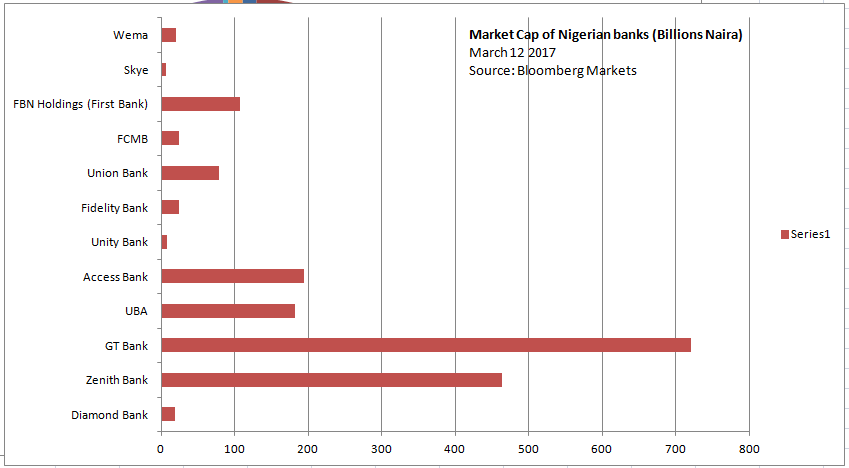
Using Bloomberg Markets, the following is the summary of market cap of major Nigerian banks in Billions of Naira, as of today:

  • Diamond Bank – 18.760
  • Zenith Banj – 464.040
  • GT Bank – 721.064
  • UBA – 182.123
  • Acess Bank – 193.528
  • Unity Bank – 7.832
  • Fidelity Bank – 23.470
  • Union Bank – 79.090
  • FCMB – 23.763
  • FBN Holdings (First Bank) – 107.327
  • Skye – 6.940
  • Wema – 19.287

If you convert the above figures to US dollars, most of the banks have no value, when you look from outside. They appear exceedingly cheap. However, foreign investors are not bouncing to claim them. The total value of most cannot pay a top American banker’s annual salary.

The only reason they have positive numbers (i.e. not negative market cap) is due to their real estate holdings. For example, Wema Bank has a strategic Head Office in Marina, Lagos. That building may cover most of the valuations investors are giving the bank. This means that in the core banking operations, Wema Bank has no zero value and its operation negligible in terms of creating value.

Growth Opportunities

The first thing is that these banks just have to hope that our economy will improve. And that means oil will flow and the militants will allow us to pump and sell them. That is the Nigerian way.

It is not likely they will do well if the economy continues to contract. Nevertheless, the following are potential opportunities in the local and African markets

  • Collaborate and challenge the Fintechs

Most banks will not notice it yet, Flutterwave and Paystacks are processing more electronic payments than them. This trajectory is expected to continue and if the banks cannot find a way out, they may be unable to change the trajectory of doom. Paga is making more money than Wema Bank. The lesson of U.S. banks on Venmo where they came together to challenge the Paypal company is a good recipe for Nigerian banks. They need their own fintech fast.

  • A totally single local currency-agnostic system

Africa is a very complex place to do business. It has multiple jurisdictions requiring visas. But payment must not be that way. One has to find a way for someone in Kenya to pay for goods in Nigeria without even thinking it was using the Kenyan currency. At the Kenyan interface, it sees the Shillings while the Nigerian counterpart sees the Naira. Everything is wired seamlessly underneath and it happens in real time. Nigerian banks with their tentacles in Africa have opportunities here.

  • Make it easier for other African businesses to do business in Nigeria

Nigeria is Africa’s most populous country and most ambitious African entrepreneurs are always thinking of Nigeria. Yet, Nigeria is not an easy place to do business. So must of them are skeptical. Nigerian banks could simplify that process and make it easier for banks to do business in the country. They could borrow the Stripe Atlas model.

With Stripe Atlas, entrepreneurs can easily incorporate a U.S. company, set up a U.S. bank account, and start accepting payments with Stripe. Starting today, it’s available to developers and entrepreneurs globally.

The promise of the internet is that location matters less. However, geographic barriers and associated complexity make it difficult to start a global business in many parts of the world.

Nigerian banks may have to do the equivalent which is centered on Nigeria for African companies.


Necessity for New Capital

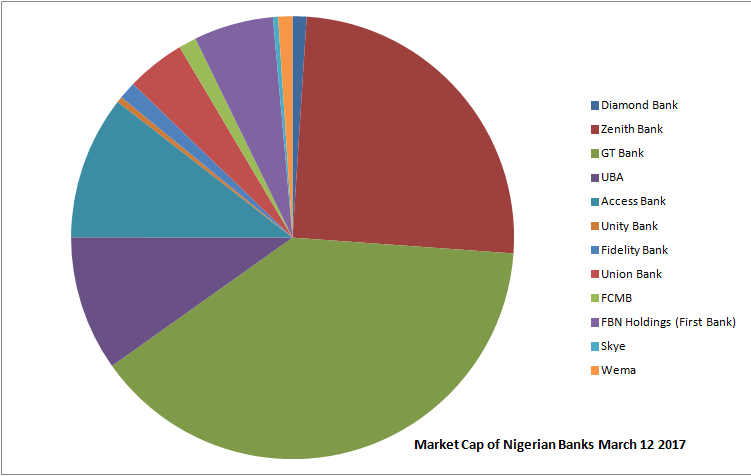
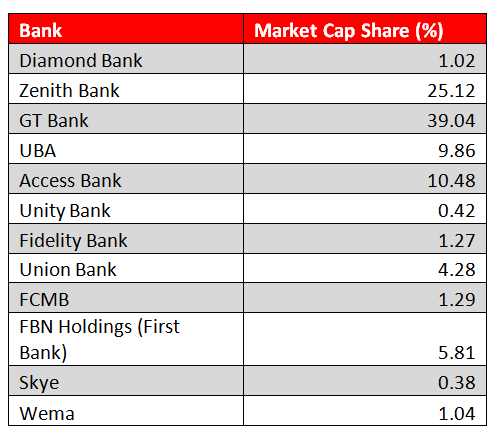
Most banks in Nigeria are seriously under-capitalized. GTBank and Zenith Bank account for more than 64% of the total market capitalization of the banking sector. (We have excluded ETI (Ecobank Trans) in this analysis since it is not really wholly Nigerian.) This presents these banks as clear leaders. Diamond Bank, Unity Bank, Skype and many others are rounding numbers. In short, GTBank can buy all the banks in Nigeria (with shares) with the exclusion of Zenith Bank. Government may have to think how to strengthen the sector as it is obvious that some cannot survive in an era of fintech which has brought erosion of bank fees.

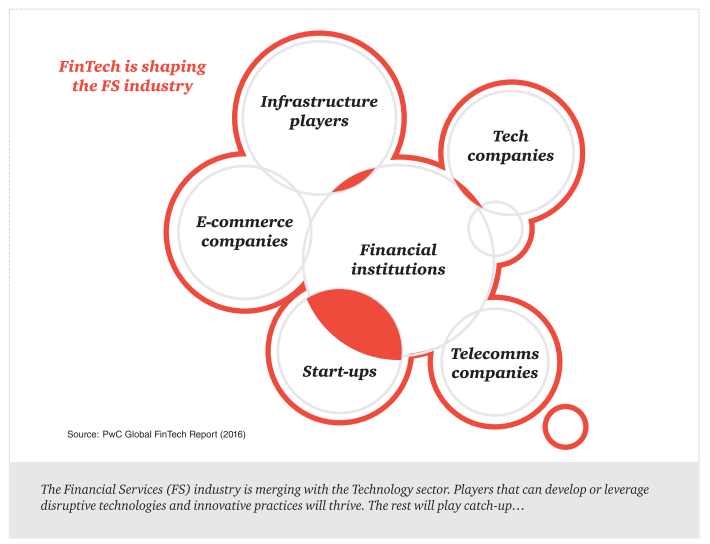
Banks need new capital because they are not just competing with other banks in Nigeria. The ecosystem of competitors are huge and they include telcos (Airtel Money via Access Money), e-commerce companies (Konga Pay), tech companies (Flutterwave) and more.

Rounding Up

It will be extremely challenging for most banks in Nigeria to continue to operate. Some of them could better pivot at this time or merge. That pivot could be redesigning their operations to be digitally driven. Unfortunately, that may mean closing branches and firing staff. Without that paradigm, it is not just clear how most of these bottom banks will survive in the next five years.Their problems are huge – they lack the capital to invest in new sources of growth and they will struggle to have scale to reduce cost which is very critical in the new banking era.

FinTechs are redrawing the competitive Financial Services landscape and blurring the lines that define players in the sector. Their offerings range from competing financial services such as alternative lending, to additive solutions atop existing banking services, to enabling technologies for the banks themselves. Capitalizing on the latest mobile, cloud and digital technologies, Nigeria is increasingly becoming home to many FinTech firms who are trying to shake up and be accretive to the banking value chain.

Findings from the survey by PwC also reveal that Nigerian Financial Services players see changing customer needs as the top impact FinTechs have on their business, with up to 60% of respondents indicating that up to 40% of financial services business will be at risk of standalone FinTechs by 2020.

There is never a time in Nigeria’s banking history for the Central Bank of Nigeria to demonstrate leadership. We are in a heavy banking crisis since without improving market caps, these banks will be timid in the markets. You cannot be talking of a deal of N10 billion as Unity Bank when your whole market cap is less than N8 billion. We are in economic stasis and banks need to move fast to avert a major crises in the nation.

“The Hard Facts To Rescue The Nigerian Economy” By Chukwuma Charles Soludo

1

1. Introduction:

Let me thank the leadership of Vanguard Newspapers for inviting me to lead the discussion on “The Hard Facts to Rescue the Nigerian Economy.” As I reviewed three of my recent interventions on the economy (“Buhari vs. Jonathan: Beyond the Elections” (January 2015); “Can a new Buharinomics Save Nigeria?” (November 2015); and “A Fragile State with a Failing Economy: Making Progressive Change work for Nigeria” (August 2016)) as well as the plethora of expert opinions, conference communique, lectures, memos and blueprints that adorn our media on a daily basis, I am not really sure what else to say. Implicit in the Vanguard choice of topic is that Nigerian economy is in dire need of a rescue, and many would agree. Let me frame the context of this rescue agenda with quotes from two voices that must know what they are talking about. On the state of the nation, the distinguished Elder statesman, Prof. Ango Abdullahi sums it this way ( February 12th 2017)

“Nigeria’s project is not working, after 50 to 60 years the Nigerian project is not working despite everything we went through, constitutional conferences, the country is at a standstill……It is unfortunate we are still where we were more than 50 years after independence and have not been able to move away from where our colonial masters left us”.

On the performance of the government that Nigerians have entrusted to rescue the situation, one of the shining lights of that ‘Team Nigeria’ has the following to say (Memo to the President which is circulating: I have received it from three persons —not from El-Rufai):

These inherited problems were aggravated by the continuing slide in crude oil prices and the renewed insurgency in the Niger Delta that reduced oil production by more than 50 percent! …. This, however, is merely the symptom and simplest explanation of our current economic problems. However, we cannot, after more than a year in office continue to rely only on this “blame them” explanation. We were elected precisely because Nigerians knew that the previous administration was mismanaging resources and engaged in unprecedented waste and corruption. We must, therefore, identify the roots of our enduring economic under-performance as a nation, and present a medium-term national plan and strategy to turn things around… We have no such clear roadmap at the moment…. In my honest opinion, we have made this situation worse by failing to be proactive in taking some political, economic and governance decisions promptly. In very blunt terms, Mr. President, our APC administration has not only failed to manage expectations of a populace that expected overnight ‘change’ but has failed to deliver even mundane matters of governance outside of our successes in fighting BH insurgency and corruption. Overall, the feeling even among our supporters today is that the APC government is not doing well……(Gov Nasir El-Rufai: September 2016).

The key point of Ango Abdullahi is that Nigeria seems to have been moving in circles since independence, while el-Rufai, in a rare patriotic duty, makes a frank wake up call to the President and the APC.

But there is a piece of good news. Finally, the Federal Government of Nigeria (FGN) now has an “Economic Recovery and Growth Plan” (ERGP) which is supposed to be its blueprint for rescuing the economy. I commend the effort. At least we now have something to frame policy discussion, and how we wish that this lecture and discussions are centered around an evaluation of the new Plan: Is it a plan for transition to post-primary commodity economy or more of the same?  In other words, is this plan the response to both Ango Abdullahi and El-Rufai as well as millions of other patriotic Nigerians who have called for a sense of direction to the ship of state? That will be for another day!

II: The FGN Response and Report Card So far?

To be fair, it bears repeating that the FGN inherited a bad economy. By May 2015, the FGN was already borrowing to pay salaries, and about 30 states had challenges meeting their salary obligations. The previous government had an unprecedented rate of debt accumulation even at a time of unprecedented oil boom, and was even depleting our foreign reserves instead of more than doubling or tripling what it met (it could have more than doubled the reserves if it grew it by just 50% of the rate of growth for 2004-2008); etc. Oil prices were falling, and disruptions of output in the Niger Delta made matters worse. Of course, insecurity, especially in the North East, was very high, and corruption was pervasive. The situation called for a state of emergency, with a progressive rescue team that could run at the speed of 1000 kilometers per hour to halt the drift and lay the foundation for a post-oil economy.

Most Nigerians acknowledge the FGN’s efforts in fighting insurgency (Boko Haram) and corruption. On the economy, it has implemented the Treasury single account (TSA) although we believe that it could have been implemented better without squeezing the economy of the much-needed liquidity at a time of recession; payroll audit and discovering thousands of ‘ghost workers’ (every government discovers these ghost workers); and a mishmash of command and control measures, demand management and exchange rate controls – all of which have wreaked havoc on business confidence and private investment, massive capital flight and driven the macro economy into recession.

Most macro variables have worsened significantly: inflation (from 9% to 19%); exchange rate (from 197/215 to 305/465); unemployment (from 7.5% to 14%); GDP growth (from 2% to -1.56%); market capitalization of NSE (from N11.658trn or $54.2 billion at parallel market rate to N8.658trn or $18.6 at parallel market rate— with daily trading down from around N11billion to N1 billion or less, i.e., about $2 million); poverty escalating; and youth agitations increasing. Business confidence remains very low at (-29) while competitiveness index remains a low 3.39 points and ranked 124th in the world. Foreign reserves remain depleted and the current account balance remains negative. Savings- investment rates are very low and Sovereign credit ratings worsened. Nigerian workers have suffered a double whammy: average nominal wages are declining while real wages dramatically shrunk (with high inflationary pressures). Asset prices have collapsed, and household wealth has shrunk. Paradoxically, Nigeria’s rank on the Corruption Perceptions Index remains unchanged at 136th position out of about 176 countries, while its ranking on the Fragile States Index has worsened from the 17th and 14th positions in 2014 and 2015 respectively to the 13th position in 2016 (down from 54th position in 2005). Many economic agents have lost count of how many exchange rates operate at the same time. The overall direction of macroeconomic policy was largely more of the same. On fiscal policy, FGN continued to spend over 100% of its revenue on recurrent expenditure (as done by the previous government) while borrowing ALL its capital expenditure. There remained half-hearted commitment to deregulation of petroleum pricing as well as privatization of refineries. The budgeting framework remained largely the same, with all the institutionalized inefficiencies (recall the ’budget padding’ scandals). Monetary and exchange rate policies were in their own world.

Let me make a point that most analysts miss namely, that in domestic currency terms, the economy is in a recession, but that in US dollar terms, the economy has suffered massive compression. Depending on the exchange rate used, the size of Nigeria’s GDP has shrunk from about US$575 billion when the current government took over to anything ranging from US$354 to US$232, and Nigeria has again lost the first and second positions in Africa’s GDP ranking. At the interbank rate of about N375 per dollar, the GDP is probably around US$288 billion but if we use the parallel market rate of about N465, then we are closer to US$232 billion. Think about this: in the previous 16 years, Nigeria’s GDP more than doubled in US dollar terms. In less than two years, the current government has managed to reduce the size of GDP in dollar terms to about 50% of what it met.  We will get out of the recession any moment from now— with oil price and output rising—but it will be a miracle if the government can return the GDP in US dollar terms back to the level it met it even by 2023!

I must congratulate the government for plugging some of the loopholes and stopping some of the bleedings. The challenge, however, is that much of these have focused on the MICRO: while trying to tie down the chicken, we are either stopping the cows from coming in or chasing them away. For example, while we are fixated with stopping the import of toothpicks and stopping the petty traders from taking dollar cash away, we have created havoc that have shut down many factories and with low capacity utilization, as well as ignited massive capital flight and halted capital inflows— with the attendant impoverishment of millions, escalating unemployment and inflation, etc. Put simply; we have missed the MACRO picture! While we are winning selected micro battles, we are losing the war on the MACRO economy. In November 2015, I argued that the policy direction of government was inconsistent with its stated objectives of economic growth, job creation, and poverty reduction, and that if it insisted on controlling price (exchange rate and capital controls) the way it was doing, the real economy (quantities) would adjust/contract with vengeance. I further warned that incomplete or dysfunctional adjustment would be costly. In a matter of months, Nigerian economy was plunged into an avoidable recession. Naturally, most people never admit their errors—but rather point to other “external factors.” The last PDP government was blaming “external shocks” while the current APC government blames not only the fall in oil price/output but also the past PDP government. No one admits to policy errors, and that is the problem.

Have we learnt any lessons from experience so far? We ought to, but I am not sure we did. One lesson we ought to have learnt is that we sought to re-write macroeconomics for Nigeria but sadly, the hapless millions of Nigerians have been the unfortunate Guinea pigs. A lesson is that the claim to Nigeria’s economic exceptionalism is false. Nigerians, like economic agents everywhere, respond to incentives and sanctions. Furthermore, the pseudo-intellectualism framed around infantile but insular nationalism does not offer a practical template for prosperity in the 21st century. It merely massages our emotions, offering no pragmatic action plan.  Another lesson is that Nigeria has refused to learn from the history of boom and bust cycles in oil/commodity prices. The current government is responding exactly like some did in the past: treating oil price/quantity fall as temporary while treating a rise as permanent/normal. It is merely embarking on short-term demand management—just as “coping strategy” while waiting for oil price/quantity to return to “normal, ” and we get back to business as usual. Every government (except those forced by external agencies such as the World Bank/IMF to undertake painful adjustments) have always skirted around the margins when faced with negative shocks and passed on the hard decisions to the next government. Every government since the 1970s has lamented a lack of diversification of export and fiscal revenues, but there has been no coherent strategy for a post-oil economy. Every government blames previous ones for “doing nothing” and promises to be the one that will “for the first time in Nigeria’s history” get the job done. The cycle continues!

III: Economic Recovery and Growth Plan (ERGP): Is it the Plan for Transition to a Post-Oil Economy that Nigeria has been waiting for?

First, we must commend the FGN for this major effort.  I will undertake a detailed evaluation of the Plan in the future. To motivate discussions here, let me raise just two or three points.

A.Whose Plan is the ERGP?

This might sound trite, but that is the issue. Ownership will determine whether the Plan is just a public relations document or will be implemented. I have seen a Plan where the President, in his handwriting constituted members of the drafting committee, commented on every page of the draft and even wrote some pages himself; spent 90 minutes every week at a meeting with heads of all economic MDAs to coordinate implementation, etc. There was the National Reform Council that included leaders of the National Assembly, leaders of the ruling party, etc. That Plan exceeded most of its targets and secured debt relief for Nigeria. On the other hand, I have seen several glossy Plans at state and federal levels prepared by bureaucrats and launched with fanfare by Presidents and governors and the rest is history.  More fundamentally, to what extent is the ERGP consistent with the APC Manifesto? The APC manifesto promised “a conscious plan for a post-oil economy”:

As a change Agent, APC intends to cleanse our closet to halt the dangerous drift of Nigeria to a failed state; with a conscious plan for post-oil-economy in Nigeria.  To achieve this laudable program APC government shall restructure the country, devolve power to the units, with the best practices of federalism and eliminate unintended paralysis of the center (APC Manifesto).

All previous Plans (see all the national development plans since the 1970s, SAP, NEEDS, Vision 2020, etc.) have all promised to diversify away from oil. How is ERGP different? (I read the Section on “ERGP’s New Approach,” and I am not too sure of the claims). Where is the new structure of the country that will deliver the new Plan? Where are the best practices of federalism that will eliminate the paralysis of the center— and alter the incentive system and drive competition in a post-oil world? How will you transit to the post-oil economy when the Plan is designed to intensify dependence on it and other primary commodities—agriculture and solid minerals? Or are we trying to repeat the same thing over and over and hoping for a different outcome?

B) Macroeconomic Framework as a Wish or More of the Same?

Some of the figures in the real sector and fiscal accounts as presented in the Plan are surprising. Except I am missing something, the numbers largely do not add up. Also, they are certainly inconsistent with the objective of moving to a new economy. Given the LEVEL of prices and GDP at market prices, the level of revenue/expenditure (about 3% of nominal GDP) or even declining capital expenditure (perhaps around 0.5% of nominal GDP), constitute a drop in the ocean. When the planners, therefore, state that “growth will be driven by fiscal stimulus…”, I wonder what exactly they mean by fiscal stimulus— with a budget of 3 – 4% of GDP? When you think of these figures in real terms, and for an anemic economy, there could be cause for concern.  The private sector ought to more than double its expenditure/investment to fill the slack. How will this happen with low domestic savings and reluctant foreign investors?  Needless to say, that the envisaged 15 million new jobs to be created during the Plan period is a nice wish. The growth vis-à-vis job accounting does not support such a wish. Up until 2018 (the last effective fiscal year for the current government), the Plan envisages to continue the practice of the last government of borrowing to finance recurrent expenditure. The deficit will continue to exceed the capital budget, meaning that every penny of capital expenditure will continue to be borrowed as done by the last government. So, what has changed? We do not see a clear program of action on what to do with the over 520 federal agencies and parastatals.

More fundamentally, the Plan talks with tongue in cheek about “improved implementation of a flexible foreign exchange rate regime to support growth.” On external balance, it talks about “expenditure switching policies to promote exports….”. Interestingly, there are no projections for the trajectory of exchange rate or foreign reserves. This is the elephant in the room. Let me say that in the context of any serious Transition Plan to a post-oil economy, the exchange rate regime, including a target path for a competitive real effective exchange rate (REER) will be decisive. It is not the silver bullet but like the advert for the American Express, ‘you don’t leave home without it.’ Attracting the badly needed foreign savings/investment as well as diversifying into competitive export-oriented industrialization will not happen without a competitive REER. You cannot accumulate foreign reserves on a sustained basis without it. The rapid accumulation of forex reserves and massive FDI and portfolio inflows in the period 2004- 2008 was not an accident. Take out the excess crude savings from our reserves, and one would see that the CBN’s component of the reserves grew very rapidly during this period ostensibly because we deliberately targeted to ensure that Nigeria avoided the Dutch disease syndrome (over-valuation of the real effective exchange rate) when oil price was rising. The IMF complained that the Naira was undervalued and pressured us to sell down reserves to mop up excess liquidity. We refused, and convinced them of the logic of our actions.  If we had not maintained an undervalued REER, the nominal exchange rate would have been around N70 -N80 but reserves at no more than US$20 billion (instead of $54 billion) at the start of the global financial crisis in 2008. The story of the Nigerian economy would have been a totally different one, and perhaps by now, the Naira exchange rate would have far exceeded N1000 per dollar. This is a subject for another day. My key point here is that the macroeconomic framework will remain dicey until we remove the huge uncertainty and opacity surrounding our exchange regime.

The Plan as packaged is a good effort, but regarding our expectations as a Plan for transition to a post-oil economy (as promised by the APC), it is a missed opportunity!  It is a generic plan, and in several aspects resembles the NEEDS document (designed for a different era) with some tinkering. It is a plan to consume the oil and commodity rents and not one to restructure to replace them. With rising oil price and output, the economy will recover and grow but in spite of the plan and not because of it. It will take the next oil/commodity shock for us to lament that we should have had a Plan to transit from oil/commodity dependence. I am willing to bet that not much will happen regarding the structure of the economy or the structure of fiscal and export revenues at the end of the plan. The Plan’s claim that by 2020 Nigeria would have made significant progress towards achieving structural change with a more diversified and inclusive economy is also a nice wish. If only we know precisely how to measure if we made “significant progress”! The next Plan will probably start by stating that this Plan failed to restructure and diversify the economy or achieve an inclusive economy. Every Plan, however, is a life document. Perhaps before it goes into full implementation, there is a need for Extended ERGP or ERGP Plus Plus!

Conclusion:

There is no doubt that the current FGN and most of the state governments mean well for Nigeria. However, the road to hell is always filled with good intentions. We have wasted too much time trying to reinvent the wheel and Nigerians are paying for it. It is never late to make a fresh and strong beginning. Our development path bypassed competitive industrialization which is sorely needed in the transition to a post-oil economy as well as to provide jobs for the millions of youths. But crafting and implementing a Plan to steer a totally new direction in a society already numbed by easy life from oil rents is not a tea party. Furthermore, politics is around the corner, and easy populism will stand in the way of the hard but painful choices that must be made for a new economy. Politics of survival will dictate business as usual or mere tinkering at the margins as we have seen so far. What Nigeria needs at this time is statesmanship politics: men and women ready to pay a huge political price to fundamentally lay a new foundation.

Editor’s Note: Charles Chukwuma Soludo, CFR is a Nigerian economics professor and a former Governor and chairman of the board of directors of the Central Bank of Nigeria. He was named Governor on 29 May 2004. He presented this paper during Vanguard Economic Discourse; March 10th , 2017 at THE CIVIC CENTRE, OZUMBA MBADIWE AVENUE, VI, LAGOS