DD
MM
YYYY

PAGES

DD
MM
YYYY

spot_img

PAGES

Home Blog Page 7438

Omatek Venture Founder Engr. Mrs. Florence Seriki is Reportedly Dead

0

The death has been announced of Engr. Mrs. Florence Seriki, the Founder and Chief Executive Officer of Omatek Venture  Plc, one of Nigeria’s pioneer and foremost indigenous Original Equipment Manufacturer (OEM), that specializes in the manufacturing of computers and other ICT devices.

The news of her death was announced this morning by Adebiyi Fashoyin, a close confidant and former Head of Corporate Communications at Omatek Computers.

“Good night, Amazon! The heavens are blazing forth, the death of the Princess! You were ahead of your time in spite of your humility and simplicity. Nigeria, nay, Africa lost an enigma, who gave me my first chance in Management. I am consoled that you named one of my children after yourself; Omatule. Death, where is your sting? I weep! I also smile at your timeless legacies. You were my friend, my boss and confidant. Your short but well accomplished life, is better than a century without a name.. RIP, Mrs Florence Seriki, OFR,” Adebiyi announced via his Facebook page.

Until her death, Engr. Mrs. Florence O. Seriki, MFR serves as Chief Executive Officer and Group Managing Director of Omatek ventures Plc.  She is a notable Entrepreneur and Industrialist who started Omatek Ventures Plc  about 25 years ago. She is the founder and Chief Executive Officer of the first Completely knocked down Computer Factories in Nigeria and Ghana.

She is a fellow of the Nigerian Society of Chemical Engineers. Nigerian Computers Society (NCS) and the Institute of Directors. She holds a Bachelors of Science degree in Chemical Engineering from University of Ife (now Obafemi Awolowo University).

Seriki is touted as Nigeria’s IT Amazon and has over a 150 national and international recognition awards; she has led Omatek in the last 25 years to become Nigeria’s only publicly quoted computer company; and helped to create massive  Local Youth Employment/Empowerment in the technology industry and has enabled Technology Transfer and increase in Local Content.

She was a former President of the Information Technology Association of Nigeria (ITAN)

How Africa can reduce waste and build a vibrant productive Circular Economy

0

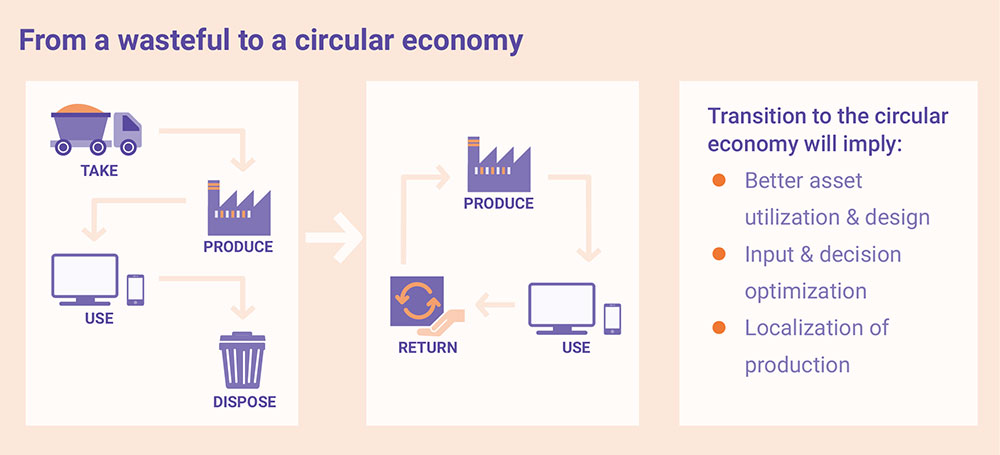
In Africa, emerging technologies like IoT, Big Data, 3D Printing and Blockchain will be at the heart of a shift from the traditional linear and wasteful ‘take-make-dispose’ economic model towards a circular economy which is restorative and regenerative by design.

A circular economy is one that is restorative and regenerative by design, and which aims to keep products, components and materials at their highest utility and value at all times, distinguishing between technical and biological cycles.

Globally, the circular economy opportunity is estimated to be worth USD 4.5 trillion by 2030. The combination of circular economy benefits with the ability of emerging technologies to create exponential change harbors greatest potential in Africa given the grand challenges the continent needs to overcome including those associated with shortage of food, water and energy.

Emerging technologies will play a critical role in supporting and scaling new circular economy business models that promise to catapult the continent towards the new age of industrialization. The virtuous and dynamic fusion of circular economy principles and technologies will manifest in the form of better design and utilization of assets, optimization and reduction of inputs and localization of production.

As ‘things’ become more and more intelligent they will generate volumes of rich granular data on run time. Cisco predicts the number of IoT devices to increase to 500 billion by 2030 and the total volume of data generated by IoT devices to rise to 600 ZB per year by 2020. Like in other countries, advancements in sensors, software, microprocessors and connectivity will also vastly enhance data storage and exchange in Africa. This will allow optimization of usage of connected objects and devices and also inform the design of more effective and durable products in the future.Tech-enabled enterprises in Africa applying circular economy models will also enhance asset reuse and contribute to a cleaner environment by delivering products as a service. Angaza offers a ‘pay-as-you-go’ platform in countries including Kenya, Tanzania, Uganda, Malawi and Zambia for selling intelligent and connected solar lighting devices. The connected devices can be directed to switch on and off depending on the user’s account balance.

Product Health has developed a connected device that helps users in Sub Saharan Africa track health of batteries that charge solar panels, using their phones. Its Smart Battery Dashboard uses algorithms to warn users of destructive battery use patterns based on readings of voltage, current and temperature.

If business continues as usual in Africa, its food import bill will rise to USD 150 billion by 2050, water scarcity will displace up to 700 million people by 2030 and it will take the continent till 2080 to achieve universal access to electricity. Emerging technologies like IoT, AI and Big Data analytics will accelerate application of circular economy principles to help Africa address these large development challenges by optimizing use of scarce resource inputs and facilitating smarter and better decisions. Innovations unfolding globally on this front hold greatest impact potential in Africa.

Aerofarms in the US for example, uses sophisticated analytics to cultivate crops indoors which significantly increases yields. The enterprise leverages advanced predictive analysis and diagnostics to grow crops without soil and pesticides, track their nutrient requirements on a run-time basis and cut water usage by 90%. In fact, the same circular economy principles of input optimization and wastage reduction are already being tapped by enterprises like UjuziKilimo in Kenya.

NUMBERS

  • The number of objects and devices connected to the internet will increase from 10 billion in 2013 to up to 40 billion in 2019 and to 500 billion by 2030.
  • The total volume of data generated by IoT devices is expected to reach 600 ZB per year by 2020.
  • Globally, consumer cloud storage per user will increase from 513 MB per month in 2015 to 1.7 GB per month by 2020.
  • The cost savings and productivity gains generated through “smart” device monitoring and adaptation are projected to create USD1.1 trillion to USD2.5 trillion in value in the health care sector, USD2.3 trillion to USD11.6 trillion in global manufacturing, and USD500 billion to USD757 billion in municipal energy and service provision over the next decade. (Source: Mercatus.org)
  • Global IP traffic will increase nearly threefold over the next 5 years. Overall, IP traffic will grow at a compound annual growth rate (CAGR) of 22% from 2015 to 2020. Monthly IP traffic will reach 25 GB per capita by 2020, up from 10 GB per capita in 2015. (Source: Cisco)

Ujuzikilimo uses a sensor-enabled data analytics system to measure soil conditions and quality to provide farmers with personalized SMS-based advice on managing soil and a range of topics including ideal crops to be farmed on their farms, required pest control and current market value of crops.

Emerging technologies such as 3D Printing, IoT, and Big Data will transform the way products are manufactured. They will trigger a transition to a more localized and decentralised production system that leverages circular economy benefits like reduced wastage, compressed supply chains and minimal logistics requirements and lower environmental damage. Such a production system promises to create opportunities for new enterprises and individuals to enter the supply chain using locally available resources.

For Africa, this shift translates to an opportunity to leapfrog into a new age of efficient, self-reliant and sustainable manufacturing. A promising start has already been made in this direction. A Togolese inventor Afate Gnikou built a 3D printer costing USD 100 from electronic waste. Tech-enabled enterprises are leveraging 3D Printing technology to develop prototypes of innovative low cost energy solutions like a portable solar power generator (Peppermint Energy) and bicycle-powered generators (Designs for Hope).

The continent needs to move from a wasteful system of economic production to a circular economic productive system to enable restoration and higher productivity.

We offer Industrial Attachment Opportunities for Nigerian Students

0

To Nigerian Students:

If you are looking for long and short term  industrial attachments (internships), in Nigeria, please contact First Atlantic Cybersecurity Institute (Facyber).

First Atlantic Cybersecurity Institute (Facyber) is a cybersecurity training, consulting and research company specializing in all areas of cybersecurity including Cybersecurity Policy, Management, Technology, Intelligence and Digital Forensics. Facyber is based in United States. with Fasmicro as its Nigerian liaison.

The clientele base covers universities, polytechnics, colleges of education, governments, government labs and agencies, businesses, civil organizations, and individuals. Specifically, the online courses are designed for the needs of learners of any discipline or field (science, engineering, law, policy, business, etc) with the components covering policy, management, and technology.

Programs are structured as Certificate, Diploma and Nanodegree programs with deep resources to support Learners.   Please see complete Facyber catalog and detailed Table of Contents.

Learn about:
– Cybersecurity Policy (Certificate, Diploma, or Nanodegree)
– Cybersecurity Management (Certificate, Diploma, or Nanodegree)
– Cybersecurity Technology (Certificate, Diploma, or Nanodegree)
– Cybersecurity Intelligence and Digital Forensics (Certificate, Diploma, or Nanodegree)

Our Owerri team will be responsible for signing your log book and you will work with them.
Regards,

Management

How to Reach us
124A Okigwe Road
Owerri, Imo State, Nigeria
Phone: 234(0)8107116861, 234(0)8036613606
Email: info@facyber.com

Great products like Uber could overcome many scandals. But do not A/B test it on your startup

0

We have seen all the scandals in the house of Uber over the last few weeks. Yet, many people are still hailing the service. Why? Uber is simply a great product. Bad PRs and scandals are bad, but for consumers, sometimes, when the alternative is terrible, they do swallow and still go for the scandal-tainted service.

Yet, do not A/B test that on your startup. You may not be as lucky as Uber.

Read this short piece from Fortune, culled from its newsletter, on the power of customer loyalty even in the midst of scandals for a brand.

Uber’s latest public relations fiasco comes via a report of how the ride-hailing company thwarts regulators with a dummy version of its app: When a would-be inspector opens the app, he or she is tricked with “ghost cars” that will accept a pick-up request, only to cancel it minutes later.

Pretty clever. Also pretty outrageous. While some libertarian types say Uber’s actions are justified, many more seem to think the stunt is further evidence of how the company is ethically unmoored.

You can also see it as another form of “growth hacking,” a Silicon Valley euphemism that describes breaking legal or moral rules in a quest for scale. The twist in this case is Uber’s growth hack, in the form of code named “Greyball,” took such blatant aim at the government.

The question is whether this will matter. In the case of consumers, they may cluck at Uber’s antics but are unlikely to abandon the company. Indeed, when I polled dinner party companions last night, everyone had heard the recent stories about sexism, driver misery, and Greyball. All of them tut-tutted—but also conceded they would take an Uber home because, well, the service is just so darn convenient.

And so it goes with consumers. They will express outrage on social media but ultimately keep using a product they like. The government, though, could be a different story. Many regulators are likely to take this personally and retaliate with a spate of subpoenas and fines, the likes of which Uber has never seen before.

My hunch is, for better or worse, Uber will weather this like it does everything else. In the meantime, CEO Travis Kalanik, who is looking for leadership advice, would do well to consult my colleague Adam Lashinsky’s helpful set of suggestions. /Jeff Roberts

Again, remember, it is better to hack growth without scandals.

Facyber Series: Introduction, Pros and Cons of Intrusion Detection System (IDS)

0

In our contemporary time, there is no question that IT internet security is a vital aspect of ensuring that your business is secured against malicious attacks. For those who are not still aware, once your whole system goes online, you leave it vulnerable to attacks in the real world.

Interestingly, the solution to protect your digitalware is modest that it is easy to ignore. A simple installation of a security software such as a firewall or an antivirus could be all that you need.

Intrusion detection system is a kind of security management which offers and manages online security for networks and computer systems. Intrusion detection system is a kind of security management, like another protection system for networks and computers. An intrusion detection (ID) gathers and investigates information from several areas of networks and computers to detect possible security breaks with both intrusions – attacks from outside the business – and exploitations.

This is usually supported with vulnerability assessment. Vulnerability assessment is designated as a scanning procedure and it includes technology intended to track the security of networks and computer systems.

Intrusion detection system works to:

  • Assess and evaluate system and user activities
  • Research system vulnerabilities and configurations
  • Evaluate system and file integrity
  • Identify and stop network intrusions
  • Implement role antivirus, anti-spyware management
  • Identify configurations typical of attacks
  • Check abnormal activity patterns
  • Monitor user policy violations

ID systems have increased because of growing responses, due to several attacks on major networks and sites, such as the White House-Pentagon, NATO, and the U.S. Defence Department. The cleverness of impostors towards technology has made the internet and computer security ever tougher.

Moreover, already tested procedures are easily available over the web demanding less technical skill to implement on targets.

The Intrusion detection system is planned to keep the system operational and active. The program examines for potential attackers from the external and then ensures they are impotent to run. They are indeed an essential module of internet security.

Basically an IDS performs as a research device which ensures that the system is not hacked by malicious attackers. These are systems which research data and also referee whether the data is safe or malicious. If the data is malicious, then the data covering the information will be prohibited and is voided from entering the system. An IDS functions as a gatekeeper between the company’s internal network and the outside world.

IDS can be specified as management system for both networks and computers. It is combination of software applications and architected devices with the aim of identifying violation of policies and malicious activities and generates report on that. Intrusion detection system can track any kind of abnormal, abusive or malicious activity that takes places in computer or network. It keeps track log of every single abusive or malicious activity. These logs are very essential for security professionals to set any rules or to take any steps against these activities. The logs kept by IDS can be used against a user as a proof to take any legitimate action.

Generally, intrusion detection systems often generate incorrect report of malicious activity. This leads to ignore the real malicious activity. One of the main features of most intrusion detection system is that they work upon packets which are encrypted.  To analyze these encrypted packets is complicated.

It functions in real-time, so IDS must be very thorough in carrying out its data research without causing lots of latency, i.e., introducing delay in information flow. Company staff who depend on the company’s system like the IT department will be highly affected if the system is taking much time to operate. This means that the IDS must be fast even when researching several other internal programs which may affect the functions and the speed of the systems.

IDS is essential for any network and company. Not only that it can protect data, but it can also enhance and reduce the time duration needed for the network to start up. Your kind of network and budget are the basis of selecting what intrusion detection system best fits.

IDS Pro

  • Response capabilities: Though they probably will be of limited use, you may require allowing some of the response aspects of the IDS. For example, they can be organized to end a user session that disrupts policy. Definitely, you must consider the threats of taking this step, as you may unintentionally end a lawful user session. Though, in some cases, it can be a key tool to avoid harm to the network.
  • Visibility:An IDS offers a clear view of what is going on your computer or network. It is a valuable basis of information about malicious or suspicious network traffic. There are some useful options to an IDS which enable you to monitor network traffic in depth.
  • Tracking of virus transmission:As soon as virus first hits your network system, an IDS will inform which mechanisms it compromised, as well as how it is spreading through the network system to infect other mechanisms. This can be much helpful in stopping or slowing a virus’s growth and ensuring you remove it.
  • Defence: An Intrusion detection system adds a defence layer to your security profile, offering a valuable backstop to some of your other security procedures.
  • Evidence:An appropriately configured IDS can generate data that can form the basis for a criminal or civil case against someone who exploits your network.

IDS Cons

  • More maintenance:Unluckily, an Intrusion detection system does not replace a virus scan, firewall or any other security measure. Therefore, when you install it, it will need extra maintenance effort and will not remove much, if any, of the present problem.
  • Personnel requirements: Managing an IDS needs qualified personnel. The less qualified your personnel are, the more duration they will spend responding to false positives. So you will be making not only more work for the IT department to manage but more tough work in some cases.
  • False positives: IDSs are known for situation of false positives, i.e., sounding the alert when nothing is amiss. Though you can pull the situations to decrease the number of false positives, you’ll never entirely remove the requirement to respond to false positives.
  • False negatives:Intrusion detection systems can also also fail to detect intrusions. Day by day technologies are improving, and IDSs may not necessarily catch everything. This means, it is not all the systems you need to be protected. You need to use more solutions.


This piece was contributed by First Atlantic Cybersecurity Institute (Facyber). You can register for Facyber today and take any of the Certificate, Diploma and Nanodegree programs on Cybersecurity Policy, Technology, Management, Forensics and Intelligence. The three-month Certificate programs begin at $200.