The federal government of Nigeria has opened the N-Power job creation portal. Applicants can now apply.
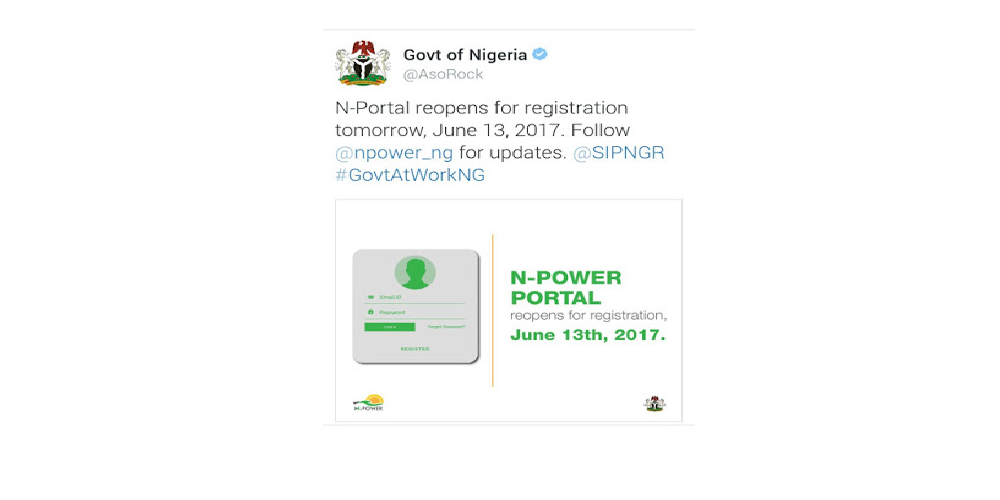
How To Apply
Go to N-Power Portal at www.portal.npower.gov.ng/
Choose your preferred program and fill in the necessary information.


The federal government of Nigeria has opened the N-Power job creation portal. Applicants can now apply.
Go to N-Power Portal at www.portal.npower.gov.ng/
Choose your preferred program and fill in the necessary information.
Nigerian episode does not look great. Everyone is not getting any decent deal in the contraction named Nigeria. Today, it is the Abuja natives. Everyone is protecting and no one seems happy. That is very troubling for a country.
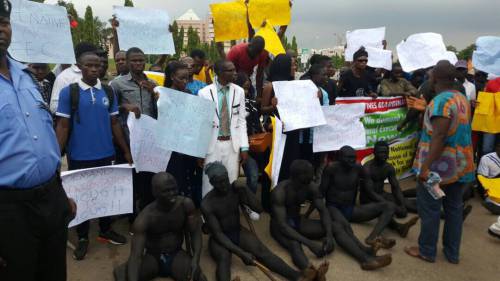
Natives of the Federal Capital Territory (FCT) today in Abuja protested half-naked to back up their campaign against the government for neglect and marginalization, and threatened a quit notice to all residents to vacate the city.
The group, under the umbrella of FCT Natives Marginalized Youths, handed down the warning after they brought their protest to the gates of the National Assembly.
Addressing the protesters, the leader of the group, Yinusa Buhu Bokunun, affirmed that for many decades the government has ignored the pleas of the FCT natives over their marginalization, deprivation and exclusion.
They accused the government of manipulating the constitution to discriminate and marginalize them, and demanded:
(1) Appointment of an FCT native into the Federal Executive Council for the purpose of geographical balance and equity.
(2) Creation of two additional Senatorial Districts and 4 additional Federal Constituencies.
(3) An elected Mayoral Council to form the legislative arm of the city Government.
(4) Integration of the original inhabitants in the development of the FCT, instead of resettlement.
(5) Creation of an Abuja Original Inhabitants Developments Commission to undertake specific infrastructural development.
Some photos, courtesy of Sahara Reporters
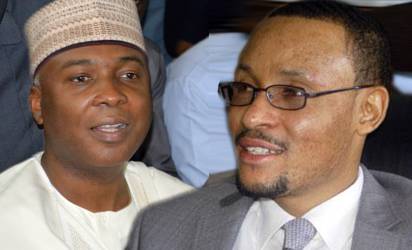
The Code of Conduct Tribunal today discharged Senate President Bukola Saraki in a stunning ruling delivered by the Chairman of the tribunal, Danladi Umar. Mr. Umar in a ruling delivered on the “no case” submission by Mr. Saraki held that the Code of Conduct Bureau had not established a prima facie case against Saraki relating to his false declaration of assets.
The Code of Conduct Bureau had in September 2015 slammed a 13-count charge of corruption on Mr. Saraki.
In charge number ABT/01/15, dated September 11 and filed before the Code of Conduct Tribunal, Mr. Saraki is accused of offences ranging from anticipatory declaration of assets to making false declaration of assets in forms he filed before the Code of Conduct Bureau while he was governor of Kwara state.
According to the charges, the Senate President was also accused of failing to declare some assets he acquired while in office as governor.
Among other offences, including allegedly acquiring assets beyond his legitimate earnings, Mr. Saraki was also accused of operating foreign accounts while being a public officer – governor and senator.
The offences, the charge said, violated sections of the Fifth Schedule of the Constitution of the Federal Republic of Nigeria 1999, as amended.
Mr. Saraki was also said to have breached Section 2 of the Code of Conduct Bureau and Tribunal Act and punishable under paragraph 9 of the said Fifth Schedule of the Constitution.
The charges were prepared by M.S. Hassan, a deputy director in the office of the Attorney General of the Federation.
The government later increased the charges to 17 on January 11, 2017. In February 2017, one more charge was added, bringing the charges to 18.
The Senate President pleaded not guilty to all the charges.
In a statement after the charges were filed, Mr. Saraki, said the processes were calculated to rubbish him, saying he was fully ready to assert his innocence.
“We therefore conclude that this is not an anti corruption driven case and cannot be part of the moves aimed at fighting corruption,” the senate president said. “It is simply a pure malicious and politically motivated prosecution aimed at undermining the person and office of the Senate President.”
He said the charges were based “on outright fabrication and mischief, will not and cannot stand the test of justice.”
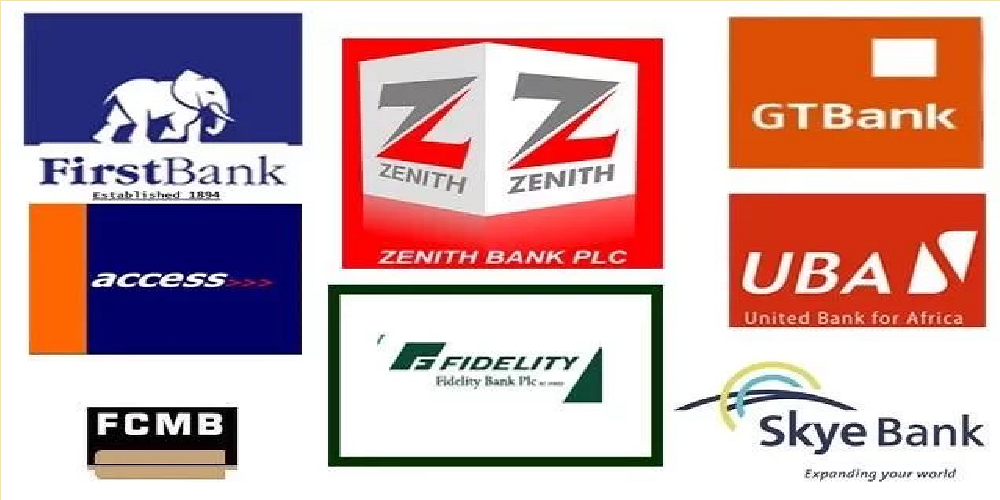
There is a huge problem in the banking sector in Nigeria. Excluding Zenith Bank and may be one other bank, GTBank can buy all the banks in Nigeria, at the present market capitalization values. Tier II banks are now going through a period where they cannot make money because the Tier I banks are pricing them out with better products. This is the beginning of a vicious circle which the Tier II banks have no way to get out. As profit erosion exacerbates through the fintech, many Tier II banks could collapse, if actions are not taken. We may be seeing fewer banks in Nigeria within three years.
The divide between the haves and the have-nots among Nigerian banks is widening, a report by Bloomberg has indicated.
At the other end of the scale, smaller lenders are scrapping plans to raise dollar loans and struggling to find investors to raise capital. Smaller banks are lagging behind as they battle rising levels of non-performing loans (NPLs) and capital buffers near regulatory minimums.
Do not expect this to stop. As fintech and technology erode further means of profitability, the Tier 2 banks could enter into major crises. This is a major asset-quality deterioration storm.
UBA, the third-biggest lender by market value, raised $500 million in its first Eurobond sale on June 1 at yields below initial guidance. This followed an equivalent issue a week earlier by Zenith Bank in a deal that was four times oversubscribed.
Unity Bank Plc, which missed a February 28 central bank deadline to recapitalise, has been in talks with investors since October, while Diamond Bank Plc started negotiations to sell businesses and issue debt over a year ago.
The central bank had to step in last year when it replaced the top management of Skye Bank Plc for breaching liquidity thresholds.
Ecobank Transnational Inc., based in Lome, Togo, plans to sell a $400 million, five-year convertible bond this month to refinance debt and provide short-term bridge funding for non-performing loans at its Nigerian unit.
Fidelity Bank Plc will decide in the third quarter whether to refinance $300 million of bonds due in May next year or issue new debt after seeing yields on the securities drop and strong demand from investors for Zenith and UBA’s notes, Chief Operations Officer Gbolahan Joshua said Tuesday. Access Bank Plc has $350 million of bonds due in July.
Local debt also comes at a price, with yields on five-year government bonds at 16.3 per cent. The Nigerian Stock Exchange Banking (NSE) Index has advanced 44 per cent this year, with UBA soaring 99 per cent to its highest since January 2014, while Access Bank has climbed more than 80 per cent to a four-year high.
Wema has gained less than 2 per cent and Skye Bank and Union Bank of Nigeria Plc are up about 10 per cent in 2017. Union Bank, in which former Barclays Plc Chief Executive Officer Bob Diamond’s Atlas Mara Ltd. owns 31 per cent, said in November it will sell as much as N50 billion in a rights issue scheduled to take place by the end of this quarter.
Sterling Bank, which announced plans to raise N65 billion in Tier 2 capital last July, managed to raise N7.9 billion in 2016 at 16.5 per cent, and is waiting for market conditions to improve before another issuance, according to Chief Financial Officer Abubakar Suleiman.
Without capital to back new business and write loans, small lenders risk falling further behind as Nigeria’s economy recovers from last year’s 1.6 per cent contraction.The International Monetary Fund (IMF) has forecast Nigeria will expand 0.8 per cent in 2017 as oil price improves.
Analysts believe that the increase in volume of transactions on the I&E segment is a positive sign of return of confidence in the financial markets as clearly demonstrated by the bull run on the stock market.
According to them, the investor sentiment has strengthened since the CBN introduced the I&E FX window, which they agreed has ensured greater flexibility in exchange rate determination.
The CBN on Monday injected $413.5 million into the interbank market in its unrelenting bid to guarantee liquidity in the market and shore up the value of the naira.
The naira remained stable at N363/$1 on the parallel market Tuesday.
Adapted from Bloomberg

IBM will integrate and scale XCC globally through the launch of a new offering called the IBM Connections Engagement Center
TIMETOACT Software & Consulting GmbH’s XCC, Web Content & Custom Apps Extension, is a digital workplace hub. The technology will join the IBM Connections Cloud platform and scale globally through the launch of a new offering called the IBM Connections Engagement Center, a single, accessible engagement center for organisational news and content. TIMETOACT Software & Consulting GmbH’s XCC, Web Content & Custom Apps Extension, is a digital workplace hub. The technology will join the IBM Connections Cloud platform and scale globally through the launch of a new offering called the IBM Connections Engagement Center, a single, accessible engagement center for organisational news and content.
The new offering will provide organisations of all sizes a single destination and intranet for personalised communication between a company and its employees, news sharing, embedded applications and other peer-to-peer collaboration.
“As digital technologies transform the way we work and live, the need for the digital workplace has become undeniable,” said Inhi Cho Suh, General Manager of Collaboration Solutions, IBM. “TIMETOACT GROUP’s XCC will strengthen the IBM Connections portfolio by providing tools organisations need to increase employee engagement and reduce content fragmentation, enabling individuals to work and communicate more effectively across their organisation.”
IBM Connections Engagement Center is expected to be available in the third quarter of 2017.