DD
MM
YYYY

PAGES

DD
MM
YYYY

spot_img

PAGES

Home Blog Page 7452

Simply Affordable, $200 for 3-Month Quality Cybersecurity Training

0

Prepare or gift a new career in 2017. Cybersecurity and digital forensics are careers in high demand and First Atlantic Cybersecurity Institute, Pittsburgh USA (Facyber.com) provides the education needed to enter these fields.

Our online learning programs are flexible and affordable and come with a (first week)100% money back guarantee.

Learn about:
– Cybersecurity Policy
– Cybersecurity Management
– Cybersecurity Technology
– Cybersecurity Intelligence and Digital Forensics

Each program category is independently phased as Certificate (online 12 weeks), Diploma (online 12 weeks), and Nanodegree (1 week live). Our programs are relevant for engineers, lawyers, policymakers, law enforcement, health professionals, students, investors, bankers,insurers, etc as they cover all areas of cybersecurity – from policy to technology to management.

Start today and you can finish your program in a few months with real world skills you can use on the job. Alternatively, gift it to someone you love (cousins, friends, students, children, etc). He/she can begin a new journey to a new career.

Grant Special!
Enroll or gift a certificate program for only $200! (The cost is now very low owing to a grant suport.) Paypal, debit & credit cards, and bank transfer supported across Africa and beyond

The Program Catalog and detailed Table of Contents are well documented.

We’re looking for local partners across Africa to help promote our programs. For more, contact Audrey Kumar via info@facyber.com
Facyber Receives Grant, Reduces Cybersecurity & Digital Forensics Training Costs in Africa

1

First Atlantic Cybersecurity Institute (Facyber) has received a generous grant from Security for All to facilitate our efforts to inform, educate, and train people on critical areas of cybersecurity, with specific focus on continental Africa.  As a result of this grant, we are cutting our training costs drastically as follows:

  • Certificate Program(Online 12 weeks): $200
  • Diploma Program(Online 12 weeks): $600
  • Nanodegree Program(Live Virtual 1 week): $1200

First Atlantic Cybersecurity Institute (Facyber) is a cybersecurity training, consulting and research company specializing in all areas of cybersecurity including Cybersecurity Policy, Management, Technology, Intelligence and Digital Forensics.

The clientele base covers universities, polytechnics, colleges of education, governments, government labs and agencies, businesses, civil organizations, and individuals. Specifically, the online courses are designed for the needs of learners of any discipline or field (science, engineering, law, policy, business, etc) with the components covering policy, management, and technology.

Programs are structured as Certificate, Diploma and Nanodegree programs with deep resources to support Learners.   Please see complete Facyber catalog and detailed Table of Contents.

With this grant, our programs are now more affordable as we continue our mission to educate people on key aspects of cybersecurity.  These online learning programs are also flexible and come with a (first week) 100% money back guarantee.

Learn about:
– Cybersecurity Policy (Certificate, Diploma, or Nanodegree)
– Cybersecurity Management (Certificate, Diploma, or Nanodegree)
– Cybersecurity Technology (Certificate, Diploma, or Nanodegree)
– Cybersecurity Intelligence and Digital Forensics (Certificate, Diploma, or Nanodegree)

Start today and you can finish your program in a few months with real world skills you can use on the job. Alternatively, gift it to someone you love (cousins, friends, students, children, etc). He/she can begin a new journey to a new career.

Select a course and enroll today – http://facyber.com/our-courses/ . We support PayPal, credit/debit cards, bank transfer and other popular payments methods.

Contacts

Audrey Kumar

Director, FACyber Institute, USA

info@facyber.com


This program is being modified.

The Limits of Impossibilities for new Generation of African Entrepreneurs

0

Africa is at the epicenter of digital innovation for social development. The significant development challenges coupled with the lack of legacy systems and infrastructure positions the continent as a hotbed for technology-led innovations that can trigger exponential impact. Although a beginning has been made towards this direction, significant whitespaces currently exist.

The whitespaces are considering only enterprise-led use cases and excluded experiments and projects. Some of the use cases which have cross-sectoral applications were mapped to development challenges where they promise to have maximum impact, in the continent.

Beyond speed and deep insights: Most emerging technology use cases in Africa currently focus on either enhancing speed of delivery of products and services or facilitating deep insights to improve decision making and product performance. Emerging technologies, however, are capable of triggering much greater impact which is all the more critical in the context of Africa’s large development challenges. These technologies can enable heightened customization of solutions and democratization of access for BoP populations. They can further converge to have potentially disruptive effect on existing industry structures and create system changes. Currently there is a dearth of innovations that promise to bring about these higher levels of impact and innovators in Africa and from around the world can capitalize on this whitespace.

Beyond Financial Inclusion: Almost half of the enterprises we identified were mapped to the development challenge associated with expanding choices for the BoP and reducing their vulnerabilities via financial inclusion. This includes a few which do not directly focus on financial inclusion but empower other enterprises to expand BoP choices. However, beyond financial inclusion there are other major development challenges in Africa that emerging technologies can help address. Innovations are particularly sparse around creating a future-ready workforce (5%), managing the competing usage of water and the interplay between water, energy and food security (5%) and securing low carbon energy security and combatting climate change (9%).

Beyond Internet of Things: Most of the innovative emerging technology applications in Africa are currently unfolding on the IoT front while evidence of use cases is relatively limited for technologies like AI, Big Data and Robotics. Innovations using sensors and wearables are finding applications in various sectors. This is partially due to the fact that globally, IoT as a technology is at a relatively more advanced stage of development compared to these other technologies. Having said this, interestingly enough our scan revealed quite a few enterprises working on Blockchain innovations although these use cases are still at early stages of development. Going forward, as internet penetration and digital connectivity expands in Africa, the case for leveraging the other emerging technologies like AI and Big Data is expected to grow stronger.

Local whitespaces exist and are waiting to be unearthed : Africa is an expansive continent comprising of 54 countries. These countries present vastly different demographic, socioeconomic, political and cultural settings implying a range of potential applications emerging technologies can have, when contextualized to each country. We believe that through this report we have only scratched the surface and that significant whitespaces for spurring emerging technology innovations at the country level are waiting to be unearthed and explored.

Turning our tech vision for Africa into reality can be sooner than we think, if we create a nurturing environment and step outside our traditional boundaries. Governments, regulators, donors, investors, corporates, and innovators have a role to play in shaping tomorrow and becoming part of Africa’s high impact tech innovation ecosystem: Through collaboration, we can find new ways of providing capital into underfunded white spaces, closing the talent gap, creating an enabling policy and regulatory environment, and triggering necessary behavior changes.

For new generation of African entrepreneurs, these challenges and what seem to be impossibilities certainly have their limits in stalling their ambitions. Tomorrow can be re-designed to provide enormous opportunities for a continent that desperately need innovations. We think the convergence of people, new processes and emerging tools will usher that new promise of Africa Rising, anchored on the new breeds of its entrepreneurs and business-people.

Intellecap is committed to drive this conversation and to jointly with like-minded organizations pursue outcomes around the following opportunities:

  • Risk-taking innovation capital
  • Open-source knowledge infrastructure
  • Building robust cyber-security infrastructure
  • Creating an enabling environment for tech convergence

Intellecap contributed to this piece.

Numeraire’s Richard Craib Adopts Nigeria’s Naira Currency Symbol for his Hedge Fund Cryptocurrency

0

Most Nigerians always think that we do not have many things other nationals could be jealous of. In the sea of our corruption, perpetual darkness and Boko Haram, we should be off the minds of many. Yet, despite these challenges, the world continues to care.

The world comes for the oil and they ship them out. They open bank accounts for our politicians in Switzerland and they steal our money.

Now, our national currency symbol is under attack by hedge funds in Wall Street. We like the Naira – not because of the absolute value which is deteriorating but because it is part of the things that define us as Nigerians. Everyone grows knowing the Naira and we treasure it.

The Naira sounds great and the symbol, ?, is also supremely appealing.

Now, someone is adopting it in the name of making money in Wall Street. It is not clear why he could not make a unique symbol instead of cloning a national currency symbol.

Twenty nine year old South African, named Richard Craib, with funding from the likes of Union Square Ventures, is launching its own cryptocurrency, the Numeraire.

It is the first virtual currency issued by a hedge fund and one of the first released by a company (rather than a group of developers or a non-profit). Numerai is ensembling machine intelligence from thousands of data scientists around the world to achieve breakthroughs in stock market prediction accuracy

Richard Craib

According to Forbes, the company plans to redesign finance and the hedge fund business with the wisdom of the crowd.

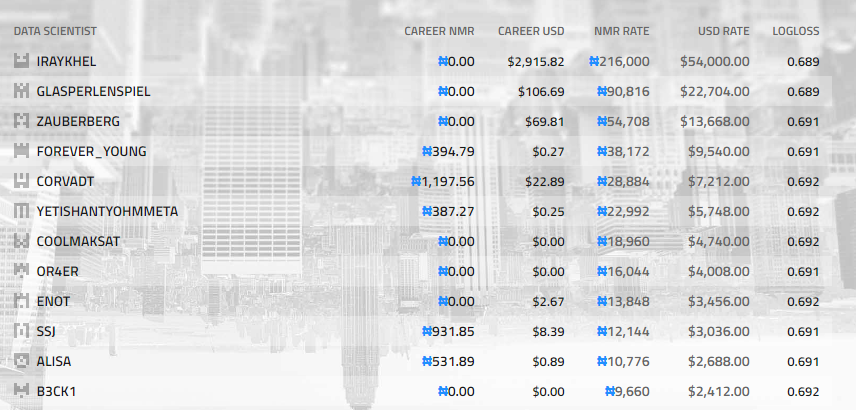
Data scientists entering Numerai’s tournament currently receive, weekly, an encrypted data set that is an abstract representation of stock market information that preserves its structure without revealing details. The scientists then create machine-learning algorithms to find patterns in that data, and they test their models by uploading their predictions to the website, which so far has received about 40 billion predictions. The models get ranked, with the top 100 earning bitcoin.

The interesting thing is that he chose to use the Naira symbol for the denomination of this digital currency. This is the letterboard of the company with the symbol clearly that of the Naira.

We wish him good luck but will hope he makes another symbol and leave the Naira alone. Naira is already under intense pressure from our government, central Bank and corrupt politicians; it needs a break!!! ::)

/photo credit: Numeraire

Comprehensive State of Crowdfunding in Africa with Regional Market Sizes

0

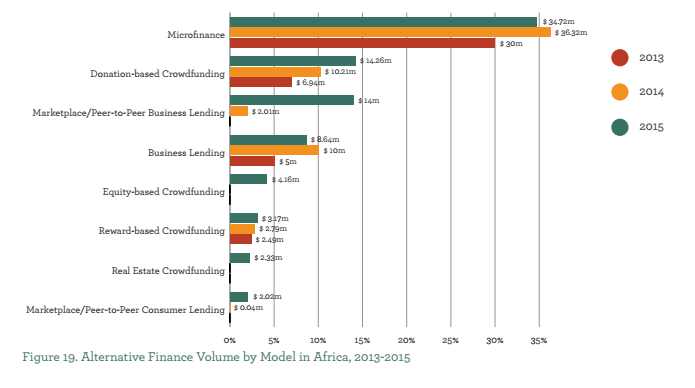
The Cambridge Centre for Alternative Finance (CCAF) has published its first benchmarking report covering alternative finance in the African and Middle East markets. The CCAF report states that alternative finance totaled more than $475 million during the period from 2013 to 2015.  Growth was said to be at 59% during 2015 with a total pegged at $242 million. Much of the alternative finance came via equity crowdfunding and online microfinancing. This is in contrast to more developed markets where peer to peer lending (online lending) tends to dominate.


Robert Wardrop, Executive Director of CCAF, said the development trends in Africa and the Middle-East were quite different than the other regions they had studied. This was due in part to alternative finance growing more slowly than in other parts of the world;

“There are other trends unique to the region and certain countries,” said Wardrop. “For example, funding flows for non-financial projects like donation, reward, and philanthropic online microfinance projects are primarily being funded via platforms based outside Africa. In the Middle East, donation and rewards-based crowdfunding are quite well established and debt-based models are starting to make their mark, but Israel is distinguished by the strong presence of equity-based crowdfunding.”

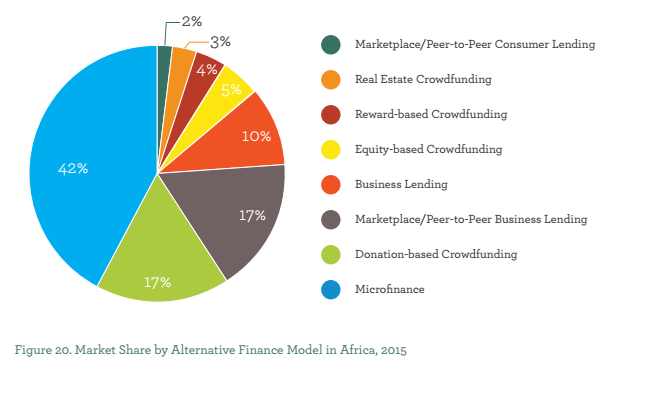
The inaugural study entitled, “the Africa & Middle East Alternative Finance Benchmarking Report,” indicated that equity-based crowdfunding accounted for 67% of total market value in the Middle East, while online microfinance was the leading model in Africa with 42% of total market value. The report was based on data collected from 70 alternative finance platforms operating across 46 countries in Africa and 12 in the Middle East. CCAF estimated they captured 85%t of the market activity.

Peer-to-peer business lending accounted for just 17% of total market volume in Africa, while peer-to-peer consumer lending accounted for only 6% of total market volume in the Middle East.

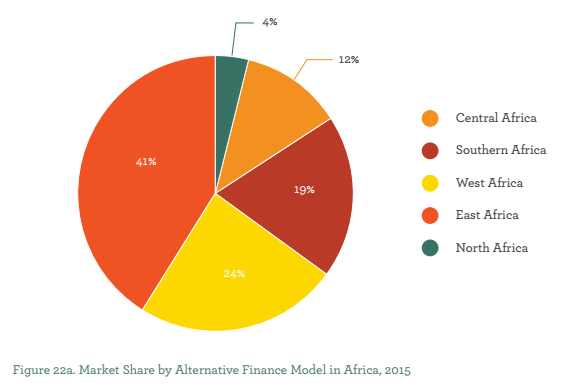
In Africa, the market was nearly $190 million between 2013-2015, and grew 36% in 2015 to $83 million. Most African activity was through online microfinance as well as donation and rewards-based crowdfunding. Investment-based equity and debt models are yet to really make their mark on the African market.

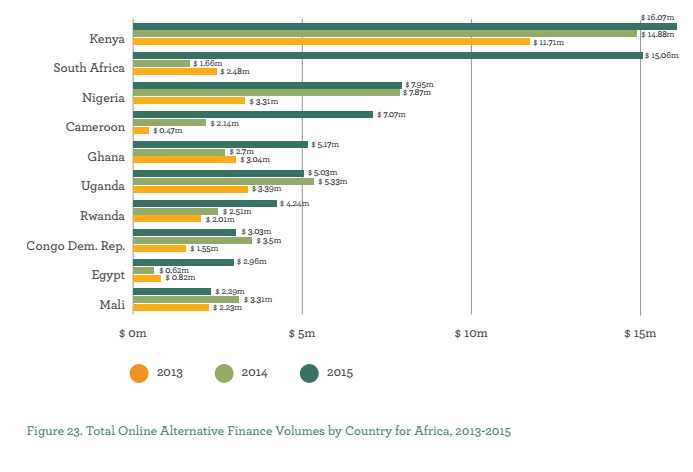
Other notable markets across Africa and the Middle East in 2015 include: Nigeria (around $8 million), Cameroon ($7 million), Ghana, Uganda and Qatar (each $5 million), and Rwanda, Lebanon and Jordan (each $4 million).


Other findings of note from the CCAF report include:

  • In 2015, well over 75% of the total online alternative finance raised from Africa and the Middle East regions was funding for start-ups and SMEs, with $62 million raised across Africa and $132 million raised across the Middle East. 
  • In Africa, 90% of online alternative finance originated from platforms headquartered outside of the continent, while in the Middle East the reverse is true with 93% of online funding originating from home-grown platforms in the region.
  • Both the African and Middle Eastern online alternative finance markets are showing signs of decelerating growth, particularly in the Middle East. The Middle East experienced an annual growth rate of 152% from 2013-2014, but that rate fell to 75 per cent from 2014-2015. The African market grew 38 per cent from 2013-14 and 36 per cent between 2014-2015.