DD
MM
YYYY

PAGES

DD
MM
YYYY

spot_img

PAGES

Home Blog Page 7479

How an Investor’s Behavioral Traits Might Completely Derail Your Pitch – Part I

0

Many startup pitch meetings start out on a promising note, but things fall apart during the conversation between the startup and its prospective investor. Sometimes this could have been prevented if the startup team had studied a little bit of behavioral psychology beforehand.1

Traditional finance theory tries to tell us how investors should behave, if they act as rational economic beings. Behavioral finance is based on the observed behavior of investors. Traditional finance is based on economic theory. Behavioral finance is based on psychology. Traditional finance assumes that investors make their decisions based on all available information, that investors are rational, and that markets are efficient.2 Even if you think this is true in public markets, you have to agree that it is not the case in venture capital. It is especially true that the market for early stage venture investments is highly inefficient, prone to extreme uncertainty and severe information asymmetries. Behavioral finance makes none of the assumptions of traditional finance.

In this post, I will describe a few behavioral biases that an investor might exhibit during a pitch meeting with the founder of a startup.3 I will describe how each bias might be exhibited during a pitch meeting. I will also suggest how the entrepreneur might attempt to mitigate each bias. Failure to mitigate a behavioral bias could mean that the pitch gets derailed, and the entrepreneur fails to communicate effectively with the investor about the startup. I have developed the examples on the basis of meetings at which I have been on the side being pitched by entrepreneurs, after-the-fact reports about investor meetings that entrepreneurs I know have spoken with me about, and also from meetings at which I have been on the side pitching an innovation to potential business partners, and investors for a startup that I have been helping to incubate since January 2011.4

The behavioral biases that I will cover in this post are categorized as cognitive errors. A cognitive error or bias stems from the inherent shortcomings people face as they try to process information that is unfamiliar and complex. Cognitive errors are further categorized as information processing errors or belief perseverance errors. This post will focus on a few belief perseverance biases. Behavioral biases generally can be grouped as cognitive errors, emotional biases, memory errors or social biases.

As you read the rest of this post you will notice that the lines between these biases is somewhat blurry – what one person sees as indicative of one kind of error could be seen by someone else looking at the same information as indicative of another bias. That seems to be the nature of those behavioral biases I have studied – there’s a lot of interconnection and it is difficult to assign an observed behavior to a single bias or error. More likely, the observed behavior arises due to a combination of biases and errors. That is why I think preparation beforehand is key. The entrepreneur can try various approaches to mitigating the observed bias until one approach leads to a break-through that restores the flow of ideas and communication between the entrepreneur and the potential investor.

Cognitive Errors – Belief Perseverance:

  1. Conservatism Bias: This occurs when a potential investor fails to revise his preconceived beliefs about your startup even when there is new evidence that suggests that his beliefs are incorrect.5
    • Case: Steve is 20 years old. He has quit college with two of his classmates to focus on building a startup – Disruptive Tech Startup (DTS). He meets with an early-stage venture capitalist to describe the work they have done so far and their vision for the future. Steve does not realize that the investor believes that he’s too inexperienced and too young to accomplish what he wants to accomplish with DTS. More specifically, the investor does not believe that Steve is experienced enough to steer DTS so that the investor realizes the minimum 10x return that the investor’s investment thesis requires. Steve thinks the meeting went well, but the investor later tells him that the fund has decided to pass on making an investment in DTS.
    • Mitigation: Steve should spend more time discussing his background, what he has done to learn how to run the startup, and how he will learn what he needs to learn in order to run the startup in the future. He should explicitly tackle the issue about his youth and relative lack of experience, and openly discuss steps he will take, or has already taken to ensure that his investors’ capital is not put at risk because of his youth and perceived inexperience. He should offer references who prospective investors might speak to about his leadership potential as it relates to managing a startup. He should not assume that the investor will conclude that he will continue to succeed in the future after seeing what he has accomplished at DTS so far.
  2. Confirmation Bias: This occurs when the investor focuses on perceived negative aspects of your startup while ignoring and dismissing your attempts togive an explanation with evidence that will contradict that perception.
    • Case: Steve is pitching DTS to another early stage investor. She thinks that the technology they have developed is trivial after having listened to Steve for about 20 minutes, and she tells them as much. Steve gets frustrated because he feels she does not understand what DTS is about. The meeting is a disaster because she keeps focusing on the notion that “But isn’t this just a simple bot that scrapes the web for data? If I were a software developer I could do this with very little effort.”
    • Mitigation: This investor likely does not understand the full extent of the problem that DTS is solving.6 If Steve is stuck in “Demo Day Pitch” mode he likely has not considered that in a small meeting the dynamic is different. He should “put away the deck” and go into “professor mode” – in this mode he is educating the investor about the problem, about how DTS is solving that problem, and also about the opportunity that presents for potential investors in DTS, all in a conversational setting – like a professor teaching a student a new concept during office hours. He should expect to follow this up with further information for the investor to consider.7
  3. Representativeness Bias:8 This occurs when the investor uses an if-then rule of thumb or mental shortcut toassess your startup because of the high levels of uncertainty associated with the decision the investor must make.
    • Case: Ademola is a Nigerian entrepreneur. He has been building an Internet software startup in Lagos for two years, African Technology Startup (ATS). He grew up in Nigeria and holds a master’s degree in computer engineering from the Obafemi Awolowo University of Science and Technology, one of Nigeria’s leading universities of technology. In order to grow ATS he has moved to New York and is raising capital from investors. ATS has customers from all over the world, and he believes ATS is solving a significant problem for them. Growth has been phenomenal. ATS has accomplished that growth on a shoe-string budget. Ademola has been building ATS with two other people, they are both co-founders of ATS as well. They will remain in Lagos to manage the technology and R&D efforts. Ademola is worried that many of the investors he will meet are ignorant about Africa. He is also worried that they may unconsciously harbor negative perceptions about ATS that they will not verbalize during a meeting.
    • Mitigation: Ademola has to work doubly hard to demonstrate his technical competence because the average early stage investor in the United States does not associate Africa with technical talent and competence. For example, investors might assume that ATS is relying on a contract software engineering consultant in Asia or Eastern Europe. If ATS is building its technology in-house, Ademola has to make that explicit. He has to talk about the technology in a way that demonstrates that he can fulfill the vision that he’s selling to his customers, and potential investors. He has to convince his audience that a software engineer trained in Nigeria can compete on the global stage. He has to remember that his accent could inhibit potential investors’ ability to understand what he is trying to communicate.9 Instead of hoping that they will ask him to clarify something, or explain something they do not understand he should practice speaking clearly and communicating effectively to people who have never encountered someone with his accent. He should avoid using colloquial terms and idioms that are used in Nigeria, but may not be commonly used elsewhere. Investors in NYC will not understand those terms. He should be friendly, but he should avoid the temptation to be unnaturally funny. His off-the-cuff attempts at humor could back-fire. The representativeness bias at play here could be “If ATS is an African startup then the probability that it is doing all this on its own is zero because all we ever see on TV about Africa is war, starvation, and political corruption and incompetence.” Ademola has to overcome that bias during his conversations.10

An investor’s cognitive biases play an important role in how that investor will hear and interpret the information that an entrepreneur is trying to convey. Time spent understanding this phenomenon and how to mitigate any possible negative effects of a prospective investors behavioral biases will invariably lead to more productive pitch meetings.

Wikipedia’s entry on cognitive biases is here. Wikipedia also has a much more extensive list of cognitive biases here. If you have the time, you should invest in a copy of Daniel Kahneman’s11 Thinking, Fast and Slow.


  1. Any errors in correctly attributing work to my sources and references is entirely my fault. I’ll make corrections if you point an error out to me. ?
  2. The efficient-market hypothesis (EMH) states that financial markets are informationally efficient and that the price of a publicly traded stock incorporates all available information about that stock. ?
  3. I am basing the outline of this post on portions of the CFA Institute’s 2013 Level III readings on Behavioral Finance. ?
  4. I am not a psychologist, so my discussion of this topic will certainly fall far short of even very modest expectations. However, I hope that budding entrepreneurs find this discussion to be a good starting point for some independent work on this topic. ?
  5. This can also be exhibited as a tendency to underestimate high-likelihood events and overestimate low likelihood events. ?
  6. The unstated assumption here is that DTS is not solving a trivial problem. ?
  7. See this post for an example?
  8. The Wikipedia entry for the Representativeness Heuristic is here. You should read it if you are building a startup and will be raising capital from investors. ?
  9. Y Combinator’s Paul Graham inadvertently got embroiled in a pseudo-controversy over this subject. You should read what he has to say, and also read what others have said. Paul’s post on the subject is here. One response is here. ?
  10. This blog post at 59 Ways is a clear, but brief explanation of this bias. ?
  11. If you purchase it through this link I will receive a small portion of the sales proceeds from Amazon to help me maintain this blog. ?

AFIF Entrepreneurship Award 2017 Contestants [Photo]

0

Six African SMEs nominated as finalists for the AFIF Entrepreneurship Award 2017. This Award is part of the annual Africa Finance & Investment Forum (AFIF)

Out of the 51 projects from around the continent and following a few rounds of selection, the jury has selected these innovative projects from Ethiopia, Kenya, Nigeria and Tanzania for their social, economic and ecological impact, and their potential for growth and job creation nationally and regionally.

Aybar Engineering (Ethiopia)

The company has developed the “Aybar BBM”, a technology that prevents excess water from suffocating crops and stores it for later use. There is no other similar technology in the market.
R n G Company limited (Kenya)

The company sells packaged Rhizo-fix (groundnut inoculum), a biofertilizer that ensures a more efficient groundnut production. It also collects the groundnuts from local farmers to produce affordable cooking oil.
EuroFresh Exotics (Kenya)

The company produces and exports fresh fruits and vegetables using innovative farming techniques. They also organise capacity building trainings for smallholder farmers.

First Atlantic Semiconductors & Microelectronics (Nigeria)

This company has developed the “Zenvus”, an intelligent solution to collect soil data using a system of electronic sensors. Its mission is to improve farming productivity.

Kimolo Super rice (Tanzania)

The company is specialized in processing and marketing branded rice and sunflower oil. The project is environmentally friendly since smallholder farmers produce paddy using water run-off from nearby hills.

Eco Act (Tanzania)

The company was established to address the challenges of urban waste management, plastic pollution, deforestation and climate change. They recycle and transform post-consumer waste plastic into durable and environmentally friendly plastic lumber.

[Source]

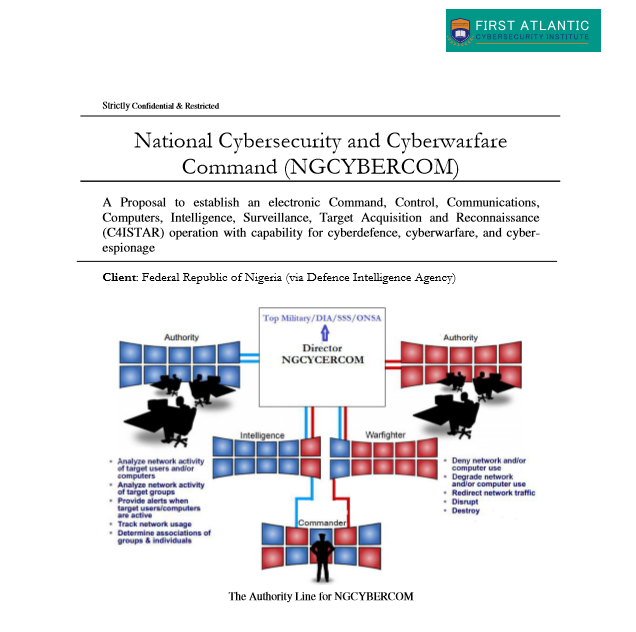
Facyber Whitepaper for Nigeria’s “National Cybersecurity and Cyberwarfare Command, NGCYBERCOM”

0

1.     Executive Summary

In the wake of recent cyber attacks launched against nations through malicious codes like Stuxnet, Duqu and Flame, and in response to the formalization of cyber-crime legislation in Nigeria’s parliament, it has become imperative for our nation to establish an operations centre to address the rising incidence of cybersecurity and cyber attacks. In Nigeria, many government websites have been consistently defaced and thefts of strategic digital assets – commercial and governments secrets – might have occurred. If the nation cannot mitigate the threats of evolving Information Warfare (IW) which uses digital technology in pursuit of a competitive advantage over nations, our long-term economic blueprint could be compromised.

This center can be structured as an electronics Command, Control, Communications, Computers, Intelligence, Surveillance, Target Acquisition and Reconnaissance (C4ISTAR) operation and tasked with ensuring the protection of highly secured data and information against cyber attacks. It can also wage cyber warfare for the nation where necessary.

Across the globe, there is a new war evolving in the world. It is not fought on the land, sea, air or even in the physical space. It is war of the fifth domain: the cyberspace. Yes, warfare perpetrated through clusters of computer networks which have linked the world in mutually dependent interrelationships of people, firms and nations.

Cyberwar is not a war of choice. It will come to Nigeria even if the nation does not want it. Just as computer virus attacks computers, this warfare is waged at national level with consequences that can shut down a military control, financial systems, health informatics, and telecommunication networks. It is something that the nation cannot afford to waste time despite our failure to use technology or strong regulation to solve the embarrassment caused by the Nigerian web fraudsters.

The world has nuclear non- proliferation treaty, but none exists for cyberwar despite the potential economic dangers the latter poses to world commerce. Accordingly, many nations have started to deploy strategic commands to protect, defend and necessarily retaliate when their systems are attacked through cyber-means. The United States Pentagon has the Cyber Command inside the National Security Agency, the British has a similar unit inside the GCHQ. China, Iran, Russia, Israel, and many other nations have developed cyber-army to protect their economies.

What is basically the threat of a cyberwar? It has been proven that people could remotely rewire networks logically and trigger avalanche of problems that can bring a nation’s economy to standstill. They plant logic bombs which on ‘explosion’ brings enormous damages to companies and private citizens. They could penetrate our oil installations, bank servers, electric grids, air-traffic controls, GSM networks, and military commands. We suddenly find out that nothing works in the land and all networks are broken.

This is perhaps the most drawbacks of computer networks- the ability to wage war through bits and bytes instead of the old fashioned way of firing bullets where the identities of the invaders are known. In cyberwar, the attackers could mask themselves and may even use your rigged networks to attack you. It is also important to understand that the world ‘computer’ has since evolved. There are pills, watches, shoes, bags, cellphones that are indeed computers. And most systems are on networks with IPs assigned to them.

In the old warfare, people were trained to become spies or soldiers with enormous risks. But now, all they have to do is use a computer to launch their strikes to vulnerable nations. If we deny the severity of these threats, we will have ourselves to blame. It used to be copies of military notes; now, the digital spies could download an entire library of military strategy.

The cyberwar is real and it is already taking place in the world. The first Web War 1 was fought in Estonia where series of orchestrated attacks on Estonian digital infrastructure forced the government to decouple the nation from Internet. In other words, both government and business websites were brought down. That was followed in Georgia during its brief recent hostility with Russia. Again, its websites were brought down and even the President website had to be moved to a secure server.

It is important to understand that this is not an ICT problem. This is a serious engineering problem that requires the use of advanced mathematical models and analytics in digital offense and defence.

First Atlantic Cybersecurity Institute proposes to assist the nation design, develop and implement a national cybersecurity, cyberdefence and cyberwarfare command. It is projected to transform the nation with capability to survive the data wars of the 21st century with cyber experts that can use analytics to connect dots and identify security patterns via automated data sharing in volume, variety and velocity.

As part of this proposal, a whitepaper is prepared for the Nigerian Military to assist in developing a world-class National Cybersecurity and Cyberwarfare Command modeled after the United States National Security Agency.

For the complete Whitepaper, email First Atlantic Cybersecurity Institute.

Zenvus wins Africa’s Best Technology Startup of the Year 2016

0

Tekedia Editors announce that Zenvus, the AgTech company, is the Best Technology Startup of the year 2016 in Africa. Zenvus is transforming agriculture in Africa where more than 70% of the adults are employed.

Zenvus is an intelligent solution for farms that uses proprietary electronic sensors to collect soil data like moisture, nutrients, temperature, pH etc. It subsequently sends the data to a cloud server via GSM, satellite or Wifi. Algorithms in the server analyze the data and advice farmers on what, how and when to farm. As the crops grow, the system deploys hyper- spectral cameras to build crop normalized difference vegetative index which is helpful in detecting drought stress, pests and diseases on crops. The data generated is aggregated, anonymized and made available via subscription for agro-lending, agro-insurance, commodity trading to banks, insurers and investors. Zenvus also has a mapping feature which can help a farmer map the farm boundary with ease.

The mission of Zenvus is to eliminate extreme poverty in emerging world especially Africa by improving crop yield and overall farming productivity. It brings the fusion of electronics and analytics to empower farmers.

The secrets on how to capitalize on mobile success

0

Google has been dominating desktop internet search and advertising for almost a decade now. It has deployed an aggressive strategy which is swiftly occupying the mobile space. Google is dominating the global mobile search market with a market share of 97% for mobile searches worldwide. Optimising its core expertise, Google has managed to anticipate the mobile demand and is constantly optimising its services to anticipate future trends.

Google is currently facing a difficult task in forming a more cohesive internal strategy, which, if left too long, might see its strategic advantage in mobile evade it. Facebook has become a key competitor in that space through its different platforms.

Yet, there are many lessons on what one can learn from what Google has done. It has a skill on leveraging its core competencies to consolidate its position. It hopes to use these strategies to overcome market barriers and industry challenges.


Expanding Core Competencies – Can You Afford to Stand Back?

Google is adding value to its existing online services and products by ensuring their availability on mobile platforms. Geo-target targeted information and data collection are enabling it to harness the full potential of mobile advertising. Its accelerated deployment of free services and open-source models is squeezing out competitors and conferring upon it a significant competitive advantage, allowing it to quickly overtake established market players.


Capitalising on Mobile Success – Strategies and Potential Revenues

Google is committing considerable resources in order to better assert its market position. In addition, Google is expanding into new markets and investing in new technologies which it believes will shape the future of mobile.


Why is Google so Important?

The mobile industry is undergoing significant structural changes as a result of convergence and technological progress. Google is quickly dominating a broad spectrum of activities pertinent to industries beyond data services and the internet. It is proving to be one of the biggest and fastest-growing conglomerates in digital services and its enterprises affect everyone, from end-users to multi-national corporations. It is staking a place in the mobile operating system with Android in a bid to turn it into a multi-purpose OS but it is also facing significant challenges due to fragmentation issues.

Recently, Android has been powering bikes and will be integrated in the infotainment ecosystems in cars next year, based on prototypes shown during the CES. The success and the challenges of this particular mobile venture affect a vast and diverse number of companies and associations.

2017 promises to be the year of audio/voice operation system with Amazon Alexa becoming a threat to Google dominance in smartphones. Google will be expected to deepen its work on Android and bring voice AI into bigger play. That is how it will sustain its winning capability in mobile. If not, Alexa can become what Android is to phones around homes and entertainments. And sooner than later expand even to mobile.

If anyone tells you the war has been won digitally, tell that person to re-think again.