DD
MM
YYYY

PAGES

DD
MM
YYYY

spot_img

PAGES

Home Blog Page 7541

In Tech We Trust – How 203 global banking executives see retail banking

0

A recent  report by the Economist surveyed 203 global banking executives to understand the challenges and changes they face. Over one-half (135) of the respondents work for banks with assets of less than $50b. The report concluded that, “The digital revolution has moved from existential threat to potential survival strategy for the world’s retail banks.”

The scale of disruption is unprecedented, across every market, every distribution channel and every single product line. Fintech poses a potentially fatal risk and will be a severe test of banks’ IT systems and their ability to respond to rapid changes in customer expectations, short product development times and growing cyber risks.

Key findings include:

  • The banking world of the future. By 2020 bankers expect the banking environment to be shaped strongly by technology and non-traditional competitors. They believe that retail peer-to-peer (P2P) lending will be available via banking platforms (65%); retail banking will be fully automated (64%); and more money will flow via fintech firms than traditional retail banks (57%).
  • Profits face multiple attacks. Business models must adapt to survive. Individually, the “scare scores” attached to changing customer behaviour (22%), new entrants (26%) and new technology (24%) are significantly lower than in previous years; collectively, however, they still represent a significant threat.
  • A multi-headed monster. That competitive threat will come from many quarters. Apple Pay and its ilk (20%) and other non-financials (20%) may yet emerge to really upset the traditional banking sector. As keen as regulators are to encourage competition, new banks are seen as less of a threat (16%). Robo-advisers could lure away more profitable wealthy (and the not-so-wealthy) clients (17%), and P2P lenders attract dissatisfied borrowers and savers (21%).
  • Regulators still watching. The too-big-to-fail rules are almost complete, but there is still plenty to keep compliance departments busy. Regulators now have time to cast an eye over consumer protection issues, with product design and transparency (24%) and fines and recompense orders (19%) still in play.
  • Banks are adapting. Bankers see three main areas that they must change in order to survive: adapting the role of the branch network (36%); getting the right talent (35%); and modernising their technology (31%). Banks still have the relationships and the data, but can they maintain and build on that advantage?

Simply, if you are in retail banking, you are running a technology business. And you must execute as such.
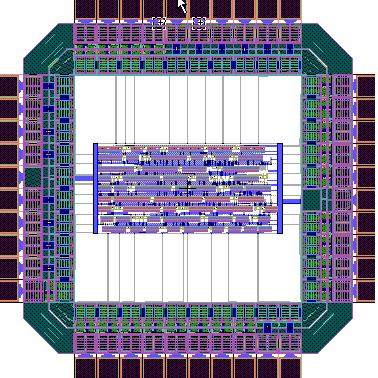

Fasmicro can help with the fabrication of your integrated circuit through MOSIS and Europractice

0

Multi-Project Chip (MPC) or Multi-Project Wafer (MPW) services integrate onto microelectronics wafers a number of different integrated circuit designs from various teams including designs from private firms, students and researchers from universities. Because IC fabrication costs are extremely high, it makes sense to share mask and wafer resources to produce designs in low quantities. Worldwide, several MPW services are available from government-supported institutions or from private firms including MOSIS, CMP and Europractice.

CMP is a service organization in ICs and MEMS for prototyping and low volume production. Circuits are fabricated for Universities, Research Laboratories and Industrial companies.
Advanced industrial technologies are available in CMOS, BiCMOS, SiGe BiCMOS, P-HEMT E/D GaAs, etc. CMP distributes and supports several CAD software tools for both Industrial Companies and Universities.
Since 1981 more than 4800 circuits for Research, Education and Industry have been fabricated. 850 academic centres and 150 industrial companies from 70 countries have been served.

With MOSIS, designs are submitted for fabrication using either open (i. e., non-proprietary) VLSI layout design rules or vendor proprietary rules. Designs are pooled into common lots and run through the fabrication process at foundries. The completed chips (packaged or unpackaged) are returned to customers.

From prototype to production, MOSIS is a design engineer’s single source for a wide variety of semiconductor processes offered by major foundries.

Costs are kept low by combining designs from many customers into multi-project wafer (MPW) runs. With prototype costs reduced, engineers can submit several variations of the same design to the same run, thus shortening time-to-market.

Final designs can then be submitted to MOSIS for low- medium volume production or dedicated Engineering wafer runs (COT).

Along with wafers and die, MOSIS provides a full range of packaging and bonding options for designs fabricated through our service.

Many silicon fabrication facilities offer MPW runs or a company can produce its own MPW, e.g. combine several of its own designs to form one wafer completely owned by the company. In the latter case, it may be profitable to use most of the wafer for production chips and a small portion for producing prototypes of next generation chips.

Fasmicro is now helping African institutions to setup the technologies required for Europractice. More on this later today.

EUROPRACTICE is a European Commission initiative, funded by the EU Seventh Research Framework Programme (FP7). The aim is to improve the competitiveness of European industry by the adoption of advanced electronics technologies.

EUROPRACTICE is a quality brand name for European service-type projects in the Microelectronics, Microsystems and Photonics fields. The EUROPRACTICE brand name covers a wide range of FP6 and FP7 projects.

Sources: Wikipedia, CMP, MOSIS, Europractice.

This is Faraday Future electric-car

0

Electric cars seem to be the future of automobiles.

The electric-car startup Faraday Future took the wraps off its first production car concept at a press conference Tuesday evening in Las Vegas ahead of CES.

The crossover SUV, dubbed the FF91, features 130 kwh of battery energy, giving it more than 378 miles of range, the company claimed. It also has an open charging system, which means that it can take charge from any charging standard.

The FF91 is capable of learning on its own to know your personal preferences so that it can adjust to provide a customized experience, said Hong Bae, director of ADAS and self-driving, at Faraday Future. It also comes with some self-driving features, including the ability to park itself. The vehicle boasts more than 30 sensors including 10 front and rear facing cameras, 13 long and short range radars, 12 ultrasonic sensors, and one high-definition 3D lidar sensor.

Tesla just got a competitor.

These Are Investors Putting Money In Tech Companies In Africa – Contact Them!

0


Bill Zimmerman

Bill Zimmerman is a serial entrepreneur having successfully built and sold companies. He is the founder of Cameroon’s leading technology incubator ActivSpaces. Having lived in Cameroon for four years Bill has a unique insight into what it takes to build a technology driven company in Africa. He has worked side by side with entrepreneurs and played an instrumental role in helping build some of Cameroon’s most promising startups. Bill is a founding member of AfriLabs, a network of African technology incubators, and is a driving force behind VC4Africa, a peer to peer network for connecting entrepreneurs with network, information and capital needed to grow and scale their business.

Find Bill Zimmerman on Twitter @billzimmerman (Hover over the link to the left for more options)


Ben White

Ben White is a serial entrepreneur who joined his first startup at the age of 24. He helped build AfricaReport CNBC in South Africa and later joined the social venture Africa Interactive to launch AfricaNews.com, now a media network comprised of more than 2000 African based reporters, photographers and film makers. Ben has done extensive ethnographic research on the emergence of software cultures in and around Kampala, Uganda. He helped establish the East Africa ICT Entrepreneurship program at Hivos and has taught a course in Interactive Media and Entrepreneurship at the HvA. Ben is a founding member of AfriLabs, a network of African technology incubators. In 2007 he founded VC4Africa as a community for entrepreneurs and investors dedicated to building innovative companies in Africa.

Find Ben White on Twitter @zia505 (Hover over the link to the left for more options)


Wesley Lynch

Founder and CEO, Realmdigital

Driven by a passion for software and problem solving, Wesley Lynch founded Realmdigital in 1999. Wesley, a technology entrepreneur, has over a decade of experience in the financial, business and software development industries; gained both locally and during his time in the UK. He is deeply involved in producing innovative technology solutions for African and international businesses and regularly shares his knowledge and experience through participation in various industry events.

Motivated by a strong belief that collaboration is essential for business and industry success, Wesley co-founded MyTrueSpark, a business that aims to provide mentorship and advisory services to start-ups as well as investors. Wesley is regularly involved in giving advice to tech start-ups looking for funding, as well as to venture capitalists and angel investors looking to invest. In 2011 Wesley was named as one of the “38 emerging South African tech entrepreneurs to watch” in the Old Mutual Entrepreneurs guide.

In his spare time Wesley enjoys travelling with his Chef wife Sam and their two kids.

Find Wesley Lynch on Twitter @wesleylynch (Hover over the link to the left for more options)


MyTrueSpark

MyTrueSpark is a consultancy founded in 2011 by a team combining roughly 30 years of experience in software and technical development, finance and venture capital. We introduce established businesses to trading online as well as assisting early stage businesses to enter the market and grow online, dealing with both the technical and business challenges. Furthermore, MyTrueSpark is a portal to reach funders and investors (including Angel, Venture Capital and Private Equity) for business owners looking for investment to grow their businesses or realise the value created in their business. We source the appropriate investor and facilitate the transaction. To that end MyTrueSpark is a co-founder of AngelHub, South Africa’s first formalized Angel Investor Group.


Alexandra Fraser

Business Development Manager, Invenfin
Alexandra joined the Invenfin team in 2009 after completed her Masters in International Business and Emerging Markets (cum laude) as a Chevening scholar, at the University of Edinburgh’s Business School. Her degree focused on finance and technology management, with her thesis analysing the Venture Capital Industry in South Africa.

Alexandra is involved in sourcing, managing and assessing all new investment proposals for Invenfin, using her technical and business background to achieve this. She is also responsible for the organisation’s marketing and communications, regularly speaking at conferences, guest lecturing and writing articles on entrepreneurship, fund raising, venture capital and intellectual property. Alexandra also has a B.SC in Molecular and Cell Biology and Post Graduate Diploma in Entrepreneurial Management from the University of Cape Town and has worked for a number of companies in South Africa, Australia and the United Kingdom. She is passionate about entrepreneurship and has worked closely with Government, University Technology Transfer Offices and the Private Sector in the start-up space.

Find Alexandra Fraser on Twitter @anfraser (Hover over the link to the left for more options)


Johanna Kollar

Johanna Kollar runs Start-Up Support programs in emerging markets for Google. One key pillar of Google Africa’s strategy is building a sustainable internet ecosystem; she focuses on facilitating the development of Tech Hubs across Africa and pilot program initiatives such as Umbono, which showcase technology as a platform for entrepreneurship. Prior to Google, Johanna was a technical consultant working in West Africa, an MBA student at Tuck, a strategy consultant inside PE portfolio companies, and an investment associate at Marlow. She also spent 2 years on business development activities in the Google office operations in Johannesburg back in the “start-up days.” She brings a decade of Africa geographic experience and multi-disciplinary insights to all her business endeavors.

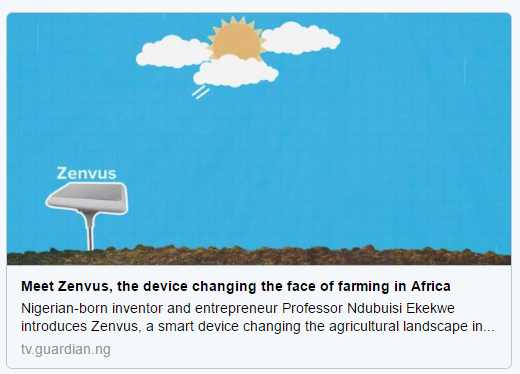
Meet Zenvus, the device changing the face of farming in Africa [GuardianTV Video]

0

Nigerian-born inventor and entrepreneur Professor Ndubuisi Ekekwe introduces Zenvus, a smart device changing the agricultural landscape in sub-Saharan Africa by telling farmers what, how and when to farm.

Watch the video here produced by Guardian TV.

[Guardian TV]