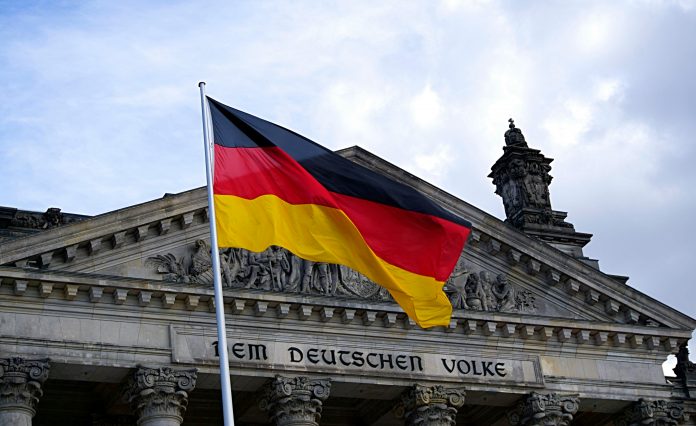
Germany’s Bundestag, lower house of parliament voted to pass the federal budget for 2026, marking a significant departure from the country’s long-standing fiscal conservatism.
The budget totals €524.5 billion ~$607.5 billion in spending, financed in part by substantial new borrowing that exceeds all but one prior year in post-war history. The vote passed narrowly with 322 in favor and 252 against, reflecting ongoing political tensions within Chancellor Friedrich Merz’s coalition of the Christian Democrats (CDU), Christian Social Union (CSU), and Social Democrats (SPD).
€524.5 billion, including €58.3 billion in core investments. Core budget borrowing: €97.9–98 billion in net new debt, adhering to the constitutional “debt brake” limit of 0.35% of GDP.
Over €180 billion when including special funds exempt from debt rules—the second-highest level ever, surpassed only by €215 billion during the 2021 COVID-19 crisis.
Total Investments: €126.7 billion, a 10% increase from 2025, boosted by off-budget funds via €500 billion infrastructure fund and defense exemptions. This budget emerges against a backdrop of economic stagnation, with Germany’s GDP contracting for two consecutive years—the first such downturn since the 2008 financial crisis.
Chancellor Merz’s government, formed after the 2025 elections, has prioritized revival through massive public investment, breaking from the “black zero” era of balanced budgets under predecessors like Angela Merkel.
An exemption from debt rules allows unlimited borrowing for the Bundeswehr, responding to Russia’s invasion of Ukraine and NATO commitments. This draws from a €500 billion special defense fund. A parallel €500 billion fund targets decaying roads, railways, and climate protection projects, addressing long-term underinvestment.
Finance Minister Lars Klingbeil (SPD) emphasized the need to counter global challenges, including energy costs and trade disruptions, with investments expected to create jobs and spur growth.
The International Monetary Fund (IMF) forecasts Germany’s deficit rising to 4% of GDP by 2027, with public debt climbing to 68%—still the lowest in the G7. Merz hailed it as a “warm-up” for bolder reforms, while Klingbeil warned of a €30 billion shortfall in 2027.
The Greens decried it as “shunting expenditures” via funds, the far-right AfD called it a “financial coup d’état” burdening future generations, and the Left Party opposed debt-financed rearmament.
In the context of Germany’s newly approved 2026 federal budget, the “defense fund” primarily refers to the Sondervermögen Bundeswehr, a €100 billion one-time allocation established in 2022 following Russia’s invasion of Ukraine.
This fund is exempt from the constitutional “debt brake” rules, allowing debt-financed spending on military modernization. It is distinct from the separate €500 billion Sondervermögen Infrastruktur und Klimaneutralität which focuses on civilian projects like roads, railways, and renewable energy but can indirectly support defense-related infrastructure.
The fund has enabled a historic surge in defense spending, with total outlays reaching €108.2 billion in 2026—more than double the 2025 level and equivalent to about 2.8% of GDP, exceeding NATO’s interim target for the year.
This positions Germany as Europe’s largest defense spender, surpassing France and the UK combined in absolute terms. Created under Chancellor Olaf Scholz’s “Zeitenwende” policy to bolster alliance and national defense capabilities.
It finances complex, multi-year procurement projects for the Bundeswehr, addressing decades of underinvestment. The fund is fully committed by 2027, with €28 billion already spent by mid-2025.
For 2026, €25.5 billion flows from the fund, complementing €82.7 billion from the core defense budget. This brings total defense spending to €108.2 billion, with a focus on procurement, €47.88 billion total, including €25.51 billion from the fund. Up 32% from 2025 (€62.3 billion); covers personnel (10,000 new soldiers + 2,000 civilians), operations, and readiness.
Total defense spending ~2.8% of GDP; enables NATO commitments and Ukraine aid €11.5 billion total, including €1 billion/month. Includes tanks, ships, aircraft; €325 billion in long-term commitments through 2041. Critical for restocking after Ukraine support; €12.67 billion from core budget.
The fund’s spending contributes to Germany’s overall €180+ billion in new debt for 2026 second-highest post-war, driven by economic stagnation and geopolitical threats. Mid-term plans project defense outlays rising to €117.2 billion in 2026 and €161.8 billion by 2029 with €380 billion borrowable for defense through 2029.
Chancellor Friedrich Merz and Finance Minister Lars Klingbeil hail it as essential for deterrence against Russia and NATO leadership. Defense Minister Boris Pistorius emphasized closing capability gaps. Opposition calls it a “shadow budget” risking future fiscal burdens; Greens decry bypassing debt rules.
Expected to spur 1.3% GDP growth in 2026 via jobs in defense industry (e.g., Rheinmetall) and supply chains, though IMF warns of rising deficits 4% of GDP by 2027. This fund marks a pivotal shift from Germany’s post-Cold War restraint, aiming to make the Bundeswehr Europe’s strongest conventional force by 2030.
The Bundesrat review is pending but expected to pass. The budget now heads to the Bundesrat— upper house for review, but passage is expected. This move signals a potential shift in Europe’s fiscal landscape, with implications for the EU’s stability pact and Germany’s role as the bloc’s economic anchor.
Germany’s Inflation Rate Stuck at 2.3%
Germany’s latest economic indicators for November 2025 paint a picture of stability with underlying pressures. Inflation held steady, while the labor market showed a modest improvement.
The year-on-year inflation rate, measured by the Consumer Price Index (CPI), remained unchanged at 2.3% in November 2025 compared to November 2024. This is based on preliminary data from the Federal Statistical Office, with final figures due on December 12.
Services prices rose by 3.7%, exerting upward pressure. Energy prices fell 0.1% year-on-year, providing some offset. Food prices increased by 1.8%. Excluding volatile food and energy, the rate ticked down slightly to 2.7% from 2.8% in October, signaling persistent underlying pressures.
For EU comparability, this stood at 2.6% year-on-year, up from 2.3% in October—driven partly by package holidays and fuel costs. Inflation has hovered around the ECB’s 2% target but shows signs of stickiness, influenced by wage growth and global energy dynamics.
Economists note this could delay ECB rate cuts. The seasonally adjusted unemployment rate dipped to 6.1% in November 2025, down from 6.2% in October. This marks a slight improvement, with the number of unemployed rising by just 1,000 far below the expected 5,000 increase.
Approximately 2.7 million employment stagnated, with virtually no net change +2,000 jobs, or 0.0%. Job vacancies fell to 624,000, down 44,000 from a year ago, reflecting subdued labor demand.
Despite the dip, the labor market remains soft amid economic slowdown. The German Labor Agency highlights ongoing challenges for companies, with forecasts pointing to over 3 million unemployed by early 2026 if growth doesn’t accelerate.
Steady inflation above the ECB target contrasts with a cooling labor market, potentially supporting a cautious monetary policy stance. Retail sales fell 0.3% month-on-month in October, underscoring weak consumer momentum.
Germany’s economy is projected to grow by just 0.2% in 2025, with 1.3% expected in 2026—bolstered by planned infrastructure and defense spending under Chancellor Friedrich Merz. However, global trade tensions and energy costs remain risks.
For Households/Businesses: Lower energy bills offer relief, but rising service costs (e.g., rents, travel) could squeeze budgets. Job seekers may face a tougher market in manufacturing and construction.
Rate cuts become less likely in December 2025 or Q1 2026. Markets now price only ~60 bps of cuts until mid-2026 down from 100 bps a few weeks ago. German 10-year Bund yields already rose ~15 bps since the data.
Sticky services inflation + strong wage settlements 2025 collective agreements ~4–5% keep core inflation above 2% well into 2026 ? ECB likely stays at 2–2.25% terminal rate longer than expected. Real wages continue to rise, but high services inflation eats ~60% of the gain. Private consumption stays weak.
If wage growth moderates only slowly, purchasing power improves from mid-2026 onward, supporting the expected consumption-led recovery. Higher-than-expected interest costs on new debt + weaker growth reduce fiscal space.
The new Merz government will struggle to finance both the €100 bn special funds and promised tax relief without breaching the debt brake in 2026. Risk of political friction inside the CDU/CSU-SPD coalition over spending priorities; possible mini-budget crisis in autumn 2026.
Profit margins remain under pressure unit labour costs +4% yoy. Companies continue to freeze hiring and cut investment. Manufacturing recession likely extends into H1 2026; only defense-related and green-tech sectors show robust order books.
Unemployment will keep drifting higher in absolute terms during the winter, but the rate stays in the 6.0–6.4% range. Underemployment and short-time work rise again. Structural mismatch worsens. Risk of 3+ million unemployed by early 2027 if no growth impulse materialises.
Rents rise 5–6% in 2025 ? keeps core inflation elevated. Construction activity remains in depression –30% vs 2021; new housing supply falls far short of demand. Continued strong upward pressure on rents in cities; home-price correction slows but does not reverse.
Weak eurozone demand + potential new U.S. tariffs under a possible second Trump administration in 2025 hit the export engine. China slowdown adds to the drag. Germany’s current-account surplus shrinks further from 8% to ~4–5% of GDP by 2027, reducing the traditional growth buffer.
The hoped-for strong rebound in 2026 now hinges almost entirely on (1) fiscal stimulus actually being spent quickly and (2) the ECB eventually cutting rates more aggressively once services inflation finally cracks. Both are uncertain.
Most forecasters have therefore downgraded 2025 GDP growth to 0.0–0.3% and only a modest 1.0–1.3% in 2026. Recessions risks remain elevated. These figures align with a broader eurozone trend, where inflation is expected at 2.1% for November.