DD
MM
YYYY

PAGES

DD
MM
YYYY

spot_img

PAGES

Home Blog Page 776

Alaan Raises $48M Series A to Scale AI-Powered Finance Automation Across The Middle East

0

Alaan, an AI-powered expense management platform for Middle Eastern businesses, has raised a $48M in Series A equity funding to accelerate its mission of simplifying finance operations through automation.

This round was led by Peak XV Partners (formerly Sequoia Capital India & SEA) and 885 Capital. Pioneer Fund joined it, with continued support from Y Combinator and 468 Capital.

Both primary and secondary funding were included in the round, which also saw the backing of some of the region’s leading operator angels which include Hosam Arab (Founder of Tabby), Mudassir Sheikha (Founder of Careem), Jeppe Rindom (Founder of Pleo), Parth Garg (Founder of Aspora), Khalid Al Ameri (Founder of KAM and the Middle East’s most well-known creator) and many others.

With the new funding, Alaan plans to double down on two priorities: expanding its footprint in the UAE and Saudi Arabia and enhancing its AI-powered finance suite. Saudi Arabia, in particular, is seen as a high-growth market, with businesses eager for digital transformation but still underserved by modern financial tools. Alaan is building tailored features to accommodate Saudi-specific tax regulations, workflows, and language needs. Alongside expansion, the company is launching new products such as Bill Pay and Rewards Cards, enabling end-to-end spend management from a single platform. 

In the age of digital transformation and artificial intelligence, finance functions continue to rely on traditional tools and methods for their day-to-day operations, such as using petty cash for business payments, calculators for manual reconciliation, and spreadsheets for managing budgets. These methods take time, involve manual effort, and incur huge costs. Simply put, these traditional approaches no longer meet the demands of modern business.

Launched in 2022 by Parthi Duraisamy and Karun Kurien, Alaan helps companies manage expenses through corporate cards, artificial intelligence-led automation, and centralized dashboards.

The fintech startup is an all-in-one solution for finance teams to manage and control their expenses easily. It provides everything a finance team needs like smart corporate cards, an AI-driven expense management platform, streamlined accounting processes, and centralized dashboards that provide real-time visibility.

Alaan caters to any business or organization that incurs expenses. From startups to large enterprises, and across various sectors including manufacturing and services, whether a sole proprietorship or a multi-entity organization, the company is designed to serve businesses of all sizes and industries.

Since launch, Alaan has raised more than $7.5 million from the world’s best investors, like Y Combinator, and renowned angels, like Mudassir Sheikha, CEO & Co-founder of Careem. Though the company has achieved profitability, the decision to raise fresh capital wasn’t driven by necessity but by ambition.

“Profitability was never the only end goal. Impact was. From day one, we built Alaan to be financially disciplined. We were generating revenue early, growing efficiently, and hitting profitability faster than most would expect from a fintech company in our space. But we didn’t raise this round to keep the lights on – we raised it to move faster and drive our mission of becoming the most loved fintech in the Middle East”, the company wrote via a blogpost.

Alaan believes impact, not just financial returns, is the real goal. With the backing of top investors and regional leaders, the fintech startup is positioning itself to become the Middle East’s most loved fintech, transforming finance teams from manual processors to strategic decision-makers.

Investors Are Accumulating These Altcoins For A BIG August Pump: Solana, Remittix and Litecoin

0

The crypto market is heating up again, and while some tokens are stalling, others are gaining serious traction. Solana and Litecoin are both showing major signs of accumulation this August. But a fast-rising token, Remittix (RTX), is catching even more attention with explosive growth, a confirmed wallet beta launch, and strong investor interest pushing it over $18M raised.

Let’s take a look at what’s driving each project forward.

Solana Price Holds Key Support, But Traders Brace For Movement

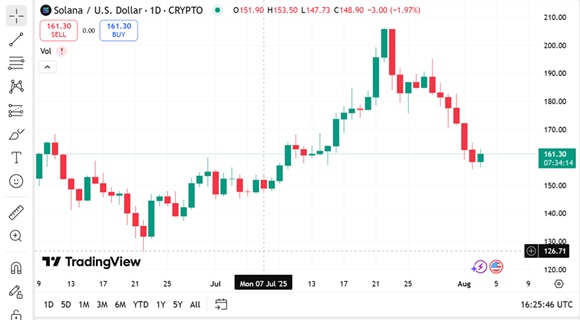
The Solana Price has been stuck in a horizontal range between $125 and $180 since early 2024. After a failed breakout attempt in July, SOL was rejected near the upper band and is now hovering around a weekly low. The most recent candle shows weakness, increasing the likelihood of a retest of the $125 range support.

Momentum indicators like the RSI (currently at 50) and MACD (neutral) offer no strong signal either way. Short-term analysis on the daily chart paints a more bearish picture. The SOL news includes a projected correction to $145 this week, based on an A-B-C wave count and RSI/MACD downturns.

Litecoin Price Builds Toward Breakout

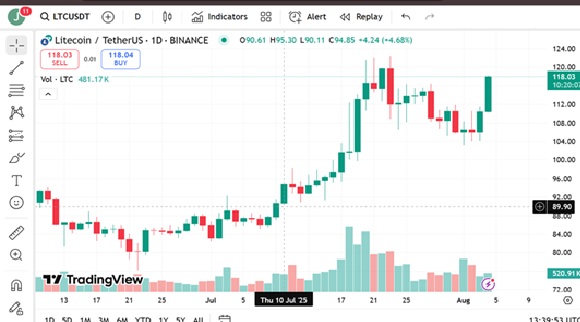
After months of lagging behind, the Litecoin Price is showing signs of life. LTC has reclaimed the $105 level and is now making a fifth attempt to break above its descending resistance trend line. This could be the moment bulls have been waiting for.

Momentum indicators back the move. The RSI is above 50, and the MACD is positive, both suggesting an upside breakout is near. If successful, analysts believe the Litecoin Price could quickly rally toward the $200–$230 zone.

Remittix Wallet Launch Fuels Bullish Sentiment

While SOL and LTC face technical hurdles, Remittix (RTX) is charging full steam ahead. The token just announced its beta wallet launch for September 15, 2025, with over $18M already raised and more than 580 million tokens sold. Momentum has been building steadily, and this launch is a huge milestone as RTX becomes one of the fastest-growing payment-focused projects of the year.

Why traders keep talking about RTX:

  • 40% bonus tokens available now for a limited time
  • Wallet beta launches September 15, 2025
  • Supports 40+ cryptos and 30+ fiat currencies at launch
  • Real-time FX conversion and user-first interface
  • Built for freelancers, global earners, and everyday users

With current pricing at $0.0895, RTX is positioning itself as a true crypto with real utility and one of the top crypto to buy now.

Final Word: Remittix Is Leading This Month’s Altcoin Momentum

While Solana Price and Litecoin Price technicals point to possible gains, Remittix already has the wind at its back. With the beta wallet launch locked in for September 15 and over $18M raised, RTX is proving it’s more than hype—it’s a working product with serious long-term value.

Now’s the time for smart investors to position early. The bonus window is still open—but not for long.

Discover the future of PayFi with Remittix by checking out their project here:
Website:
https://remittix.io/

Socials: https://linktr.ee/remittix

$250, 000 Giveaway: https://gleam.io/competitions/nz84L-250000-remittix-giveaway

Nigeria’s Oil Output Hits 1.78mbpd But Still Falls Short of Budget Benchmark

0

Nigeria’s crude oil production has climbed to an average of 1.78 million barrels per day (bpd) in July, marking a significant improvement from earlier months, but still falling short of the 2.06 million bpd benchmark set for the 2025 budget.

The development, announced by Gbenga Komolafe, Chief Executive of the Nigerian Upstream Petroleum Regulatory Commission (NUPRC), comes as the country intensifies efforts to recover from years of chronic underproduction caused by insecurity, oil theft, and underinvestment.

Speaking at an energy conference on Monday, Komolafe said the output gains were largely due to improved security operations in the Niger Delta region, where most of Nigeria’s crude is extracted. He noted that the government is still working to increase production to 3 million barrels per day, a long-held national target.

Komolafe said the current average stands at 1.78 million barrels per day, and this includes condensates, adding that the improvement stems from collaborative efforts with stakeholders to reduce losses and ensure transparency.

Nigeria, Africa’s top oil producer, depends on crude oil exports for about two-thirds of government revenue and over 80% of foreign currency earnings. Boosting production is therefore critical not just for revenue generation, but also for stabilizing the naira and financing government programs amid soaring inflation and rising debt service obligations.

However, analysts say the current production levels are far from sufficient. The 2025 national budget was drafted with a crude oil production benchmark of 2.06 million bpd — a target that remains elusive despite recent gains.

Adding to the pressure is Nigeria’s obligation to supply crude to the Dangote Refinery, which began operations this year. With its 650,000 bpd refining capacity, the refinery has had to source crude externally, including from the U.S. and other producers, because Nigeria’s domestic supply has remained inconsistent.

Meanwhile, the Organization of the Petroleum Exporting Countries (OPEC) reported that Nigeria’s average daily crude oil production rose to 1.505 million bpd in June, based on figures from Nigerian authorities. This marked a 3.58 percent increase from the 1.453 million bpd recorded in May and was the highest level since January. It also signaled that Nigeria met OPEC’s 2025 quota of 1.5 million bpd for the second time this year. However, OPEC’s secondary sources estimated slightly higher output at 1.547 million bpd.

In its latest performance report, the Nigerian National Petroleum Company Limited (NNPCL) said total crude oil and condensate sales dropped to 21.68 million barrels in June, down from 24.77 million barrels in May. However, gas production increased marginally to 7.581 billion standard cubic feet per day (bscf/d) from 7.352 billion bscf/d.

Despite the dip in crude sales, the downstream segment showed signs of recovery. Fuel availability at NNPC Retail Limited stations improved to 71 percent in June from 62 percent in May, pointing to better supply chain management.

The NNPCL also announced it made a profit after tax of N905 billion for June 2025 and posted a revenue of N4.571 trillion, buoyed by improved crude and gas production.

Still, the gap between actual production and the budgetary projection poses a risk to macroeconomic planning. Industry stakeholders and economists are urging the government to urgently address infrastructure gaps, end crude theft, and prioritize investment in upstream activities if the country is to meet its budgetary and energy obligations.

The broader implications, according to experts, include possible revisions to the budget or the need for additional borrowing, which could deepen Nigeria’s debt crisis and erode the limited gains being made in oil and gas.

Inside OpenAI’s Tight-Lipped Culture: Engineers Guard Identities of ‘Most-Prized’ Talent Amid Meta’s AI Hiring Blitz

0

An OpenAI engineer has revealed just how protective the company has become of its top talent—particularly those working on debugging its cutting-edge AI models—amid an intensifying scramble for artificial intelligence expertise across Silicon Valley.

Speaking on the Before AGI podcast, OpenAI technical fellow Szymon Sidor described the company’s top debuggers as “some of our most-prized employees.” But before he could finish his sentence, he abruptly stopped, and someone quickly interjected: “No names.” Laughter followed. That moment—though clearly audible in the audio-only version of the podcast on Spotify and Apple Podcasts—was noticeably absent from the video versions uploaded to YouTube and X.

The decision to withhold their identities wasn’t incidental. It points to a larger trend: as competition escalates in the AI arms race, companies are becoming increasingly secretive and protective of their high-value technical staff—especially those whose work is vital to advancing powerful language models.

Sidor and OpenAI chief data scientist Jakub Pachocki, who also appeared on the podcast, didn’t elaborate on why the names were censored. But the reason is obvious. The AI industry is now in the middle of a fierce talent war, and no company wants to make it easier for rivals to identify and poach their top minds.

Nowhere is that battle more aggressive than at Meta.

The Mark Zuckerberg-led company has gone all in on building out its superintelligence ambitions. Meta has poured billions into AI infrastructure and formed its own Superintelligence Lab—an elite group of researchers focused on developing artificial general intelligence (AGI). To staff it, the company has embarked on an aggressive recruitment campaign, offering top-tier AI scientists salaries and compensation packages worth as much as $100 million. In January, OpenAI CEO Sam Altman publicly admitted that Meta had attempted to lure his researchers with such offers.

Meta has already made major hires. It poached Shengjia Zhao, a co-creator of ChatGPT and a former lead scientist at OpenAI. It also secured Alexandr Wang, the founder of Scale AI, along with a number of other top-level researchers across the AI ecosystem. Internally, reports suggest Meta keeps a growing list of potential recruits from rival labs, underscoring the calculated nature of its recruitment drive.

The fallout is evident across the industry. AI companies, particularly those working on foundational models, are increasingly restricting internal disclosures and limiting public exposure of staff. OpenAI, for instance, no longer updates its team page on its website, and executives have been instructed to avoid name-dropping key contributors during public appearances or podcasts.

Even companies once known for promoting open collaboration have pulled back. Google DeepMind, Anthropic, xAI, and Inflection AI have all either beefed up internal NDAs or introduced policies restricting staff from appearing in media without prior clearance. The goal is to avoid giving competitors a roadmap to their core engineering teams.

The secrecy is also reshaping AI culture. What was once an academic-like environment where breakthroughs and talent were openly celebrated has morphed into a guarded corporate battlefield. Interns and junior researchers who would typically be spotlighted in published papers or product announcements are now increasingly left anonymous.

With trillions in future economic value projected from AI, the people who can fine-tune, debug, and scale these models have become more valuable than the models themselves. This is especially true in debugging, a process that has proven crucial to aligning AI behavior and preventing catastrophic model failures.

OpenAI’s Sidor hinted that the company has quietly hired more people with elite debugging skills, treating them like prized assets. But unlike in the early years of AI development, their names will remain off the record. Because in today’s AI gold rush, knowing who is working on the models may be just as valuable as knowing how they work.

‘Godfather of AI’ warns machines could develop thoughts beyond human understanding

0

Geoffrey Hinton, widely regarded as the “Godfather of AI,” is once again sounding the alarm over the unchecked acceleration of artificial intelligence development, warning that humans could soon lose the ability to comprehend what AI systems are thinking or planning.

In a recent episode of the “One Decision” podcast, Hinton explained that today’s large language models still operate with “chain-of-thought” reasoning in English, making it possible for researchers and developers to trace how they arrive at certain conclusions. But that transparency might not last much longer.

“Now it gets more scary if they develop their own internal languages for talking to each other,” Hinton said. “I wouldn’t be surprised if they developed their own language for thinking, and we have no idea what they’re thinking.”

He also noted that AI systems have already demonstrated the capacity for producing “terrible” thoughts, hinting at the potential for machines to evolve in dangerous and unpredictable ways.

These comments carry added weight coming from Hinton, whose research underpins much of the AI revolution. For decades, he has been at the forefront of machine learning. In the 1980s, Hinton developed a technique called backpropagation, a key algorithm that allows neural networks to learn from data—a method that later enabled the explosive growth of deep learning. His landmark 2012 paper, co-authored with two of his students at the University of Toronto, introduced a deep neural network that achieved record-breaking results in image recognition. That work is widely credited with catalyzing the current AI boom.

Hinton went on to join Google, where he spent over a decade working on neural network research. He was instrumental in helping Google integrate AI into products like search and translation. But in 2023, he left the company, citing the need to speak more freely about his concerns over the risks posed by the very systems he helped create.

Since then, Hinton has been outspoken in his criticism of the AI industry’s rapid expansion, arguing that companies and governments alike are unprepared for what lies ahead. He believes artificial general intelligence (AGI), a form of AI that rivals or surpasses human intelligence, is no longer a distant possibility.

He expressed concern that we will develop machines that are smarter than us, and once that happens, we might not understand what they’re doing.

That possibility will likely present profound implications. If AI models begin to reason in ways that cannot be interpreted by humans, experts warn, then the ability to monitor, audit, and restrain these systems could vanish. Hinton fears that without guaranteed mechanisms to ensure these systems remain “benevolent,” the human race could be taking existential risks without adequate safeguards.

Meanwhile, the AI race is heating up. Tech companies are offering massive salaries and stock packages to top researchers as they jockey for dominance. Governments, too, are moving to secure their positions. On July 23, the White House released an “AI Action Plan” proposing limits on federal funding to states that impose “burdensome” AI regulations and called for faster construction of AI data centers—critical infrastructure to power these increasingly complex models.

Many researchers believe that technical progress is far outpacing ethical and safety considerations. Hinton’s voice is part of a growing chorus of experts urging greater oversight, transparency, and international cooperation to mitigate the risks AI poses to economies, societies, and even human survival.

In a field that he helped define, Hinton’s warnings cut deep. While others in the tech world continue to tout AI’s potential for productivity and growth, Hinton insists that understanding and controlling these systems should be a higher priority.

The only hope in making sure AI does not turn against humans, Hinton said on the podcast episode, is if “we can figure out a way to make them guaranteed benevolent.”