DD
MM
YYYY

PAGES

DD
MM
YYYY

spot_img

PAGES

Home Blog Page 8

Why It’s So Hard to Kill a Project That Isn’t Working

0

Every founder or business owner ends up staring down some version of the same uncomfortable question eventually, a product line, a hire, a market that isn’t converting, a partnership that keeps needing rescuing, and the honest answer about whether to keep going usually has less to do with the numbers than with how much has already gone into it. Economists have a specific name for the bias sitting underneath that hesitation, the sunk cost fallacy, the tendency to let money, time, or effort already spent influence a decision that should really only be about what happens next. A short round of Playsolitaire has become my own way of stepping back from exactly that kind of call for a few minutes before making it, since the pull of “we’ve already come this far” tends to be strongest right when a decision needs the clearest head.

Why Past Spending Keeps Getting Treated Like a Reason to Continue

Formal economic logic says only future costs and benefits should factor into a forward looking decision, since money or time already spent is gone regardless of what happens next. In practice, decades of research show people do the opposite fairly reliably, continuing to fund a struggling project specifically because of how much has already gone into it rather than despite it. Part of the pull, according to the researchers who first documented the effect carefully, is that walking away can feel like formally admitting the earlier spending was wasted, and most people would rather keep spending than sit with that admission. The bias shows up so consistently across contexts, and even across species in controlled lab studies, that it looks less like a personal failing and more like a basic feature of how decision making tends to work under pressure.

A Famous, Expensive Example

The clearest illustration is also one of the most expensive, the Concorde supersonic jet program, a joint effort between the British and French governments that continued receiving funding for years after it was clear the plane would never be commercially profitable. The pattern was so recognizable that economists sometimes call the sunk cost effect the Concorde fallacy specifically because of it. What makes the example useful for a much smaller business is the size of the mistake being roughly beside the point. A two person startup protecting a failing feature because of six months of engineering time already spent is running the identical piece of flawed logic as a government protecting a billion dollar aircraft program, just at a different scale.

A Cleaner Way to Ask the Question

The practical fix researchers and strategists tend to recommend is less about willpower and more about changing the question being asked. Instead of weighing how much has already been invested, the more useful version asks whether you would choose to start this project today, from scratch, knowing everything currently known about it. If the honest answer is no, the money or time already spent is not a reason to keep going, it is simply the cost of the information now available, and that information is what should be driving the next decision rather than the invoice history behind it. It is a simple reframe to state and a genuinely difficult one to apply in the moment a real project is on the table.

Making Space to Ask It Properly

None of this makes the decision itself painless, and it shouldn’t, a real team and a real amount of work are usually attached to whatever gets cut. It does help to have a clean break built into the process somewhere before the final call gets made, a few minutes away from the spreadsheet and the sunk cost pulling at the decision from underneath it. Stepping away, even briefly, tends to make it easier to ask the only question that was ever actually relevant, which is what happens next rather than what already happened.

What Software Evolution Reveals About the Future of Digital Infrastructure

0

Over the past decade, the technology industry has witnessed one of the most significant waves of infrastructure transformation in its history. While much attention is often given to the emergence of new programming languages, databases, and cloud platforms, a more revealing story lies in the technologies that companies have chosen to migrate to. Technology migration is more than a technical exercise, it is a strategic decision that reflects changing business priorities, evolving customer demands, and the relentless pursuit of scalability, performance, and resilience.

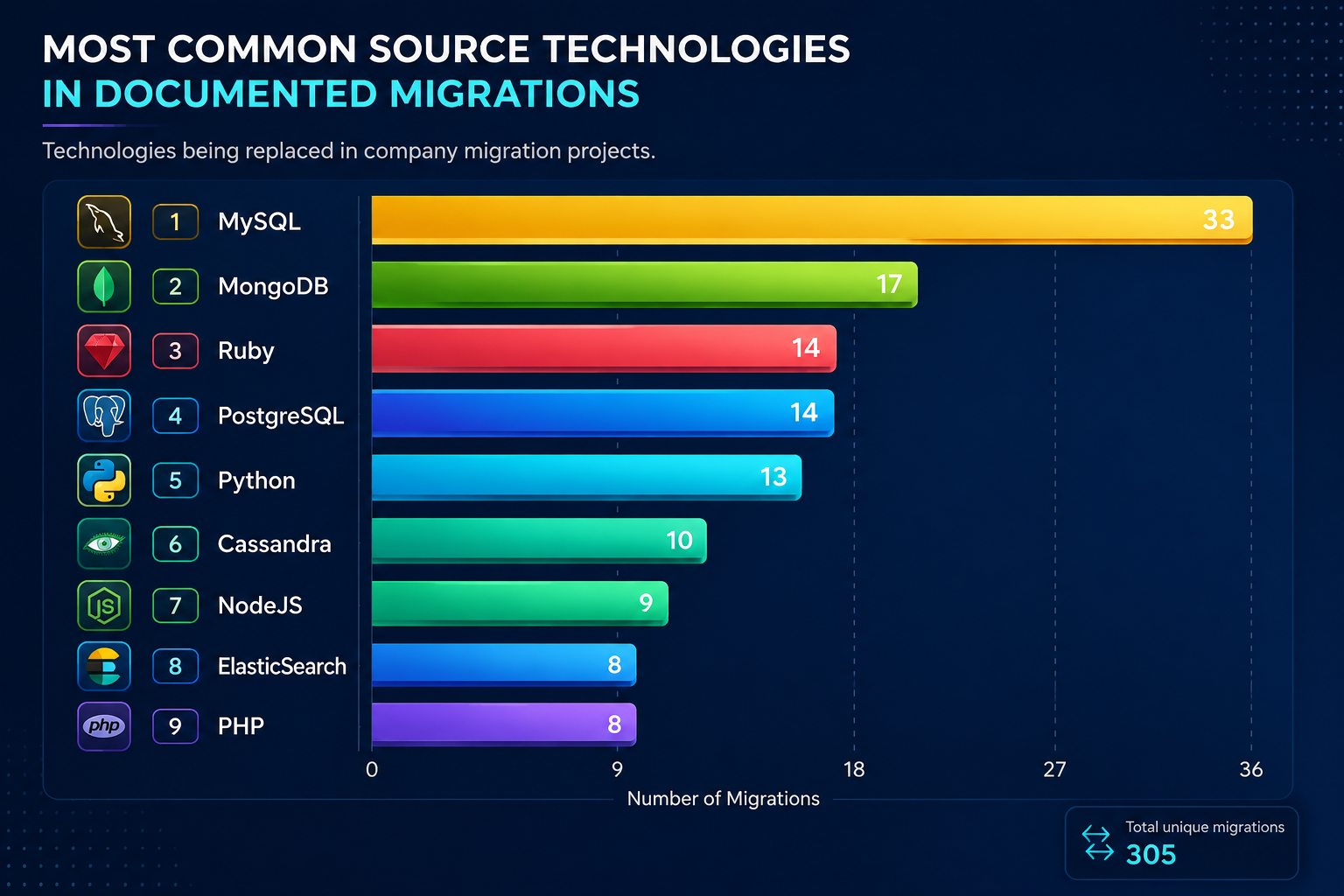
An analysis of more than 300 publicly documented technology migration cases between 2011 and 2025 reveals clear patterns in how ICT companies have modernised their technology stacks. The findings show that organisations are increasingly moving away from traditional monolithic architectures and toward cloud-native, distributed, and highly scalable technologies capable of supporting modern digital services.

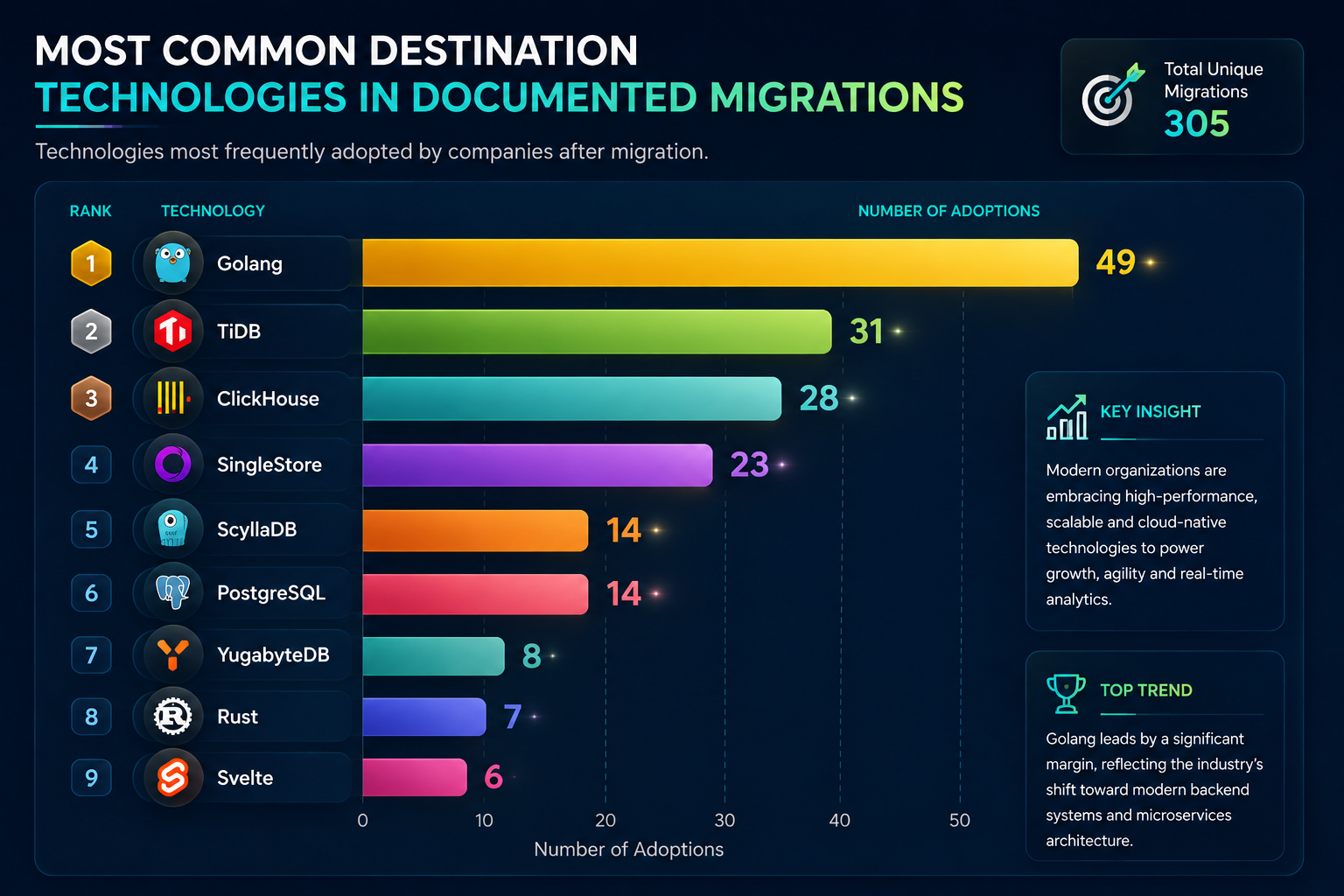
Perhaps the most striking trend is the dominance of Golang as the preferred destination technology. Nearly fifty documented migrations involved organisations replacing existing backend technologies with Go, making it the most frequently adopted programming language in the dataset. This trend reflects a broader industry shift towards high-performance, concurrent programming that supports microservices, containerisation, and cloud-native application development. As digital platforms expand to serve millions of users, organisations increasingly value technologies that deliver predictable performance while reducing operational complexity.

The database ecosystem has experienced an equally profound transformation. Traditional relational and NoSQL databases such as MySQL, MongoDB, and Cassandra frequently appeared as technologies organisations migrated away from. In their place, companies increasingly adopted distributed databases such as TiDB, YugabyteDB, ScyllaDB, SingleStore, and analytical databases like ClickHouse. These migrations are not necessarily indictments of legacy databases. Rather, they illustrate the natural evolution of organisations as their data volumes, transaction rates, and analytical requirements outgrow the capabilities of earlier systems.

One important lesson emerging from the data is that technology choices are closely linked to organisational maturity. Start-ups and rapidly growing companies often begin with proven technologies that enable rapid product development and lower development costs. As user bases expand and business operations become more sophisticated, these same organisations encounter new challenges involving scalability, availability, fault tolerance, and operational efficiency. Technology migration therefore becomes an inevitable stage in organisational growth rather than an admission of previous technological failure.

The years between 2020 and 2021 represent the peak period of documented technology migrations. This surge coincided with accelerated digital transformation across industries, driven by cloud adoption, remote work, increased online transactions, and heightened demand for digital services. Organisations could no longer rely solely on systems designed for traditional enterprise workloads. Instead, they required architectures capable of supporting distributed teams, continuous deployment, real-time analytics, and global-scale applications. The migration wave during this period demonstrates how external disruptions often accelerate technological innovation.

Another noteworthy finding is the growing emphasis on performance engineering. Technologies such as Rust and Go continue to attract organisations seeking greater computational efficiency, lower memory consumption, and improved reliability. As computing costs continue to rise alongside increasing user expectations, software performance is no longer viewed as a purely technical concern but as a strategic business advantage. Faster applications reduce infrastructure costs, improve customer experiences, and strengthen competitive positioning.

Equally significant is the emergence of analytical databases as mainstream infrastructure. The increasing adoption of ClickHouse demonstrates that organisations are placing greater emphasis on real-time business intelligence, observability, event processing, and data-driven decision-making. In today’s digital economy, organisations are no longer satisfied with storing data; they seek technologies capable of transforming vast volumes of operational data into actionable intelligence almost instantaneously.

The migration patterns also highlight the growing importance of distributed computing. Technologies designed specifically for horizontal scalability and fault tolerance increasingly dominate destination platforms. This reflects the reality that modern applications must remain available across multiple geographic regions while supporting continuous growth without significant downtime. High availability has become a business expectation rather than a technical luxury.

These migration patterns carry important strategic implications. First, no technology should be viewed as a permanent investment. Successful organisations continuously evaluate whether their infrastructure aligns with evolving business objectives. Second, migration planning should become an integral component of long-term technology strategy rather than an emergency response to system limitations. Finally, organisations should recognise that digital transformation extends beyond adopting new technologies; it requires building architectures capable of adapting to future technological change.

Our analyst notes that the technology migration data provides valuable insights into the evolution of the global software ecosystem. It reveals how innovation diffuses across industries, how organisations respond to technological disruption, and which technologies emerge as foundational infrastructure for the digital economy. Such evidence can also inform curriculum development, workforce planning, and national digital transformation policies by highlighting the skills and technologies that are increasingly shaping modern software engineering.

Specifically, our analyst observes that every migration represents an organisation responding to new realities, whether those realities involve millions of additional users, increasingly complex data environments, or heightened demands for speed, reliability, and scalability. As digital transformation continues to accelerate, the technologies companies choose to migrate to today provide valuable clues about the architecture of tomorrow’s digital economy. Organisations that understand these patterns will be better positioned not only to keep pace with technological change but to lead it.

Nigeria’s AI Research Boom Signals a New Era of Scientific Innovation

0

Nigeria is experiencing a remarkable transformation in artificial intelligence (AI) research, with scholarly publications reaching unprecedented levels over the past decade. A review of publication data covering journal articles, conference papers, working papers, and preprints with English-language titles or abstracts shows that the country’s research output has grown from just 161 publications in 2016 to 1,369 in 2024. This represents an increase of more than 750 percent in nine years, highlighting Nigeria’s emergence as one of Africa’s leading contributors to AI scholarship.

The data indicates a total of 5,687 AI-related publications between 2016 and 2024. On average, Nigerian researchers produced about 632 publications annually during the period. While the early years were characterised by modest research activity, the pace of scholarly production has accelerated significantly since 2019, reflecting growing institutional interest, international collaboration, and wider application of AI technologies across different sectors.

The journey began with 161 publications in 2016. Research output increased to 229 in 2017 before experiencing a slight decline to 220 publications in 2018. Although the decrease was relatively small, it suggested that AI research in Nigeria was still developing and had yet to establish consistent momentum. At the time, AI remained a specialised field with limited participation from universities, research institutes, and industry.

A dramatic shift occurred in 2019 when the number of publications almost doubled to 437. The increase of 217 publications represented the highest annual growth rate in the dataset at 98.6 percent. This marked a turning point for AI scholarship in Nigeria. Researchers increasingly embraced machine learning, data science, natural language processing, and other AI applications, while collaborations with international partners became more common.

The upward trend continued despite the disruptions caused by the COVID-19 pandemic. Nigeria produced 559 AI publications in 2020, representing a further increase of nearly 28 percent over the previous year. Rather than slowing research activity, the pandemic highlighted the importance of AI in addressing complex challenges in healthcare, education, economic planning, and digital communication. Researchers explored AI-driven solutions for disease surveillance, remote learning, predictive analytics, and public service delivery, contributing to sustained scholarly growth.

The momentum strengthened in 2021 as publication output climbed to 777 articles. This increase of 218 publications demonstrated that AI research was becoming firmly established within Nigeria’s academic landscape. Universities expanded postgraduate research in AI-related fields, while government agencies, private organisations, and international development partners increasingly recognised the strategic importance of AI for national development.

Although growth moderated slightly in 2022, with publications reaching 844, the overall trajectory remained positive. The slower annual increase of 8.6 percent reflected consolidation rather than stagnation. During this period, researchers diversified the application of AI across agriculture, financial technology, environmental management, cybersecurity, governance, transportation, and media studies. AI was no longer confined to computer science departments but had become an interdisciplinary research area attracting scholars from medicine, engineering, economics, education, and the social sciences.

The most impressive expansion occurred during 2023 and 2024. Nigeria crossed the milestone of 1,000 AI publications for the first time in 2023, recording 1,091 scholarly outputs. Just one year later, the total increased again to 1,369 publications. Together, these two years contributed 2,460 publications, accounting for more than 43 percent of all AI research produced during the entire nine-year period.

This rapid increase reflects broader global developments in artificial intelligence. The widespread adoption of generative AI technologies, increased availability of open-source AI tools, improved computing resources, and growing international funding opportunities have encouraged more researchers to pursue AI-related studies. Nigerian institutions have also benefited from stronger research partnerships, enhanced digital infrastructure, and expanding postgraduate programmes that focus on data science and artificial intelligence.

The publication trend suggests that Nigeria has moved beyond the stage of being an emerging participant in AI research. Instead, the country is becoming an important contributor to scientific knowledge within Africa and beyond. The consistent increase in publication output demonstrates not only greater research productivity but also improved capacity for innovation and knowledge creation.

The implications extend well beyond academia. Stronger AI research can support evidence-based policymaking, stimulate technological entrepreneurship, improve industrial productivity, strengthen healthcare systems, modernise agriculture, and enhance public service delivery. As AI continues to shape economies and societies around the world, Nigeria’s expanding body of scholarly work provides a foundation for developing locally relevant technologies capable of addressing national and regional challenges.

Despite the encouraging progress, sustaining this growth will require continued investment in research infrastructure, funding, digital resources, and human capital. Strengthening collaboration between universities, government, industry, and international partners will be essential for translating research findings into practical innovations that benefit society. Equally important is the need to develop ethical and regulatory frameworks that ensure responsible AI development while encouraging innovation.

The figures tell a compelling story of transformation. From fewer than 200 publications annually less than a decade ago to well over 1,300 in 2024, Nigeria’s AI research ecosystem has undergone a remarkable expansion. The country’s scholars are producing knowledge at an unprecedented pace, positioning Nigeria as an increasingly influential voice in Africa’s AI landscape. If the current trajectory continues, the coming years could see Nigeria become not only a regional leader in AI research but also a significant contributor to global conversations on artificial intelligence, innovation, and sustainable development.

NNPC Posts N535bn June Profit, Highest Monthly Earnings in 10 Months As Gas Output Rises

0

The Nigerian National Petroleum Company Limited (NNPC) reported a profit after tax (PAT) of N535 billion in June 2026, its strongest monthly earnings in 10 months, as higher revenue and improved natural gas production helped offset a slight decline in crude oil output.

According to the company’s June 2026 Monthly Financial and Operations Report, the profit represents a 15.8% increase from the N462 billion recorded in May and is the highest monthly profit since August 2025, when the national oil company posted N539 billion.

The latest performance comes against a backdrop of relatively firm global oil prices during June, driven by geopolitical tensions in the Middle East, which supported earnings for oil producers worldwide.

NNPC generated N4.39 trillion in revenue during June, underscoring the company’s continued importance to Nigeria’s public finances.

The report also showed that cumulative statutory payments to the Federation reached N6.29 trillion in the first six months of 2026, reinforcing NNPC’s role as one of the federal government’s largest revenue contributors at a time when authorities are seeking to strengthen fiscal buffers and reduce dependence on borrowing.

The June profit also signals a continued recovery in the company’s financial performance after earnings weakened earlier in the year.

NNPC’s profitability has been volatile over the past year, reflecting changing oil market conditions, production levels and operational challenges.

After recording N539 billion in profit in August 2025, earnings fell sharply to N216 billion in September before recovering to N447 billion in October and N502 billion in November.

Profit eased to N351 billion in December and rose slightly to N385 billion in January 2026 before plunging to N136 billion in February, the weakest monthly performance during the period.

Since then, the company has steadily recovered, posting N276 billion in March, N481 billion in April, N462 billion in May and N535 billion in June.

The June result represents a N399 billion improvement from February’s low point, suggesting stronger operational performance and a more favorable pricing environment.

Oil Production Slips Marginally

Despite the stronger financial performance, crude oil production remained broadly unchanged. Average crude oil and condensate production stood at 1.72 million barrels per day (mbpd) in June, marginally lower than the 1.73 million barrels per day recorded in May.

The company attributed the slight decline to operational disruptions, facility integrity challenges and subsurface issues affecting several producing assets.

Although the reduction was modest, Nigeria continues to face challenges in raising crude production to levels required to maximize export earnings and meet budget assumptions. Sustained improvements in production remain critical for increasing foreign exchange inflows and supporting government revenues.

In contrast to crude production, natural gas output increased during the month.

Gas production rose to 7.841 million standard cubic feet per day (mmscf/d) in June from 7.774 million mmscf/d in May, representing a 0.86% month-on-month increase.

The continued expansion of gas production aligns with Nigeria’s strategy of positioning natural gas as a key driver of energy security, industrial development and export growth while supporting the country’s energy transition objectives.

Gas has become an important segment of NNPC’s business as Nigeria seeks to monetize its vast reserves through domestic power generation, industrial use and liquefied natural gas exports.

The report showed continued progress on two of Nigeria’s most strategic gas infrastructure projects.

The Obiafu-Obrikom-Oben (OB3) Gas Pipeline reached 98% completion, with final tie-in activities underway ahead of targeted first gas in August 2026.

Meanwhile, construction of the Ajaokuta-Kaduna-Kano (AKK) Gas Pipeline advanced to 94% completion.

NNPC said the AKK project remains on track to support the delivery of natural gas to Abuja later this year before extending supplies further north.

Both projects are central to Nigeria’s “Decade of Gas” strategy, which aims to expand domestic gas utilization, improve electricity supply, stimulate industrial development and reduce reliance on imported fuels.

Outlook

NNPC’s June performance is seen as another indication that the state-owned company, notorious for operating at a loss for decades, is increasingly becoming profitable, even as crude production remains below long-term targets.

The combination of stronger global oil prices, rising gas production and continued progress on major infrastructure projects has supported profitability, while statutory payments continue to provide significant revenue to the Federation.

Looking ahead, energy analysts note that sustaining profit growth will depend on several factors, including improvements in crude oil production, the successful completion of the OB3 and AKK pipelines, continued expansion of domestic gas infrastructure and the trajectory of international oil prices.

Chinese Military Researchers Use OpenAI and Anthropic Models to Advance Defense AI, Reuters Review Finds

0

Chinese military researchers have extensively used outputs from advanced artificial intelligence models developed by OpenAI and Anthropic to train domestic AI systems for defense and security applications, indicating Beijing is exploiting a widely used AI training technique to narrow the technological gap with the United States despite tightening export controls.

A Reuters review of more than 80 Chinese academic papers and patent filings, including research compiled by the Washington-based Jamestown Foundation, found that institutions linked to the People’s Liberation Army (PLA), China’s military universities and defense research organizations have relied on “model distillation” to develop specialized AI systems for applications ranging from battlefield decision-making and drone navigation to cyber warfare and surveillance.

The findings provide one of the clearest public pictures yet of how China’s military research ecosystem is incorporating knowledge generated by leading U.S. frontier AI models while avoiding the enormous computational costs required to build comparable systems from scratch.

At the center of the issue is model distillation, a common AI development technique in which a smaller model learns from the outputs generated by a larger, more capable system. Rather than recreating a frontier model from the ground up, developers query an advanced AI model, collect its responses, and use those outputs to train a lighter model optimized for specific tasks.

The approach significantly reduces computing costs while allowing organizations to deploy AI on local infrastructure, including devices with limited processing power such as drones, satellites and battlefield computers.

Distillation itself is widely accepted throughout the AI industry and is used by companies worldwide to improve efficiency. The dispute instead centers on whether some organizations have extracted proprietary capabilities from commercial AI systems without authorization, potentially violating intellectual property rights and undermining U.S. export restrictions.

That distinction has become a bone of contention as Washington intensifies efforts to protect advanced AI technologies from military applications in China.

Military-Linked Institutions Used Frontier U.S. AI Models

Reuters identified widespread evidence that Chinese defense researchers view leading U.S. AI models not only as useful research tools but also as a means of accelerating domestic military AI development.

According to the review, researchers affiliated with PLA Unit 96941, a Beijing-based military intelligence and cyber warfare unit, published a paper last year describing how they used OpenAI’s GPT-3.5 to process sensitive military software code. Recognizing that foreign commercial AI services were unsuitable for handling classified information directly, the researchers reportedly used GPT-3.5 to summarize source code before training a domestic model capable of operating entirely within secure Chinese military networks.

Other studies demonstrated similarly broad military applications.

Researchers from the PLA’s National University of Defense Technology described using distilled AI models to reduce the size of image-recognition systems so they could operate onboard unmanned aerial vehicles. The optimized models enable drones to analyze live video feeds and assist navigation and targeting even when communications with operators are interrupted.

Separately, China’s Academy of Military Sciences published research showing how distilled AI models could support target recognition during simulated maritime operations involving unmanned submarines, naval vessels and drones.

Outside direct military applications, researchers at North University of China, an institution closely linked to the country’s weapons industry, reportedly used Anthropic’s Claude 3 Haiku model to generate synthetic training data for systems designed to classify online content for social media monitoring and content moderation.

Experts say Chinese researchers are interested not simply in copying AI outputs but in capturing the reasoning processes that distinguish today’s most advanced frontier models.

Sunny Cheung, a fellow at the Jamestown Foundation who analyzed more than 60 of the papers, said the objective is to transfer sophisticated reasoning capabilities into domestic systems that can be deployed independently.

“Teaching a model the right answer is one thing, but teaching it the reasoning behind the answer is much harder,” he said.

Cheung said the research indicates Chinese military scientists are attempting to preserve the reasoning patterns of Western AI models for surveillance, cyber operations and battlefield decision-making.

That objective exposes one of the most significant developments in modern AI. Increasingly, competitive advantage comes not simply from producing accurate answers but from building models capable of complex reasoning across multiple tasks.

AI Becomes Another Battleground In U.S.-China Rivalry

The findings arrive as artificial intelligence becomes a central arena of strategic competition between Washington and Beijing.

The Trump administration has accused several Chinese AI companies of improperly extracting capabilities from U.S. frontier models through large-scale distillation, warning that such practices circumvent export controls while appropriating valuable intellectual property.

The dispute has centered particularly on Beijing-based startup Moonshot AI, whose recently released Kimi K3 model attracted attention for advanced coding capabilities. U.S. officials have alleged that Moonshot distilled Anthropic’s Claude models to accelerate development, accusations the company has denied, insisting its performance improvements resulted from proprietary architectural innovations.

China has rejected broader U.S. allegations, accusing Washington of pursuing what it describes as “AI hegemonism” while arguing that American companies have also benefited from similar techniques throughout AI development.

The disagreement has emerged as a major issue ahead of expected bilateral discussions on AI governance, safety and national security.

Distillation Offers Advantages—But Not Full Independence

Although distillation allows developers to build capable AI systems at a fraction of the computational cost, experts caution that the technique has inherent limitations.

Unlike frontier models trained on massive proprietary datasets using vast computing resources, distilled models typically inherit only selected capabilities optimized for specific applications.

Trevor Koverko, co-founder of AI data company Sapien, said distilled systems should not be viewed as replacements for frontier AI.

“It is best understood as transferring selected capabilities into a cheaper, locally controlled system, not achieving independence from frontier AI,” he said.

Chinese researchers themselves appear increasingly aware of those limitations. In January, researchers at the Army Engineering University published work examining the risks associated with “data-free distillation,” a technique that attempts to reconstruct model capabilities without direct access to underlying parameters.

The researchers proposed defensive mechanisms intended to conceal logical reasoning embedded within publicly accessible model outputs, highlighting growing concerns that AI models themselves have become valuable strategic assets vulnerable to reverse engineering.

However, the widespread use of distillation reflects China’s broader response to U.S. restrictions on advanced semiconductors and AI hardware. Unable to freely acquire the latest high-performance AI chips, Chinese researchers have focused on making AI systems more efficient through lightweight models capable of running on limited computing resources.

Central and local governments have directed funding toward edge computing, compact AI models and autonomous systems that can operate independently on drones, satellites, robotics platforms and military equipment.

Rather than competing solely by building ever-larger frontier models, China is now emphasizing efficient deployment across operational environments where computing resources are constrained.

That approach could allow Chinese defense organizations to field capable AI systems across a wide range of military platforms without requiring access to the world’s largest supercomputers.