DD
MM
YYYY

PAGES

DD
MM
YYYY

spot_img

PAGES

Home Blog Page 8

Amazon to Invest Over €300M in Germany as Deutsche Bahn Ends Seven-Year Profit Drought

0

Germany’s economic recovery gathered fresh momentum in the first half of 2026 as two major developments highlighted growing confidence in Europe’s largest economy.

National rail operator Deutsche Bahn announced its first operating profit in its core business in seven years, while Amazon revealed plans to invest more than €300 million to expand its operations in southwestern Germany.

These announcements signal renewed optimism for the country’s infrastructure, logistics, digital economy, and long-term competitiveness.

Deutsche Bahn’s return to profitability marks a significant milestone after years of financial struggles, operational disruptions, and declining public confidence.

The state-owned railway operator has faced mounting challenges over the past decade, including aging infrastructure, frequent service delays, rising operating costs, and the financial impact of the COVID-19 pandemic.

The latest results indicate that extensive restructuring efforts, efficiency improvements, and investments in rail operations are beginning to deliver measurable outcomes. The company’s core business posted a profit during the first six months of 2026, representing its strongest operational performance since 2019.

This achievement reflects better cost management, increased passenger demand, and stronger freight operations as economic activity gradually strengthened across Germany and Europe.

Improved punctuality, optimized maintenance schedules, and modernization projects have contributed to restoring customer confidence in the rail network.

A financially healthier Deutsche Bahn carries broader implications for Germany’s economy. Efficient railway infrastructure supports domestic commerce, facilitates international trade, and advances the country’s environmental objectives by encouraging more passengers and businesses to shift from road transport to lower-emission rail services.

As Germany seeks to meet ambitious climate targets, a stronger national rail operator will remain central to reducing transportation-related carbon emissions while improving economic productivity.

Amazon’s decision to invest more than €300 million in expanding one of its sites in southwestern Germany reinforces the country’s position as a key European logistics and technology hub.

The investment is expected to enhance warehouse capacity, improve automation systems, and create additional employment opportunities across the region. Amazon’s expansion reflects sustained confidence in Germany’s consumer market and strategic location within Europe’s supply chain.

Germany offers excellent transport infrastructure, access to major European markets, and a highly skilled workforce, making it an attractive destination for multinational technology and logistics companies seeking long-term growth.

The investment is likely to generate significant economic spillover effects. Construction activities will support local contractors and suppliers, while expanded operations could create new jobs in logistics, engineering, information technology, maintenance, and administrative services.

Local businesses may benefit from increased commercial activity surrounding the expanded facility. Beyond employment, Amazon continues to invest heavily in automation, robotics, artificial intelligence, and cloud-enabled logistics solutions. These technologies improve operational efficiency, accelerate order fulfillment, and strengthen supply chain resilience.

As Germany continues its broader digital transformation agenda, private-sector investments of this scale complement public efforts to modernize infrastructure and promote innovation.

Deutsche Bahn’s return to profitability and Amazon’s major expansion underscore two important pillars of Germany’s economic strategy: modern infrastructure and digital commerce.

Public investment in transportation, combined with private-sector commitments to technology and logistics, creates a foundation for sustainable economic growth and improved competitiveness.

While Germany still faces headwinds such as global trade uncertainty, demographic challenges, and high energy costs, these developments suggest that confidence among both public institutions and multinational corporations is strengthening.

If continued reforms, infrastructure modernization, and private investment remain on course, Germany could reinforce its position as Europe’s industrial and logistics powerhouse, supporting stronger growth, greater innovation, and long-term economic resilience throughout the remainder of 2026.

German Inflation Rebounds in July as Food and Services Costs Stay Elevated

Meanwhile, German inflation unexpectedly accelerated in July, adding fresh complexity to the eurozone’s economic outlook as households and businesses continue to grapple with elevated living costs.

Preliminary figures released by Germany’s Federal Statistical Office showed that consumer prices increased by 2.8% year-on-year in July, compared with 2.3% in June, marking a sharper-than-expected rise and signaling that inflationary pressures remain persistent in Europe’s largest economy.

The increase comes at a time when many policymakers and investors had anticipated a more gradual decline in inflation following months of easing price growth.

Instead, the July figures suggest that underlying price pressures have not disappeared and may continue to challenge the European Central Bank as it seeks to balance inflation control with economic growth.

Germany’s inflation data is closely watched because it often provides an early indication of broader price trends across the eurozone. As the bloc’s largest economy, developments in Germany frequently influence expectations for ECB monetary policy.

A higher-than-expected inflation reading could reinforce the argument for maintaining relatively restrictive interest rates for longer, even as economic growth across Europe remains subdued. Several factors likely contributed to the rebound in inflation.

Energy prices, which had previously eased due to favorable base effects, may have begun exerting upward pressure again. Food prices also remain volatile, while services inflation has continued to stay elevated, reflecting higher labor costs and strong wage growth.

German employers have been raising wages in response to previous inflation shocks, helping workers recover lost purchasing power but also increasing operating costs for businesses, many of which pass those expenses on to consumers.

The latest figures highlight the ongoing tension between economic recovery and price stability.

Germany has experienced sluggish economic performance over the past year, with weak industrial production, softer exports, and cautious consumer spending weighing on overall growth.

Persistently high inflation reduces household purchasing power, making consumers more selective in their spending while increasing uncertainty for businesses planning future investments.

Financial markets are likely to scrutinize the inflation report for clues about future ECB decisions. Although the central bank has made progress in bringing inflation closer to its long-term target of 2%, the July increase demonstrates that the final phase of disinflation may prove more difficult than expected.

Policymakers will likely examine whether the rise represents a temporary fluctuation or the beginning of a broader resurgence in price pressures. The renewed increase means that everyday expenses may continue to rise faster than many households would prefer.

Higher prices for essential goods and services can strain family budgets, particularly for lower-income households that spend a larger share of their income on necessities. Businesses, meanwhile, face the challenge of managing higher input costs without significantly weakening consumer demand.

The July inflation data also carries broader implications for the eurozone economy. If similar trends emerge across other member states, the ECB could become more cautious about easing monetary policy too quickly.

Higher borrowing costs for an extended period may help restrain inflation but could also slow investment, lending, and overall economic activity. Economists will closely monitor upcoming inflation reports, wage data, and energy price movements to determine whether July’s increase represents a temporary spike or a more persistent trend.

Germany’s inflation rebound serves as a reminder that the fight against rising prices is not yet over. While inflation has fallen substantially from the record highs experienced in recent years, achieving lasting price stability remains one of the most significant economic challenges facing Germany and the wider eurozone.

BNB Fights Back, ONDO Takes Off, But BlockDAG Emerges as 2026’s Next Big Crypto with Rising Utility and $0.00000015 Entry

0

The crypto market rarely hands out easy answers, and this week’s action across three projects proves it. Trading near $565, Binance Coin is fighting to hold the $563 support zone, with buyers eyeing $571 as the next hurdle before sentiment can truly turn bullish. Meanwhile, Ondo Finance has unveiled Ondo Network to address the execution bottlenecks that its earlier chain design couldn’t solve, a move that sent ONDO surging nearly 12%.

Then there’s BlockDAG, which is dominating conversations about the next big crypto opportunity. Claiming and staking are now live across six batches; the network processed 100,000 transactions in a single day, and a new 24-hour offer prices BDAG at $0.00000015 before Batch 7 claims open tomorrow morning. Let’s break down the outlook for all three.

Binance Coin Price Faces a Critical Test at $571

The Binance Coin price is showing cautious signs of recovery after finding support near $563 and trading around $565.26, posting a modest 0.21% daily gain. Analysts believe buyers will need to push the token above the $571 resistance level to strengthen the short-term outlook, while a drop below $560 could trigger fresh selling. Despite the current bearish sentiment, technical indicators such as the RSI suggest buying interest is gradually returning.

Looking further ahead, forecasts remain optimistic, with projections of around $840.20 in 2026, $1,261 by 2028, and as high as $2,828 by 2032 if adoption continues to grow. While these targets are not guaranteed, they reflect confidence in the long-term potential of the BNB ecosystem. Overall, the Binance Coin price outlook remains mixed in the short term but more positive over the longer horizon.

Ondo Finance Upgrades Its Network

Ondo Finance has introduced Ondo Network, a new platform designed to make trading tokenized real-world assets much faster while keeping users in control of their funds. The company replaced its earlier Ondo Chain after finding that trade execution, not settlement, was slowing transactions.

The new system separates execution, validation, and settlement, allowing quicker and more private trading. Ondo Perps is the first application on the network, offering round-the-clock perpetual futures linked to stocks and commodities. For now, transactions settle on Ethereum, with more blockchains expected later.

Meanwhile, Oasis Pro can now provide U.S. investors access to equities, ETFs, mutual funds, index funds, and IPOs. Following the announcement, the ONDO token climbed nearly 12%, reaching about $0.40, with a market capitalization close to $2 billion. Ondo Finance said ONDO will continue serving as its governance and ecosystem token.

BlockDAG

Utility is usually the deciding factor when people search for the next big crypto, and BlockDAG’s recent upgrades make it a top contender today. Its RPC infrastructure just processed 100,000 transactions within a 24-hour span, a jump that has translated into faster claims, quicker transaction confirmations, and improved smart wallet support through the upgraded BDAGSCAN system.

Alongside that, the project’s casino and sportsbook arm has passed $200 million in wagering, signaling massive adoption. The recent BDAG AI launch added roughly $500 million to the project’s overall valuation, giving the network another working commercial layer.

And things get even more exciting now: Claiming and staking are officially live, with Batches 1 through 6 already processing and Batch 7, covering purchases made up to July 19, set to go live the next morning.

To mark the moment, there’s a 24-hour-only offer: BDAG at $0.00000015, or 30% under its CoinMarketCap value through Live Swap. On top of this, anyone buying today also gets $1,000 in Exchange Credit ahead of the BlockDAG Exchange launch. The network’s TPS upgrade to 7,000 is now live as well.

Given all of this progress, analysts have predicted returns as high as 500x today’s price once the exchange and Super App launch. Nearly 10 billion BDAG have been staked by earlier buyers, and paired with the current staking batches, that adds to the supply pressure. That’s why traders looking to maximize returns through the lowest entry are rushing in now.

Final Thoughts

Looking ahead, Binance Coin’s price will likely hinge on whether $571 flips into support, a move that could open the door toward the $840 target analysts have projected for 2026. However, a drop below $560 would keep sellers in control for a while longer. Ondo Finance has its own runway now that Ondo Network separates execution from settlement. With Ondo Perps live and Oasis Pro opening access to equities and IPOs for U.S. investors, ONDO’s climb toward $0.40 could be just the opening chapter.

BlockDAG, meanwhile, isn’t waiting around to see how the rest of the market plays out. With 100,000 transactions processed in a day, $200 million wagered through its casino arm, 7,000 TPS now running, and nearly 10 billion BDAG already staked, the case for it as the next big crypto is iron-clad. Savvy buyers are rushing in now, knowing there are only 24 hours left to secure shares at $0.00000015.

Presale: https://purchase.blockdag.network

Website: https://blockdag.network

Telegram: https://t.me/blockDAGnetworkOfficial

Discord: https://discord.gg/Q7BxghMVyu

ContiSX Sage – Your Boardroom’s New Protocol

0

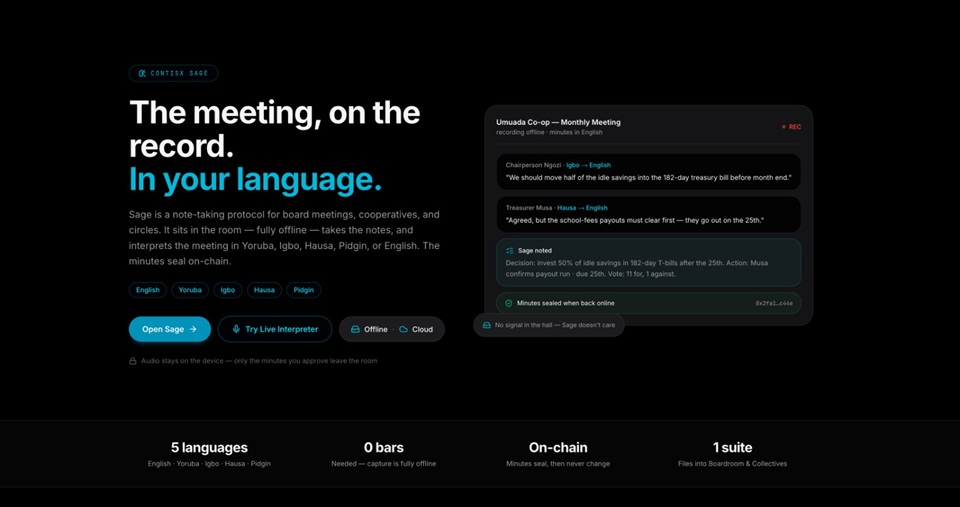
Meet your boardroom’s new protocol. ContiSX Sage is a fully offline, multi-lingual note-taking system built for cooperatives, circles and corporate boards. It sits in the room, records the meeting, interprets in Yoruba, Igbo, Hausa, Pidgin, or English, and seals the minutes on-chain. It is a pure Wazobia breed where any person can speak his or her language; Sage will unify everything when done!

No signal? No problem. Sage processes entirely on-device for boardrooms and village halls alike. Prefer to be connected? The online version syncs your minutes across your ContiSX identity, fully searchable and verified on the chain explorer.

From Lagos boardrooms to Ovim village squares, Sage turns discussions into data. That data feeds into ContiSX Boardroom for seamless voting, which then triggers compliant ContiSX Collectives to execute investment opportunities if that is the purpose.

CONSIDER FOR Progress Co-Op Jos Plateau

Chairperson Ngozi · Igbo >> English

“We should move half of the idle savings into the 182-day treasury bill before month end.”

Treasurer Musa · Hausa >> English

“Agreed, but the school-fees payouts must clear first — they go out on the 25th.”

Decision: invest 50% of idle savings in 182-day T-bills after the 25th. Action: Musa confirms payout run · due 25th. Vote: 11 for, 1 against.

ContiSX Sage unifies Nigerian languages. ContiSX Boardroom provides a voting system and governance layer on blockchain. ContiSX Collectives enables people to organize at software-level, not investment layer, to invest together even though at atomic level they are different with unique CSD accounts, meeting all regulatory requirements.

Sage will be available across iOS, Android, Web, Chrome Extension, SmartTV, and the ContiSX Phone. It is part of ContiSX Securities Exchange plc’s strategy to deepen investment inclusion in Nigeria, reducing barriers associated with language and location across the nation.  Join the waitlist: https://contisx.com/

How the ContiSX Phone Can Attract Muslim Investors

0

How the ContiSX Phone Can Attract Muslim Investors

Nigeria is home to one of Africa’s largest Muslim populations, yet participation in the country’s capital market remains relatively low. While several factors contribute to this gap, one of the most significant is the limited availability and visibility of investment products that align with Islamic financial principles. The launch of the ContiSX Phone, powered by the Cube ecosystem, presents an opportunity to address this challenge. Its success, however, will depend not only on technological innovation but also on whether it can earn the confidence of Muslim investors through genuine Shariah-compliant financial services.

Technology alone does not drive financial inclusion. Trust does. For many Muslim investors, the decision to invest is guided by religious principles that prohibit riba (interest), excessive uncertainty, and investment in businesses whose primary activities are considered impermissible under Islamic law. Any platform seeking to attract this market must therefore demonstrate that compliance is built into its investment ecosystem rather than treated as an optional feature.

The ContiSX Phone has already been positioned as more than a smartphone. It is intended to function as a gateway to digital investing, business financing, and capital market participation. This creates an opportunity to rethink how Islamic finance can be delivered through a mobile-first platform.

One of the strongest ways ContiSX could attract Muslim investors is by creating a dedicated Islamic investment marketplace. Rather than asking investors to search through hundreds of securities to determine which are permissible, the platform could provide a clearly labelled section containing only Shariah-compliant investment opportunities. This would simplify investment decisions while increasing confidence in the platform.

The marketplace should include Shariah-screened equities, Sukuk, Islamic mutual funds, exchange-traded funds that meet Islamic investment criteria, and equity-based funding opportunities for small and medium-sized enterprises. Such an ecosystem would allow investors to diversify their portfolios without compromising their religious convictions.

Equally important is the establishment of an independent Shariah Advisory Council. Every successful Islamic financial institution relies on credible scholars to review products, certify compliance, and provide ongoing oversight. Without such governance, claims of Shariah compliance are unlikely to gain widespread acceptance. Transparency would become a competitive advantage if ContiSX publishes the screening methodology, advisory opinions, and periodic compliance reports directly within the phone’s investment application.

Artificial intelligence also offers unique possibilities. The AI capabilities promoted for the ContiSX Phone could be adapted to support ethical investing. Instead of merely recommending securities based on expected returns, the system could analyse companies against recognised Islamic screening standards. Investors could receive notifications whenever a company’s compliance status changes, allowing them to make informed decisions without conducting complex financial analysis themselves.

The phone could also include tools that automatically classify investments as compliant or non-compliant, estimate portfolio purification where applicable, and generate simple compliance reports for users. Such features would transform the device from a trading platform into a trusted financial companion.

Another opportunity lies in financing Nigerian businesses through Islamic partnership models. Many entrepreneurs avoid conventional borrowing because of interest-based financing. ContiSX could introduce digital structures based on Musharakah, Mudarabah, Murabaha, and Ijara, allowing businesses to raise capital through profit-sharing or asset-backed financing arrangements. This would not only attract Muslim investors but also expand access to finance for entrepreneurs seeking ethical alternatives.

Education will be equally important. Many potential investors remain unfamiliar with Islamic capital market products. The ContiSX Phone could include an educational hub explaining concepts such as Sukuk, profit-sharing, risk-sharing, halal investing, and Shariah screening using videos, interactive guides, and AI-powered assistance. Financial literacy delivered through the same device used for investing could significantly reduce barriers to participation.

Nigeria already possesses a growing Islamic finance ecosystem, including sovereign Sukuk, non-interest banking, and Takaful insurance. Yet these services often operate independently. The ContiSX Phone has the potential to become the digital platform that connects these components into a single investment experience. Integration with Islamic banks, non-interest payment systems, and licensed Islamic asset managers would further strengthen its appeal.

This opportunity extends beyond Nigeria. Across Africa, millions of Muslims remain underserved by conventional capital markets. A mobile platform that combines modern financial technology with credible Islamic governance could position ContiSX as a regional leader in ethical investing. Such positioning would attract not only Muslim investors but also non-Muslim investors increasingly interested in environmental, social, governance, and values-based investment strategies, many of which share common principles with Islamic finance.

If ContiSX embraces Islamic finance as a core strategic pillar rather than a niche offering, it could unlock a vast and largely untapped segment of Nigeria’s investment community. In doing so, it would demonstrate that financial innovation is not merely about building smarter devices but about designing financial ecosystems that reflect the diverse values of the people they are meant to serve.

EY’s AI Routing Technology Could Transform Enterprise Generative AI Costs

0

As enterprises rapidly integrate artificial intelligence into their daily operations, one of the biggest challenges has become managing the soaring costs associated with running large language models.

Every AI prompt consumes computational resources, often measured in tokens, and as businesses scale AI adoption across thousands of employees, token usage can translate into significant operational expenses.

Against this backdrop, global professional services firm EY has revealed that its internally developed invisible AI router has reduced token consumption by as much as 60%, marking a significant breakthrough in enterprise AI optimization.

Unlike traditional AI systems that send every request to a single large language model, EY’s AI router works behind the scenes, intelligently directing each query to the most suitable model based on the complexity of the task.

Simple requests, such as summarizing documents or answering routine questions, are handled by smaller, less expensive models, while more demanding tasks requiring advanced reasoning are routed to more powerful frontier models. The entire process happens seamlessly, making the routing mechanism effectively invisible to end users.

This intelligent orchestration addresses one of the biggest inefficiencies in enterprise AI deployment. Many organizations rely on premium AI models for every task, regardless of whether such computing power is necessary.

While this guarantees high-quality responses, it also results in excessive token usage and unnecessarily high infrastructure costs. By matching the right model to the right workload, EY has demonstrated that substantial savings can be achieved without compromising user experience.

Token efficiency has become increasingly important as businesses expand AI adoption across departments including finance, legal, consulting, customer support, and software development.

Millions of prompts generated every day can quickly drive cloud computing bills into the millions of dollars annually.

Reducing token consumption by up to 60% represents not only lower operational costs but also improved scalability, enabling organizations to deploy AI more broadly without facing exponential increases in spending.

Beyond financial benefits, the routing system also improves overall performance. Smaller models often generate responses faster than larger ones, reducing latency for routine tasks.

Employees receive quicker answers while organizations reserve premium computing resources for tasks that genuinely require sophisticated reasoning. This balanced allocation enhances productivity and maximizes the return on AI investments.

EY’s approach reflects a broader trend within the AI industry toward multi-model ecosystems. Rather than relying exclusively on a single provider, enterprises are increasingly combining models from different vendors and selecting the best option dynamically.

AI orchestration platforms are becoming essential infrastructure, allowing organizations to balance cost, speed, accuracy, and security according to business requirements. The development underscores a growing shift in enterprise AI strategy.

Competitive advantage is no longer determined solely by access to the most advanced language models but by how intelligently companies manage and optimize those models.

Routing technologies, prompt optimization, caching mechanisms, and workflow automation are emerging as critical tools for improving AI efficiency while controlling expenses.

As AI continues to transform industries, organizations will increasingly prioritize solutions that maximize value rather than simply increasing computing power. EY’s invisible AI router demonstrates that significant efficiency gains can be achieved through smarter system design instead of larger models alone.

The reported reduction in token consumption illustrates how innovation in AI infrastructure can deliver meaningful business outcomes. By optimizing model selection behind the scenes.

EY has shown that enterprises can simultaneously reduce costs, improve performance, and scale AI adoption more sustainably. As businesses continue investing heavily in generative AI.

Intelligent routing technologies are likely to become a standard feature of next-generation enterprise AI architectures, shaping how organizations deploy and manage artificial intelligence in the years ahead.