DD
MM
YYYY

PAGES

DD
MM
YYYY

spot_img

PAGES

Home Blog Page 860

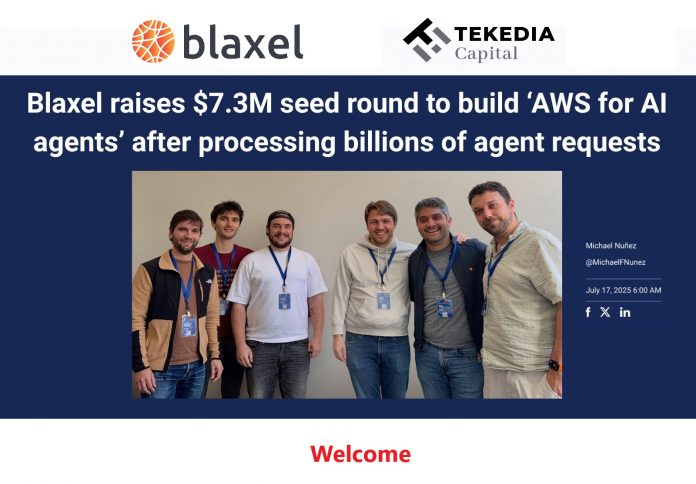
Tekedia Capital congratulates our portfolio company, Blaxel, for $7.3M Raise

0

Tekedia Capital congratulates our portfolio company, Blaxel, a computing platform that gives AI Builders the toolbox and infrastructure to build, deploy and scale agents efficiently, for raising $7.3m. This is the world’s first “agentic AI cloud” which has developed the foremost Global Agentics Network, a production-grade network built for agentic AI.

Good People, this is the AWS for the agentic era, and all AI agents are welcome in Blaxel pioneering ecosystem. Visit blaxel.ai for more and connect with Paul Sinaï , CEO of Blaxel, to host your AI agents in the habit created for the best AI agents!

Tokenization of Real-World Assets in African Markets: A Practical Look Ahead

0

Across Africa, interest is growing in how blockchain technology might help solve everyday financial problems. One idea at the center of this is tokenization, a system where digital tokens represent ownership in real-world items like land, houses, gold, or even a share in a small farm. This approach allows people to invest in high-value assets without needing large sums of money or access to traditional banking systems.

In parts of the continent where formal financial services remain limited, the idea of dividing assets into smaller, tradable parts offers a new way to grow wealth and share resources. It’s especially relevant where paperwork, legal bottlenecks, and access to capital make investing slow or out of reach for many.

Small Steps, Large Potential

Tokenization is not a new concept, but in African markets, it is still nascent. Perhaps the timing is perfect. Mobile technology is more prevalent than ever, and there is already an established, tech-inclined demographic that has shown interest. As more people look for better ways to manage value, tokenized property could transform how investment and business ownership is conceptualized in the region. Blockchain startups working on tokenization have started raising funds through presales and early-stage offerings.

These projects are gaining visibility on global watchlists tracking the top presale crypto opportunities, and several of them excel in market fit, tokenomics, and staking utility, making them attractive to those looking for superior functionality and scalability. Most important, adaptability in the global market.

Legal Recognition Matters

Even with good ideas and working technology, legal backing is still the most important piece missing. In many countries, digital ownership is not officially recognized. Without that recognition, owning a digital token might not mean much if a dispute arises.

Nigeria, South Africa, and a few others are beginning to outline how digital assets should be treated. These early efforts could help provide a model for how tokenized ownership can be legally enforced, taxed, and transferred. Until then, any project involving tokenization will carry extra risk.

It’s also worth noting that land rights, inheritance issues, and property records in many African countries are already complicated. Adding technology won’t fix those problems unless the laws catch up and offer real support.

Digital Access Still Lags Behind

Even the best digital tools are useless without a strong infrastructure. Reliable internet, safe mobile networks, and affordable smartphones remain out of reach for many, especially in rural areas. Without these, tokenized platforms can’t gain wide use.

Electricity supply is another issue. When power is unreliable, people can’t consistently access online tools or manage their digital wallets, which limits participation.

Learning and Trust Are Key

Understanding how tokenization works is a big hurdle for many people. Blockchain, wallets, and digital transactions remain new concepts in many communities. Education programs that explain these ideas clearly and simply will be necessary to build confidence.

Scams and fraud have made some people wary of crypto projects. Transparency and regulation will help build trust over time, but for now, caution is understandable.

The Role of Financial Institutions

Traditional banks and financial companies can help tokenization gain acceptance. They already know how to handle money, identity verification, and compliance with regulations. By working with blockchain startups, they can make digital asset platforms easier and safer for everyday users.

Some banks have begun experimenting with blockchain to speed up transactions and reduce fraud. There is potential for collaboration, where banks provide the support and stability, while startups build innovative products.

Benefiting Sectors

Once again, real estate is a definite opportunity. A lot of people struggle to buy whole properties, but now they can partially invest in them. This can expand markets as well as improve the funding of development projects.

This is also applicable to other sectors, for example, agriculture. Farmers usually have difficulties in obtaining loans or investments. Tokenized shares of land or crops might receive funding with the collapse of traditional banking structures.

Natural resources, like minerals or even oil, could have their tokenization reduce corruption while increasing confidence from investors.

Renewable energy projects, especially in underdeveloped areas, like solar and wind farms, may also use tokens for an easier and faster collection of money and project initiation.

Challenges to be Expected

Without a doubt, the biggest obstacle is the lack of legislation. Projects may stall, and investors may be more reluctant without proper rules. Drafting and enforcing regulations will be pivotal to the progress of the case for investment.

Integration with other financial systems and the interoperability of various blockchain systems pose additional challenges that have yet to be resolved. Cultural norms that are too accustomed to using cash will also be a challenge and will require significant time to reform. Systems will have to prove themselves valuable and reliable to gain acceptance.

Looking Forward

Across Africa, tokenization provides a new method for sharing and accessing wealth. Financial barriers are lowered, allowing wider participation in previously inaccessible investment opportunities.

The collaborative efforts of governments, businesses, and communities towards developing appropriate legal policies, infrastructure, and user education could make tokenization a powerful driver of economic growth.

A number of projects today are already working toward these goals and are being funded through crypto channels, thereby paving the way for future opportunities.

AAS Miner Launches Bitcoin Cloud Mining Platform with XRP Payments

0

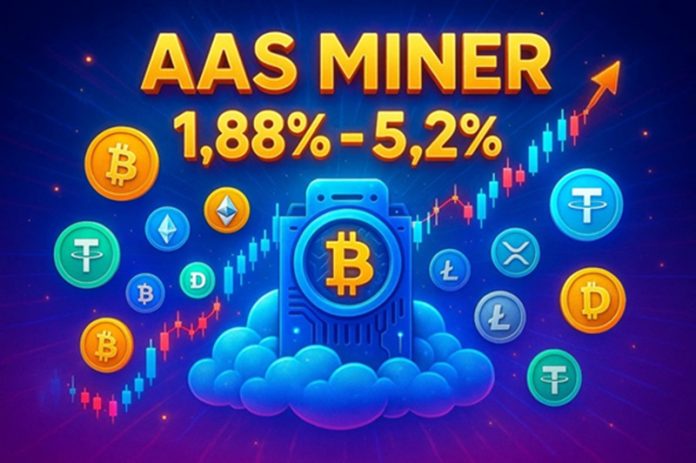
Experience AAS Miner, the world’s first AI-driven Bitcoin cloud mining platform – secure, energy-efficient, and optimized for maximum returns. Support BTC, BCH, ETH, SOL, XRP, LTC, DOGE, USDT, USDC and other stablecoin payments, and get a guaranteed daily return of 1.88% to 5.2% in a fully transparent and convenient cloud mining solution.

In the rapidly evolving world of Bitcoin Mining, staying ahead of the curve means embracing innovation, transparency, and user-centric services. Today, AAS Miner proudly announces the launch of its next-generation Bitcoin Cloud Mining solution—a cutting-edge Cloud Mining Platform that simplifies digital asset investment and empowers users worldwide. Featuring seamless XRP payments and backed by AI-driven optimization, this platform sets a new industry benchmark for efficiency, security, and passive income generation.

Revolutionizing Bitcoin Mining with AI-Driven Cloud Technology

Traditional Bitcoin mining requires significant upfront investment in hardware, technical know-how, and ongoing maintenance. AAS Miner’s new Bitcoin Cloud Mining offering removes these barriers. By leveraging powerful, top-of-the-line mining machines in state-of-the-art data centers, AAS Miner provides:

Effortless Access: No complex setup or hardware management—simply sign up, choose your plan, and start mining immediately.

AI-Driven Efficiency: Proprietary AI algorithms optimize mining operations in real time, ensuring maximum hash rates and reduced energy consumption.

Scalability on Demand: Upgrade or scale down your mining power at any time to match market conditions and personal investment goals.

This innovative Cloud Mining Platform caters to both seasoned miners and newcomers, delivering a user-friendly dashboard, real-time performance analytics, and 24/7 technical support.

Seamless XRP Payments for Faster, Cheaper Transactions

Recognizing the importance of flexible and cost-effective payment options, AAS Miner integrates XRP Payments directly into its Cloud Mining Platform. XRP’s speed and low transaction fees enable:

Instant Contract Activation: Fund your account and deploy mining contracts in seconds—no waiting for blockchain confirmations.

Global Accessibility: XRP’s liquidity and widespread exchange listings make it easy for users in any region to participate.

Reduced Fees: Enjoy lower processing costs compared to traditional fiat or other cryptocurrencies, preserving more of your mining returns.

By accepting XRP alongside Bitcoin and stablecoins, AAS Miner ensures a truly global and frictionless experience for all users.

Unmatched Trust: Guaranteed Yields and On-Chain Transparency

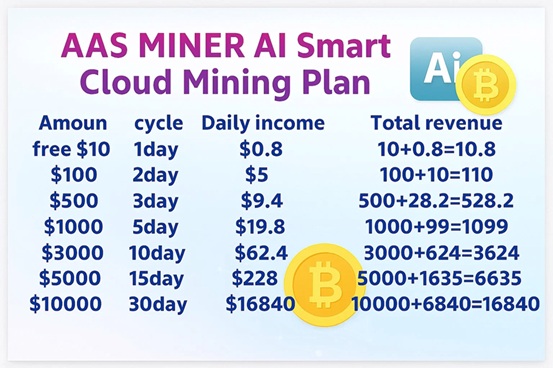
Investing in Cloud Mining can feel uncertain—but not with AAS Miner. Every AI cloud computing contract is 100% guaranteed for principal and interest, offering fixed daily yields between 1.88% and 5.2%. Underpinning this trust are:

AAS Miner AI cloud computing contract revenue example diagram (visualization)
On-Chain Transparency: All mining payouts and contract details are verifiable on public ledgers, ensuring full accountability.

Stringent Fund-Security Protocols: Cold storage, multi-signature wallets, and regular security audits protect user assets.

Dedicated Customer Support: AAS Miner’s expert team is available around the clock to address any questions or concerns.

Sign-Up Bonus: Kickstart Your Bitcoin Mining Journey

New to AAS Miner? There’s never been a better time to get started:

Receive a $10 welcome credit immediately upon sign-up.

Reinvest your credit into free daily mining contracts that yield approximately $0.80 per day.

These rewards enable you to experience the benefits of Bitcoin Cloud Mining risk-free, while building your passive income stream from day one.

Multi-Currency Support: Diversify Your Crypto Portfolio

Beyond Bitcoin, AAS Miner’s Cloud Mining Platform supports a wide range of popular cryptocurrencies, allowing you to diversify and maximize passive income opportunities:

BTC (Bitcoin) ,BCH (Bitcoin Cash),ETH (Ethereum),SOL (Solana),XRP (Ripple),LTC (Litecoin),DOGE (Dogecoin),USDT,USDC (Stablecoins)

With this comprehensive crypto portfolio, investors can pivot quickly between assets, optimizing returns based on market dynamics.

Why Choose AAS Miner’s Cloud Mining Platform?

AAS Miner is the world’s top AI-driven cloud mining industry benchmark platform, designed to provide a simple and convenient mining experience, and is committed to providing seamless services. Combined with top mining machines, it opens the door to the world of digital assets for investors, brings passive income, is efficient and energy-saving, safe and reliable. Join AAS Miner and start your cloud mining wealth appreciation journey.

AI-Optimized Operations: Continuously tuned for peak performance.

User-Centric Design: Intuitive interface and transparent reporting.

Robust Security: Multi-layered protection for peace of mind.

Flexible Plans: From entry-level contracts to enterprise-scale solutions.

Get Started Today

Embark on your Bitcoin Mining adventure with AAS Miner’s premier Cloud Mining Platform. Take advantage of the $10 sign-up bonus, guaranteed yields, and multi-currency support. Visit www.aas8.com now to open the door to effortless, AI-enhanced Bitcoin Cloud Mining.

Official Website: https://aas8.com


Hodling Bitcoin Now is Poor Strategy [podcast]

0

This vdeo podcast by Ndubuisi Ekekwe presents a strong argument against the long-term “hodling” of Bitcoin, particularly for investors seeking substantial future gains. The speaker, a self-proclaimed “mathematics guy,” bases the analysis on Bitcoin’s current market capitalization of approximately $2.4 trillion, arguing that most of its significant value appreciation has already occurred. By comparing Bitcoin to other trillion-dollar assets like gold, Microsoft, and “Nvidia,” they project that even in highly optimistic scenarios (e.g., $100 trillion market cap), the maximum return for new investors would be around 40x, with more realistic scenarios yielding much less (20x or 10x). This is contrasted with the massive returns enjoyed by early adopters who bought Bitcoin at significantly lower prices.

The speaker introduces the concept of “injection settlement,” suggesting that current purchases primarily serve to allow early investors to exit. They predict that once Bitcoin reaches an “inflection point” of around $250,000 per Bitcoin, its asset growth will largely halt, transforming it more into a transactional currency rather than a high-growth investment.

As an alternative, the speaker strongly advocates for investing in Bitcoin and cryptocurrency infrastructure companies. They believe these foundational infraco businesses have significant growth potential ahead, enabling the broader digital finance and digital economy. They claim that such infrastructure investments can yield returns of “50x faster” than direct Bitcoin investments, offering “better value” and easier 25x gains for those willing to take on risk. 

  • Podcast Video: Sign-up at Blucera and check Tekedia Daily podcast category under Training Module

Expansion of PYUSD To Arbitrum Strengthens PayPal’s Position In The Stablecoin Race

0

PayPal has expanded its USD-pegged stablecoin, PYUSD, to the Arbitrum blockchain, marking its first integration with an Ethereum Layer-2 network. Previously available on Ethereum (since August 2023) and Solana (since May 2024), PYUSD now leverages Arbitrum’s optimistic rollup technology for faster transactions and lower fees. This move aligns with PayPal’s goal to enhance digital payment efficiency and compete in the stablecoin market against Tether and Circle. Issued by Paxos, PYUSD is fully backed by USD deposits, US Treasury bonds, and similar assets, maintaining a 1:1 peg with the US dollar.

The expansion, reflected in PayPal’s updated terms on July 16, 2025, also introduces a rewards program offering daily yield for users holding at least 1.0 PYUSD in their Cryptocurrencies Hub, with no negative balances or restrictions. Arbitrum’s native token, ARB, surged 10% following the announcement, signaling market enthusiasm. The integration aims to boost PYUSD’s adoption, potentially mirroring its 45% market cap growth after the Solana expansion, despite its current $844 million valuation, down 17% from a June 2025 peak of $1.01 billion.

Arbitrum, as an Ethereum Layer-2 solution, offers faster transaction processing and lower gas fees compared to Ethereum’s mainnet. By integrating PYUSD with Arbitrum, PayPal enables cheaper and quicker transactions, making the stablecoin more attractive for everyday payments and DeFi applications. This could drive broader adoption of PYUSD in decentralized applications (dApps), particularly for microtransactions or high-frequency use cases where Ethereum’s high fees were prohibitive.

PYUSD’s expansion to Arbitrum follows its integration with Solana, showing PayPal’s strategy to diversify across high-performance blockchains. This positions PYUSD to compete more effectively with dominant stablecoins like Tether (USDT) and USD Coin (USDC), which together hold over 80% of the stablecoin market.

With a market cap of $844 million (as of July 2025), PYUSD remains a smaller player, but its 45% market cap growth post-Solana suggests potential for further gains. Arbitrum’s growing DeFi ecosystem (with over $3 billion in total value locked) could amplify PYUSD’s utility and market share. The integration enhances Arbitrum’s appeal as a Layer-2 network, especially for institutional-backed projects. The 10% surge in ARB’s price post-announcement reflects market confidence in Arbitrum’s growing relevance.

PYUSD’s presence could attract more developers and users to Arbitrum, fostering new dApps and liquidity pools, further strengthening its position against competitors like Optimism and Polygon. PayPal’s rewards program, offering daily yield for holding at least 1.0 PYUSD, is a strategic move to encourage retail adoption. Unlike many crypto reward programs, it avoids negative balances or restrictive conditions, making it accessible to PayPal’s vast user base.

This could bridge the gap between traditional finance (TradFi) and decentralized finance (DeFi), as PayPal’s 400 million+ users gain exposure to crypto through a familiar platform. Issued by Paxos and backed 1:1 by USD and Treasury bonds, PYUSD benefits from regulatory oversight and transparency, appealing to risk-averse users and institutions. Arbitrum’s integration further aligns with PayPal’s push for compliant, scalable blockchain solutions.

Tether ($110 billion market cap) and USDC ($34 billion) dominate due to their early-mover advantage and widespread integration across blockchains and exchanges. PYUSD, with under $1 billion, faces a steep climb to gain market share. Despite PayPal’s brand and user base, PYUSD’s growth is constrained by limited exchange support (e.g., only 20% of top exchanges list it compared to 90% for USDT). Arbitrum’s DeFi ecosystem could help, but PYUSD needs broader adoption in lending protocols and trading pairs to close the gap.

PayPal’s rewards program and integration with its payment infrastructure give PYUSD a unique edge for retail users, unlike USDT or USDC, which focus heavily on institutional and DeFi use cases. Ethereum’s high fees and slower transaction speeds have driven adoption of Layer-2 solutions like Arbitrum and Layer-1 alternatives like Solana. PYUSD’s presence on both Arbitrum and Solana positions it to leverage their strengths—Arbitrum’s Ethereum compatibility and Solana’s high throughput.

The divide between blockchain ecosystems (e.g., Ethereum vs. Solana) creates fragmentation. PYUSD’s multi-chain strategy mitigates this but requires seamless cross-chain bridging, which remains technically complex and costly for users. A significant divide exists between crypto-savvy users and mainstream consumers. PayPal’s integration of PYUSD into its Cryptocurrencies Hub lowers the entry barrier, but crypto’s complexity (e.g., wallet management, gas fees) still deters mass adoption.

While USDT and USDC dominate institutional DeFi (e.g., liquidity pools, lending), PYUSD’s retail focus via PayPal’s platform targets everyday users. The rewards program could narrow this divide by incentivizing non-crypto natives to hold PYUSD. Stablecoins face varying regulatory scrutiny globally. PYUSD’s Paxos backing and PayPal’s compliance efforts align with U.S. regulations, giving it an edge in markets with strict oversight. However, competitors like Tether face criticism for transparency issues, creating a divide in trust and adoption.

Arbitrum’s integration may attract regulatory attention, as Layer-2 solutions are less tested in compliance frameworks compared to Ethereum or Solana. The expansion of PYUSD to Arbitrum strengthens PayPal’s position in the stablecoin race by leveraging Layer-2 scalability and appealing to both DeFi and retail users. It narrows the technological and adoption divides by offering cost-efficient transactions and user-friendly rewards.

However, the competitive divide remains stark, with PYUSD trailing USDT and USDC in market cap and ecosystem integration. To bridge this gap, PayPal must expand PYUSD’s exchange listings, DeFi integrations, and cross-chain functionality while capitalizing on Arbitrum’s growing ecosystem to drive adoption.