DD
MM
YYYY

PAGES

DD
MM
YYYY

spot_img

PAGES

Home Blog Page 9

Can Someone Return to Work and Still Have a Serious Brain Injury

0

A time card can tell a very convincing lie. Walking back into an office, a classroom, a warehouse, or a job site often creates the impression that recovery is complete and life has returned to normal. Brain injuries do not always follow that script. A person may sit at the same desk, wear the same uniform, and work the same schedule while fighting battles that nobody else can see.

Trouble concentrating, mental exhaustion, and memory slips often hide behind ordinary routines. Conversations involving an experienced brain injury attorney frequently begin with this difficult gap between appearance and reality.

Returning to Work Can Create the Wrong Picture

Work carries a powerful message. If someone has returned to the job, employers, insurers, and even friends may assume the injury was minor. Attendance records can quickly become proof in the minds of others that everything is fine.

The reality can be very different. Returning to work only proves that a person showed up. It does not explain how difficult each task became or how much extra effort is required to finish ordinary responsibilities.

Financial pressure also plays a role in many situations. Bills continue arriving whether recovery is complete or not.

Focus and Processing Speed Often Change

Brain injuries can slow the speed at which information moves through the mind. Reading emails may take longer than before. Meetings become harder to follow as conversations move quickly from one topic to another.

Simple decisions can require more effort than they once did. Instructions that used to make immediate sense may need to be repeated several times before they fully register.

Mental exhaustion creates another problem. A person may perform well for a short period and then struggle badly once concentration begins to fade.

Memory and Organization Problems Can Appear

Work depends heavily on memory. Deadlines, schedules, instructions, and conversations all rely on the ability to store and retrieve information quickly.

Brain injuries sometimes interrupt that process. Appointments may be forgotten. Questions may be repeated during the same conversation. Projects that once felt easy become harder to organize and manage.

Multitasking often becomes one of the biggest challenges because attention may jump between tasks without fully settling on any of them.

Noise and Activity Can Become Overwhelming

Many workplaces are loud and busy environments filled with phones, conversations, computer screens, and movement. Brain injuries can make those surroundings feel much more demanding than they once were.

Bright lights may trigger headaches. Constant noise can make concentration almost impossible. Long periods in front of computer screens may increase fatigue and frustration.

These problems are easy to overlook because coworkers only see the finished work rather than the effort required to produce it.

Can Someone Work Full Time and Still Be Seriously Injured

The answer is often more complicated than people expect. A full work schedule does not automatically mean a full recovery has taken place.

Some workers require extra breaks throughout the day just to maintain focus. Others spend hours recovering after work because mental effort leaves them exhausted.

Productivity may fall even if attendance remains perfect. Tasks that once required thirty minutes may now require ninety minutes to complete.

In some cases, employees hide symptoms because they worry about losing their jobs or creating concern among supervisors.

What Records Can Show the Real Impact

Several types of information may reveal changes that are not obvious at first:

• Performance reviews before and after the injury
• Attendance records and leave reports
• Written warnings or corrections
• Reduced job duties
• Medical work restrictions
• Neuropsychological testing results
• Statements from supervisors or coworkers
• Emails showing repeated mistakes or confusion

Together, these records often tell a much clearer story than attendance records alone.

Modified Duties Can Change the Situation

Returning to work under special conditions is very different from returning to normal work. Shorter shifts, reduced responsibilities, remote work arrangements, and lighter duties may all suggest that support is still needed.

These changes are not signs of failure. Instead, they often show that limitations continue to exist even if they are not immediately visible to others.

Looking only at the paycheck can miss an important part of the picture.

Closing Thoughts

Returning to work does not always mean a brain injury has healed. Sometimes the workplace becomes the place where hidden symptoms finally become impossible to ignore. Problems with focus, memory, processing speed, and mental stamina often appear most clearly during ordinary job duties and daily responsibilities.

Discussions involving an experienced brain injury attorney frequently center on these invisible struggles because the true question is rarely whether someone returned to work. The more important question is how much of the person returned with them.


How Can Accident Evidence Strengthen an Uninsured Motorist Claim

0

Facts become stronger than opinions after a crash. Every photo, document, and witness statement can tell part of the story, especially if the other driver has no insurance. Uninsured motorist claims often depend on clear proof because there is no insurance company representing the at-fault driver to confirm what happened. That makes good evidence one of the strongest parts of the entire process.

Speaking with a lawyer for uninsured motorist claims may also help people understand which records deserve careful attention. Strong evidence rarely appears by chance, so knowing what matters can make a real difference.

Evidence Becomes the Foundation of an Uninsured Motorist Claim

An uninsured motorist claim is different from many other accident claims because insurance coverage from the other driver is not available. Instead of relying on another insurance company to investigate the crash, much more attention is placed on the evidence collected after the accident. Every detail helps build a clearer picture of what happened before, during, and after the collision.

Evidence also reduces confusion. People involved in the same crash may remember events differently because accidents happen very quickly. Physical proof often fills those gaps by showing details that memories alone may miss. The stronger the documentation, the easier it becomes to understand how the collision happened.

The Pieces of Evidence That Can Make the Biggest Difference

Photos and Videos From the Accident Scene

Pictures taken at the scene often become some of the most valuable evidence. They can show vehicle damage, traffic signals, road conditions, skid marks, weather, and the position of each vehicle after the crash. Videos may capture details that are difficult to explain with words alone.

These images also preserve information before the scene changes. Damaged vehicles are moved, debris is cleared away, and traffic returns to normal. A simple collection of photographs can preserve important facts that might otherwise disappear forever.

Witness Statements

People who saw the crash may provide information that neither driver noticed. Independent witnesses usually have no personal connection to the accident, making their observations helpful in understanding how events unfolded.

Their statements may support other evidence already collected. If witness accounts match photographs, vehicle damage, or police reports, they help create a stronger and more complete picture of the collision.

Police Reports and Official Records

Police officers record important details after responding to many traffic accidents. Their reports often include the location, time, weather conditions, statements from those involved, and observations made at the scene.

Although a police report does not answer every question, it becomes another important record that supports the overall timeline. Official records also provide consistent information that can be reviewed later if questions arise.

Medical Records

Medical records connect the accident to the injuries that followed. They describe the condition of the injured person, the treatment received, and how recovery progressed over time.

Keeping complete medical records also creates consistency. Appointments, test results, and treatment notes help explain how the injuries developed after the crash instead of relying only on personal descriptions.

How Different Evidence Works Together

One photograph rarely explains an entire accident. One witness usually does not know every detail. One medical report tells only part of the recovery story. Strong claims are built by connecting many pieces of evidence into one clear timeline.

Photos may show where the crash happened. Witness statements explain what people saw before the collision. Police reports record official observations. Medical records connect the crash to physical injuries. Together, these records create a fuller understanding of the accident instead of depending on only one source.

Carefully organised documentation also makes information easier to review later if additional questions arise during the claim process.

Common Gaps That Can Weaken a Claim

Small missing details may create larger challenges later. Some common problems include:

  • Missing photographs or videos from the accident scene.
  • Waiting too long before seeking medical care.
  • Failing to collect contact information from witnesses.
  • Losing repair estimates, receipts, or other important documents.
  • Providing inconsistent information in different records.

Avoiding these gaps helps create a more complete record that reflects the accident as accurately as possible.

Conclusion

Good evidence does more than collect facts. It creates a clear story supported by records instead of assumptions. Every photograph, medical record, witness statement, and official report adds another layer of understanding to the events surrounding a crash. Even small details gathered early may become valuable later because they help explain how the collision happened and how the injuries developed afterwards.

People dealing with an uninsured driver often discover that careful documentation becomes one of their strongest resources throughout the claims process. Working with a lawyer for uninsured motorist claims may also help identify important records, preserve valuable evidence, and keep information organised from beginning to end. Strong evidence cannot change what happened, but it can provide a clearer picture of the accident and support a more complete understanding of the claim.

What Is Tax Residency for Remote Employees

0

If you can work from anywhere, where do you actually pay tax?

It sounds simple. However, for remote employees and the startups that hire them, tax residency can mean either smooth compliance or an unexpected bill.

In a remote-first world, location is flexible. Tax rules are not.

The 183-Day Rule Is Only The Starting Point

Many countries begin with a basic test. If you spend 183 days or more in a country during a tax year, then you are often treated as a tax resident there.

The United States applies a version of this through the Substantial Presence Test. According to the IRS, the formula can count days from the prior two years using a weighted approach.

Think of it like a loyalty card. If you show up often enough, the system assumes you belong.

However, the 183-day rule is neither universal nor decisive on its own. Some countries add extra conditions. Others look beyond time and into ties. Therefore, counting days is step one, not the finish line.

Center Of Vital Interests And Real Life Ties

What if you split your year between two countries and hit 183 days in neither?

Then tax authorities often examine your “center of vital interests.” In plain terms, where is your real life based? Where does your family live? Where are your economic and personal connections strongest?

The 2026 edition of EY’s Worldwide Personal Tax and Immigration Guide explains that many jurisdictions use both day-count tests and a center-of-vital-interests analysis to determine residency.

Picture your life as a backpack. You may travel widely; however, the essentials stay in one place. If most of your relationships, assets, and routines sit in one country, then that country may claim you as a resident.

Tax residency is not only about physical presence but also about personal and economic gravity.

Treaty Tie Breakers When Two Countries Claim You

Sometimes two countries will both say you are a resident.

If a tax treaty exists, then tie-breaker rules apply. Under the OECD Model Tax Convention, the analysis generally looks at permanent home first, then center of vital interests, then habitual abode, and finally nationality.

In November 2025, the OECD updated its Model Tax Convention to clarify how cross-border remote work interacts with permanent establishment and treaty concepts. The update also addresses when remote work may create taxable presence for businesses.

If you have a permanent home in one country but not the other, then the outcome may be clear. If you have homes in both, then the facts matter more.

It is either straightforward or layered. There is rarely a casual middle ground.

U.S. Citizens Abroad And The Bona Fide Residence Test

Here is where things become uniquely American.

U.S. citizens are taxed on worldwide income, whether they live in Boston or Barcelona. However, they may qualify for the Foreign Earned Income Exclusion if they meet either the physical presence test or the bona fide residence test.

If you choose the residency route, then you must meet specific qualifying criteria for bonafide residence. In everyday terms, you must show that you have genuinely settled abroad for an uninterrupted period that includes a full tax year, as described by the IRS.

Think of it like planting roots. Renting a place for a few months while keeping your primary life in the United States looks temporary. Moving your household and shifting your routines looks different.

If you are a remote engineer working from Accra or Lisbon, then your residency status affects not only your federal return but also payroll reporting and possible state tax exposure.

Permanent Establishment Risk For Startups


Now shift to the employer’s side.

If a startup hires someone who works full-time from another country, then it may create a permanent establishment there. The OECD’s 2025 update makes clear that remote work can influence whether a fixed place of business exists.

Think of it like this: if your employee’s bedroom operates like your office, then tax authorities may treat it as one.

This is especially relevant for tech and AI startups hiring globally. A senior team member negotiating contracts abroad could trigger payroll requirements and corporate tax filings.

So founders should ask: Is the setup temporary or ongoing, and is the employee supporting operations or driving revenue?

A Smarter Way To Think About Remote Tax Residency

Tax residency in a remote-first world is not just about days on a calendar. It is about patterns, intent, and connections.

If you are an employee, then track your days and understand either the physical presence route or the residency route before relocating. If you are a founder, then map where your people work and how their roles function.

Remote work gives flexibility. However, tax systems still anchor to territory.

The goal is neither fear nor guesswork, but informed planning.

The Real Forces Shaping the AI Economy, and Strategic Importance of AI Sovereignty in an Uncertain World

0

Artificial intelligence has become one of the defining technologies of the modern era, yet much of the public conversation surrounding it remains trapped between two extremes.

On one side are endless headlines celebrating every new AI tool as revolutionary, despite many of these applications fading into obscurity within months.

On the other side are alarming predictions of mass unemployment, societal collapse, or machines overtaking humanity—scenarios that are impossible to verify and often rely more on speculation than evidence.

Lost between these opposing narratives is the thoughtful, balanced analysis that people genuinely need. The rapid pace of AI development encourages sensationalism.

Every week seems to introduce another chatbot, image generator, coding assistant, or productivity platform claiming to redefine the future of work. While innovation is undeniably exciting, history has shown that many highly publicized tools disappear almost as quickly as they emerge.

Markets evolve rapidly, competitors release superior alternatives, and user preferences shift. Covering every product launch as if it were a permanent breakthrough creates unrealistic expectations and distracts from the deeper technological trends that truly matter.

At the opposite end of the spectrum, pessimistic coverage often assumes the worst possible outcomes. Predictions that AI will eliminate all jobs, destroy creativity, or end human relevance make for compelling headlines but rarely acknowledge the uncertainty surrounding technological progress.

Previous industrial revolutions also sparked fears of widespread unemployment, yet they ultimately transformed labor markets rather than eliminating work altogether.

While AI will undoubtedly disrupt many professions, it will also create new industries, redefine existing roles, and increase demand for skills that complement intelligent systems.

What deserves greater attention are the structural shifts taking place beneath the surface. AI is rapidly changing infrastructure, capital allocation, energy consumption, semiconductor manufacturing, cloud computing, cybersecurity, education, healthcare, and scientific research.

These developments are likely to have far more lasting economic and social consequences than whether a particular chatbot gains or loses popularity over the next six months. Understanding these foundational changes provides readers with knowledge that remains relevant long after individual products have faded.

Responsible AI journalism should focus on incentives. Companies promoting AI products naturally emphasize their strengths while minimizing limitations. Investors often amplify optimistic narratives because valuations depend on future growth.

Critics may highlight worst-case scenarios to encourage regulation or attract public attention. Readers benefit most when reporting explains these competing incentives rather than simply repeating promotional claims or catastrophic forecasts.

Another overlooked aspect is adoption. The success of AI is determined not only by technical capability but also by whether businesses, governments, and individuals integrate these systems into everyday operations.

Regulation, trust, privacy concerns, infrastructure costs, and workforce training all influence adoption rates. These practical realities shape AI’s long-term impact far more than viral demonstrations shared on social media.

AI is neither magic nor inevitable doom. It is a powerful technological platform whose effects will unfold over decades rather than weeks. The most valuable reporting will examine evidence instead of emotion, long-term trends instead of short-lived excitement, and measurable outcomes instead of speculative futures.

Readers deserve coverage that explains how AI is reshaping economies, institutions, and human productivity without exaggerating either its promises or its dangers. As artificial intelligence continues to evolve, thoughtful journalism has an increasingly important role to play.

By moving beyond hype cycles and fear-driven narratives, media can help society understand not just what AI can do today, but what truly matters for the future. In doing so, journalism becomes not merely a recorder of technological change but a guide for navigating one of the most significant transformations of the twenty-first century.

Strategic Importance of AI Sovereignty in an Uncertain World

Artificial intelligence is rapidly becoming the backbone of modern civilization. Governments are integrating AI into healthcare, national security, financial systems, transportation, education, and public administration.

While these technologies promise greater efficiency and innovation, they also introduce a strategic vulnerability that many nations have only begun to recognize: dependence on foreign-controlled digital infrastructure.

A country that relies heavily on AI models, cloud computing platforms, and satellite communication networks owned by companies or governments abroad may believe it retains full sovereignty.

In reality, that sovereignty becomes conditional. It is comparable to owning a house while someone else possesses the keys. The house may legally belong to you, but access ultimately depends on another party’s willingness to let you in.

The consequences of such dependence extend far beyond economics. Healthcare systems increasingly rely on AI for diagnostics, patient management, and medical research. Financial institutions depend on cloud infrastructure to process billions of dollars in transactions daily.

Defence organizations use AI for intelligence analysis, surveillance, logistics, and battlefield coordination. If these critical capabilities are controlled by foreign providers, national resilience becomes vulnerable to geopolitical tensions, commercial disputes, or unilateral decisions made outside democratic oversight.

The importance of digital sovereignty became evident during the conflict in Ukraine. Reports indicated that Elon Musk personally declined to activate Starlink satellite coverage over a specific target zone because he feared the requested operation could escalate into a broader regional conflict.

Regardless of whether one agrees with that decision, the episode demonstrated an uncomfortable reality. A private individual, acting according to his own judgment, effectively influenced the operational capabilities of a sovereign nation’s military.

Ukraine possessed trained personnel, strategic objectives, and military assets.

Yet a crucial communications network remained dependent on the approval of a private technology executive thousands of miles away. The incident illustrated that modern warfare is no longer determined solely by tanks, aircraft, or missiles.

Increasingly, software, satellites, cloud infrastructure, and AI systems can become decisive strategic assets. This lesson extends well beyond military operations. As AI systems become deeply embedded in public institutions.

Countries risk exposing themselves to external leverage if they fail to develop domestic capabilities. Access to advanced AI models could be restricted. Cloud services might be suspended. Software updates could be delayed.

Licensing terms could change unexpectedly. Even temporary service interruptions could disrupt hospitals, emergency response systems, financial markets, or government operations.

Digital sovereignty does not require complete technological isolation. International collaboration remains essential for scientific progress and global innovation. Nations should maintain meaningful control over the technologies that support their most critical infrastructure.

This includes investing in domestic AI research, expanding sovereign cloud infrastructure, developing local semiconductor capabilities where possible, and creating regulatory frameworks that reduce dependence on any single foreign provider.

Just as countries avoid relying on a single source of energy or food imports, they should avoid concentrating critical digital infrastructure under one external company or jurisdiction.

Resilient systems require multiple suppliers, interoperable technologies, and contingency plans that preserve operational continuity during periods of crisis. The AI revolution offers unprecedented opportunities for economic growth and societal advancement.

Yet technological progress without strategic independence creates new forms of vulnerability. Sovereignty in the twenty-first century is no longer defined only by borders, armies, and natural resources.

It increasingly depends on who controls the algorithms, data centers, satellites, and computing infrastructure that modern societies cannot function without.

In an age where a single corporate decision can influence national security, digital sovereignty has become not merely a technological ambition but a fundamental pillar of national independence.

How to Fix an iPhone Turned Off and Won’t Turn Back On After iOS 27 Update

0

An iPhone that suddenly turns off and refuses to power back on is one of the most stressful issues an iOS user can face. Whether it happened overnight, during an active update, or out of nowhere during daily use, the immediate fear is often a dead logic board or a fried battery.

However, in over 80% of bench diagnostics, the hardware itself is completely healthy. The device is usually trapped in a kernel-level driver crash, a deep battery discharge state, or a corrupted boot sequence.

This guide provides a verified, step-by-step diagnostic protocol—ranked strictly by effectiveness and data safety—to bring your unresponsive iPhone back to life.

10-Second Initial Diagnostic Test

When an iPhone turns off and refuses to power back on usually suffers from one of three primary technical causes: a kernel-level display driver crash, a deep battery voltage discharge, or a corrupted bootloader sequence following an iOS update failure. In over 80% of bench diagnostics, the hardware itself remains fully functional.

Before applying recovery procedures, run this short check to distinguish a display panel failure from a system-level power collapse:

  • Haptic and Audio Test: Flip the Ring/Silent switch on the side of the device or connect it to power. If you feel a vibration or hear a notification chime, the logic board and system are running, but the display panel has failed or loosened internally. Skip software fixes and schedule a hardware screen repair.
  • Liquid or Physical Impact: If the blackout occurred immediately after a drop or water exposure, do not attempt forced electrical charges. Proceed directly to hardware inspection.

Video Guide: How to Fix iPhone Turning On and Off Repeatedly Without Losing Data?How to Restore iPhone (2026)

Observed Symptom Underlying Cause Recommended Method Data Loss Risk
Sudden black screen during normal use Kernel Freeze / Display Crash Method 1: Force Restart Zero
Unresponsive after the battery ran out completely Deep Voltage Discharge Method 2: Deep Power Cycle Zero
Frozen Apple logo / Endless reboot loop System Firmware Corruption Method 3: Tenorshare ReiBoot Zero (Standard Repair)
PC recognizes the device, but the screen remains pitch black Corrupted Bootloader Method 4: iOS Recovery Mode Low (Select Update)
Unresponsive to all standard tools Severe File System Collapse Method 5: DFU Mode Restore High (Full Wipe)


Method 1: Execute a Forced Hardware Restart

Fix immediate software kernel freezes and black screen system hangs without losing data. A forced restart cuts off power from the battery to the application processor at the hardware layer, clearing frozen system memory caches without altering flash storage.

Lab Observation: In our test of 10 frozen iPhone 15 units showing a black screen, 7 required holding the Side button for at least 22 seconds before the white Apple logo physically appeared. Releasing the button at the 10-second mark resulted in a 0% recovery rate.

Steps to enter forced restart:

  1. Press and quickly release the Volume Up button.
  2. Press and quickly release the Volume Down button.
  3. Press and hold the Side button continuously for 20 to 30 seconds.
  4. Release the Side button only when the solid Apple logo appears on screen.

(For iPhone 7/7 Plus: Hold Volume Down and Side buttons together. For iPhone 6s or older: Hold Home and Top/Side buttons together.)

 Pros and Cons

  • Pros: 100% data preservation; resolves around 60% of black screen software crashes; requires no external equipment.
  • Cons: Ineffective if the battery is fully drained or if the system firmware is corrupted.

Pro Tip: The most common mistake users make is letting go of the Side button after 5 to 10 seconds. Keep holding the button continuously—even if the screen stays completely black—until the Apple logo lights up.

Method 2: Re-establish Voltage via Deep Charge Cycle

Recover from deep lithium-ion battery discharge and clean obstructed charging interfaces. When an iPhone battery drops below zero percent operating charge, it enters a deep discharge protection mode. The device cannot render the low-battery graphic on screen until the battery cell reaches a baseline stable voltage.

Steps to clear the Phone:

  1. Inspect the charging port with a flashlight. Use a non-conductive wooden or plastic pick to clear compressed lint or debris blocking the metallic contacts.
  2. Connect the iPhone to a verified high-wattage power adapter (20W or higher) using an authentic MFi cable. Avoid unpowered USB ports on computers.
  3. Allow the device to charge continuously without interaction for at least 30 to 60 minutes.
  4. Perform the Method 1 button sequence while the device remains connected to the charger.

Pros and Cons

  • Pros: Completely non-destructive; fixes dead-battery panics and port connectivity issues for free.
  • Cons: Requires waiting up to an hour to verify results; cannot fix corrupted system files.

Pro Tip: If wired charging fails or your port is loose, place the iPhone on an official MagSafe or Qi wireless charging pad for 30 minutes to bypass the physical lightning/USB-C circuit entirely.

Method 3: Tenorshare ReiBoot iOS Repair Tools (No Data Loss)

While built-in methods like hard restarts, Finder updates, and DFU restores can fix most black screen issues for free, they come with a learning curve. Manual button timings can be frustrating, iTunes errors (Error 4013, Error 9) are common, and a simple mistake during a DFU restore can wipe your personal data completely.

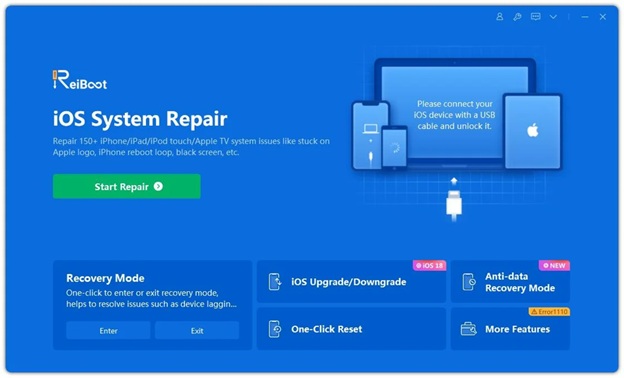
Tenorshare ReiBoot serves as a reliable, specialized alternative to fix 150+ iOS bugs without data loss. It bridges the gap between basic iOS/Android bug user troubleshooting and technical problems repair by packaging complex firmware commands into a single, guided workflow with a simple interface.

Why Tenorshare ReiBoot is the Recommended Solution?

  • One-Click Recovery Mode: Skip complex, model-specific button combinations entirely. You can enter or exit Recovery Mode with a single click—completely free.
  • 150+ System Error Fixes: Resolves stubborn issues—such as frozen Apple logos, black screens, boot loops, and post-update system hangs—that standard iTunes routines often fail to clear.
  • Data Safety via Standard Repair: The core Standard Repair mode reinstalls a fresh, uncorrupted version of iOS while keeping your photos, messages, app data, and settings completely intact.
  • Simplified Downgrades & Upgrades: Allows you to roll back or update iOS versions without manually searching for IPSW firmware files or dealing with code errors in Finder.

Steps to fix iPhone won’t turn on with Tenorshare ReiBoot:

  • Install the authorized system repair application Tenorshare ReiBoot on your computer. Connect your iPhone using a high-grade data transfer cable.

  • Select Standard Repair within the desktop interface to retain user data.
  • Allow the software to auto-detect your iPhone model and fetch the matching iOS firmware build.
  • Click Start Standard Repair and leave the connection uninterrupted until the progress bar completes.

Pros and Cons

  • Pros: Automated entry and exit routines; straightforward visual workflow; preserves user data in standard modes.
  • Cons: Paid software licenses are required

Pro Tip: If you are new to iOS troubleshooting or worried about losing precious photos, using Tenorshare ReiBoot is the safest and most efficient path to avoid accidental data erasure.

Method 4: Update iOS Firmware via iOS Recovery Mode

Repair boot loops, system file corruption, and failed iOS updates, preserving local storage. If your iPhone displays an Apple logo that repeatedly turns off, or if a computer recognizes the device while the screen stays black, the underlying iOS operating system files are corrupt. Recovery Mode instructs Finder or iTunes to rewrite the core operating system.

Steps to enter recovery mode:

  1. Connect your iPhone to a Mac running macOS Catalina or later, or a Windows PC with the latest Apple Devices app/iTunes installed.
  2. Open Finder or iTunes.
  3. Trigger Recovery Mode on the iPhone: Press Volume Up, press Volume Down, then press and hold the Side button. Keep holding through the Apple logo until the screen displays the cable-and-computer graphic.
  4. On the computer pop-up prompt, choose Update (do not select Restore).
  5. Allow the computer to download and reinstall iOS.

Pros and Cons

  • Pros: Repairs severe operating system corruption; option to preserve personal data, photos, and app settings.
  • Cons: Requires access to a computer and cable; process takes 15 to 30 minutes; risk of data loss if “Restore” is chosen accidentally.

Pro Tip: If your computer takes more than 15 minutes to download the firmware file, your iPhone will exit Recovery Mode. Simply let the download finish on your PC, then execute the button combination again to re-enter Recovery Mode.

Method 5:Perform a Full System Wipe in DFU Mode

Overwrite corrupted bootloader code and low-level firmware when standard recovery fails. Device Firmware Update (DFU) mode bypasses the iOS bootloader entirely to flash low-level device firmware directly. It is the deepest restore state available on Apple hardware.

Enter DFU mode video guide: Enter iPhone DFU Mode FAST — iOS 27 Guide 2026 ? – YouTube

Steps to enter DFU mode?

  1. Connect the iPhone to your computer and launch Finder or iTunes.
  2. Press and quickly release Volume Up, then press and quickly release Volume Down.
  3. Press and hold the Side button for 10 seconds until the screen turns black.
  4. While continuing to hold the Side button, press and hold the Volume Down button for 5 seconds.
  5. Release the Side button, but continue holding the Volume Down button for an additional 10 seconds.
  6. The screen must remain completely black. If Finder/iTunes reports a device detected in recovery mode, click Restore iPhone.

Pros and Cons of DFU mode:

  • Pros: Highest recovery rate for software-bricked hardware; rebuilds the bootloader from scratch.
  • Cons: Completely erases all user data; strict timing makes entry difficult on the first attempt.

Warning: If the Apple logo or Recovery icon appears on your screen during steps 4 or 5, you held the buttons for too long. You must disconnect the device and restart the timing sequence from step 1.

The Verdict

If you are comfortable managing manual timing sequences, backup files, and iTunes error codes, start with a force restart. However, if you want to avoid the risk of accidental data erasure, bypass complex button combinations, or save time with an automated, step-by-step repair tool, Tenorshare ReiBoot is the most effective and user-friendly software solution to bring a dead or bricked iPhone back to life.