

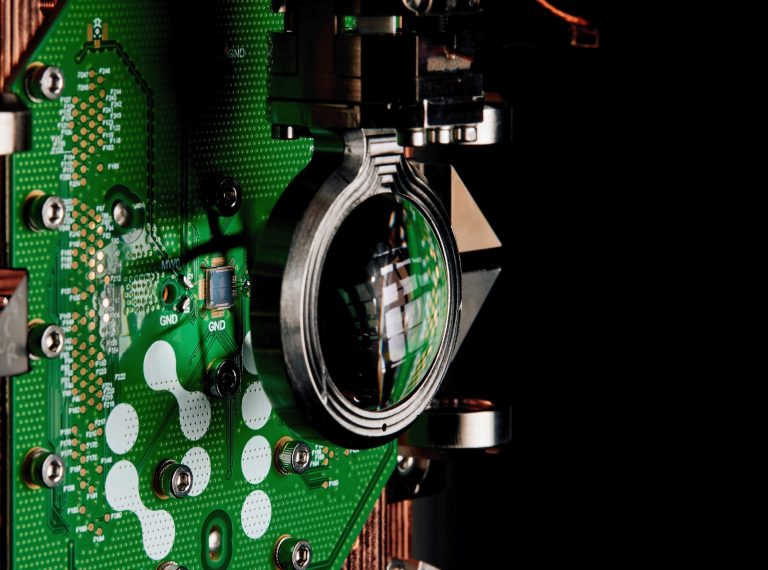
Even as global markets reel from geopolitical tensions and a fresh wave of volatility, a handful of quantum technology companies are pushing ahead with public listings this year.
They are determined to tap fresh capital and accelerate the long-promised shift from laboratory curiosity to real-world applications, according to a CNBC report.
The latest example came Friday when Toronto-based Xanadu Quantum Technologies, a pioneer in photonic quantum computing and a partner of chipmaker Nvidia, began trading on both the Nasdaq and Toronto Stock Exchange following a merger with blank-check company Crane Harbor Acquisition Corp. Shares opened rocky but rallied to close up about 15 percent in New York trading at around $11.50, though they gave back some ground in after-hours action.
Register for Tekedia Mini-MBA edition 20 (June 8 – Sept 5, 2026).
Register for Tekedia AI in Business Masterclass.
Join Tekedia Capital Syndicate and co-invest in great global startups.
Register for Tekedia AI Lab.
Xanadu’s debut followed closely on the heels of Singapore’s Horizon Quantum Computing, which started trading on Nasdaq under ticker HQ after merging with dMY Squared Technology Group and raising roughly $120 million. Earlier in February, neutral-atom specialist Infleqtion became the first company focused on that approach to list publicly via a SPAC deal with Churchill Capital, pulling in more than $550 million.
These moves echo the path blazed by IonQ back in 2021, when dMY Technology Group took the pure-play quantum computing firm public. SPACs, shell companies that raise money through an IPO and then merge with a private target, have emerged as the favored shortcut for quantum startups seeking faster access to public markets with lighter regulatory hurdles than a traditional IPO.
Markets remain jittery over the ongoing U.S.-Israeli conflict with Iran, oil price spikes, and broader economic uncertainty — precisely the sort of environment that usually punishes speculative, long-horizon bets like quantum computing. Xanadu’s shares slipped more than 10 percent after hours Friday, Horizon Quantum has shed around 18 percent since its debut, and Infleqtion’s stock has plunged over 30 percent since mid-February.

Yet company executives argue the window is actually ideal. “It’s an interesting time to be entering the public markets, of course, with everything happening in the world,” Horizon Quantum founder and CEO Dr. Joe Fitzsimons told CNBC. “But for quantum computing, it’s actually a very ideal time to be coming out. We’re really starting to hit something of an inflection point.”
That inflection stems from a string of tangible scientific advances over the past 18–24 months. Researchers have demonstrated meaningful progress in quantum error correction — the critical technique for protecting fragile quantum information from noise and decoherence. Milestones include higher qubit counts, longer coherence times, and early signs that logical qubits (error-protected units of quantum information) can outperform raw physical ones in real computations.
Industry observers point to demonstrations of up to dozens of logical qubits with error rates low enough to show “beyond break-even” performance. Bain & Company partner Velu Sinha noted that practical quantum advantage, where quantum machines solve useful problems faster or better than classical supercomputers, could emerge around 100 logical qubits by 2028–2029.

Commercially transformative applications in drug discovery, materials science, logistics optimization, or financial modeling will likely require 1,000 to 10,000 logical qubits, a threshold many expect in the mid-2030s.
“The narrative has shifted from science project to commercial trajectory,” Sinha said. “Quantum is one of a small number of technology categories investors view as structurally inevitable.”
At full maturity, the addressable market could reach $100–250 billion, giving patient capital reason to look past near-term volatility.
Early revenue pathways are already appearing. Horizon Quantum has concentrated on software tools that bridge classical and quantum systems, allowing developers to prepare code that can run on future hardware while generating income today. The company plans to expand its research team and roll out an early version of its platform to select users later this year.
Xanadu, which uses photons (particles of light) for its qubits, has developed cloud-based platforms where developers can experiment with quantum algorithms on existing hardware. The firm has set an ambitious goal of helping deliver one of the world’s first practical quantum data centers by 2030 and boasts strong engagement from partners in automotive, aerospace, and finance.
Infleqtion’s CEO Matthew Kinsella emphasized that neutral-atom technology is moving from pure scientific progress toward commercial relevance, particularly in quantum sensing and networking alongside computing.
“Going public gives us the capital to accelerate commercialization and invest behind the markets where we already see customer demand,” he said. “We think commercialization will happen in stages.”
Governments have long bankrolled the heavy lifting in quantum R&D, with the U.S., China, and the European Union each committing billions to secure strategic edges in computing power and cybersecurity. National labs and universities remain central. But the current wave of listings signals a clear pivot: private companies are now chasing market traction, even if widespread consumer-facing quantum devices remain decades away.
As Counterpoint Research director Marc Einstein put it, quantum computers could one day perform trillions of operations instantaneously, revolutionizing fields from cryptography to complex simulations. Large organizations are far more likely to own or access the hardware as a service in the coming years than individuals will ever have desktop quantum machines.
For now, these newly public quantum firms must prove they can convert scientific momentum into sustainable revenue while navigating the unforgiving realities of public markets. The road from lab breakthrough to broad commercialization is still long and capital-intensive. But with error correction improving, qubit scales rising, and real customer interest emerging in optimization and simulation, the sector’s leaders are betting that going public is the best way to fund the next leg of the journey.