


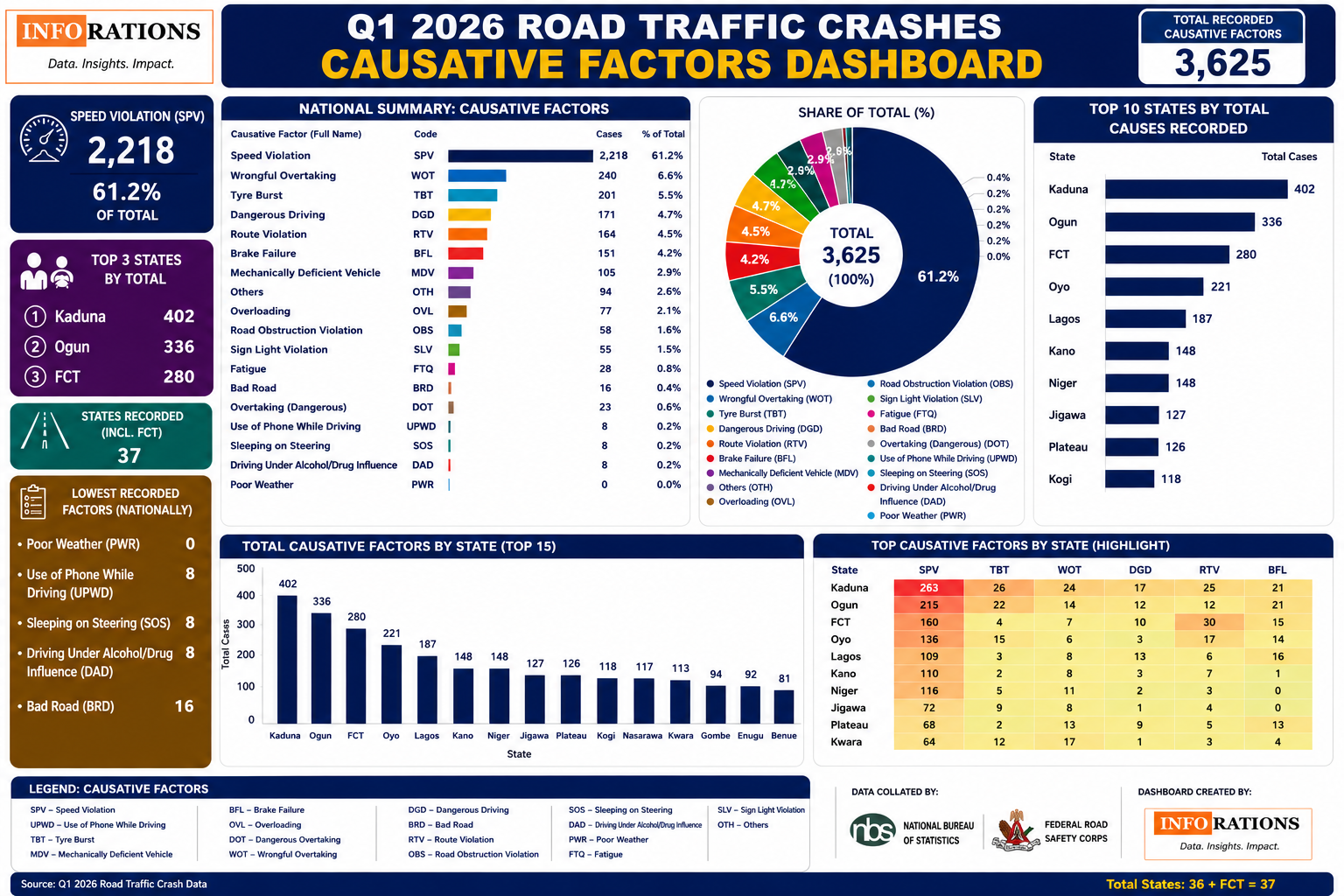
A newly released data on road traffic crashes for the first quarter of 2026 paints a stark picture of Nigeria’s road safety landscape, with speed violations overwhelmingly dominating causative factors across the country. The data, which records 3,625 total causative incidents across 37 reporting jurisdictions (36 states and the FCT), shows that driver behavior remains the most significant driver of road crashes, far outweighing environmental and infrastructural causes.
Speeding accounts for more than half of all crash factors, which alone accounts for 2,218 cases, representing approximately 61% of all recorded causative factors. This makes speeding not only the leading cause but a dominant risk factor by a wide margin.
Road safety analysts often treat such a high concentration in a single category as a signal of systemic behavioral non-compliance, rather than isolated incidents. The data suggests that despite enforcement efforts, excessive speed remains deeply embedded in driving culture across major highways and urban corridors.
Register for the next Tekedia Mini-MBA.
Register for Tekedia AI in Business Masterclass.
Join Tekedia Capital Syndicate and co-invest in great global startups.
Dangerous driving behaviors compound the risk
Beyond speeding, several other human-behavior-related violations contribute significantly to crash risk. Wrongful overtaking (240 cases), dangerous driving (171 cases), and route violations (164 cases) collectively highlight the prevalence of risky decision-making on Nigerian roads.
Overtaking-related violations in particular stand out as a persistent issue. When combined with dangerous overtaking behaviors, these account for more than 260 recorded cases, reinforcing concerns about unsafe lane discipline and impatience on highways.

Fatigue and distraction, though lower in absolute numbers, remain present. Route violations, fatigue-related crashes, sign light violations, and phone use while driving together indicate that driver attention and compliance remain inconsistent.
Mechanical failures still a major concern
While human behavior dominates, the data shows that vehicle condition is also a significant contributor. Mechanical-related factors such as tyre bursts (201 cases), brake failures (151 cases), and mechanically deficient vehicles (105 cases) collectively account for more than 450 incidents.

These figures suggest gaps in vehicle maintenance culture, inspection enforcement, and roadworthiness compliance. Transport experts often link these failures to aging vehicle fleets, inconsistent inspection regimes, and cost-cutting by commercial drivers operating under economic pressure.
Infrastructure and environmental factors remain low
Interestingly, traditional concerns such as poor weather and bad roads appear relatively minor in this dataset. Bad road conditions account for only 16 cases, while poor weather records zero incidents in Q1 2026.
This does not necessarily mean infrastructure is safe, but rather that driver behavior and vehicle condition are far more immediate crash triggers in this reporting period. It also suggests that even when road conditions are less than ideal, crashes are more likely triggered by human decisions than environmental constraints.
State-level disparities reveal concentrated risk zones
A look at geographic distribution shows significant variation across states. The highest total causative factor counts were recorded in: Kaduna (402 cases), Ogun (336 cases), Federal Capital Territory (280 cases), Oyo (221 cases), Lagos (187 cases). These states include major transport corridors, dense urban populations, and heavy inter-state traffic movement, all of which contribute to elevated crash exposure.
Notably, Kaduna records both the highest overall total and one of the highest speeding-related figures, reinforcing its position as a high-risk corridor. Ogun, which serves as a key gateway between Lagos and the rest of the country, also shows consistently high counts across multiple categories including speeding, mechanical failure, and overtaking violations.
Urban mobility pressure intensifies risks
In high-density commercial states such as Lagos and the FCT, congestion and time pressure may be contributing indirectly to risky behaviors. Frequent stop-and-go traffic, commercial transport activity, and long commuting hours can increase fatigue and encourage speed violations when traffic clears.
Data indicates that engineering solutions alone will not substantially reduce crash rates without strong behavioral enforcement. The data points toward a need for intensified speed control measures, improved driver education, stricter vehicle inspection systems, and sustained enforcement of traffic laws.