

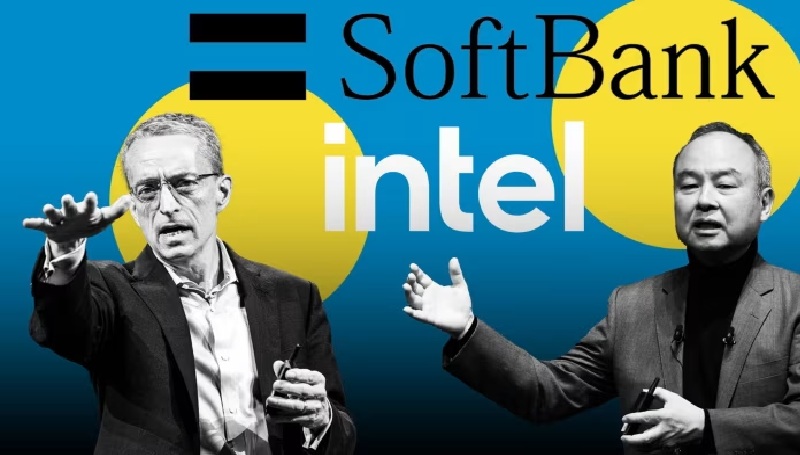
Japanese conglomerate SoftBank has agreed to make a $2 billion investment in Intel, a move that signals renewed confidence in the U.S. semiconductor industry and aligns with Washington’s aggressive push to bring chip manufacturing back onshore.
The deal, announced Monday after markets closed, will see SoftBank purchase Intel common stock at $23 per share. Intel shares, which ended the day at $23.66, jumped more than 5% in after-hours trading following the announcement.
SoftBank Chairman and CEO Masayoshi Son described the investment as a commitment to “advanced technology and semiconductors in the United States,” calling Intel a vital player in ensuring America’s long-term leadership in innovation.
Register for Tekedia Mini-MBA edition 20 (June 8 – Sept 5, 2026).
Register for Tekedia AI in Business Masterclass.
Join Tekedia Capital Syndicate and co-invest in great global startups.
Register for Tekedia AI Lab.
“Semiconductors are the foundation of every industry. For more than 50 years, Intel has been a trusted leader in innovation. This strategic investment reflects our belief that advanced semiconductor manufacturing and supply will further expand in the United States, with Intel playing a critical role,” Son said.
For Intel, the deal offers a powerful vote of confidence as the company fights to reclaim ground lost to rivals like Nvidia. The chipmaker has been undertaking a sweeping restructuring under new CEO Lip-Bu Tan, who was appointed earlier this year. Intel has cut back non-core businesses, including shuttering its automotive architecture arm and laying off most of the staff there, while also reducing its Intel Foundry division workforce by as much as 20%. The aim is to refocus on its most profitable businesses: client processors and data centers.
Tan welcomed the SoftBank investment, framing it as a deepening of ties with one of the world’s most influential technology investors.

“We are very pleased to deepen our relationship with SoftBank, a company that’s at the forefront of so many areas of emerging technology and innovation and shares our commitment to advancing U.S. technology and manufacturing leadership. Masa and I have worked closely together for decades, and I appreciate the confidence he has placed in Intel with this investment,” Tan said.
The deal also ties into a broader political context. President Donald Trump has made semiconductor manufacturing a centerpiece of his domestic industrial policy, repeatedly stressing that America must reduce its reliance on foreign chip suppliers, particularly from Asia. Just last week, the Trump administration threatened new tariffs on imported semiconductor chips, part of its strategy to spur domestic investment in the sector.
SoftBank’s decision to pour money into Intel comes against that backdrop and is widely seen as part of the company’s pledge to expand U.S. investments under Trump’s push for domestic manufacturing.

SoftBank itself has been actively ramping up its presence in America. Beyond its stake in Intel, the company recently acquired Foxconn’s former factory in Lordstown, Ohio, which it plans to repurpose into a hub for AI data centers. The move underscores Son’s conviction that the future of artificial intelligence depends heavily on robust chip manufacturing and data infrastructure — both areas in which the U.S. is seeking to assert global leadership.
For Intel, the SoftBank deal provides more than just a financial boost. It positions the company as a central partner in the geopolitical struggle over semiconductor supremacy, a sector increasingly at the heart of U.S.-China tensions. Washington has imposed curbs on advanced chip exports to Beijing, while China, in turn, has accelerated efforts to build up its domestic chipmaking capabilities. Analysts say SoftBank’s investment strengthens Intel’s ability to remain competitive in this volatile landscape.
The announcement also comes as CEO Lip-Bu Tan faces political turbulence of his own. President Trump recently called for his resignation, citing supposed conflicts of interest — an accusation made without evidence. Reports also surfaced that the administration had explored taking a direct stake in Intel as part of its broader effort to shore up domestic chipmaking.
While those discussions remain uncertain, the SoftBank deal appears to provide the political cover Intel needs at a critical time. It signals to Washington that global investors remain bullish on U.S. technology leadership, especially in semiconductors — an industry Trump has described as the “backbone of the 21st-century economy.”
As the shares of Intel surged after the announcement, some analysts note that the deal could inject much-needed momentum into the company’s turnaround story.