

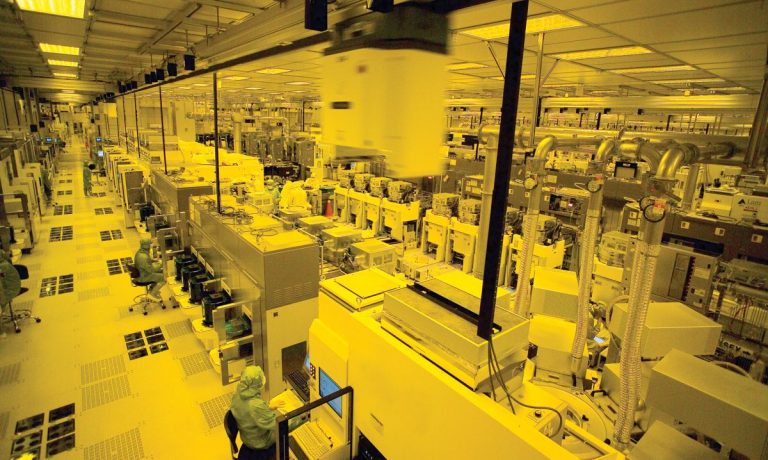
South Korea is considering the construction of a ?4.5 trillion ($3.06 billion) semiconductor foundry funded through a mix of state and private investment, a move aimed at strengthening its standing in the fast-evolving race to build essential chips for artificial intelligence and national security infrastructure.
President Lee Jae Myung chaired a high-level meeting on Wednesday with top executives from Samsung Electronics, SK Hynix, and DB HiTek, alongside policymakers and industry experts, to chart a coordinated strategy that would help South Korea reinforce its lead in memory chips while bolstering the country’s weaker areas: the foundry business and fabless chip design.
“South Korea needs to take a new leap forward, and… the semiconductor sector is an area where we are very competitive,” Lee said, underscoring Seoul’s push to capture more of the value chain at a time when AI demand is rapidly expanding.
Register for Tekedia Mini-MBA edition 20 (June 8 – Sept 5, 2026).
Register for Tekedia AI in Business Masterclass.
Join Tekedia Capital Syndicate and co-invest in great global startups.
Register for Tekedia AI Lab.
The country is home to the world’s two largest memory chip producers — Samsung Electronics and SK Hynix — but has long lagged behind Taiwan Semiconductor Manufacturing Co (TSMC) in logic chip manufacturing, as well as companies like Nvidia and Qualcomm that dominate high-performance chip design. Officials said the proposed 12-inch, 40-nanometre foundry would serve as a testbed for fabless firms working on legacy chips used in cars, data centers, telecommunications, and other critical applications.
According to the industry ministry, the facility would be developed in consultation with local foundry players, including Samsung Electronics and DB HiTek. The ministry described the joint public-private funding model as essential for accelerating domestic production capacity that smaller developers cannot afford to build alone.
Industry Minister Kim Jung-kwan warned that the semiconductor landscape has shifted beyond commercial rivalry.

“We face a very serious crisis and challenge. The semiconductor industry has already escalated from competition between companies to war between nations,” he said, pointing to major subsidy pushes underway in China, the United States, Europe, and Japan as they race to secure supply chains and avoid dependence on foreign suppliers.
South Korea’s plans extend beyond commercial chips. The government said it will pursue domestic production of defense-related semiconductors at a time when the country relies on imports for 99% of its military chip supplies. Authorities are weighing provisions that would require national security facilities to prioritize the purchase of locally produced semiconductors, a measure that could reshape procurement rules in defense, infrastructure, and energy systems.
To coordinate the country’s broader semiconductor policies, the government will set up a special committee under President Lee to act as the central control tower, bringing together agencies and industry stakeholders to oversee strategy, regulation, investment, and long-term planning.

The initiative reflects a deeper recalibration of South Korea’s semiconductor model. For decades, its strength rested on memory chips, where Samsung and SK Hynix dominate global supply. But AI-driven demand has shifted the spotlight to logic chips, specialized accelerators, and advanced packaging — areas that require different capabilities, capital structures, and long-term partnerships. Seoul is now trying to ensure that local fabless firms have the infrastructure needed to scale, innovate, and eventually compete on a global stage.
How The Foundry Fits Into The Global “Chips Act” Arms Race
The proposal also points to a broader strategic realignment, where South Korea is positioning semiconductors as a national-security asset, not just an export engine. The rise of AI, the hardening of U.S.-China tech tensions, and the surge in global subsidy competition have pushed countries to treat chips as geopolitical currency.
The U.S. CHIPS and Science Act rewired the market by offering large, targeted financial incentives to attract foundries, fabs, and R&D to U.S. soil. It created a sizable manufacturing fund and carve-outs for legacy nodes and advanced packaging, while attaching strings — including restrictions on expanding capacity in certain foreign jurisdictions.
That mix of grants, tax credits, and conditionality has changed corporate calculus: public incentives now routinely tip where companies site new plants, and the law has made “on-shoring” a financially viable option for cap-intensive fabs. For countries like South Korea, that matters because capital and strategic partnerships increasingly follow subsidy envelopes.
Europe’s Chips Act pursues a similar goal from a different starting point: it aims to bolster supply-chain resilience and expand the EU’s chip market share through coordination, funding instruments, and state-aid flexibility. The EU approach is more distributed (national and EU layers), with ambitions to mobilize large amounts of public and private investment into a fragmented European ecosystem.
Both the U.S. and EU packages signal a new normal of governments subsidizing capacity, talent, and design to keep strategic semiconductor capabilities onshore. That normative shift puts pressure on South Korea to respond if it wants to avoid losing mindshare and upstream business to subsidized overseas investments.
Where Seoul’s foundry plan dovetails with these global programs is threefold. First, it protects national priorities: the proposed facility would reduce Korea’s reliance on imports for defense and legacy chips, an explicit policy objective in the government statement. Second, it aims to keep the country competitive in an era when fabless and system-chip design matter as much as memory manufacturing. Third, a jointly funded, domestic foundry can serve as leverage when negotiating partnerships with global suppliers and integrators that are chasing CHIPS/EU grants and negotiating plant siting decisions.
Put plainly: if the U.S. and EU can lure capacity with public money, Korea needs its own fiscal and policy toolkit to keep certain layers of the value chain at home.
But the subsidy era also creates strategic trade-offs. Generous incentives worldwide raise the risk of overcapacity in some nodes and geographic duplication of like capacity — a costly outcome for an industry where utilization drives profitability. Conditionalities in U.S. funding (e.g., restrictions on expanding in certain countries) can reshape alliance patterns and push firms to bifurcate supply chains by customer geography or security classification.
That creates both opportunity and complexity for Seoul: attracting foreign partners may require matching or complementing incentives, and Korea must decide how tightly it will tie state support to national-security procurement and local sourcing rules.