

At the core of Musk’s argument is a stark claim that the global AI race will be constrained less by algorithms or chips than by electricity, land, and political limits on Earth.
Elon Musk’s vision of placing artificial intelligence data centers in orbit pushes the debate about AI infrastructure into unfamiliar territory, but it also draws attention to pressures that are already reshaping the technology industry.
As the demand for computing power accelerates, the world’s largest economies and companies are running into bottlenecks that money alone may not be able to solve.
Musk’s proposal emerged publicly alongside SpaceX’s decision to acquire xAI, his artificial intelligence company, earlier this month. In an internal memo announcing the deal, he argued that “space-based AI is obviously the only way to scale in the long term,” framing the move as a strategic necessity rather than a futuristic experiment.
Register for Tekedia Mini-MBA edition 20 (June 8 – Sept 5, 2026).
Register for Tekedia AI in Business Masterclass.
Join Tekedia Capital Syndicate and co-invest in great global startups.
Register for Tekedia AI Lab.
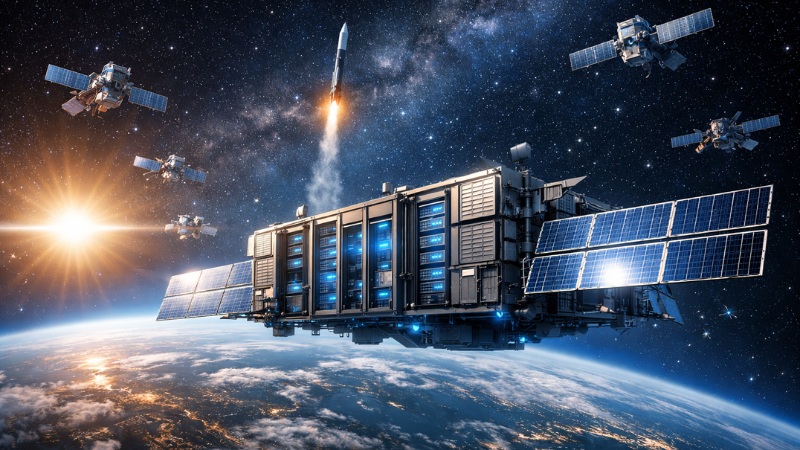
SpaceX has since said it aims to deploy a constellation of up to one million satellites designed to function as orbital data centers, collectively adding about 100 gigawatts of AI compute capacity each year.
That figure is striking when set against today’s infrastructure. A single gigawatt is enough to power hundreds of thousands of homes, and hyperscale data centers increasingly draw power in that range. The ambition suggests Musk is not merely talking about niche applications or backup capacity, but about relocating a meaningful share of global AI compute off-planet.
The logic, as Musk has explained, is rooted in energy availability rather than short-term cost savings. On the Dwarkesh Podcast this week, he argued that electricity generation growth outside China has largely flattened, even as AI workloads are expanding at an unprecedented pace. From his perspective, this mismatch makes terrestrial scaling unsustainable over time, regardless of how much capital companies are willing to deploy.

This concern is already visible in financial markets and corporate strategy. Big technology companies are committing record sums to data centers, chips, and networking equipment. Amazon has outlined plans to spend $200 billion on capital expenditures in 2026, while Alphabet and Meta have also sharply raised their spending forecasts. Much of that money is going toward securing power, land, and long-term grid connections, increasingly through bespoke deals with utilities and renewable energy providers.
Yet even these efforts face limits. In the United States, data centers consumed about 4.4% of total electricity in 2023, according to the Department of Energy. Globally, the International Energy Agency estimates data centers accounted for roughly 1.5% of electricity use in 2024, a share that is rising quickly. McKinsey has estimated that meeting global data center demand by 2030 will require $6.7 trillion in investment, underscoring the scale of the challenge.
The physical footprint of this expansion is also becoming politically sensitive. In regions such as Northern Virginia, Ireland, and parts of the Netherlands, local governments and residents have pushed back against new data center projects, citing strain on power grids, water usage, and land availability. In some cases, permitting delays and moratoriums have slowed construction, adding uncertainty to long-term planning for cloud and AI providers.

Musk’s space-based concept sidesteps many of these constraints in theory. Solar energy in orbit is constant and abundant, cooling can rely on the vacuum of space, and land scarcity is effectively eliminated. SpaceX has also spent years driving down launch costs through reusable rockets, a prerequisite for making such an idea even marginally plausible.
Still, the challenges remain formidable as maintaining and repairing complex computing infrastructure in orbit would require new approaches to reliability and redundancy. Latency could limit certain applications, especially those requiring real-time interaction. Orbital congestion and space debris are growing concerns, and a constellation of a million satellites would raise regulatory and environmental questions of its own.
Skeptics also point out that energy costs typically account for only a fraction of a data center’s total operating expenses, with maintenance, staffing, and depreciation making up much of the rest. Musk’s response has been that availability, not marginal cost, is the binding constraint. In his view, once terrestrial grids can no longer expand fast enough, the economics will tilt decisively toward space, regardless of today’s cost structures.
SpaceX’s recent hiring signals that the company is treating the idea as more than rhetoric. A job posting by Starlink Engineering Vice President Michael Nicolls referenced “many critical engineering roles” tied to space-based data centers, including specialists in space lasers, which could be used for high-speed inter-satellite communication.
Whether Musk’s timeline proves realistic is an open question. He has often missed self-imposed deadlines, even as his companies have eventually delivered transformative technologies. What is harder to dismiss is the underlying pressure he is highlighting. The AI boom is colliding with finite resources on Earth, forcing governments, utilities, and corporations to rethink how and where computing power can be generated.
Although the moves are notable, space-based data centers remain speculative, at least for now. But as capital expenditures surge, grids strain, and communities resist further expansion, Musk’s idea serves as a provocative signal of where the next phase of the AI infrastructure debate may be heading. In an industry accustomed to exponential growth, the limits of the planet itself are becoming part of the calculation.