

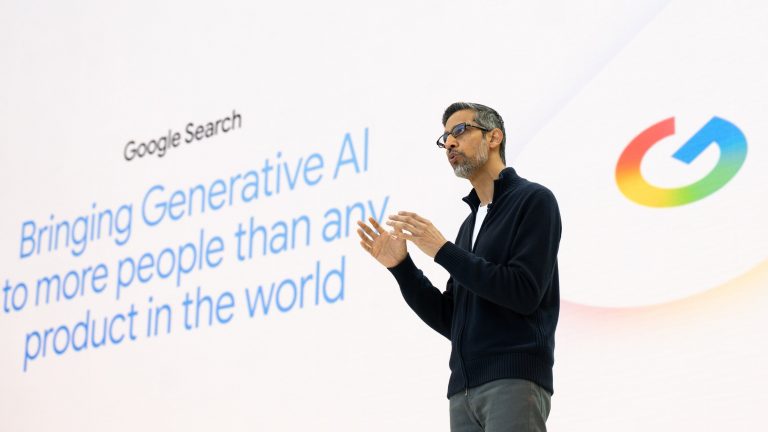
Alphabet Inc. has structured a new three-year compensation package for CEO Sundar Pichai that could be worth up to $692 million, according to a recent SEC filing first reported by the Financial Times.
The package, one of the largest ever for a sitting U.S. public-company CEO, ties the majority of its value to performance-based equity incentives, including specific milestones linked to Google’s autonomous-driving unit Waymo and drone-delivery subsidiary Wing. The structure reflects Alphabet’s continued emphasis on long-term value creation in AI, autonomous mobility, and logistics.
While base salary and annual bonuses remain relatively modest compared to the headline figure, the bulk of the potential payout comes from performance stock units (PSUs) and restricted stock units (RSUs) that vest only if Waymo achieves aggressive commercialization targets (such as expanded robotaxi fleets in multiple cities and meaningful revenue contribution) and Wing scales drone delivery to new geographies and higher volume thresholds.
Register for Tekedia Mini-MBA edition 20 (June 8 – Sept 5, 2026).
Register for Tekedia AI in Business Masterclass.
Join Tekedia Capital Syndicate and co-invest in great global startups.
Register for Tekedia AI Lab.
Analysts view the package as both ambitious and aligned with Alphabet’s strategic priorities. Waymo — already operating commercial robotaxi services in Phoenix, San Francisco, Los Angeles, and Austin — is targeting profitability and broader geographic expansion in 2026–2028, while Wing is scaling urban and suburban delivery in the U.S., Australia, and select international markets. Success in these areas could significantly boost Alphabet’s non-advertising revenue streams, which remain a small but fast-growing portion of the company’s overall business.
Despite the eye-catching headline number, Pichai has historically received far less public fascination than Google co-founders Larry Page and Sergey Brin, currently ranked as the world’s second- and fourth-richest individuals, respectively (per Bloomberg Billionaires Index as of early March 2026). While Pichai remains quietly rooted in Los Altos, California — with no major public real-estate transactions reported in recent years — Page and Brin have drawn attention for rapidly accumulating high-end properties in Miami’s Coconut Grove neighborhood.
Page reportedly spent more than $173 million on two adjacent mansions in Coconut Grove in late 2025, while Brin was linked to a $51 million megamansion purchase roughly 14 miles away, on top of two earlier acquisitions totaling $92 million. The moves have been widely interpreted as a hedge against California’s proposed Billionaire Tax Act — a ballot initiative that would impose a one-time 5% levy on net worth exceeding $1 billion for the state’s roughly 200 billionaires.

The measure, if approved by voters in November 2026, would generate an estimated $50–$80 billion for state coffers over several years, with proceeds earmarked for housing, education, and climate initiatives. Pichai, a billionaire in his own right, has benefited enormously from Alphabet’s nearly sevenfold market-cap growth since he assumed the CEO role in 2015.
Bloomberg calculations estimate that Pichai and his wife, Anjali, currently hold Alphabet shares worth nearly $500 million, with an additional ~$650 million in stock sales executed through last summer. Unlike the founders, Pichai has maintained a relatively low public profile on personal finances and real estate, with no significant property acquisitions reported in recent years.
The contrast underscores a generational and stylistic divide: Page and Brin — who stepped back from day-to-day management in 2019 but retain massive voting control through Class B shares — have pursued high-profile diversification of their wealth, including real-estate moves and investments in longevity research, climate technology, and private aviation. Pichai, by contrast, has focused almost exclusively on Alphabet’s operational leadership and public advocacy for AI safety and responsible development.

The new pay package, subject to shareholder approval at Alphabet’s 2026 annual meeting, underlines investor and board confidence in Pichai’s ability to navigate the company through the AI era while maintaining regulatory and reputational discipline. It also signals that Alphabet remains committed to tying executive rewards to concrete progress in its highest-conviction moonshots: autonomous mobility (Waymo) and logistics innovation (Wing).
As Alphabet prepares for its next earnings report and continues to invest heavily in AI infrastructure, the Pichai package will likely be viewed through the lens of execution: whether Waymo can scale profitably beyond pilot cities and whether Wing can achieve meaningful commercial volume. Success in these areas could justify the headline compensation figure and further cement Pichai’s legacy as the steward of Google’s post-search transformation.
However, while Page and Brin quietly reposition personal assets amid California tax debates, Pichai remains focused on Alphabet’s core mission — a contrast that has drawn relatively little public commentary but speaks volumes about the differing roles each plays in one of the world’s most valuable companies.