While policy manifestos are yet to be unveiled, subtle cues, like public felicitations, homage to traditional rulers, and alignment with political godfathers, offer a glimpse into how candidates are positioning themselves in the political market.
Our social network analysis of these symbolic gestures reveals Olayinka Segelu, Olaloluwa Peter Abidemi, and Saheed Oladele as the three major actors. Their early moves provide critical insights into the power of symbolic capital in the cultural and political terrain of Oyo. This piece unpacks their strategies and distills key lessons for political aspirants, strategists, and observers navigating the interplay of tradition, identity, and party politics in Nigeria.
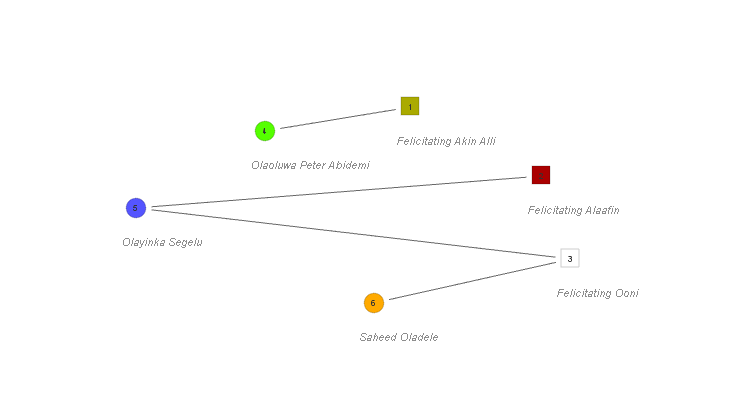
Exhibit 1: Strategic alliance network
Register for Tekedia Mini-MBA edition 20 (June 8 – Sept 5, 2026).
Register for Tekedia AI in Business Masterclass.
Join Tekedia Capital Syndicate and co-invest in great global startups.
Register for Tekedia AI Lab.
Olayinka Segelu: Building Broad Cultural Legitimacy
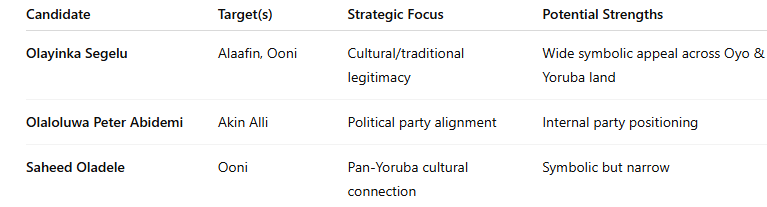
Olayinka Segelu emerges as the most strategically embedded candidate in the symbolic network, having extended public felicitations to both the Alaafin of Oyo and the Ooni of Ife. These aren’t mere ceremonial gestures, calculated acts of political signaling.
The Alaafin and Ooni represent two of the most iconic traditional authorities in Yoruba land. By engaging both, Segelu taps into a reservoir of pan-Yoruba legitimacy, positioning himself as a unifier with reach beyond Oyo State’s internal party divisions. This is particularly potent in a region where traditional rulers retain strong moral, cultural, and even political influence over both elite and grassroots constituencies.
Key Lesson: In a state like Oyo where tradition is deeply woven into politics, symbolic overtures to respected cultural institutions can serve as multipliers of political legitimacy. Candidates who ignore this dynamic risk being seen as disconnected from local values.

Olaloluwa Peter Abidemi: Betting on Political Structures
In contrast, Olaloluwa Peter Abidemi has so far made a single public symbolic move, felicitating with Akin Alli, a former chairman of the All Progressives Congress (APC) in Oyo State. While Alli is not a traditional ruler, he is a critical figure within the APC machinery and holds sway among key stakeholders.
Exhibit 2: Candidates’ centrality in symbolic capital acquisition
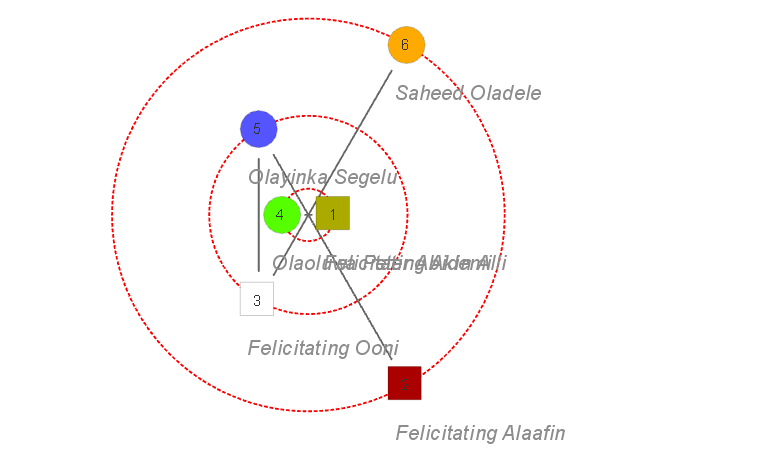
This suggests Abidemi’s symbolic capital strategy is rooted in party dynamics rather than cultural engagement. It reflects a calculated move to shore up internal political support, perhaps with the goal of securing the party ticket or aligning with a strong political bloc ahead of primaries.

However, while this approach may work within the confines of the APC, it does little to cultivate broader voter sympathy or cultural resonance. It assumes that political endorsements are sufficient, an assumption that may fall short in a state where emotional and symbolic legitimacy carry serious electoral weight.
Key Lesson: Party structures matter, but so does emotional connection to the electorate. Political capital without symbolic grounding can appear technocratic and out of touch, especially in culturally conscious electorates like Oyo.
Saheed Oladele: A Symbolic Yet Narrow Gesture
Saheed Oladele’s gesture is focused solely on the Ooni of Ife, indicating an effort to align with Yoruba cultural heritage. While this move speaks to a desire for regional legitimacy and traditional blessings, it falls short of the wider engagement seen in Segelu’s strategy.
Symbolic outreach to only one royal institution may not be enough in a competitive political environment where breadth of engagement matters. Oyo’s political geography is diverse; allegiance to one royal house may not resonate equally across all constituencies.
Key Lesson: Symbolism matters, but range matters more. Candidates should not only reach out to key traditional figures but also balance these gestures across different cultural, religious, and geopolitical zones to build a compelling cross-cutting appeal.
Exhibit 3: Summarised strategic implications