

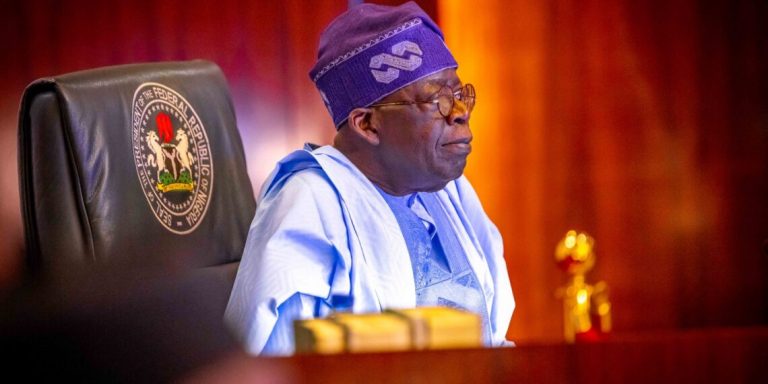
President Bola Tinubu has formally asked the National Assembly to approve a new wave of borrowing—seeking $21.5 billion in external loans, a N758 billion bond issuance, and an additional $2 billion in domestic borrowing—to finance critical infrastructure and offset long-standing pension arrears.
The request, read during Tuesday’s Senate plenary, has been referred to the Senate Committee on Local and Foreign Debts, which is expected to report back within two weeks.
In his letter to the legislature, President Tinubu explained that the proposed borrowings were necessary to finance key sectors of the economy, including infrastructure, health, education, and water supply. He further requested legislative approval to issue bonds in the domestic market worth N757.9 billion to settle outstanding pension liabilities under the Contributory Pension Scheme.
Register for Tekedia Mini-MBA edition 20 (June 8 – Sept 5, 2026).
Register for Tekedia AI in Business Masterclass.
Join Tekedia Capital Syndicate and co-invest in great global startups.
Register for Tekedia AI Lab.
The president said the request is to enable the Federal Government to meet its obligations to retired public servants and to support the implementation of major infrastructure projects that will drive growth and job creation.
This is not the first such appeal by the Tinubu administration. A separate request was also sent to the House of Representatives seeking approval for the revised 2025–2026 external borrowing plan. Under this plan, the government is looking to secure $21.5 billion, €2.2 billion, ¥15 billion in Japanese yen, and a €65 billion grant. The House Speaker, Tajudeen Abbas, read the letter on the floor and referred it to the House Committee on Aids, Loans, and Debt Management for further review.
Mounting Debt Profile and Soaring Debt Servicing
The fresh requests come at a time Nigeria’s public debt burden is rising rapidly, triggering alarm from economists, financial watchdogs, and ordinary citizens.

According to the data released by the Debt Management Office (DMO), Nigeria’s total public debt as of December 31, 2024, stood at N144.7 trillion (approximately $94.2 billion). Of this amount, N74.4 trillion is domestic debt, while N70.3 trillion is external.
Even more worrisome is the cost of servicing the debt. In 2023, the country spent N7.8 trillion on debt servicing—more than double the N3.52 trillion spent in 2022. That figure soared to N13.12 trillion in 2024, reflecting a 68 percent rise within a single year.
These figures show that Nigeria is increasingly spending more to service existing loans than on capital projects. It also signals a deeper structural weakness: the country is not generating enough revenue to meet its obligations. Analysts warn that such a trend is unsustainable and could crowd out spending on critical sectors like education, healthcare, and infrastructure.

Borrowing for Consumption, Another Concern
Beyond the sheer size of Nigeria’s debt, another growing concern is how the borrowed funds are being utilized. Many have long pointed out that Nigeria borrows heavily to fund recurrent expenditure or service arrears, rather than to build capital projects that can stimulate the economy and generate returns.
This concern is not unfounded. The Tinubu administration’s new borrowing request includes a N758 billion domestic bond specifically earmarked for settling pension liabilities—a noble gesture on its own but one that falls under consumption, not investment.
A financial expert, Mr. Babatunde Salami, has cautioned both the federal and state governments against borrowing from the capital market for consumption. In an interview with VON, Salami said government at all levels should only borrow for capital projects whose capital returns would pay for the borrowed fund.
While President Tinubu’s request has now been submitted to the appropriate legislative committees, it is likely to be approved, though, several lawmakers have previously expressed concern over the country’s borrowing spree, especially without a clear repayment plan or project-specific transparency.
Senator Ali Ndume (APC, Borno South) earlier this year, expressed concern that the government is borrowing for consumption.
Ndume said, “Let me say that I am not against borrowing, America, Japan, China and other big countries do borrow.
“They (Nigerian government) borrow for fiscal, tangible and accountable projects, which they pay back over time. But my worry is what they borrow for.”
If approved, the proposed borrowings will push Nigeria’s total public debt beyond the N150 trillion mark. And with debt servicing costs already consuming a significant chunk of government revenue, concerns remain over how the administration intends to manage fiscal stability in the long term.