

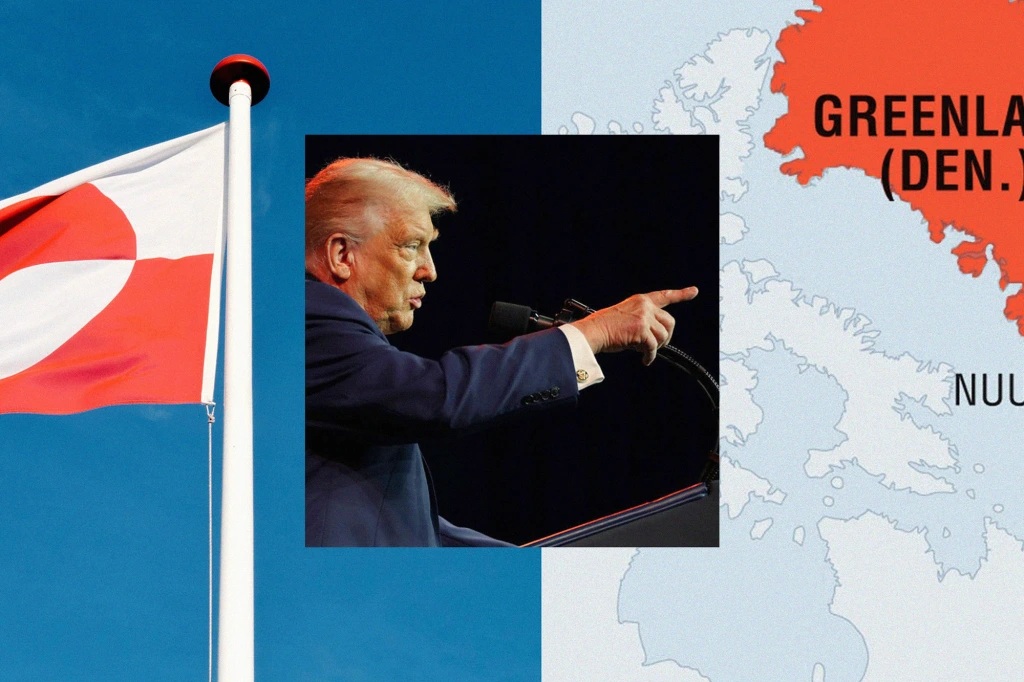
President Donald Trump has sharply raised the stakes in his long-running push to acquire Greenland, vowing to impose a rolling wave of tariffs on key European allies until the United States is allowed to buy the Arctic island, a move that has alarmed European capitals and injected new tension into transatlantic relations.
In a post on his Truth Social platform on Saturday, Trump said the United States would slap an additional 10% import tariff from February 1 on goods from Denmark, Norway, Sweden, France, Germany, the Netherlands, Finland, and Great Britain. Those levies, which would be applied on top of existing tariffs, would rise to 25% by June 1 and remain in place until Washington secures a deal to purchase Greenland.
Trump framed the move as a response to what he called a “dangerous game” being played by European governments.
Register for Tekedia Mini-MBA edition 20 (June 8 – Sept 5, 2026).
Register for Tekedia AI in Business Masterclass.
Join Tekedia Capital Syndicate and co-invest in great global startups.
Register for Tekedia AI Lab.
“These Countries … have put a level of risk in play that is not tenable or sustainable,” he wrote, without elaborating on the specific actions that prompted the warning.
Greenland, an autonomous territory within the Kingdom of Denmark, has repeatedly rejected the idea of being sold. Danish officials and Greenland’s leadership have insisted the territory is not for sale and that its future should be determined by its own people. Public opinion in the United States also appears lukewarm. A Reuters/Ipsos poll conducted this week found that fewer than one in five Americans support the idea of acquiring Greenland.
Trump’s threat immediately triggered pushback across Europe. Denmark’s Foreign Minister Lars Lokke Rasmussen said the announcement was unexpected and reiterated Copenhagen’s position that trade measures should not be linked to Greenland. British Prime Minister Keir Starmer took the unusually direct step of condemning the move publicly, writing on X that applying tariffs on allies acting within NATO’s collective security framework was “completely wrong” and promising to raise the issue directly with Washington.

European Commission President Ursula von der Leyen and European Council President Antonio Costa said the European Union stood in “full solidarity” with Denmark and Greenland, warning that tariffs would damage transatlantic ties and risk a downward spiral in relations. Norway, Sweden, France, and Germany echoed those sentiments, while Cyprus, which currently holds the EU presidency, called an emergency meeting of ambassadors from the bloc’s 27 member states.
Protests also broke out in Denmark and Greenland on Saturday, with demonstrators calling for the territory’s right to determine its own future and rejecting Trump’s demands.
The confrontation threatens to unravel tentative trade arrangements reached last year between the United States, the European Union, and Great Britain, which set baseline tariffs of 15% on most European imports and 10% on British goods. William Reinsch, a trade expert at the Center for Strategic and International Studies, warned that singling out specific EU countries could harden opposition within Europe.

“It may well convince the European Parliament that it is pointless to approve the trade agreement with the U.S., since Trump is already bypassing it,” he said.
Trump has not cited a clear legal basis for linking tariffs to the Greenland issue, but the tactic fits a broader pattern. Tariffs have become a central tool in his foreign policy, used to pressure both allies and adversaries. This week, he said he would impose 25% tariffs on any country trading with Iran over Tehran’s crackdown on protests, even though no formal policy documentation has yet appeared on the White House website. The U.S. Supreme Court has already heard arguments on the legality of Trump’s sweeping use of tariffs, a case that could have wide implications for presidential authority and global trade.
At the heart of the dispute lies Greenland’s strategic value, which Trump has repeatedly highlighted. The island occupies a critical position between North America and Europe, straddling key air and sea routes in the North Atlantic and Arctic. As melting ice opens new shipping lanes and access to previously unreachable resources, Greenland has become more central to global competition in the far north.
The territory is rich in minerals considered essential for modern technologies, including rare earth elements used in electric vehicles, wind turbines, and advanced electronics. Reducing reliance on China for these materials has become a priority for Washington, and Greenland’s deposits are seen as a potential alternative source.
There are also security considerations. Greenland hosts the Pituffik Space Base, formerly known as Thule Air Base, a cornerstone of U.S. missile warning and space surveillance systems. About 200 U.S. personnel are already stationed there, and a 1951 agreement with Denmark allows Washington to deploy additional forces as it sees fit. The island is also covered by NATO’s collective defense pact, a point European officials have stressed in rebutting Trump’s claims that U.S. ownership is necessary for security.
Trump has argued that growing activity by China and Russia in the Arctic makes Greenland indispensable to American defense. European leaders counter that existing NATO arrangements already address those concerns. EU foreign policy chief Kaja Kallas warned that the dispute risks benefiting Washington’s rivals.
“China and Russia must be having a field day. They are the ones who benefit from divisions among allies,” she said on X.
Even within the United States, the president’s approach has drawn concern. Senators Jeanne Shaheen and Thom Tillis, bipartisan co-chairs of the Senate NATO Observer Group, said in a joint statement that pressing allies through tariffs over Greenland was “bad for America, bad for American businesses and bad for America’s allies.”
Some analysts urged restraint. Carsten Brzeski, global head of macro at ING Research, said Europe should avoid rushing into countermeasures.
“Just ignore it and wait and see,” he told Reuters, arguing that past experience suggested Trump’s threats do not always translate into sustained policy.
Greenland, once a remote geopolitical afterthought, has become a flashpoint in global politics. What began as an unconventional idea has evolved into a serious diplomatic rift, with trade, security, and alliance cohesion all now tied to the future of a vast Arctic island that insists it does not want to be bought.
It’s now obvious that President Donald Trump is retaliating against the Kingdom of Denmark, Greenland, and the entire European Union (EU) countries’ standoff regarding the proposed buyout of Greenland with a 10% tariff.
Read full story ?
https://www.finngdaily.com/2026/01/trump-10-percent-tariff-on-eu.html