

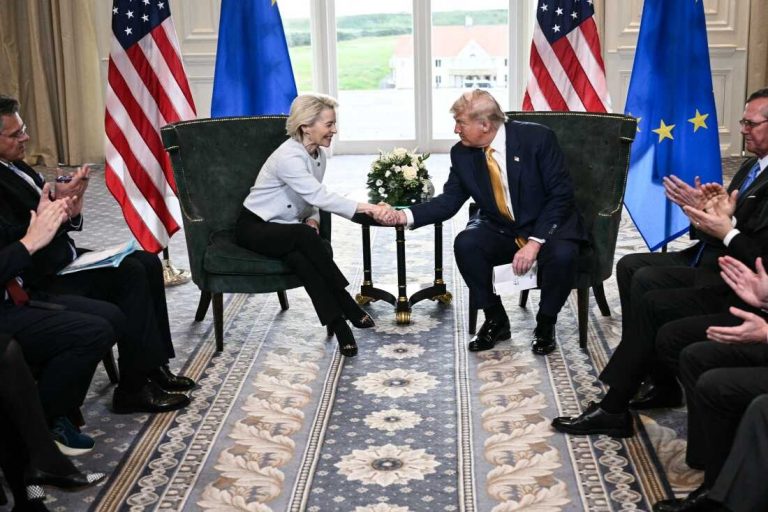
President Donald Trump on Friday announced that his administration will launch a trade investigation into the European Union, escalating transatlantic trade tensions after Brussels imposed a €890 million ($1 billion) fine on Google for violating the bloc’s landmark Digital Markets Act (DMA).
Trump said the probe could ultimately lead to the reversal of European penalties imposed on U.S. technology companies and pave the way for “substantial” new tariffs on goods imported from the 27-member bloc.
The announcement marks a significant expansion of the administration’s use of trade policy to counter what it views as discriminatory treatment of American companies overseas, particularly large technology firms that have faced increasing regulatory scrutiny in Europe.
Register for the next Tekedia Mini-MBA.
Register for Tekedia AI in Business Masterclass.
Join Tekedia Capital Syndicate and co-invest in great global startups.
In a lengthy post on Truth Social, Trump accused the European Union of unfairly targeting America’s biggest technology companies and using regulatory enforcement as a revenue-generating tool.
“The European Union is at it again and, as usual, taking direct aim at GREAT American Companies!” Trump wrote.
He accused the bloc of “‘ROBBING’ American Companies and, in turn, the American Taxpayer,” citing the European Commission’s recent decision to fine Google over alleged anti-competitive practices.

Trump also referenced previous European enforcement actions against Apple, Meta and Amazon, arguing that Brussels has repeatedly singled out leading U.S. technology firms.
“The United States of America is not a ‘PIGGYBANK’ for Europe, nor will we allow it to be!” he said.
Trump further claimed that Google’s latest penalty was imposed “without explanation.”

However, the European Commission said earlier this week that the €890 million fine resulted from Google’s failure to comply with provisions of the Digital Markets Act.
According to the Commission, Google unlawfully favored its own services, including shopping and hotel listings, in search results while also restricting app developers from directing users to alternative purchasing options outside the Google Play Store. Regulators ordered the company to change those practices within 60 days or face additional penalties that could reach 5% of Google’s worldwide annual turnover.
Google has said it is reviewing the decision and considering an appeal.
Trump said his administration will immediately initiate an investigation under Section 301 of the Trade Act of 1974, one of the U.S. government’s most powerful trade enforcement mechanisms.
Section 301 authorizes the Office of the U.S. Trade Representative to investigate foreign policies or practices that are deemed unreasonable, discriminatory, or harmful to U.S. commerce. If violations are found, the president can impose retaliatory measures, including tariffs or other trade restrictions.
The provision has become a cornerstone of Trump’s trade strategy.
During both his first and current terms, Trump has repeatedly relied on Section 301 investigations to justify tariffs on imports from major trading partners, arguing that the authority allows the United States to respond aggressively to unfair trade practices.
“The European Union will pay a very big price for this illegal and highly unethical conduct, which I have consistently warned them about,” Trump wrote.
“The penalties will be entirely reversed and, we anticipate, a substantial TARIFF to be placed on them at the earliest possible moment.”
He concluded the post with the message: “Stay tuned!”
The announcement comes only hours after the administration imposed new tariffs ranging from 10% to 12.5% on goods from more than 80 countries, including members of the European Union, citing concerns related to forced labor.
Those measures immediately drew legal challenges.
By Friday afternoon, the Liberty Justice Center had filed a lawsuit in the U.S. Court of International Trade on behalf of two small businesses, arguing that the administration is improperly using Section 301 to effectively revive Trump’s 2025 “Liberation Day” tariffs.
According to the lawsuit, those earlier tariffs were struck down by the U.S. Supreme Court, and the plaintiffs contend that the administration is attempting to achieve the same policy objective through a different legal mechanism.
The latest dispute underscores how technology regulation is becoming an increasingly important flashpoint in U.S.-EU trade relations.
For years, European regulators have pursued aggressive antitrust and digital market enforcement against major American technology companies, arguing that dominant platforms have abused their market positions to the detriment of competitors and consumers.
The Digital Markets Act, which came into force in 2024, is central to that effort. The law designates companies such as Alphabet, Apple, Meta, Amazon and Microsoft as “gatekeepers,” subjecting them to stricter rules governing competition, interoperability and consumer choice.
Brussels maintains that the legislation is designed to foster fair competition rather than target companies based on nationality. Washington, however, has stated that the practical effect of Europe’s digital regulations falls disproportionately on U.S. firms because they dominate global digital markets. Trump’s decision to link trade policy directly to technology regulation signals that disputes over digital competition are now being treated as broader trade issues rather than purely regulatory matters.
Should the Section 301 investigation conclude that the EU’s enforcement actions unfairly discriminate against American companies, the administration could impose additional tariffs on European exports, further straining economic relations between two of the world’s largest trading partners.
The dispute also raises the prospect of retaliatory measures from Brussels.
The European Union has previously responded to U.S. tariffs with countermeasures targeting politically sensitive American exports. Another round of tariff escalation could affect sectors well beyond technology, including automobiles, industrial goods, agriculture and consumer products.