

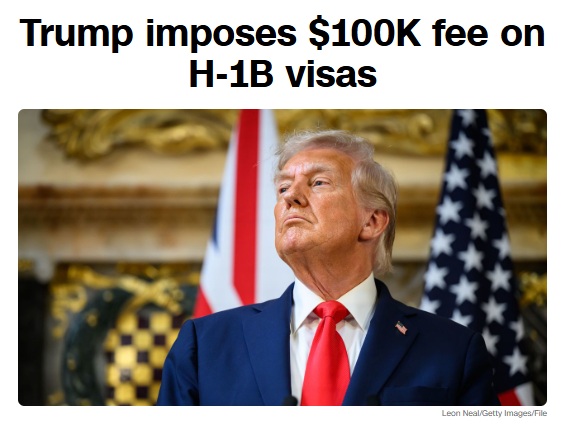
Employees at some of America’s largest technology and financial firms were urged to stay put in the United States—or scramble to return within hours—after President Donald Trump signed a surprise executive order requiring companies to pay $100,000 per year for each H-1B visa.
Amazon, Microsoft, Meta, and JPMorgan Chase were among those issuing urgent internal advisories to staff on Friday night, according to employees and internal communications reviewed by Business Insider.
“If you have H-1B or H-4 status and are outside the U.S.: Try to return before tomorrow’s deadline if possible,” Amazon told employees in a memo sent Friday, warning that staff should make every effort to clear U.S. customs before 12:00 a.m. EDT on Sunday, September 21, 2025. “We realize this is short notice but returning soon is advisable,” the message said.
Register for Tekedia Mini-MBA edition 20 (June 8 – Sept 5, 2026).
Register for Tekedia AI in Business Masterclass.
Join Tekedia Capital Syndicate and co-invest in great global startups.
Register for Tekedia AI Lab.
Amazon added that those already in the U.S. should suspend travel plans for now: “Stay in the country for the immediate future.” The memo further advised anyone unable to make it back before the deadline to avoid attempting reentry “until further guidance is provided.”
The urgency highlighted the scale of disruption across the tech sector, where foreign workers are critical to operations. Amazon employed nearly 15,000 workers under H-1B visas in fiscal year 2024, according to federal filings.
Within hours of the executive order, similar warnings went out from Microsoft, Meta, and JPMorgan. A Microsoft advisory urged visa holders in the U.S. to remain “for the foreseeable future” and told those abroad to return as quickly as possible before the deadline.

“We know this may interrupt your travel plans. But the critical thing is to stay in the U.S. in order to avoid being denied reentry,” the guidance said, according to five employees.
Microsoft’s memo acknowledged the anxiety caused by the abrupt move: “I know these developments are creating uncertainty for many of you. While we don’t have all of the answers right now, we ask that you prioritize the recommendations above.”
JPMorgan sponsored the most H-1B visas among U.S. banks last year, nearly 2,000, most tied to software engineering roles.

Trump signed the order late Friday, requiring employers to pay a $100,000 annual fee for each H-1B application, though it remains unclear whether the measure applies only to new applicants or also to renewals. The order, effective September 21 at 12:01 a.m. ET, could bar thousands of skilled workers from reentering the U.S. without their companies paying the hefty fee.
Commerce Secretary Howard Lutnick suggested on Friday that the fee would apply to both renewals and new applications. “Renewals, first times, the company needs to decide,” Lutnick told reporters. “Do they want — is the person valuable enough to have a $100,000 a year payment to the government or they should head home, and they should go hire an American.”
But the White House later walked back those remarks. A White House official told Business Insider that the fee would only apply to new petitions, not current lawful visa holders or renewals.
“This is a one-time fee that applies only to the petition,” the official said in an email. “It ONLY applies to new visas, not renewals or current visa holders. It will first apply in the next upcoming lottery cycle.”
Abigail Jackson, the White House deputy press secretary, echoed the clarification in a statement on X, writing that the order “does not impact the ability of any current visa holder to travel to/from the U.S.”
The conflicting statements have left workers and companies in uncertainty. Amazon’s blunt instruction for visa holders outside the U.S. to rush back before the deadline underscored the uncertainty over how the order will be enforced.
The executive order is part of Trump’s broader effort to restrict immigration in his second term, with H-1B visas a frequent flashpoint. The administration argues that forcing companies to pay steep fees ensures only highly valuable workers are retained while pushing firms to train and hire more Americans.
“Either the person is very valuable to the company and America, or they’re going to depart and the company is going to hire an American,” Lutnick said.
The order also reflects Trump’s long and complicated history with the H-1B program. Though some allies have pushed for tighter controls, Trump himself has praised the visa in the past.
“I have many H-1B visas on my properties. I’ve been a believer in H-1B. I have used it many times. It’s a great program,” he told the New York Post in December.
The immediate consequences, however, are grave. Tech firms, including Amazon, Microsoft, Alphabet, Meta, and Apple, consistently rank among the top sponsors of H-1B visas, using the program to fill technical roles amid fierce competition for talent. Analysts warn that the $100,000 fee could hit smaller companies and startups especially hard, potentially pushing more firms to shift work overseas and weakening America’s competitive edge in areas like artificial intelligence.