

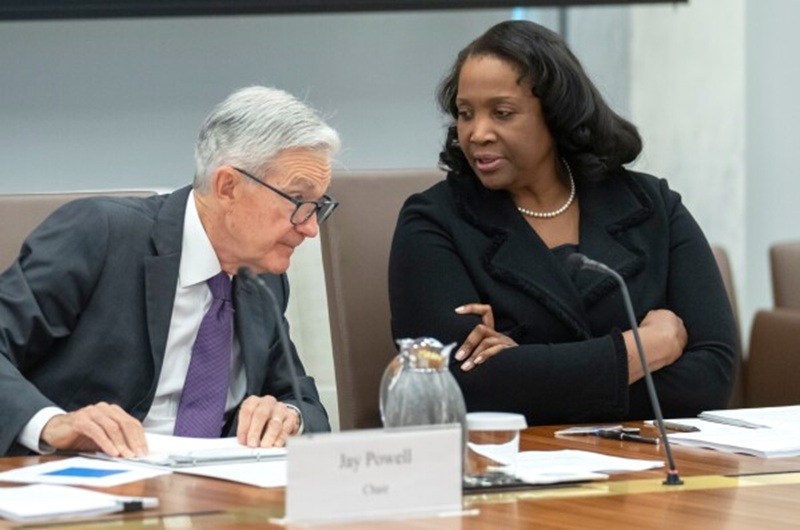
President Donald Trump announced on August 25, 2025, via Truth Social, his intention to fire Federal Reserve Governor Lisa Cook, citing allegations of mortgage fraud raised by Federal Housing Finance Agency Director William Pulte.
The allegations claim Cook falsely declared two primary residences to secure better mortgage terms. Cook, the first Black woman on the Fed’s board, appointed by President Joe Biden in 2022 for a term until 2038, has denied the accusations and stated she will not resign, asserting Trump lacks legal authority to remove her.
Her attorney, Abbe Lowell, plans to challenge the action in court, potentially escalating the case to the Supreme Court. The Federal Reserve Act allows removal of governors only “for cause,” typically interpreted as serious misconduct during their term, leaving Trump’s legal basis contentious, as the allegations predate Cook’s tenure.
Register for Tekedia Mini-MBA edition 20 (June 8 – Sept 5, 2026).
Register for Tekedia AI in Business Masterclass.
Join Tekedia Capital Syndicate and co-invest in great global startups.
Register for Tekedia AI Lab.
Legal experts suggest the move could test the Fed’s independence, a cornerstone of its ability to manage monetary policy without political interference. If successful, Trump could gain influence over the Fed’s board, especially with another vacancy from Adriana Kugler’s resignation and his nomination of Stephen Miran.
However, even with additional appointees, Trump’s influence over interest rate decisions may be limited, as the Federal Open Market Committee includes non-board members. Financial markets showed minimal immediate reaction, but analysts warn that undermining the Fed’s autonomy could unsettle investors.
Trump has historically discussed using tariff revenue to fund domestic initiatives. For instance, during his campaign, he proposed tariffs on imports, particularly from China, to generate revenue for tax cuts or other benefits for Americans.

The Federal Reserve Act stipulates that governors can only be removed “for cause,” typically interpreted as serious misconduct during their term. The allegations against Cook, related to mortgage fraud predating her tenure, may not legally qualify as sufficient cause. If Trump succeeds in removing her, it could set a precedent allowing future presidents to dismiss Fed governors for political reasons, eroding the Fed’s insulation from executive influence.
Cook’s legal team plans to challenge the dismissal in court, potentially reaching the Supreme Court. A ruling in Trump’s favor could weaken the legal protections surrounding Fed governors’ terms, making them more vulnerable to political pressure. Conversely, a ruling against Trump could reinforce the Fed’s autonomy.
Trump’s action aligns with his history of criticizing the Fed and its chair, Jerome Powell, for not aligning monetary policy with his economic goals. Successfully removing a governor could embolden further attempts to influence the Fed’s decisions on interest rates, inflation, or employment, undermining its mandate to prioritize long-term economic stability over short-term political objectives.
The Fed’s Board of Governors, currently with six members following Adriana Kugler’s resignation, could see a shift in dynamics if Trump fills vacancies with loyalists, such as his nominee Stephen Miran. While governors alone don’t control monetary policy (the Federal Open Market Committee includes regional bank presidents), a Trump-aligned board could pressure the FOMC toward policies favoring his agenda, such as lower interest rates to boost growth, even if inflationary risks persist.
The Fed’s independence is critical to maintaining investor confidence in U.S. monetary policy. Any perceived politicization could unsettle financial markets, potentially increasing volatility in bond yields, stock prices, or the dollar’s value. While markets showed minimal immediate reaction to the Cook announcement, prolonged uncertainty or successful interference could lead to broader economic repercussions.

Trump’s move could be seen as part of a broader effort to assert control over independent institutions, potentially polarizing public and political opinion. Supporters may view it as a bold stand against perceived misconduct, while critics may see it as an attack on institutional integrity.
Cook’s historic role as the first Black woman on the Fed’s board adds a layer of sensitivity. Her removal could spark debates about diversity in economic leadership, especially if the allegations are perceived as politically motivated or insufficiently substantiated.
However, if Trump were to propose using tariff revenue for direct payouts, it could indirectly pressure the Fed. For example, large-scale fiscal policies like dividends could fuel inflation, forcing the Fed to adjust interest rates. If Trump perceives the Fed as resistant to accommodating such policies, he might intensify efforts to influence its leadership, further threatening its independence.
Tariffs, a cornerstone of Trump’s economic agenda, could generate significant revenue but also raise consumer prices, complicating the Fed’s dual mandate of price stability and maximum employment. A less independent Fed might face pressure to keep rates low to offset tariff-driven inflation, risking long-term economic stability.
How This Affects Fed Independence
The attempt to fire Cook directly challenges the Fed’s structural independence by testing the legal boundaries of gubernatorial removal. If successful, it could embolden future interventions, weakening the Fed’s ability to act without political interference.
A precedent allowing presidents to remove governors for non-term-related reasons could make the Fed more susceptible to political cycles, aligning monetary policy with electoral goals rather than economic data. This could undermine global confidence in the U.S. dollar and the Fed’s credibility as a neutral arbiter.
The Fed’s design, with staggered 14-year terms and a mix of board and regional bank input, provides some buffer against immediate politicization. However, sustained efforts to stack the board with loyalists could gradually erode this resilience, especially if combined with legislative changes or public pressure.
A less independent Fed could lead to higher risk premiums in U.S. financial markets, as investors demand compensation for uncertainty. Internationally, central banks and foreign investors might question the reliability of U.S. monetary policy, potentially impacting the dollar’s status as the world’s reserve currency.
The outcome of this action—whether through legal battles or political negotiations—will shape the Fed’s ability to operate free from executive influence. While the tariff revenue dividend proposal remains unconfirmed in this context, any such policy could amplify pressure on the Fed to align with Trump’s fiscal agenda, further testing its autonomy.