

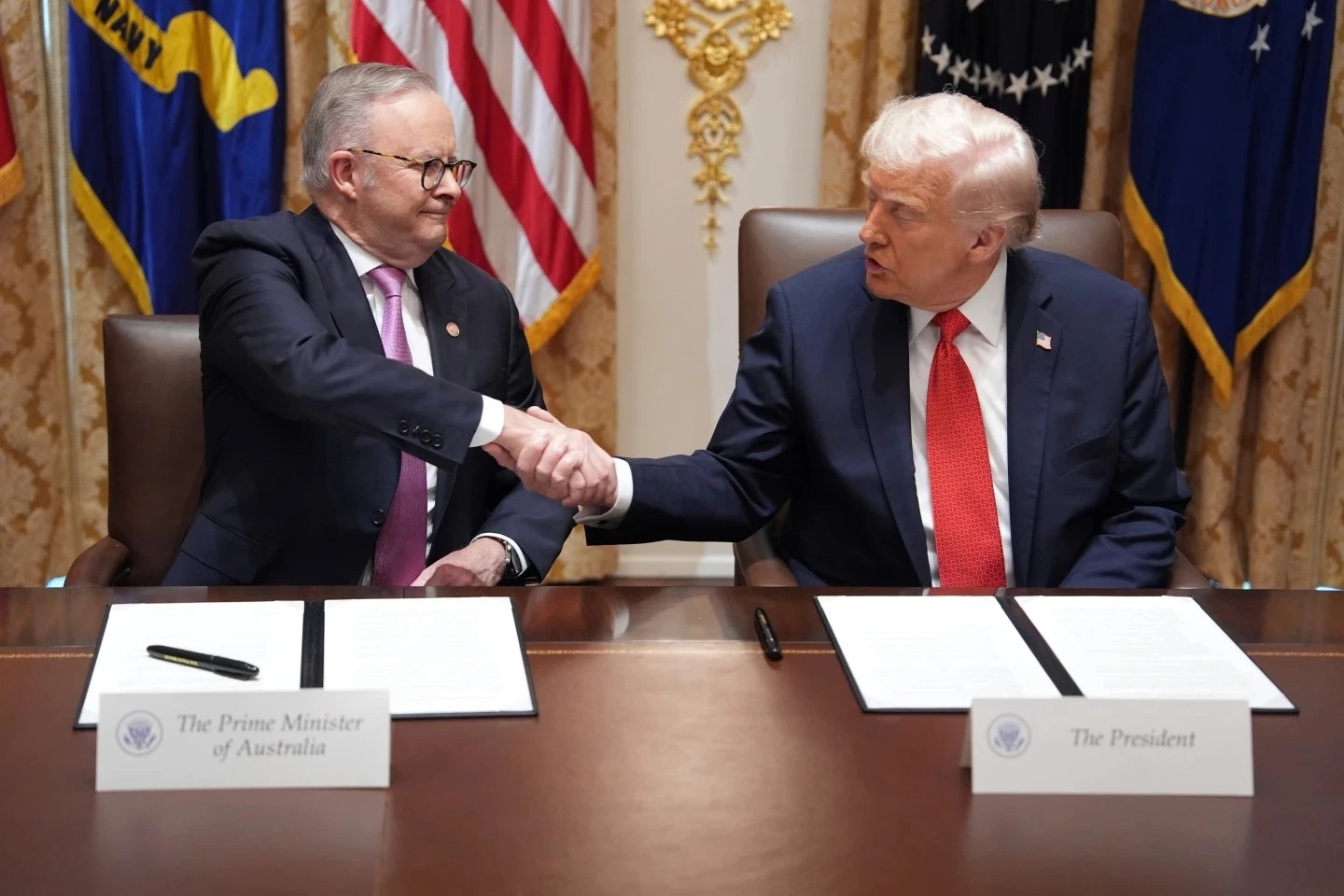
President Donald Trump and Australian Prime Minister Anthony Albanese on Monday sealed a multibillion-dollar agreement aimed at expanding joint investment in critical minerals, signaling a deepening strategic partnership between Washington and Canberra as both allies move to reduce dependence on Chinese supply chains.
Under the deal, the U.S. and Australia will jointly contribute $3 billion over the next six months to projects in the critical minerals sector, with a total project pipeline valued at $8.5 billion, according to statements from both governments. The investment will focus on materials considered vital to the energy transition and advanced technologies, including those used in electric vehicles, semiconductors, and defense systems.
Defense Department to Back Gallium Refinery
A centerpiece of the new arrangement is a U.S. Department of Defense–backed gallium refinery in Western Australia, designed to produce about 100 tons of the metal annually. The U.S. currently imports its entire gallium supply — roughly 21 tons a year — with most of it previously sourced from China, according to data from the U.S. Geological Survey.
Register for Tekedia Mini-MBA edition 20 (June 8 – Sept 5, 2026).
Register for Tekedia AI in Business Masterclass.
Join Tekedia Capital Syndicate and co-invest in great global startups.
Register for Tekedia AI Lab.
Gallium is a key component in high-frequency microwave circuits, power electronics, and the production of blue and violet LEDs, which in turn are used in laser technologies. Washington aims to ensure stable access to materials that underpin modern electronics and military hardware by funding a domestic-capable refinery within an allied country.
The refinery investment has been described as “a strategic step to secure the supply of high-performance materials necessary for next-generation defense and industrial technologies.”
The project is expected to come online within the next two years, creating a new non-Chinese source for gallium — a move aligned with broader Western efforts to counter Beijing’s dominance in the global critical minerals trade.

China’s Tight Grip on Rare Earths
The timing of the Trump–Albanese deal follows Beijing’s recent tightening of export controls on gallium, germanium, and other rare earth elements critical to high-tech manufacturing. Those restrictions, introduced last year, have already strained global supply chains and underscored the vulnerabilities faced by nations heavily reliant on Chinese exports.
Washington and Canberra aim to accelerate alternative supply routes across allied nations by pooling investment resources, while stimulating exploration and refining capacity in Australia — which holds some of the world’s largest reserves of lithium, cobalt, and rare earth elements.
Analysts say the agreement reflects a growing consensus among Western allies that access to critical minerals has become an economic and national security imperative. The deal also fits into the U.S. strategy of “friend-shoring,” or relocating essential production to politically aligned partners to mitigate geopolitical risk.

Anduril’s $1.2bn Defense Deal
In a parallel development tied to the new partnership, Australia confirmed plans to purchase $1.2 billion worth of autonomous underwater vehicles (AUVs) from U.S. defense startup Anduril. The White House did not clarify whether the acquisition is new or an extension of the previously announced $1.12 billion Ghost Shark program, under which Anduril will supply a fleet of large, uncrewed submarines to the Royal Australian Navy.
The deal highlights the increasingly intertwined nature of defense and industrial cooperation between the two allies. While the minerals agreement aims to secure materials critical to high-end manufacturing and defense production, the Anduril purchase underscores Canberra’s growing investment in next-generation maritime defense capabilities — particularly as regional tensions in the Indo-Pacific continue to rise.
The dual agreements come amid Washington’s broader push to diversify global supply chains and reduce strategic vulnerabilities exposed by China’s dominance in the processing of key resources. The U.S. Department of Energy has identified more than a dozen minerals where American industries are wholly dependent on foreign suppliers, with gallium, lithium, and rare earths among the most critical.
Australia, in turn, stands to benefit as both an exporter and processing hub. The country has been positioning itself as a reliable alternative supplier for Western economies seeking to cut their reliance on China.
The $8.5 billion pipeline, officials said, will support exploration, refining, and value-added manufacturing projects, potentially creating thousands of jobs across regional Australia while strengthening bilateral trade ties with the United States.
Looking ahead, the Trump–Albanese accord represents one of the most ambitious U.S.–Australia economic and defense collaborations in recent years, aligning with a broader strategic shift in the Indo-Pacific that prioritizes supply chain resilience, defense technology integration, and industrial sovereignty.
While the initial $3 billion injection is expected to roll out over six months, officials from both governments indicated that the broader investment pipeline could expand further as new projects are identified.
The move adds another layer to Washington’s ongoing effort to decouple critical technology supply chains from Beijing, while it marks a step toward solidifying Canberra’s role as a linchpin in the West’s resource security architecture.