

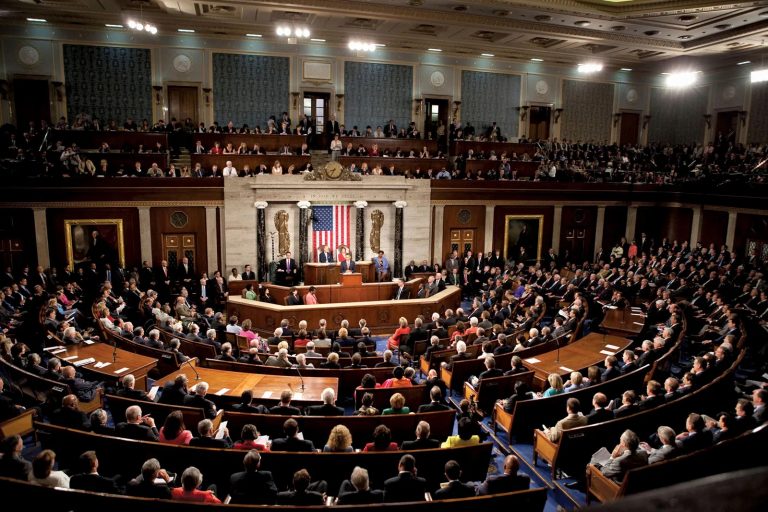
President Donald Trump notched a major political win on Thursday after the House narrowly passed a sweeping tax and spending package that revives key parts of his 2017 economic agenda.
Dubbed the “big, beautiful bill” by Trump himself, the measure passed by a razor-thin margin of 215 to 214, marking a dramatic victory for both Trump and House Speaker Mike Johnson, R-La., after weeks of fractious intraparty negotiations and last-minute deal-making.
The bill, a sprawling multitrillion-dollar package, now moves to the Senate, where Republicans hold a majority and are expected to pass it with few changes, especially after Trump urged GOP senators to “get it done quickly.”
Register for Tekedia Mini-MBA edition 20 (June 8 – Sept 5, 2026).
Register for Tekedia AI in Business Masterclass.
Join Tekedia Capital Syndicate and co-invest in great global startups.
Register for Tekedia AI Lab.
The legislation is anchored in an extension of Trump’s expiring 2017 tax cuts and includes a massive increase in military spending, aggressive border security funding, and provisions to support Trump’s mass deportation initiative. It also eliminates federal income taxes on tipped and overtime wages—two proposals Trump had emphasized during his reelection campaign.
But the bill also slashes funding across several domestic programs, triggering a wave of opposition from Democrats and concern from business leaders, economists, and policy analysts who argue that the legislation will deepen the national debt, further strain public services, and disproportionately benefit wealthier Americans at the expense of the poor.
An All-Night Fight and a Fragile Victory
The final vote capped a 21-hour marathon of late-night negotiations and a dramatic floor showdown. All Democrats present voted against the bill, joined by two Republicans—Reps. Thomas Massie of Kentucky and Warren Davidson of Ohio. Rep. Andy Harris, R-Md., a member of the House Freedom Caucus, voted “present,” while two GOP lawmakers missed the vote entirely.

Speaker Johnson described the bill’s path to passage as “an act of God,” recounting moments when the package nearly fell apart.
“There’s a lot of prayer that brought this together,” he told reporters after the vote. “I went to the little chapel over here and got on my knees and prayed that these guys would have wisdom and stamina.”
Economists Warn of a Debt Explosion
But outside the House floor, a more sobering tone came from corporate offices and economic think tanks. Business leaders, especially from the financial and healthcare sectors, expressed concern over the long-term fiscal implications of the bill.

Chief among those sounding the alarm is Peter Schiff, Chief Economist and Global Strategist at Euro Pacific Capital, who sharply criticized the bill’s cost structure.
“Trump claims the Big, Beautiful Bill is ‘the most significant piece of legislation signed in the history of our country.’ The only thing significant about the bill is the increase in the national debt it will produce,” Schiff said. “It’s full of gimmicks that hide the added cost of government.”
Schiff and other fiscal conservatives argue that the bill masks true costs through sunset clauses, front-loaded tax breaks, and delayed implementation of unpopular spending cuts. The nonpartisan Congressional Budget Office (CBO) projected the measure will add at least $2.3 trillion to the national debt over the next decade, though that figure could rise if temporary provisions are extended—as they often are.
The CBO also estimated the bill would result in the loss of health coverage for 8.6 million Americans, mostly through cuts to Medicaid and the Supplemental Nutrition Assistance Program (SNAP) while reducing household resources for the lowest-income earners by 4% by 2033. At the same time, it would increase household resources for the wealthiest 10% by about 2%.
GOP Internal Bargaining and Trump’s Pressure Campaign
To secure enough votes, Speaker Johnson made a series of concessions to different Republican factions. Conservative hardliners from the House Freedom Caucus pushed for—and won—an accelerated timeline for imposing work requirements on Medicaid recipients, now set to begin in late 2026. They also succeeded in fast-tracking the phaseout of clean energy tax credits passed by Democrats in 2022.
Moderate Republicans from high-tax states extracted a raise in the state and local tax (SALT) deduction cap to $40,000, a move seen as necessary for their political survival back home.
Still, the margin remained so tight that even minor absences threatened to derail the bill.
Trump played an active role in closing the deal. He joined a closed-door GOP conference meeting earlier in the week and later summoned key Freedom Caucus holdouts to the White House. His message was blunt: it was time to unify.
Rep. Ralph Norman, R-S.C., one of the fiscal hawks who ultimately voted for the bill said “some of the stuff we didn’t like stayed in.”
“Am I happy with the deficits? No,” Norman told reporters after the vote. “We held it out as long as we could to get the cuts, as long as we could. We couldn’t do it. We live to fight another day.”
Democrats Warn of Dire Consequences
Democrats lambasted the measure as a giveaway to the wealthy and a betrayal of vulnerable Americans. They accused Republicans of pushing through the bill “under the cover of darkness” and gutting critical social safety nets.
“Children will get hurt. Women will get hurt. Older Americans will get hurt. People with disabilities will get hurt. Hospitals will close. And people will die,” said House Minority Leader Hakeem Jeffries, D-N.Y., during a fiery floor speech before the vote.
Jeffries also predicted political consequences. “When the votes are ultimately cast on that first Tuesday in November next year, this day may very well turn out to be the day that House Republicans lost control of the United States House of Representatives,” he warned.
Senate Showdown and July 4 Deadline
The bill now heads to the Senate, where Republicans control the chamber and are expected to fast-track the legislation. Speaker Johnson, who lunched with GOP senators earlier in the week, urged them to make “as few changes as possible.” But even small amendments will require a second vote in the House—no easy feat given the fragile coalition that carried the bill through on Thursday.
Republican leaders say they hope to have the bill on Trump’s desk by July 4, a symbolic date Trump has touted as a celebration of “economic freedom.”
However, business leaders and economists warn that the true fireworks may come later—when the long-term fiscal costs begin to surface, and the promised benefits fail to materialize for many Americans.
“The claim that the Big, Beautiful Bill cuts taxes is a lie. The real cost of government that taxpayers must bear is total spending. Since this bill increases spending, it’s a tax hike, not a tax cut. Americans will ultimately pay the cost with higher inflation and interest rates,” Schiff added.