

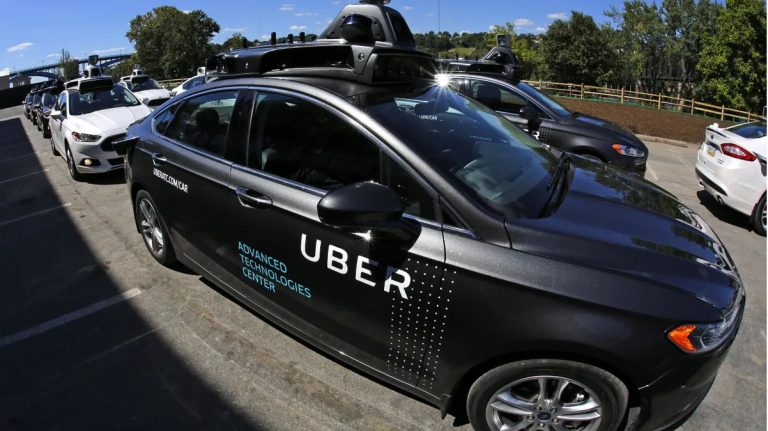
Uber is moving aggressively to reclaim its place at the front of the transportation revolution with a sweeping new partnership announced Thursday that will see it deploy more than 20,000 robotaxis across the United States over the next six years.
The initiative marks a bold new chapter in the ride-hailing giant’s quest to dominate autonomous transport, teaming up with electric vehicle maker Lucid and self-driving tech startup Nuro to develop and deploy the fleet.
Under the agreement, Uber will invest $300 million in Lucid, which will manufacture the electric robotaxis. Nuro, backed by Google and the SoftBank Vision Fund, will provide the Level 4 autonomous driving technology capable of ferrying passengers without a human driver under normal conditions. The rollout is set to begin in a major U.S. city next year, though the companies have not yet disclosed which one.
Register for Tekedia Mini-MBA edition 20 (June 8 – Sept 5, 2026).
Register for Tekedia AI in Business Masterclass.
Join Tekedia Capital Syndicate and co-invest in great global startups.
Register for Tekedia AI Lab.
“We’re thrilled to partner with Nuro and Lucid on this new robotaxi program, purpose-built just for the Uber platform, to safely bring the magic of autonomous driving to more people across the world,” said Uber CEO Dara Khosrowshahi.
Lucid interim CEO Marc Winterhoff hailed the partnership as a leap into a “completely new” addressable market. The company’s Gravity EVs, with a reported 450-mile range, are expected to reduce operating costs and charging downtimes, improving both affordability and scalability.
The announcement sent Lucid’s stock soaring 30 percent on Thursday, while Uber shares ticked up slightly.

The move comes amid intensifying competition in the robotaxi space, with Uber’s longtime rival Waymo—owned by Alphabet—already offering driverless rides in Phoenix, San Francisco, Los Angeles, and, more recently, Atlanta and Austin. Waymo’s fleet, also rated Level 4 by industry standards, is considered a frontrunner in safe, real-world deployment. Meanwhile, Tesla, which launched a supervised robotaxi pilot in Austin this June, is betting on its Full Self-Driving (FSD) software to eventually evolve into a true driverless system, though it remains classified as Level 2 automation, requiring constant driver oversight.
The battle to define the next era of mobility has escalated rapidly, and Uber’s latest deal signals it does not intend to watch passively as newcomers and rivals eat away at the market it pioneered.
With over 130 million users worldwide, Uber is banking on its scale and brand loyalty to position itself as a central player in the robotaxi economy, which many analysts now consider the next major frontier in U.S. tech. The company’s earlier stumbles in autonomous driving—including the fatal 2018 crash that led it to offload its self-driving unit to Aurora—now appear to be giving way to renewed ambition backed by established EV and AI players.

Nuro, which is already testing its autonomous tech at a proving ground in Las Vegas, described the deal as a “blueprint for a robotaxi program that’s both commercially viable and globally scalable.” The startup raised $106 million in fresh capital in April from investors including T. Rowe Price, Fidelity, Tiger Global, and Greylock, further strengthening its runway.
With robotaxis shaping up to be the next seismic shift in mobility and artificial intelligence, Uber’s new deal is seen as a high-stakes bid to ensure it doesn’t get left behind in a market it helped create.