

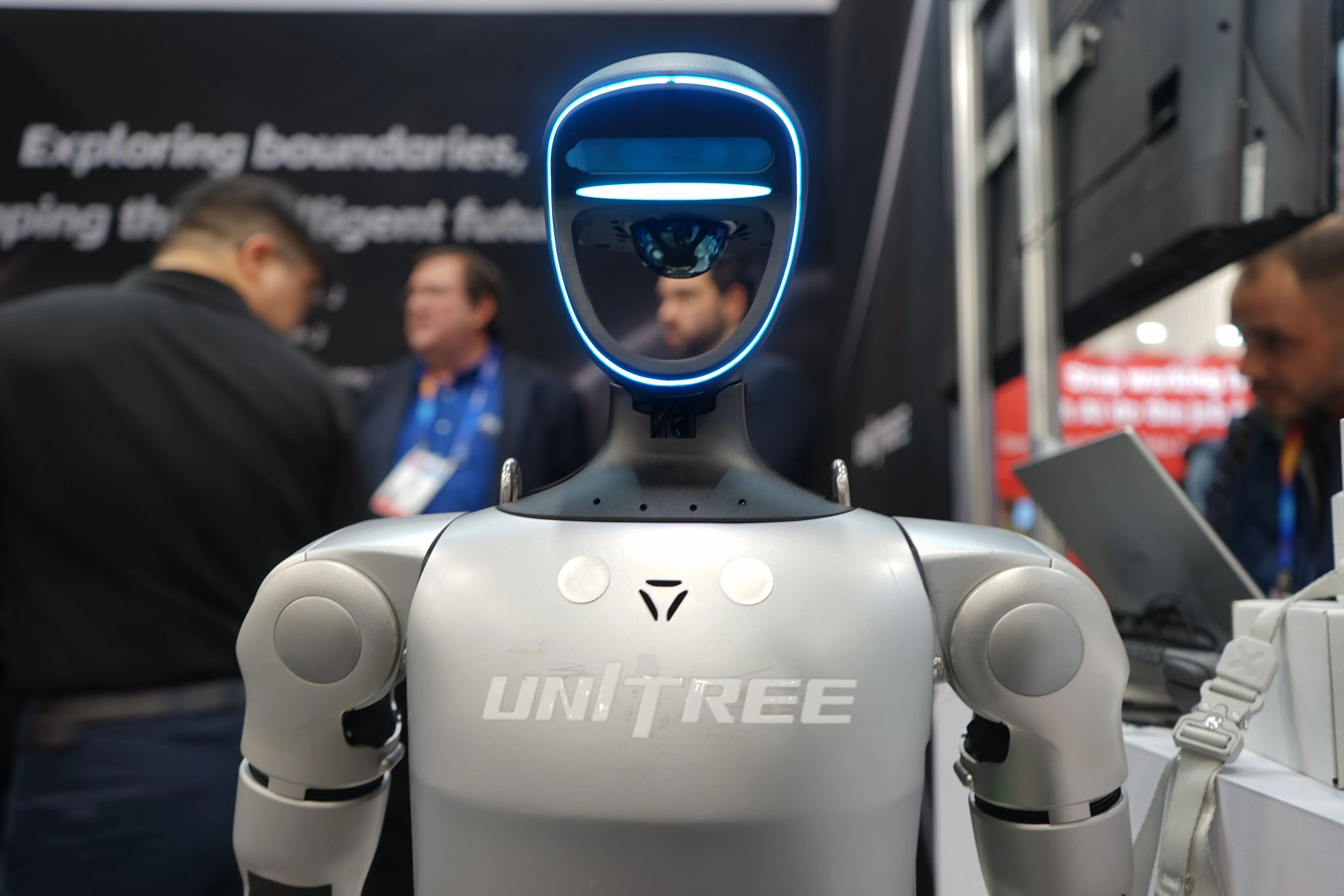
Chinese robotics company Unitree Technology has warned that expanding U.S. restrictions on foreign-made robots could weigh on its overseas growth, highlighting mounting geopolitical risks for Chinese technology firms as the company prepares for a high-profile listing on Shanghai’s STAR Market next month.
The Hangzhou-based maker of humanoid and quadruped robots disclosed in its initial public offering (IPO) filing on Thursday that additional U.S. tariffs, regulatory restrictions and tighter export policies could limit future access to one of its most important overseas markets, potentially affecting sales growth and long-term international expansion.
The disclosure comes as Washington intensifies scrutiny of Chinese technology products amid growing concerns over national security, supply chain resilience and the strategic importance of artificial intelligence and advanced robotics. The latest regulatory moves suggest that robotics is becoming the newest front in the broader technology rivalry between the United States and China, extending restrictions that have already reshaped the semiconductor, AI and telecommunications industries.
Register for the next Tekedia Mini-MBA.
Register for Tekedia AI in Business Masterclass.
Join Tekedia Capital Syndicate and co-invest in great global startups.
Unitree has emerged as one of China’s best-known robotics companies, drawing global attention through demonstrations of its humanoid and four-legged robots performing sophisticated tasks, including running, dancing, martial arts routines and industrial applications. Its products have become symbols of China’s rapid advances in robotics and embodied artificial intelligence, a field that combines AI software with physical machines capable of interacting with the real world.
U.S. Market Faces Growing Uncertainty
The company said its existing humanoid and quadruped robots have already received certification from the U.S. Federal Communications Commission (FCC), allowing them to be sold in the United States.
However, Unitree cautioned that future products may not qualify under the latest regulatory framework, creating uncertainty around future product launches.

The warning follows a decision by the FCC on Tuesday to add foreign-made advanced robots to its Covered List. The designation restricts manufacturers from obtaining the equipment authorization required to introduce new robotic products into the U.S. market unless they receive exemptions or conditional approval.
While robots that have already secured FCC authorization can continue to be sold, Unitree acknowledged that further tightening of U.S. policy, including the possible withdrawal of existing approvals, could also disrupt sales of products currently on the market.
The company said these regulatory developments represent a material business risk given the importance of the U.S. market to its international operations.

Although Unitree has expanded rapidly across international markets, the United States continues to account for a significant share of its overseas business. According to the IPO filing, overseas revenue represented more than 40% of total sales during each of the three reporting periods disclosed by the company. Within that international business, revenue generated from the United States accounted for 18.39%, 19.54% and 13.30%, respectively, across the reporting periods.
Those figures underscore both the company’s growing global footprint and its exposure to changes in U.S. trade and regulatory policy.
Any additional restrictions on advanced robotics imports could force Unitree to redirect sales toward other international markets or accelerate efforts to strengthen its domestic business, where China continues to invest heavily in robotics, automation and AI-driven manufacturing.
Shanghai IPO to Test Investor Appetite
The regulatory warning comes as Unitree moves ahead with plans for one of China’s most closely watched technology listings this year.
The company intends to issue 40.446 million new A-shares on Shanghai’s STAR Market, representing 10% of its enlarged share capital. Existing shareholders will not sell shares in the offering, meaning all proceeds will be directed toward the company.
The IPO timetable calls for preliminary institutional price inquiries on Aug. 5, pricing on Aug. 6, final offering terms on Aug. 7 and investor subscriptions beginning on Aug. 10.
Unitree had been targeting a valuation of as much as 50 billion yuan (about $7 billion), according to a Reuters report citing people familiar with the matter.
The company’s March prospectus sought to raise approximately 4.202 billion yuan ($620 million), implying a valuation of roughly 42 billion yuan based on the planned sale of 10% of the business. The final valuation will depend on investor demand and the eventual offer price.
Unitree enters the public market after posting rapid revenue growth, reflecting rising demand for advanced robotics across industrial, research, commercial and AI development applications. The company reported revenue of nearly 1.7 billion yuan in 2025, more than quadrupling from 393 million yuan a year earlier.
The strong financial performance mirrors broader growth in the global robotics sector, where advances in generative AI, computer vision, motion control and large language models are accelerating investment in autonomous machines capable of performing increasingly complex physical tasks.
Humanoid robots, once largely confined to research laboratories, are increasingly being developed for manufacturing, logistics, warehouse automation, healthcare and service industries, prompting technology companies worldwide to invest heavily in embodied AI.
Founder to Retain Voting Control
Following the IPO, founder and Chairman Wang Xingxing and an entity under his control are expected to own 31.29% of Unitree’s equity.
Through the company’s dual-class share structure, however, Wang will retain control of 65.31% of the voting rights, giving him effective control over major corporate decisions after the company becomes publicly traded.
The governance structure mirrors that adopted by many technology companies seeking public listings, allowing founders to maintain strategic control while raising capital to fund expansion.
Unitree is among China’s leading robotics companies and has become one of the country’s highest-profile developers of humanoid and quadruped robots. Its machines have attracted international attention through public demonstrations showcasing agility, balance and AI-powered movement, highlighting China’s growing capabilities in advanced robotics.
The company’s IPO also comes at a time of heightened competition in the global robotics industry, with Chinese firms racing against U.S., Japanese and European rivals to commercialize humanoid robots for industrial and commercial use.
At the same time, Washington has expanded restrictions on Chinese technology across sectors including semiconductors, artificial intelligence, telecommunications and now advanced robotics, increasing regulatory uncertainty for Chinese companies seeking to expand in the U.S. market.