

A report published by Daily Trust which indicated that the United States Secretary of War, Pete Hegseth, said his department was preparing for possible military action in Nigeria has triggered a wave of mixed reactions across social media. This was gleaned from our analysis of public comments on the newspaper’s official Facebook page.
While the statement attributed to Hegseth suggested heightened geopolitical tension, Nigerians online did not respond uniformly. Instead, they negotiated the meaning of the report in different ways that reflect the country’s political consciousness, economic anxiety, and cultural orientation.
A significant portion of commentators reacted with a show of national confidence. They argued that Nigeria was capable of defending its sovereignty and would not be intimidated by an external power like the United States. These users acknowledged the potential seriousness of the threat but reframed it as an opportunity to assert Nigeria’s strength. Comments such as “We are ready for you, we will protect our sovereignty with all our hearts” and “Our generals are waiting for you” reflected this spirit of bold resistance. About 36 percent of the comments analyzed took this nationalist defiance approach.
Register for Tekedia Mini-MBA edition 20 (June 8 – Sept 5, 2026).
Register for Tekedia AI in Business Masterclass.
Join Tekedia Capital Syndicate and co-invest in great global startups.
Register for Tekedia AI Lab.
Others embraced humor over fear. About 20 percent of the online reactions mocked the idea of a US attack, portraying it as exaggerated or unrealistic. Laughter emojis accompanied sarcastic questions and jokes such as “Secretary of war keh” and “Who go open gate for them.” Some users compared gun sounds in Nigeria with those in the United States as a way to downplay the scenario, turning a potentially alarming headline into comedy. This oppositional reading rejected the threat and challenged the credibility of the initial report through humour.
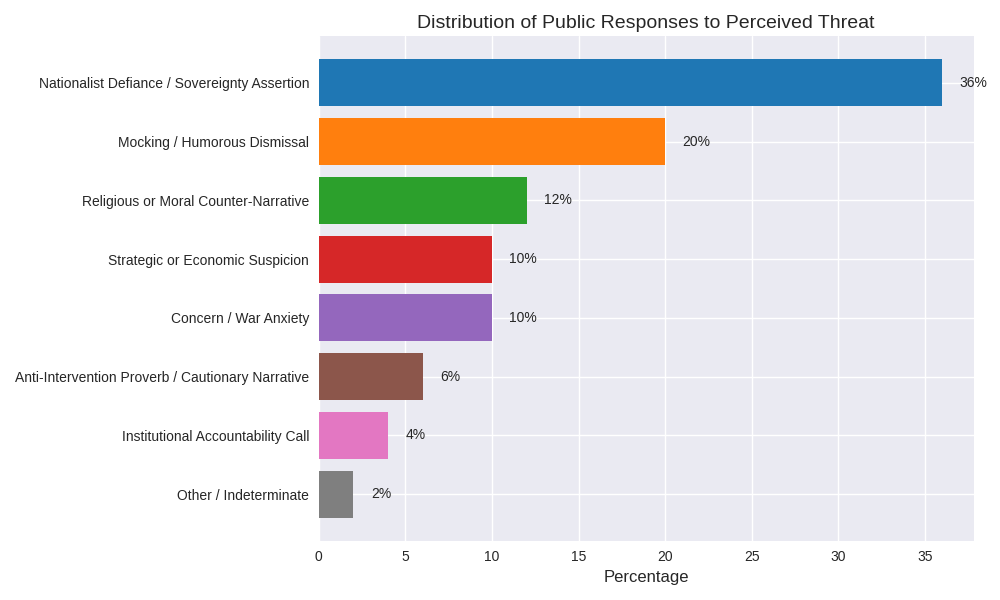
Religion played a central role in several reactions, particularly around narratives of persecution. Hegseth’s comment reportedly referenced concerns about religious freedom in Nigeria, but some Nigerians strongly objected to the suggestion that the country targets Christians. These reactions insisted that Islam in Nigeria is a peaceful religion and that Muslims have also been victims of terrorism. Messages encouraged unity and rejected what they perceived as foreign propaganda meant to divide communities. Religious or moral counter narratives made up around 12 percent of the responses.
Suspicion of foreign motives also surfaced frequently. Five out of the 50 analyzed reactions questioned whether the United States was interested in protecting human rights or if the real objective was to secure Nigeria’s strategic resources. Oil was a common focus of these suspicions. Users wrote comments like “Is US running short of crude oil” and warned that Western powers are often driven by economic agendas. Others suggested that Nigeria’s mineral wealth such as californium could be an attraction for intervention. These negotiated readings did not dismiss the threat entirely but framed it as self-serving geopolitical interference.

A visible minority expressed fear and worry that any military action would affect civilian lives. These users advised prayers and urged people to take the situation seriously. Some recalled the devastation in Libya as a cautionary example. For them, war is not an avenue for bravado or humor but a destructive force that would sweep up even those who support it. Around 10 percent of comments reflected this anxiety.
Another group redirected the attention inward. They interpreted the reported statement as a wake up call for Nigerian leaders to strengthen institutions, address insecurity and reduce the nation’s vulnerability on the world stage. These voices asked the government to reinforce internal governance instead of engaging in rhetoric. This accountability oriented view represented a smaller portion of comments but demonstrated that some citizens see international pressure as a reflection of domestic shortcomings.
Across all categories, the reactions highlighted the complexity of Nigerian public opinion when confronted with foreign threat narratives. The dominant pattern was not simple acceptance or rejection but a negotiation of meaning rooted in nationalism, lived insecurity, humor as coping strategy and distrust of global power intentions.

Although the credibility of the report and the existence of a United States Secretary of War have been questioned, the reactions offer insight into how Nigerians decode political information online. The conversation has shown that for many citizens, external pressure becomes a lens through which they reinterpret national identity, political grievances and global inequality.
Such a interesting story
The painful part is we are coming out of economy hardship and trump decided to present another problem to us.there is God o
I think we should just voice out now before our territory become a wonder land
Nice story
Nice story
Such a nice story