

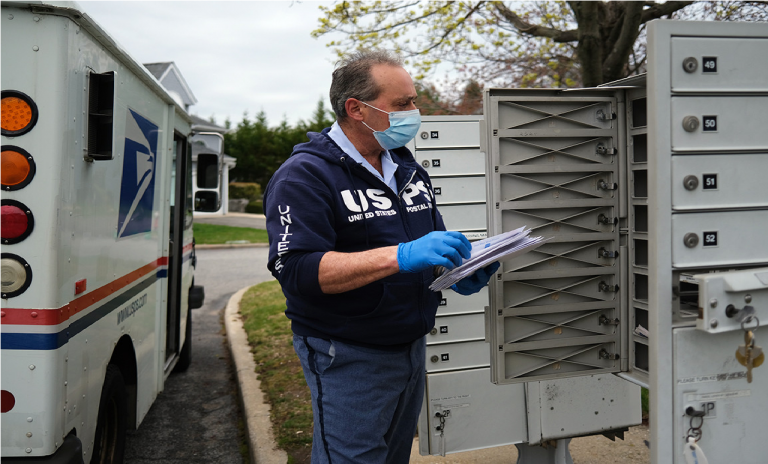
In a rapid policy reversal, the United States Postal Service (USPS) announced on Wednesday that it would resume accepting all international inbound mail and packages from China and Hong Kong, just 12 hours after initially suspending shipments due to the ongoing US-China trade war.
The decision to reinstate package shipments, which had been abruptly halted Tuesday, underscores the confusion surrounding the newly imposed 10% tariff on all Chinese imports, part of an executive order signed by President Donald Trump. The USPS, in a statement on its website, said it was now “working closely” with the Customs and Border Protection (CBP) agency to create an “efficient collection mechanism” for the new tariffs, ensuring that package delivery faces minimal disruption.
A Chaotic Policy Shift Linked to the “De Minimis” Crackdown
The initial suspension of packages followed the elimination of the “de minimis” rule for Chinese imports—a policy that previously allowed packages valued under $800 to enter the US duty-free. This system had been widely used by Chinese e-commerce giants Shein and Temu, allowing them to sell low-cost products directly to American consumers without tariffs.
Register for Tekedia Mini-MBA edition 20 (June 8 – Sept 5, 2026).
Register for Tekedia AI in Business Masterclass.
Join Tekedia Capital Syndicate and co-invest in great global startups.
Register for Tekedia AI Lab.
The sudden reversal suggests pressure from various stakeholders, including possibly major US retailers who both compete with and depend on Chinese suppliers. Notably, Amazon, the world’s largest retailer, has also ramped up its own use of de minimis shipments from China, per SCMP.
Although the USPS did not explain its about-face, the move mirrors the Trump administration’s temporary delay of 25% tariffs on imports from Canada and Mexico. The erratic shifts in trade policy add to the economic uncertainty and further complicate US-China relations, which have become increasingly fraught as both nations escalate tariffs and trade restrictions.
China Reacts With Strong Disapproval and Retaliatory Measures
Before the USPS reversed course, the Hong Kong government issued a statement expressing “strong disapproval” of both the temporary postal suspension and the additional 10% tariffs imposed on Chinese goods.

Beijing also responded aggressively. Chinese Foreign Ministry spokesperson Lin Jian condemned the US move, saying: “We urge the United States to stop politicizing trade and economic issues and using them as tools, and to stop the unreasonable suppression of Chinese companies.”
In retaliation, China announced counter-tariffs ranging from 10% to 15% on select US imports, set to take effect on Monday, February 10. Among the affected goods are:
- 15% tariffs on coal and liquefied natural gas
- 10% tariffs on crude oil and agricultural machinery
Additionally, Beijing introduced export controls on strategic metals, such as tungsten—a key material for industrial and defense applications—and tellurium, used in solar panel production.

China also took regulatory action, launching an anti-monopoly investigation into Google and adding US companies to its entity list. The companies include Illumina, a leading US biotechnology firm, PVH Corp, the parent company of Calvin Klein and Tommy Hilfiger.
Amazon’s Silent Role
While it remains unclear what exactly prompted the USPS’s quick reversal, some observers speculate that corporate lobbying may have played a role—particularly from Amazon, which has a complicated relationship with Chinese e-commerce platforms.
Amazon has faced mounting competition from Shein and Temu, both of which heavily rely on the de minimis exemption to avoid US import duties. However, Amazon itself has increasingly utilized the same loophole to ship Chinese-made products to American consumers.
Adding to speculation is the fact that Amazon reportedly donated $1 million to Trump’s 2017 inauguration, and its founder Jeff Bezos was given a prime seat at the ceremony. While Bezos and Trump later had a public falling-out, Amazon remains deeply embedded in the global supply chain, making any disruption in US-China trade logistics a potential concern for its business model.
Will This Escalate Into a Full-Blown Trade War?
The sudden USPS reversal, coupled with broader tariff moves, raises questions about whether Trump’s trade policies are leading to a larger economic confrontation with China.
Julian Evans-Pritchard, a China analyst at Capital Economics, noted that China’s countermeasures appear restrained compared to US tariffs.
“The measures are fairly modest, at least relative to US moves, and have clearly been calibrated to try to send a message to the US,” he said.
Nonetheless, analysts warn that the policy shifts are creating uncertainty for businesses, especially with Trump previously threatening to impose 60% tariffs on all Chinese imports.
According to Capital Economics, Trump’s 10% tariffs affect $450 billion worth of Chinese goods, whereas China’s countermeasures impact only $20 billion in annual US exports. This disparity suggests that Beijing may be holding back on more severe economic retaliation, possibly leaving room for negotiation or future escalation.
Trump’s long-standing negotiation strategy involves ratcheting up pressure before striking a deal, and his latest tariff moves may be part of that playbook. However, it is unclear whether these tactics will yield meaningful concessions from Beijing or simply provoke a deepening trade war.
For now, the resumption of Chinese package shipments highlights the instability of US trade policies—and leaves businesses, consumers, and governments guessing what will happen next.