

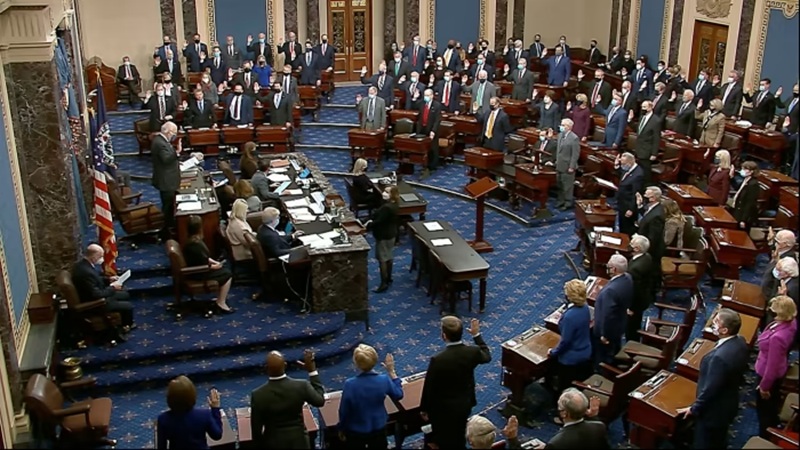
The US Senate committee’s approval of a crypto market structure bill marks a procedural milestone, but it does not yet translate into durable legislative momentum. The bill now enters a far more complex phase—one defined less by technical drafting and more by entrenched jurisdictional conflict, institutional lobbying, and unresolved policy questions about how digital asset markets should be governed in the United States.
The legislation attempts to delineate regulatory authority between the Securities and Exchange Commission (SEC) and the Commodity Futures Trading Commission (CFTC). This is not a new ambition. For years, both agencies have operated in overlapping and often ambiguous territory, particularly as crypto assets blur the traditional distinction between securities and commodities. The bill seeks to formalize a taxonomy for digital assets and establish clearer registration pathways for exchanges, brokers, and token issuers.
In theory, this would reduce regulatory uncertainty and bring digital asset markets closer to a compliant institutional framework. However, the Senate committee win masks the scale of disagreement that still exists within Congress. The most immediate hurdle is intra-legislative fragmentation.
Even among lawmakers broadly supportive of crypto regulation, there is no consensus on the balance between innovation and investor protection. Some factions prioritize rapid integration of digital assets into the financial system through lighter-touch oversight, while others advocate for stricter disclosure requirements and expanded enforcement authority for the SEC.
Register for the next Tekedia Mini-MBA.
Register for Tekedia AI in Business Masterclass.
Join Tekedia Capital Syndicate and co-invest in great global startups.
These differences are not cosmetic; they directly affect how token classifications, decentralized finance (DeFi) protocols, and stablecoin issuance would be treated under law. Beyond Congress, institutional resistance further complicates the bill’s trajectory. Both the SEC and CFTC have historically defended their jurisdictional boundaries, and neither is eager to concede authority without significant safeguards.
The SEC, in particular, has maintained an expansive interpretation of what constitutes a security in the crypto sector, while the CFTC has positioned itself as a more innovation-friendly regulator for commodities-like digital assets. Any statutory realignment will therefore require not only legislative clarity but also institutional recalibration—an inherently slow and contested process.
Industry lobbying also plays a dual role. Major crypto exchanges and infrastructure providers support clearer rules, viewing regulatory ambiguity as a barrier to institutional adoption. At the same time, the industry is not monolithic. Different segments—centralized exchanges, DeFi developers, custodians, and stablecoin issuers—have divergent preferences regarding compliance thresholds and decentralization standards.

This fragmentation weakens the industry’s ability to present a unified position during negotiations. Political timing adds another layer of uncertainty. With election cycles approaching and broader economic concerns dominating legislative priorities, crypto regulation risks being deprioritized or reshaped into a broader financial services bill.
Historically, complex financial regulatory reforms in the United States tend to slow significantly once they move beyond committee stages, often requiring multiple sessions of Congress to reach final passage.
The Senate committee approval should be viewed as an opening move rather than a decisive breakthrough. The bill has successfully entered the formal legislative pipeline, but the path ahead is constrained by institutional rivalry, ideological division, and the inherent difficulty of codifying rapidly evolving financial technology.
Whether it becomes landmark legislation or stalls as another incomplete reform effort will depend on whether policymakers can reconcile competing visions of what crypto markets should become—not just how they should be regulated.
