

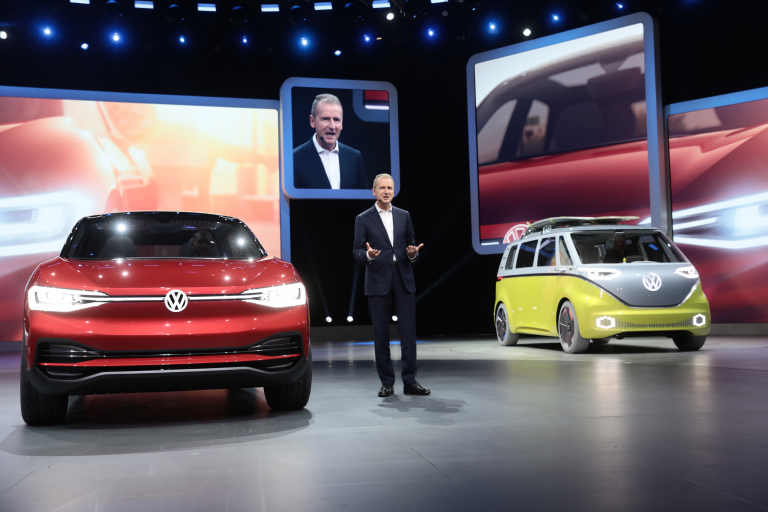
Germany’s Volkswagen Group is making steady headway in implementing extensive job cuts across its portfolio, as confirmed by CEO Oliver Blume in a recent interview with dpa news agency.
The restructuring, aimed at navigating a severe downturn in the European automotive sector, targets over 35,000 positions at the core Volkswagen brand, alongside 7,500 at Audi and approximately 4,000 at Porsche, with additional reductions planned for other subsidiaries.
Blume described the process as progressing “well,” emphasizing the need for cost controls to ensure long-term viability, especially as first-half profits fell 38% year-over-year.
Register for Tekedia Mini-MBA edition 20 (June 8 – Sept 5, 2026).
Register for Tekedia AI in Business Masterclass.
Join Tekedia Capital Syndicate and co-invest in great global startups.
Register for Tekedia AI Lab.
The moves come against a backdrop of declining sales—down by a fifth in Europe over the past five years—and intensifying competition from Asian manufacturers.
Volkswagen is also shifting production of smaller electric vehicles to more cost-effective sites in Spain and Portugal, reducing capacity by over 700,000 units annually at its German facilities.
While earlier plans in 2024 sparked protests from workers and unions, including potential factory closures, the current focus is on voluntary redundancies and operational efficiencies to safeguard the company’s future in “turbulent times.”

Germany’s auto industry, which employs 770,000 people and generates over €540 billion in annual revenue, remains a cornerstone of the economy, making these adjustments critical for broader economic stability.
Germany extends EV Tax Breaks and Introduces Incentives for Working Retirees. In a dual push to bolster its electric vehicle (EV) transition and address labor shortages, the German government is advancing policies to prolong tax exemptions for EVs while rolling out new benefits for pensioners who continue working.
On the EV front, Finance Minister Lars Klingbeil announced plans to extend the current 10-year vehicle tax exemption for battery electric vehicles (BEVs) and fuel-cell electric vehicles (FCEVs)—originally set to expire for new registrations after December 31, 2025—through to 2035.

This measure, part of a comprehensive automotive support package to be discussed at an industry summit hosted by Chancellor Friedrich Merz, aims to stimulate EV adoption, secure jobs in the sector, and position Germany as a leader in sustainable mobility.
Additional incentives include accelerated depreciation for corporate EV purchases up to 40% in the first year, valid through 2028 and ongoing investments in charging infrastructure.
Klingbeil underscored the urgency: “Everyone knows that the future is electric,” highlighting the need to keep high-quality manufacturing in Germany. Simultaneously, the coalition government has greenlit the “active pension” (Aktivrente) initiative, effective January 1, 2026, allowing working pensioners to earn up to €2,000 per month tax-free on top of their retirement benefits.
This policy removes prior restrictions on re-employment with former employers and seeks to retain skilled workers in high-demand fields like engineering, healthcare, and transport amid an aging population and talent shortages.
CDU General Secretary Carsten Linnemann described it as a way to “make working in old age more attractive” and combat skilled labor gaps. While praised for its potential to fill vacancies, critics from employers’ associations and unions argue it may prove costly—estimated at billions annually—without fully resolving underlying issues like health barriers or poor working conditions for seniors.
These developments reflect Germany’s strategic efforts to revitalize its auto industry and workforce resilience in the face of economic headwinds and demographic shifts.
Germany Records High LNG Imports in 2025
In a significant milestone for Europe’s energy transition, Germany’s liquefied natural gas (LNG) imports reached an all-time high in the third quarter of 2025, underscoring the country’s rapid pivot away from Russian pipeline gas following the 2022 invasion of Ukraine.
According to data from the Federal Network Agency (BNetzA), a record 35 terawatt-hours (TWh) of LNG was supplied to the German gas network during this period—the highest volume since the first terminal opened in Wilhelmshaven in late 2022.
This surge has positioned 2025 as the most successful year to date for LNG deliveries to German terminals, surpassing all prior annual totals.
The record 35 TWh of LNG supplied in Q3 2025 ensures a stable gas supply for German industries, particularly energy-intensive sectors like manufacturing, chemicals, and steel. In 2022, gas shortages threatened industrial output, with GDP losses estimated at 1.5–2% due to reliance on Russian pipeline gas.
The shift to LNG has mitigated these risks, supporting continuous production. Stable energy supply prevents production halts, preserving jobs and output. For example, Germany’s industrial sector, which accounts for ~30% of GDP, benefits directly.
The chemical industry, a key gas consumer, employs over 460,000 people and contributes €220 billion annually to the economy. Avoiding disruptions supports these figures.
Germany accelerated the construction of floating storage and regasification units (FSRUs) and land-based terminals to diversify supplies. By mid-2025, five major facilities were operational or nearing completion.
Wilhelmshaven (North Sea): The pioneering site, operated by Uniper, began in 2022 and now includes a second FSRU Wilhelmshaven 2 launched in August 2025.
Brunsbüttel (North Sea): A permanent land-based terminal, supported by €40 million in state aid, became fully operational earlier this year.
Lubmin (Baltic Sea): Relocated FSRU operations boosted capacity. Mukran saw a dramatic uptick, with over 10 TWh fed into the grid in Q2 alone—more than any other site. Weekly LNG carrier arrivals deliver about 1 TWh each, and all regasification slots for late 2025 are booked.
Stade (upcoming): Set to add further capacity by late 2025, with advance bookings from utilities like Czech CEZ for 2 billion cubic meters annually starting 2027.
These expansions have increased Germany’s total LNG regasification capacity by over 30% since 2021, with an additional 3.5 billion cubic feet per day (Bcf/d) expected EU-wide by January 2025, much of it in Germany.
Seasonal factors played a role, as summer imports allow for cheaper stockpiling ahead of winter demand. Gas storage levels hit 75% by early September 2025, easing earlier shortages.
The share of LNG in Germany’s total gas supply jumped from 8% in the first half of 2025 to 13.25% in Q3, reflecting a 500% year-on-year increase in Russian LNG imports alone valued at €7.32 billion in 2024, with trends continuing.
Europe’s LNG imports fell 16% overall in 2024 to about 21 billion cubic meters less than peak levels, thanks to reduced consumption down 15.6% from 2017–2022 averages and renewables growth.
However, Germany’s aggressive buildout—aiming for a “safety buffer” of oversized capacity—has made it a key player, with imports now primarily from the US leading supplier, Qatar, and Nigeria.
This record highlights Germany’s success in securing energy independence, but it raises concerns. Critics argue the infrastructure is “massively oversized,” potentially locking in fossil fuel dependence amid climate goals under the European Green Deal.
Plans for hydrogen/ammonia conversions at sites like Wilhelmshaven aim to mitigate this, with green hydrogen imports targeted for 2025. Environmental groups have challenged projects legally, though most hurdles have been cleared.
Overall, these developments ensure supply stability for winter 2025–2026, but sustained demand reduction and renewable integration will be crucial to align with decarbonization targets.