

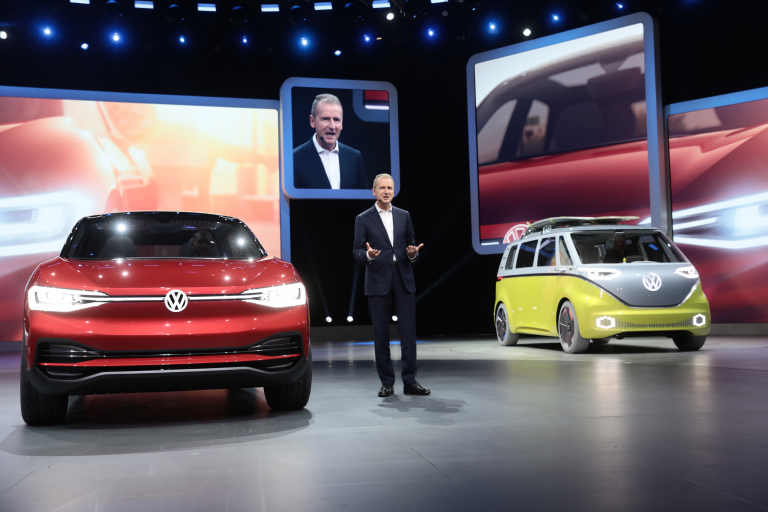
Volkswagen has announced plans to invest up to €1 billion ($1.2 billion) in artificial intelligence by 2030, in what it describes as a company-wide transformation that will feed AI into every area of its business.
The German carmaker said on Tuesday that the initiative is designed not just to modernize operations but also to unlock cost savings of up to €4 billion by 2035.
The declaration came on the opening day of the IAA car show in Munich, Europe’s largest automotive showcase, where European carmakers are mounting a fresh counteroffensive against growing Chinese competition. In particular, Chinese brands such as BYD, Nio, and XPeng have been aggressively expanding in Europe with cheaper electric models and rapid technology adoption.
Register for Tekedia Mini-MBA edition 20 (June 8 – Sept 5, 2026).
Register for Tekedia AI in Business Masterclass.
Join Tekedia Capital Syndicate and co-invest in great global startups.
Register for Tekedia AI Lab.
Volkswagen said the new AI strategy will touch everything from vehicle development to production lines and IT infrastructure. Hauke Stars, the company’s chief IT executive, framed AI as “the key to greater speed, quality and competitiveness — along the entire value chain, from vehicle development to production.”
The initiative arrives at a pivotal time for Volkswagen, which is undergoing structural changes in its two biggest markets, Germany and China. In Germany, the company has embarked on major cost-cutting programs to offset falling margins, while in China, it is racing to keep pace with local electric vehicle makers who are eroding its market share.
AI integration will support Volkswagen’s ability to bring new models to market faster, a critical advantage as the car industry shifts toward electrification. Just days earlier, Volkswagen unveiled a concept for the ID.CROSS, a small, affordable electric SUV that represents part of its broader strategy to expand access to battery-powered vehicles.

Industry analysts note that Volkswagen’s €1 billion commitment reflects a broader trend among automakers pivoting to digital and AI-driven efficiency as the EV transition intensifies. Tesla, for instance, has touted its AI-driven manufacturing and self-driving capabilities as key differentiators, while Mercedes-Benz and BMW have invested in AI-based design and software-defined vehicles. The move also mirrors similar transformations in the U.S. and Asia, where automakers are blending AI with robotics, supply chain optimization, and autonomous driving research.
By promising €4 billion in savings over a decade, Volkswagen is underscoring that its AI bet is not only about innovation but also about survival in a cutthroat market where pricing power is diminishing. With AI now positioned at the center of its corporate strategy, the company is signaling to investors and competitors that it intends to move faster and leaner, even as it navigates the uncertainty of an industry in upheaval.
Best- and Worst-Case Scenarios
From an analyst’s perspective, Volkswagen’s €1 billion wager on AI sits at the crossroads of necessity and opportunity.

In the best-case scenario, Volkswagen’s aggressive AI adoption could streamline R&D cycles, cutting years off the development timeline of new models. That would allow the company to release competitive EVs at lower prices while protecting margins. The €4 billion in savings projected by 2035 could be realized — or even exceeded — if AI proves capable of eliminating waste in logistics, reducing defects in production, and optimizing global supply chains.
In this outcome, Volkswagen would emerge not only as Europe’s strongest bulwark against Chinese competition but also as a global leader in digital automotive efficiency, perhaps even rivaling Tesla’s reputation for AI-driven operations.
In the worst-case scenario, the heavy investment may fail to yield meaningful differentiation. If Chinese EV makers continue undercutting European brands on price while scaling faster, Volkswagen’s AI savings may be too slow to materialize. There is also the risk that AI-driven efficiencies could be offset by the high costs of retraining staff, integrating systems, or dealing with regulatory scrutiny around automation.
A failure to deliver the promised €4 billion in savings by 2035 would call into question whether the investment was justified, especially as Volkswagen is already pursuing deep cost cuts in Germany. In this outcome, AI becomes less a competitive edge and more a costly experiment in a market that rewards speed over strategy.